MiniMax Surges Over 356% in 108 Days, First Post-IPO Earnings Beat Expectations | Yunqi Capital

Model leap + commercial validation: continuous companionship, continuous evolution!
108 days after its IPO, Yunqi Capital's first-round portfolio company MiniMax (00100.HK) has delivered its first earnings report.
Revenue grew 158.9% year over year, with international revenue accounting for over 70%. The company is driven by dual engines on both B and C ends, and its ARR exceeded $150 million by February 2026. While model capabilities continue to iterate, gross margin and cost structure are also improving, further enhancing commercial efficiency.
At a stage when the AI industry is shifting from "model capability competition" toward "platform-based delivery and ecosystem building," such an earnings report carries phase-defining significance. As one of the earliest investment institutions to follow and accompany the company's growth, we also look forward to — when intelligence density continues to increase and token throughput capacity continues to expand — the company being ready to embrace the next wave of scaled applications.
From "large model company" to "platform company for the AI era," MiniMax is using data to validate this path.
The following content is reprinted from IPO Zao Zhi Dao
MiniMax (00100.HK) released its annual results announcement for the year ended December 31, 2025 on March 2, its first earnings announcement since listing on the Hong Kong Stock Exchange on January 9. Since its IPO, MiniMax's share price has risen over 356%.
The financial report shows that MiniMax's total revenue in 2025 was $79.038 million, up 158.9% year over year, with over 70% of revenue coming from international markets.
It should be noted that MiniMax has established a dual-engine revenue structure spanning B and C ends — in 2025, MiniMax's AI-native product revenue grew 143.4% year over year to $53.075 million, driven primarily by the global viral growth of products such as Hailuo AI and Talkie/STARFIELD, alongside significantly enhanced user willingness to pay; open platform and enterprise service revenue for B-end clients grew 197.8% year over year to $25.963 million, indicating that model APIs are already demonstrating scale effects in enterprise applications.
More importantly, MiniMax's profitability has improved significantly — in 2025, MiniMax's gross profit was $20.079 million, surging 437.2% year over year, while gross margin jumped 13.2 percentage points to 25.4%; adjusted net loss was $250 million, with the loss ratio narrowing substantially year over year as commercial efficiency continues to optimize. Meanwhile, MiniMax's cost structure is also improving, with R&D expenses growing 33.8% in 2025 and marketing expenses declining 40.3%.
At the business level, both MiniMax's AI-native products and open platform revenue achieved rapid growth, cumulatively serving over 236 million users across more than 200 countries and regions, as well as 214,000 enterprise clients and developers from over 100 countries and regions. On the technology front, MiniMax released its next-generation foundation model M2.5 in early 2026, reaching global leading levels across programming and Agent scenarios, driving rapid growth in model call volume. Average daily token consumption of the M2 series text models in February 2026 had grown more than 6x compared to December 2025.
Additionally, management revealed during the earnings call that MiniMax's ARR (Annual Recurring Revenue) had exceeded $150 million in February 2026.
Dr. Junjie Yan, MiniMax's founder and CEO, stated: "In 2025, we built full-modal R&D capabilities, with globally competitive models across all major modalities including language, video, voice, and music. At the same time, we continuously bring better experiences to global users through technological innovation, upgrading our AI-native products. Our globalization layout has also gone deeper and become more solid.
We believe model intelligence levels will rise further in the coming year. Programming will see L4 to L5-level intelligence, moving from 'tool' to 'colleague-level' collaboration; the office domain will replicate last year's pace of progress in programming; and multimodal creation will move toward 'directly deliverable' medium-to-long-form content, even approaching streaming, real-time output formats. The combination of these three developments means we will face an unprecedented explosion in intelligent supply at scale, and an unprecedented window for application-layer innovation — the demand we carry will be amplified to an entirely new magnitude.
Looking ahead, at the corporate strategy level, we will advance from a large model company toward a platform company for the AI era, continuously defining and driving new intelligence paradigms, constantly improving technological and product innovation capabilities, as well as scalable infrastructure and token throughput capacity, while deepening commercialization layout and cultivating global market opportunities, to provide more powerful intelligence for global users and partners."
From large model company toward
platform company for the AI era
At the earnings communication meeting, Junjie Yan further elaborated on the logic behind "advancing from a large model company toward a platform company for the AI era."
Notably, Junjie Yan innovatively defined AI platform value as "intelligence density × token throughput," pointing out that the core of future AI industry competition lies in the ability to define intelligence boundaries. When intelligence boundaries are broken, large numbers of new scenarios and users will emerge, further forming new ecosystems and new commercialization dividends.
MiniMax made three judgments on 2026 industry trends:
1. Programming domain: L4–L5-level intelligence will begin to emerge, moving from "tool" to "colleague-level" collaboration.
2. Office domain: Over the coming year, it will replicate the pace of progress seen last year in programming, with AI agents' delivery capability and penetration rate in the office domain rising significantly.
3. Multimodal creation: This year will move toward "directly deliverable" medium-to-long-form content, even approaching forms closer to streaming, real-time output.
Junjie Yan stated that with these three developments combined, token volume could see growth of 1 to 2 orders of magnitude.
Currently, MiniMax has initiated R&D on the M3 and Hailuo 3 series models, while continuously optimizing inference architecture and compute efficiency. At the same time, MiniMax is internally advancing "AI-native organization" practices, with internal agents already covering over 90% of employees' daily work scenarios. These internal application scenarios provide a direct feedback path for model iteration, helping to more precisely define the next phase of R&D direction.
Synthesizing financial data and strategic expression, MiniMax is transitioning from a model company to a platform for the AI era. The company is building a platform structure around token throughput and ecosystem carrying capacity — 158.9% revenue growth and ARR exceeding $150 million provide phase validation; while maintaining efficiency advantages as intelligence density continues to increase will become the key proposition for its next stage of development.
108 days, three generations of models iterated
Full-modal capabilities leading the industry
Within 108 days from Q4 2025 through early this year, MiniMax completed three consecutive generations of language model product updates — M2, M2.1, and M2.5 — demonstrating industry-leading model iteration speed, with progress significantly outpacing overseas giants such as Anthropic, OpenAI, and Google.
Among these, M2.5, released by MiniMax in February this year, reached global top-tier levels across productivity scenarios including programming, tool invocation, and office work. Programming efficiency improved 37% over the previous generation M2.1, and M2.5 makes running complex agents economically cost-scalable to infinity.
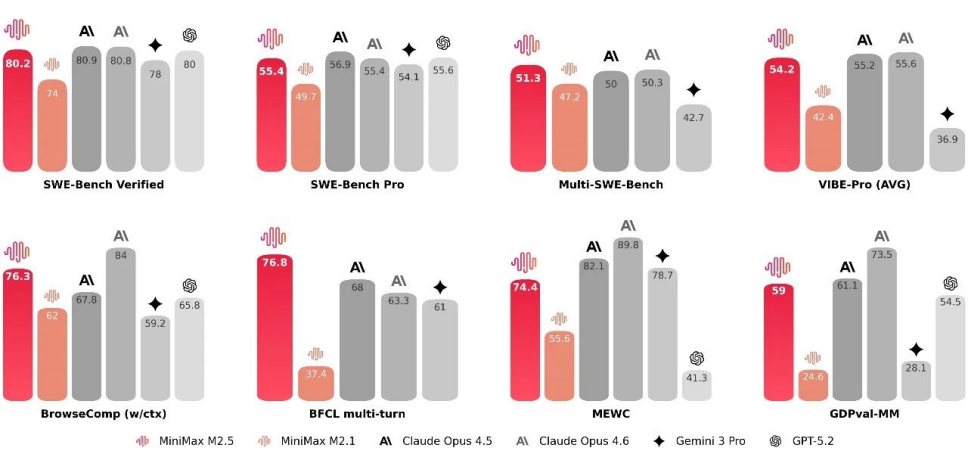
Meanwhile, from M2 to M2.1 to M2.5, each generation saw significant improvement in both capability and usage volume — average daily token consumption of the M2 series text models in February 2026 had grown to over 6x that of December 2025, with token consumption from Coding Plan growing over 10x.
Undeniably, in an era where technology leadership windows are being rapidly compressed, any single-point benchmark ranking quickly loses meaning. The standard for evaluating an AI company has shifted from how strong it is now, to how fast it can become stronger. That MiniMax can continuously launch SOTA-level model products in a short time reflects the technical support of its MoE architecture optimization and native Agent RL framework Forge, with technical capabilities achieving a dual breakthrough of "performance improvement + efficiency optimization."
In multimodal capabilities, MiniMax has also established three major model capabilities: video, voice, and music.
Among these, the video model Hailuo 2.3 released in October 2025 achieved significant improvements in character motion, image quality, and stylization, with the Fast model reducing batch creation costs by up to 50%. The upgraded Media Agent in the Hailuo AI product supports full-modal, all-capability creation, enabling one-click video generation based on user descriptions. By the end of 2025, MiniMax's video models had helped global creators cumulatively generate over 600 million videos.
The voice model Speech 2.6, released in the same period, optimized voice interaction experience for Voice Agent scenarios, achieving globally top-tier ultra-low latency and supporting over 40 languages. By the end of 2025, MiniMax's voice models had helped global users cumulatively generate over 200 million hours of voice, becoming one of the core infrastructures in the global voice intelligence field.
Additionally, MiniMax's music models Music 2.0 and 2.5 also achieved significant leaps, stably mastering multiple singing techniques and emotional styles, with single works reaching up to 5 minutes in length.
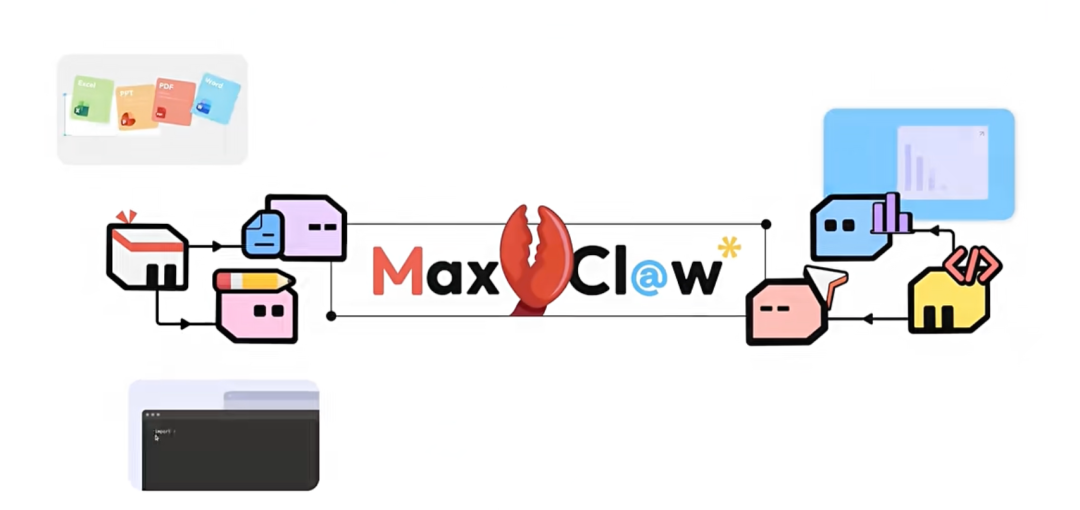
Just a week ago, MiniMax Agent also launched MaxClaw, a cloud-based AI assistant built on OpenClaw, successfully achieving zero deployment, no additional API fees, and 7×24 cloud-based permanent availability. Users only need a MiniMax Agent basic subscription to experience it, and it was well-received upon release.
From a long-term development perspective, on one hand, given that MaxClaw can directly create mature "digital labor" for users, user willingness to pay for MiniMax and user stickiness will certainly increase significantly; on the other hand, as MaxClaw usage continues to climb, it will also feed back more valuable data to MiniMax's models, thereby forming a flywheel effect between "product" and "model" ends.
Consistent recognition from leading domestic and international investment banks/brokerages
Over the past period, leading domestic and international investment banks/brokerages including JPMorgan Chase, UBS, Goldman Sachs, CICC Capital, CSC Financial, and Guotai Haitong have completed coverage of MiniMax and unanimously issued "Buy"/"Overweight"/"Outperform" ratings, with target prices all exceeding HK$1,000.
Among these, JPMorgan Chase noted that in the AI foundation model field, MiniMax is a rare enterprise combining technical strength, multimodal commercialization potential, and global scalability. The company has established solid technical accumulation, with models performing excellently in core benchmarks, while its full-spectrum product matrix lays the foundation for dual-end monetization on B2B/B2C, and its globalization layout further enhances scale expansion potential and profitability.
UBS believes MiniMax is well-positioned to capture AI development opportunities in both domestic and international markets, with core advantages lying in its unique multimodal technology strategy, efficient R&D efficiency, and globalized commercialization layout; Goldman Sachs similarly pointed out that MiniMax's biggest highlight is its highly globalized revenue structure and comprehensive multimodal product line, having already secured excellent competitive positioning in the broad global potential markets for text/code, multimodal, and AI agents/digital labor; CICC Capital also believes MiniMax is currently one of the few domestic companies that has simultaneously succeeded in both foundation model capabilities and globalized AI-native application commercialization, possessing scarcity value in the AI track.
CSC Financial emphasized that global large model competition is a dynamically changing marathon, and MiniMax's continuously leading model capabilities, expanding cost-performance advantages, clearly validated overseas expansion capability and commercialization path, and thriving third-party open-source and Agent ecosystem constitute its competitive moat; Guotai Haitong summarized MiniMax's three major advantages: 1. Technical capabilities achieving quality and efficiency dual improvement, with core scenario performance ranking in the global first tier; 2. Extreme cost control building cost-performance barriers, making commercialization economically viable; 3. Product iteration and ecosystem layout dual-engine drive, positioning at the core track of the universal Agent era.
Additionally, in JPMorgan Chase's view, China's artificial intelligence industry is transitioning from the early "hundred-model war" stage of粗放 competition to a new era where commercialization fulfillment capability, model originality, and globalization depth are core competitive strengths. Against this backdrop, MiniMax is not merely a technology company, but an important representative of Chinese AI going global and participating in global value chain reconstruction.