2 Million Units, Top Two Globally: How Chinese Pool Robots Conquered the European and American Markets | Yunqi Capital

Aiper's "Three Trump Cards"
2 million units sold, global #2. If you want to understand Aiper in the shortest time possible, these two figures alone reveal its leading position in the pool-cleaning robot race.
Europe and North America are the "main arena" for pool-cleaning robots. How did a Chinese company break into this market, squeezed between overseas giants, and climb to second place globally? Recently, tech media outlet Leiphone dissected Aiper's "moat" in depth, offering answers across product innovation, user insight, and channel advantages. This issue of Yunqi Capital shares that analysis with you.
The following is republished from Leiphone. Original title: Aiper: The Climber in the Pool Robot Race
"Aiper."
When a star founder preparing to enter the pool-cleaning robot space was asked which company he planned to benchmark against, he gave this answer without hesitation. His reasoning was simple: "Aiper's products are more pragmatic."
Yang Yu is the founder of another pool-cleaning robot manufacturer. When discussing his company's next market expansion direction, he said they would focus heavily on the European market. "For pool-cleaning robots in China right now, the most important channel is Amazon. Looking at Amazon sales and keyword data, Aiper has already established absolutely dominant positioning in Europe and America — especially North America. It's very hard to shake."
In competitors' eyes, Aiper is both the rival they most want to challenge and the one they most want to avoid. The reason is simple: Aiper is currently the strongest player in this domestic track.
01 Tearing Open a Breach in the Iron Wall
There was a time when the pool-cleaning robot track was not viewed favorably.
Investor Liu Hong had looked at multiple pool-cleaning robot projects in 2023, including Aiper, and came away thinking "this company is very strong." Unfortunately, his team felt the pool-cleaning robot market was too small, and with Dolphin already holding half the territory, there wasn't much opportunity for newcomers. They rejected the project. "Then the next year, we saw Aiper had already hit over a billion RMB in revenue."
Currently, Aiper ranks among the top two globally by sales volume and #1 in online sales for pool-cleaning robots, with cumulative global sales exceeding 2 million units, and presence in 7,000 mainstream offline retail stores across Europe and North America, including Home Depot, Lowe's, Best Buy, Walmart, Leroy Merlin, and MediaMarkt.
As China's earliest and largest pool-cleaning robot company, Aiper used sustained innovation and rock-solid product strength to forcibly tear open a breach in the iron wall built by foreign giants, opening up the track's imaginative possibilities and attracting more domestic players to enter. At the same time, it has built new barriers with its strength that followers find difficult to surmount.
Entering 2025, Aiper's momentum shows no signs of slowing. It not only completed a new strategic funding round of nearly 1 billion RMB, but also reached a deep strategic partnership with global pool industry giant Fluidra.
Securities analyst Haoran believes that pool-cleaning robots will increasingly become a stage for Chinese manufacturers to compete on, and that Aiper, with capital and channel advantages in hand, has something of an "unstoppable momentum."
Sales data provides the most direct evidence. Amazon sales data shows that from January to June 2025, the Aiper Scuba S1 held a 51% market share in the $500–700 price segment for cordless models. In June 2025, Aiper captured 41% market share in the $1,000–1,500 cordless segment.
Yet more than these numbers, Aiper's greatest barrier is the reputation it has built in consumers' minds.
On Amazon, 22.7% of users gave Aiper products positive reviews citing "strong suction / cleans debris, walls, and waterline"; 18.2% praised "excellent battery life / fast charging"; and 15.9% noted "efficient intelligent path planning."
Beyond strong performance, Aiper's product design has also won favor with European and American consumers, with 27.3% of users praising its "beautiful design / premium aesthetics." In 2025, multiple Aiper products won 6 German iF Design Awards and 3 Red Dot Design Awards for outstanding design and innovation.
These user accolades and honors together form Aiper's brand moat. And all of this stems from Aiper's continuous technological innovation and deep insight into user needs.
02 From Greatest Common Divisor to Extreme Innovation
Many people simplistically attribute Aiper's success to "cost-performance ratio," overlooking its technological and product innovations.
In fact, the fundamental reason Aiper could tear open a breach in the iron wall built by foreign giants is that it was the first to complete the wireless revolution in this product category, creating a generational gap in user experience compared to competitors.
Taking this as its starting point, Aiper continuously anchored itself to real user needs, deepening its work in technological innovation and product experience optimization. This drove comprehensive, systematic leaps across core dimensions: cleaning capability, coverage capability, functional leadership, and product reliability.
For pool-cleaning robots, cleaning capability is the foundation of survival. To pursue extreme cleaning performance, Aiper carved its own path, independently developing a world-leading underwater fluid simulation platform. This platform can, in the early R&D stages, simulate millions of complex pool environments with high precision, providing powerful simulation data support for the extreme tuning and structural optimization of key power units.
Veteran investor Huifei once conducted a detailed comparison between Aiper and a same-priced competitor. He rated Aiper's cleaning capability at 7.5 out of 10, versus roughly 6 for the competitor. He identified the root problem: the competitor's product was "noticeably smaller" than Aiper's equivalent, preventing it from accommodating a more powerful motor. "This is clearly a decision lacking sufficient market research and data论证," Huifei analyzed.
Underwater communication has long been an industry-level challenge constraining pool robots' full-coverage capability.
"The technology stack for pool robots presents enormous challenges," admitted Lin Shu, overseas head of a leading brand. "Sensors available underwater are scarce. Traditional 2.4G wireless communication is unstable underwater. Common sensing solutions like infrared radar also fail due to water's diffusion and reflection. Information capture is extremely difficult."
To overcome this hurdle, Aiper's R&D team rooted itself long-term in typical waters worldwide — from Sanya and Australia to Europe and America — conducting underwater environment adaptive R&D. Through massive field data collection and precise calibration, Aiper successfully broke through key technical bottlenecks including underwater signal processing and light refraction adaptation.
These breakthrough achievements ultimately crystallized in the third-generation Scuba X series. This series not only dramatically improved coverage, ensuring stable performance across various extreme scenarios, but also pioneered underwater communication functionality, allowing users to remotely and precisely control the robot — setting a new industry benchmark.
On reliability validation, Aiper has likewise built solid defenses. Its independently developed virtual simulation platform aggregates massive pool data, simulating myriad scenarios of robot operation to achieve thorough training. Especially for high-risk scenarios like operational failures and anomalous errors that are difficult to reproduce in the real world and where data is scarce, the simulation platform lets robots "continuously trial and error, iteratively improve" in virtual environments, greatly enhancing product robustness.
Beyond simulation, Aiper has also invested heavily in building a rigorous physical testing system: within a 4,000-square-meter dedicated testing center, 45 pools simulating various scenarios (including terrain pools and trajectory pools) are dotted across the space, alongside over 50 accelerated lifespan test pools.
Before products hit the market, testing teams execute dozens of rigorous tests daily — from routine performance to reliability validation under extreme conditions — using parameters far exceeding real-world usage standards, ensuring every robot can withstand repeated trials by fire.
Once products have withstood market testing, Aiper also continuously pushes upward into the premium segment. Aiper's approach is to accumulate and iterate continuously, forming replicable hit products.
For example, the second-generation Aiper Scuba S1 launched in early 2024 became a hit in the $500–700 price segment, and continued its hot sales into 2025 with a 51% market share, generating sustained compounding returns. The third-generation Aiper Scuba X1 launched in 2025 became another hit in the $1,000–1,500 price segment.
Recently, multiple overseas media outlets including Digital Trends and Les Numériques, as well as leading overseas bloggers like The Hook Up and Redskull, conducted comparative reviews of mainstream pool robots on the market, giving Aiper's core products high praise.
Among them, leading US tech media Digital Trends reviewed Aiper's premium product, the Aiper Scuba X1 Pro Max, judging it to be among the best pool robots currently on the market. It outperformed competitors including Dolphin in appearance, cleaning performance, and multiple other dimensions, and was awarded the Editor's Choice badge.
Additionally, YouTube authoritative tech product reviewer The Hook Up evaluated over 10 mainstream pool-cleaning robots across dimensions including cleaning coverage, cleaning power, weight, and filter basket ease of cleaning. The final results showed: the Aiper Scuba S1 (2025 version) and Aiper Scuba X1 Pro Max tied for first place overall. The Aiper Scuba S1 (2025 version) was named "Best Overall" model, while the Scuba X1 Pro Max was named Best All-in-One model.
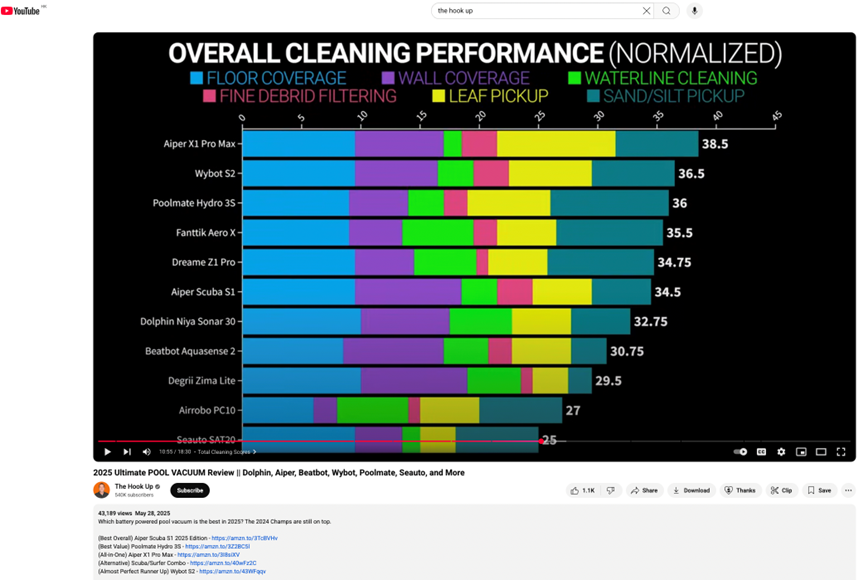
An industry insider told Leiphone, "In European and American countries, professional media or bloggers conduct product reviews that are objective and neutral. They don't accept brand sponsorship, and brands cannot influence the final conclusions, so trust levels are very high."
Aiper's understanding of premium positioning is that it's not about higher unit prices being better, but rather about the degree to which you satisfy user needs. Its approach is to first focus on users' most rigid needs, then continuously mine finer pain points and stack new functions on top of satisfying the greatest common denominator of customer needs. It's like building a house: first solidify the foundation, then add layer by layer upward, rather than pursuing comprehensiveness from the start.
Aiper's steady, step-by-step premium path bears some resemblance to Insta360, which recently listed on the A-share market.
Insta360 also started from entry-level products like the Insta360 ONE, continuously innovating and iterating to improve image quality, functionality, and stability, as well as refining software-hardware ecosystems including AI editing. It moved from "being able to shoot" to "shooting clearly" to "shooting effortlessly," continuously meeting consumer needs, ultimately becoming the global leader in the panoramic camera race.
03 User Insight and Channel Capability Are the Deeper Moats
China today possesses supply chain advantages and engineer dividends, with innovation emerging endlessly. But this also means the freshness period for innovative technology is very short. When a new technology emerges, competitors can often follow quickly.
In this landscape, whether a company can maintain competitiveness over the long term depends not on momentary innovation, but on whether the enterprise has soil that can continuously produce innovation. This partly relies on precise insight into user needs to ensure innovation doesn't stray off course; partly requires efficient organizational culture to ensure R&D efficiency doesn't fall behind.
A long-term observer of the overseas expansion track once shared an interesting observation: "Many companies in China's overseas expansion circle doing hundreds of millions in business have bosses who've never lived abroad long-term. They think about and understand products more from a manufacturing perspective, rather than truly understanding the usage scenarios and what users are actually thinking." In his view, such companies may achieve success for a time, but will struggle to go far.
At Aiper, from the company founder down to ordinary product managers, people spend considerable time each year with suitcases in hand, traveling back and forth between countries, visiting terminal stores and end consumers, personally scrubbing pools with brushes in consumers' backyards, and talking with consumers.
In Aiper founder Wang Yang's view, consumer electronics are not technology-driven but consumer-demand-driven, which requires companies to have very deep understanding of consumers.
He believes that if companies rely on third-party research firms for user research, the information will inevitably be distorted and truncated. "Research firms might only see a few dozen consumers a year, and these few dozen are pre-screened. The collected information gets processed into PowerPoints, and by the time it reaches the company founder's hands, it's certainly very distorted. So you can't take shortcuts with product development — you have to genuinely touch and feel."
After Aiper opened up the imaginative possibilities of the pool-cleaning robot track, more and more new players began pouring in, and pool-cleaning robots have gradually become a red ocean market. Going forward, various players' technical capabilities will gradually converge, making generational product gaps unlikely to reappear.
At this point, beyond competing on product and technology, channel capability is becoming increasingly important.
A veteran hardware overseas expansion practitioner told Leiphone that people accustomed to the domestic market often underestimate the importance of overseas channels — especially offline channels. Taking this year's very hot intelligent lawn-mowing robot as an example, startup teams breaking through on product strength alone have barely emerged so far.
"Unlike digital accessories, which have low unit prices and low trial costs, allowing users to easily decide online. Products like lawn-mowing robots and pool-cleaning robots, priced at $1,000–2,000, aren't small sums even for Europeans and Americans. About 60–70% of such products are still sold offline." Therefore, in a sense, whoever wins offline channels will win in the end.
Aiper started from Amazon and is currently the #1 pool-cleaning robot brand globally in online sales. After solidifying its online advantage, Aiper has also made huge breakthroughs in offline channels, with offline sales already exceeding 40% of total sales this year.
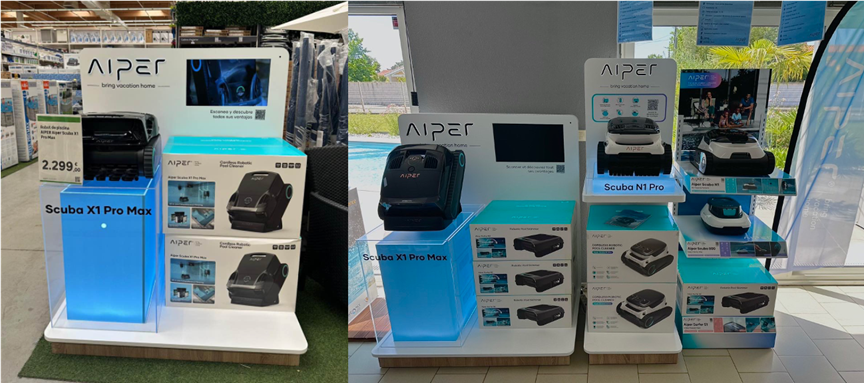
Pool-cleaning robot offline channels divide into mass-market channels and professional channels. On the mass-market side, Aiper has already entered mainstream European and American retailers including Home Depot, Lowe's, Best Buy, and Walmart.
Pool-cleaning robots are a narrow-shelf product. Offline retail shelf space is limited, and stores generally don't bring in multiple brands. Once you're in, it's very hard for others to follow.
On the professional pool channel side, the world's two largest pool industry players are Fluidra, global leader in pool and wellness equipment, and SCP, the world's largest pool equipment distributor.
The professional pool channel has the highest barriers and the highest margins. This channel is very closed, basically dominated by local white players, and not very welcoming to foreign brands. But Aiper's过硬的技术和产品力 ultimately broke through these "sectarian barriers" and won their favor. Recently, Aiper formally reached a deep strategic partnership with Fluidra.
04 Conclusion
From conversations with Wang Yang, Aiper's mountaineer culture leaves a deep impression — this not only symbolizes the spirit of climbing peaks, but also represents courage and perseverance.
This company's journey is like the mountaineer's footsteps — both harboring ambition to conquer summits, and practicing the pragmatism of one step at a time.
In the fiercely competitive global pool-cleaning robot market, Aiper has built a deep brand moat overseas with硬核产品力 as its foundation. Whether it's the sales figures sweeping Amazon charts, or the professional media and user acclaim, all testify to its exceptional product experience.
But for Aiper, these are merely the beginning. The journey is forever in the climbing.
Note: Yang Yu, Liu Hong, Haoran, Huifei, and Lin Shu are all pseudonyms.