Yunqi Capital's Chengyu Mao in Conversation with SenseTime's Xu Li: 2025 — Is AI Entrepreneurship Getting Harder?

Run with a marathoner's mindset — just keep going.
At a time of rapid technological change, every step forward in AI is redefining the future. Yet in this era that seems so abundant with opportunity, a challenging macro environment has added a note of difficulty to innovation.
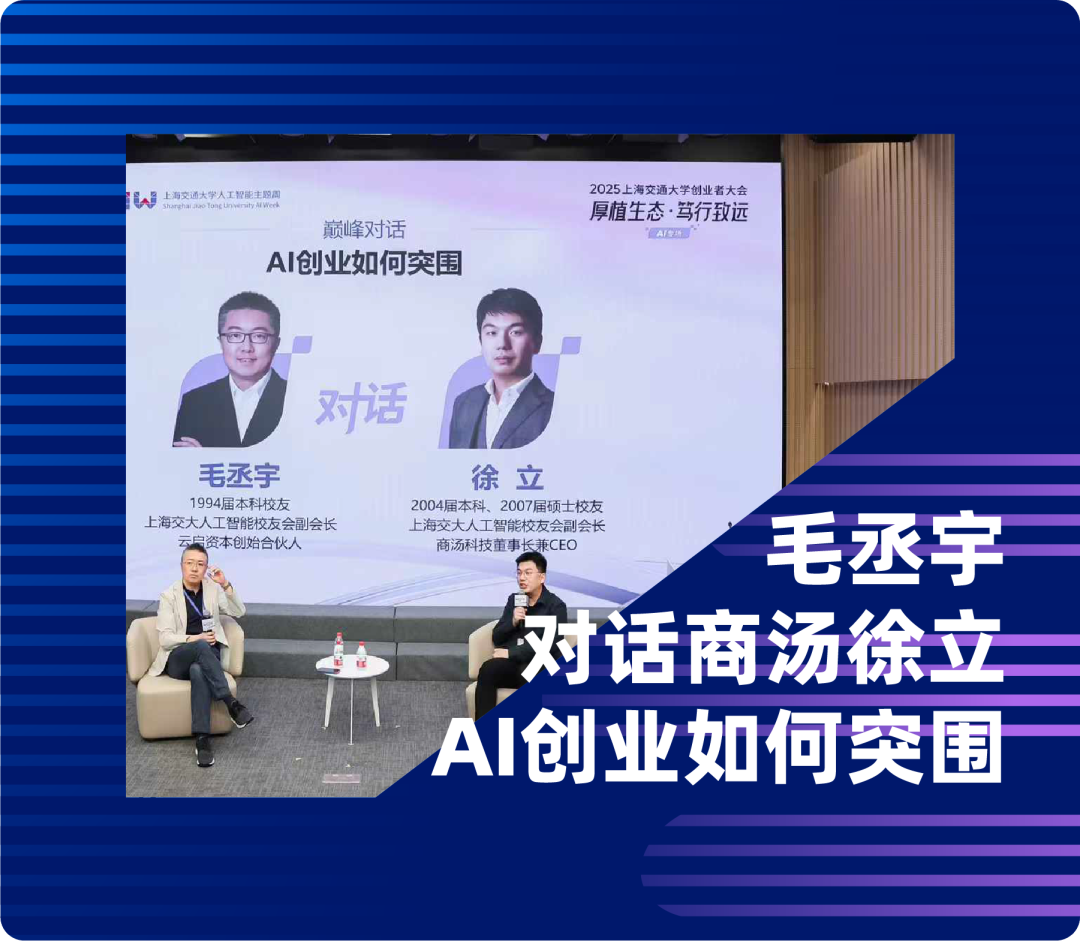
Between opportunity and challenge, how should AI startups break through? Recently, at Shanghai Jiao Tong University's AI-themed week, Yunqi Capital founding partner Michael Mao sat down with fellow SJTU alumnus Xu Li, Chairman and CEO of SenseTime, for a conversation on exactly this. Here's a transcript of their discussion.

AI Entrepreneurship: Opportunities and Challenges — The Industry Transformation Triggered by DeepSeek
Michael Mao: Xu Li and I interact frequently offline, and when we talk about AI, DeepSeek inevitably comes up. On January 15, before DeepSeek went viral, we were having dinner together. That evening we discussed DeepSeek, and just two days later, there was a flood of news coverage. It had a significant impact on the AI industry. As a veteran entrepreneur of the AI era, Xu Li, what are your thoughts? What kind of impact has it had on you?
Xu Li: The speaker in the first half of today's event emphasized the importance of young people — that their perspectives represent the future. I strongly agree. So much of the industry's development, including China's DeepSeek moment, the AlphaGo moment, and the iPhone moment, represented consensus-breaking events. Before each of these, societal consensus was completely the opposite. Before AlphaGo, no one believed a machine could win. But the shock and influence these moments deliver is what drives industry transformation at its core. What DeepSeek has given us is also a break from consensus.
In fact, DeepSeek has triggered extensive discussion and reflection. Of course, from a technology deployment perspective, there's still a long road ahead. From technological breakthrough to truly universal industry access, to fundamental transformation of industry logic — there's much ground still to cover. But at minimum, one cognitive shift DeepSeek has brought is that more people are willing to experiment with the changes it can bring. That's an extremely important point.
For enterprises, disruptive change in application scenarios depends on whether a shared consensus can form around this. Many people discuss DeepSeek's impact on the AI industry, but I believe its greatest impact is on market perception. People's use of AI, and their openness to new scenarios, has increased significantly. Michael, you've also invested in AI models and industrial applications. From your perspective, how do you see DeepSeek's impact on large model companies?
Michael Mao: We've positioned ourselves in large models internally as well, and we've discussed DeepSeek's impact. On one hand, the road is still long with much room for development. Just the other day there was an article about how the "Six Little Dragons" are breaking through — not just American large model companies, but domestic ones too, are facing direct impact. Everyone is now using different approaches, combining them with their own capabilities, to break through in this area.
Today's theme is also about how this generation of AI entrepreneurs can break through in the current environment. On one hand, in the large model landscape, DeepSeek has suddenly claimed a relatively high position. It's like when Baidu emerged during the internet era's search wars, or when consumer-facing search 2.0 appeared — these kinds of gateway effects give first-movers significant advantages. In large models, if we think in terms of search, there's still Yuanbao now. And at the foundational large model level, there are still areas like multimodality worth exploring.
The counter-consensus view might be that, amid major challenges, the few companies with sufficient ammunition need to find their own paths to breakthrough — to locate other hills on the map and occupy them as quickly as possible. That's quite critical.
This is just one piece of the large model puzzle. Like when DeepSeek arrived, its push on the industry has been quite positive. For funds, positioning isn't just in large models — it's more in applications, including B2B, B2C, and previously invested big data companies, for whom the push has been quite positive.
Looking at late last year, when many companies were making plans for this year, there's been a huge shift compared to Q1. After DeepSeek broke through and the broader industrial community, enterprises, and B2C consumers broke through their mental barriers, the speed of AI adoption has accelerated significantly compared to before. Investors are still pleased to see DeepSeek's push on the entire industry and ecosystem.
Scientist Entrepreneurs: Crossing from Research to Business
Xu Li: This industry has many scientists and professors who start companies. When we started out, we were also a professor team, and many investors said scientist entrepreneurs weren't reliable. Ten years have passed, Michael — how do you view this assessment now? And how do you view scientist entrepreneurship overall?
Michael Mao: Looking back, 1999 was the first wave of internet entrepreneurship. There was no concept of "technology entrepreneurship" then — the idea of serial entrepreneurs didn't even exist. What we saw were investment banks, consulting firms, Fortune 500 companies; teams from these backgrounds were considered prestigious. By 2013, mobile internet arrived, and we started seeing serial entrepreneurs or experienced founders coming out of major tech companies — these were product managers. During the O2O era, people were poached from 58.com, just as former corporate executives had been poached before. Starting with SenseTime, scientist entrepreneurship gradually emerged as a concept, but it came with many challenges. Including what Academician E discussed this morning about "integration" and "breaking boundaries." Science and industry need to integrate, and leaders need to understand not just technology, but also politics and business. For founders serving as CEO in this era, having a strong foundational background while also understanding business is quite challenging.
Our AI angel fund with SJTU, including our collaboration with SJTU's AI Institute, stems from this perspective. Today at the AI Institute, scientists are exploring the frontiers of science; while the SJTU Engineering Research Institute we collaborate with aims to gather 100 serial entrepreneurs with rich business experience. From Yunqi Capital's perspective, what we can bring entrepreneurs is our understanding of capital markets and macro environments after experiencing so many cycles. At the same time, we also have substantial industrial resources behind us, because much technology ultimately needs to land in specific industrial applications. Combining these several parties together —
Compared to ten years ago, while today we have exciting foundational technology breakthroughs, the macro environment is far more challenging. So regardless of background, entrepreneurs face a considerably challenging task. As scientists or technical personnel, understanding of business, product implementation, sales, and capital markets may relatively lag behind executives from major companies or serial entrepreneurs. So building more diverse teams through individual or team supplementation to achieve complementarity, and recognizing the challenges while giving them high priority, is what we all need to do together in this environment. You also came from a technical background in founding your company — there have been many challenges along this journey. Share your experience in this area.
Xu Li: To some extent, pure researchers may have different focuses. From an entrepreneurship perspective, we should seek the intersection between researchers and product managers — redefining a role. Product managers originally started at Procter & Gamble, connecting products with markets, called product marketing managers. But in reality, when researchers start companies, technology itself cannot be monetized directly. We need to find people who connect technological foresight with market connection — call them technology marketing managers.
Pure technological development relies on its "uselessness." There's an interesting example in Euclid's geometry: a student asked, "What's the use of studying this?" The teacher got angry and said, "Get out." If it's useful, it's wrong — we explore the truths of the universe. Working in AI essentially requires this kind of confidence. An investor asks what's the use of this? "Get out, we explore the truths of the universe." Are you willing to pay for truth? Most investors aren't. We need to find the person between "getting out" and "coming in" who says, "OK, you don't have to leave — let me explain the connection between technological differentiation and the market."
The biggest challenge now is different from before. Previously, the iteration cycle from technology to scenario was relatively long. Everyone knew about AI, but computer vision — facial recognition, video recognition — didn't have such close ties to ordinary people's lives. Today, which company doesn't use large models to write code may get eliminated. The iteration speed is extremely fast, with very high demands on technology companies. In this era, the demands on technology company CEOs are higher than in any previous era — they need to refresh their understanding at higher frequency.
Entrepreneurial Challenges: High Valuations and the Path to Commercialization
Michael Mao: Speaking of commercial implementation, among those present there are embodied intelligence entrepreneurs — this track is quite hot right now. I was in Haidian last week, with investors lined up there, probably the ones who "got out" and "came back in." There are also several AI4S projects above. Ultimately these technologies and applications will penetrate their respective fields. Back when CV (computer vision) emerged, everyone was searching for landing scenarios, experienced a rapid rise, raised lots of money, gradually took lots of government contracts, became hardware models, had many B2G large orders — and also faced much discussion. Whether to focus on technology or operations? Or become a hardware company? In this, what more experience can you offer this generation of entrepreneurs? I believe they may still need to walk the same path: digesting high valuations and truly generating revenue.
Xu Li: Commercial implementation still requires walking the same path — pitfalls that predecessors stepped in don't fully prevent others from stepping in again; this logic is certain. Value closure requires speaking to vertical scenarios, with delivery work connecting the last mile. In the 1.0 era, consensus formed relatively slowly, all in vertical directions; industry delivery grew quickly, but everything required customization. The 1.0 era was essentially selling advanced AI human resources.
In the 2.0 era, human resources are no longer the most critical capital element — computing resources become the important element. A core point of the 2.0 era is that everyone's approach is correct: reducing costs. When factor costs drop by a hundredfold, you can enter various scenarios to solve major problems — smart cities, smart industry, intelligent quality inspection, these are all major enterprise problems. But now generative AI models are more general-purpose, able to solve very small needs in daily life. And ordinary people's daily use truly assists the large-scale development of general-purpose AI models. The Confucians say, "The way of the sage is no different from the daily use of ordinary people." The way of AI must be the way of the sage — it must address matters of national importance and the small concerns of people's livelihoods; unifying these two is the core.
We also need to consider marginal effects. What researchers excel at is reaching for the heavens and standing on earth, but when it comes to covering the world, we need to consider costs and business models. Some say this year is the first year of AI applications. Michael, among all the AI applications you've seen, has anything made your eyes light up, or made you willing to put 20% of your fund into it?
Michael Mao: If I saw something that made my eyes light up, and I wanted to pay for the passion, it'd be easier to put my own money in. As an early-stage investor, there's generally that impulse in one's bones.
On September 30, 2021, we talked with Junjie Yan (MiniMax founder and CEO) for three or four hours, and then other funds rushed in. We'd been investing in AI for over a decade — robotics, autonomous driving. When we met Junjie, there wasn't even the concept of large language models yet; we just felt he was a good person who told many AGI stories. Though we couldn't fully think through what the ultimate landing would be, or what covering the world would look like, we just felt that someday it would reach for the heavens, or there would be a grand vision worth early-stage investors betting on. Later we got a bit carried away — after doing this for so many years, you always want to find projects that give you some excitement when investing.
Xu Li: So was it your own money you spent?
Michael Mao: Not yet — there's still a conflict of interest there. Haven't used my own money to invest in twenty years; otherwise it's hard to explain, unless it's B2C. Returning to "covering the world" — when later investors come in, they put tremendous pressure on you. With such a high valuation invested in you, they definitely need "covering the world," ultimately needing to land. From this perspective, whether for entrepreneurs or investors, everyone faces pressure, which ultimately converts into pressure on the entrepreneur.
Whether robotics, AI hardware, or other applications, China indeed has many applications. From American investors' or entrepreneurs' perspectives, China has abundant data and application scenarios, so people are optimistic about industrial development. From a competitive standpoint compared to the US, many fields are competitive. NVIDIA also went through its darkest moments — everyone thought the company was nearly finished, that it would eventually be killed by Intel. Tesla certainly had them too; Google came through relatively smoothly, with technology driving the underlying layer. Companies that can maintain long-term evergreen status with high gross margins — China hasn't produced such companies in the past. In this new macro environment, whether we can develop such companies or leaders — we do have companies like Tencent, but building purely on technology-driven models is quite challenging. As an entrepreneur, you're still young and can continue — what are your views and thoughts on this?
Xu Li: From technology to real scenario application, moving forward from the technology side — this path is uncertain, so we need resilient entrepreneurs. For our downstream incubation or industrial investment, we also prefer to find serial entrepreneurs who have truly experienced these cycles. Jialiang just mentioned this too — he's my senior from high school and university, also a model of serial entrepreneurship; he's been through these cycles and knows how to accumulate capabilities. Michael, do you invest in serial entrepreneurs?
Michael Mao: Generally speaking, serial entrepreneurs are still preferred for most investment institutions, including ours. Whether they can go all in, how capable they are after success — we're more cautious in judging these questions. We encounter many types of entrepreneurs in our daily work. Some are indeed following their inner dreams in entrepreneurship. There are also professors or corporate executives who, seeing the environment heat up, feel that since their students or subordinates have started companies with decent valuations, they should go out and start companies too, and their valuations certainly shouldn't be lower. So we still carefully distinguish. Entrepreneurs with strong past backgrounds and track records still have higher success probabilities, but there are still quite a few pitfalls.
On Embodied Intelligence Hype: Cooling Down Is Good for the Industry
Xu Li: You've also invested in Cewu Lu's Noematrix. What's your view on embodied intelligence?
Michael Mao: We've been investing in robotics since we first started. We've invested in quite a few scenario-specific robots — construction, cooking, cleaning, and so on. But that generation of robots was all oriented toward specific scenarios. The new generation of embodied intelligence pursues more generality and generalization; this is a long-term track. For us, we'll still make systematic deployments.
The valuations of the past few months make us feel like we're back to the overheated period of a few years ago. It may have something to do with Unitree's appearance at the Spring Festival Gala. Yesterday's (April 19) marathon might cool things down a bit — one robot needed three people accompanying it, and online some even joked whether it was a short-seller-organized marathon? To let everyone cool down. This marathon is quite like entrepreneurship — you have to keep falling, but eventually you'll reach the finish line. But since it's a marathon, you don't run it at 100-meter sprint speed; you run a very long distance. Those leading at the start aren't necessarily leading at the end. Though many robots fell, cooling down is a good thing for the industry's healthier development.
If the mentality becomes, my competitors all raised funding so I must raise too — that's no different from an arms race. What valuation a peer got, I need that too. Ultimately high valuations all convert into CEO pressure, and everyone pays the price. Recently many companies are preparing to go public, and some later investors require that the IPO valuation must reach a certain level; if it needs to be lowered, compensation must be given. Including in some acquisition processes, there's gaming between early and later investors — this gaming ultimately also converts into pressure on entrepreneurs. I feel the entrepreneurial environment is far more pressurized than ten years ago, which is also very challenging for investors.
Being too hot is definitely not a good thing, because we've been through four or five waves of hype. During hot periods, those who followed along basically didn't succeed; those who made money were the ones who went against consensus. Entrepreneurs still need to stay calm and approach this with a longer-term marathon mentality.