Browse 3D Worlds Like Scrolling Short Videos — Manycore Tech Open-Sources Aholo Viewer | Yunqi Capital Portfolio --- Manycore Tech has open-sourced **Aholo Viewer**, a tool that lets users browse 3D content with the same swipe-based interaction model as short-video apps. The move marks the company's latest push to lower the barrier for immersive content consumption. Yunqi Capital, an early investor in Manycore Tech, counts the Hangzhou-based company among its portfolio. The firm has also backed AI unicorn MiniMax, among other bets.

Click a link and "step into" a 3D world.

Not long ago, Manycore Tech, an early Yunqi Capital portfolio company that recently listed on the Hong Kong Stock Exchange, has been pushing to fit the 3D world into the browser.
Today, Manycore Tech announced the open-source release of Aholo Viewer, a 3D Gaussian browser. In simple terms, it lets users browse massive-scale 3D scenes as smoothly as scrolling through videos — no client installation needed, straight from the browser on phones, computers, or VR devices.
For decades, the internet has primarily presented the world through text, images, and video. The 3D browsing capability that Aholo Viewer represents is making real spaces easier to digitize, distribute, and use — while also providing AI with higher-quality spatial data to understand the physical world.
In this edition of "Yunqi Partners," we explore Manycore Tech's latest progress toward the 3D internet and spatial intelligence.
The following is adapted from Manycore Tech
Have you ever wondered:
The world we see with our eyes is clearly three-dimensional, so why do the photos and videos we take with our phones come out flat?
The answer is simple: for decades, the internet has been doing one thing — "flattening" our three-dimensional world into two dimensions. Photos, videos, short-form content — each one is a dimensional reduction, stripping away so much real spatial depth and detail.
But today, that's about to change.
Manycore Tech has officially open-sourced a 3D Gaussian browser: Aholo Viewer. No complex setup, no installation required. It works on phones, computers, and VR devices.
In simple terms:
It lets you browse massive 3D worlds
In your browser, as smoothly as scrolling through videos
What's more impressive: even on a phone, it can easily run 3D worlds with a billion Gaussian points!
Watch the video below for a first look 👇
Some of you are probably asking: ① What exactly is a Gaussian point? ② How big is a billion Gaussian points, really?
First, Gaussian points are essentially the "pixels" of the 3D world. Unlike the pixels in 2D images we're used to, they carry not just color, but also position, opacity, and scale information.
Combine millions or even more of these Gaussian points, and you get a 3D virtual scene nearly indistinguishable from the real world.
Second, how big is a billion Gaussian points?
Here's an intuitive comparison: that scale is roughly equivalent to the entire West Lake.
In other words, what Aholo Viewer can transmit isn't just a small model — it could be an office building, a factory, or even an AI-generated virtual city.

And you can actually "walk into" it yourself, observing light, shadow, and spatial relationships — like a 3D version of Douyin or Bilibili, where massive 3D worlds load smoothly without stuttering.

Another thing users might care about: how hard is it to get started?
Aholo Viewer is compatible with mainstream 3D Gaussian formats on the market, handles format conversion, and comes with built-in high-quality LOD generation and 3D Gaussian collider generation tools. No extra configuration needed — it works out of the box.

Not just viewable — but usable!
Once the internet can carry 3D content, what can we actually do with it?
Manycore Tech's Aholo spatial intelligence platform has opened up a suite of API capabilities that address the question: "How can 3D content be produced and used at scale?"
Its full stack of spatial APIs includes:
Spatial reconstruction — shoot a video on your phone, automatically generate a high-fidelity 3D scene

Cloud rendering — one line of code, upgrade to cinematic ray-traced quality

3D AI model generation — supports image-to-3D and text-to-3D model creation

Robotics training data — open-source spatial datasets like InteriorGS, ready for embodied intelligence simulation training
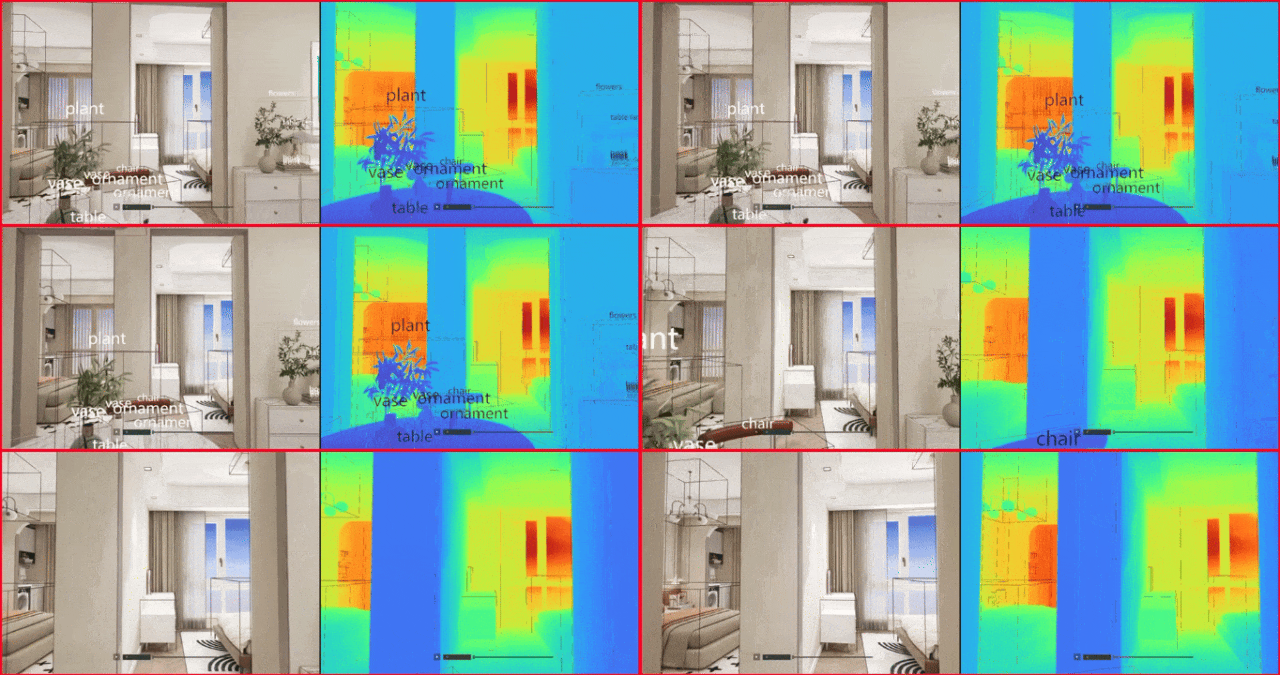
Going forward, building 3D applications could become as straightforward as calling a maps API or payment API today: just call a "spatial API" instead of building the entire technical framework from scratch — saving time and cutting costs.
The next stop for the internet:
From 2D to 3D
The past:
Thanks to their intuitive information delivery efficiency,
images and video defined the mobile internet era.
The future:
With its higher-dimensional fidelity in representing the world,
3D content will become the core content format of the next-generation internet.
3D browsers will become the universal entry point for ordinary people to access the digital world — just as short-video apps are today.
Why invest so heavily in the 3D internet? There's a deeper significance here — helping AI better understand our real world.
The core bottleneck preventing AI from penetrating the physical world is the lack of scalable, high-precision 3D data. The essence of 3D content is a digital replica of the physical world, providing AI with direct access to spatial structure, object relationships, environmental properties, and other critical 3D data. 3D isn't just a content format — it's the shortest data path for AI to understand the real world.
The next step for AI understanding the world is understanding real space. And the true mark of spatial intelligence maturing won't be any single technical breakthrough, but when ordinary people start using it every day.
We believe that as core infrastructure like Aholo Viewer continues to roll out and gain adoption, the future 3D world will be as easy to access as a web page, as easy to share as a video, and as easy to create as an image.
Only then will the 3D internet era truly arrive, transforming how we live, work, and play.

Special Notice

Aholo Viewer is now live on GitHub. Developers worldwide are welcome to download and try it out 👏
Experience it here 👉
https://github.com/manycoretech/aholo-viewer