How Can a "3D Printer" Boost Productivity in the Pharmaceutical Industry? | The B-Side of Entrepreneurship

Take the hard, meaningful path

"The Other Side of Entrepreneurship" spotlights tech-ToB founders. In this series, we'll zoom in on Yunqi Capital's portfolio companies on the front lines of industry —
to see how they're engineering the extraordinary behind the scenes of better living and efficient production.
The pharmaceutical industry directly serves the quality of human life. That's why pharma professionals hold every step of the R&D process to exacting standards. For decades, even as digitalization and new manufacturing technologies advanced, the industry remained cautious in its evaluation, and the overall paradigm of drug-making saw little fundamental change.
But change is underway. The novel formulation technology of 3D printing has opened a new path for an increasing number of pharma professionals, and regulatory agencies worldwide are beginning to pay attention to emerging technologies. In 2022, Triastek's first 3D-printed drug, T19, received Investigational New Drug (IND) approval from China's National Medical Products Administration for rheumatoid arthritis — China's first 3D-printed drug to enter clinical trials. Overseas, T19 and two other 3D-printed drugs, T20 and T21, have also received IND approvals from the U.S. Food and Drug Administration (FDA).
After eight years of technological innovation and industrial application, Triastek has achieved four global firsts in pharmaceutical 3D printing: first in patent volume, accounting for over 20% of all applications in the field; first in clinical product volume, with T19, T20, and T21 all in clinical stages; first in production capacity, with a self-built GMP-compliant continuous 3D-printed drug manufacturing center capable of 75 million tablets annually; and the only Chinese pharmaceutical company selected for the FDA's Emerging Technology Program (ETP).
In this episode of "The Other Side of Entrepreneurship," we invited Dr. Senping Cheng, founder and CEO of Triastek, to share how a bold scientific vision has marched step by step into reality — bringing a new paradigm to the pharmaceutical industry and meaningful, valuable 3D-printed drugs to patients.

How does 3D printing make drugs?
"The Other Side of Entrepreneurship": How exactly does 3D printing "print" medicine?
Senping Cheng: Triastek's MED (Melt Extrusion Deposition) 3D printing process sounds cutting-edge, but the workflow is straightforward — a "three-act" structure. Step one: blend and melt the raw materials and excipients. Step two: precision extrusion. To put it simply, imagine piping cream frosting onto a cake, except with far higher precision requirements. Step three: layer-by-layer deposition to form the final drug product with an internal "three-dimensional structure."
"The Other Side of Entrepreneurship": What is this "three-dimensional structure" inside the drug? What advantages does it have over conventional drugs?
Senping Cheng: This "extrusion-type" 3D printing process we've developed has essentially founded a new discipline called "structural pharmaceutics." What this discipline solves is enabling a drug's active ingredients to release in the body according to therapeutic needs, following a programmed sequence.
Some drugs have very low bioavailability after immediate release, yet simply increasing the dosage can cause severe toxic side effects. The three-dimensional structure we design can precisely control the timing, location, and rate of drug release through programmed control, with flexible combinations of release modes — thereby improving efficacy and convenience while reducing side effects. For example, for insomnia patients, there could be a drug taken before bed that first releases zolpidone as a sedative to help the patient fall asleep quickly; then steadily releases melatonin to maintain sleep for about seven hours; and finally releases caffeine in the morning to wake the patient.
Scientists proposed this discipline long ago, but were constrained by the solid formulation processes available at the time. 3D printing, as a means of free-form design and manufacturing, can combine spatial design with manufacturing processes for structural pharmaceutics, turning this vision into reality. Along this line of thinking, we can also provide unprecedented tools for new product development.
"The Other Side of Entrepreneurship": Why was Triastek able to realize this R&D approach? What was the biggest challenge?
Senping Cheng: This project started from a foundation of "three nos": first, no printer; second, very little prior research on pharmaceutical-grade printable materials; third, this mode of in vivo drug release hadn't been fully validated. This required professionals from multiple disciplines — pharmacy, chemistry, materials science, engineering — to come together around a shared goal, first building the scientific framework, then developing the technology and products.
Plus, the pharmaceutical industry is highly regulated, with different regulatory policies in every country. Beyond maturing the technology, we needed to navigate the pathways with regulatory agencies in each country. We're a company doing original technology development. Few startups are willing to start from fundamental R&D — it's grueling work, and far from quick profits. But once achieved, the moat is extremely deep. We anticipate that most companies won't choose to tread this path again; they'll prefer to partner with companies like us that have mature platform technology to co-develop products.
Currently, only two companies worldwide have 3D-printed drugs in clinical stages: Triastek and America's Aprecia. Triastek, based in China, has leveraged China's complete manufacturing chain advantages to significantly accelerate the engineering development of our equipment.
Using MED as an innovative technology, Triastek collaborates with pharmaceutical companies to design and develop drugs that could transform patients' lives. We maintain broad commercial partnerships with global pharma companies, both at the product level and through technology solutions. To date, we've established collaborations with multinationals including Eli Lilly, Merck, Boehringer Ingelheim, Siemens, and Sperogenix, as well as domestic pharmaceutical firms.
"The Other Side of Entrepreneurship": You're walking a difficult but correct path.
Senping Cheng: A difficult but meaningful path.

Using new technology to give pharma "a new way of thinking"
"The Other Side of Entrepreneurship": Beyond helping patients improve drug efficacy, what other positive changes has 3D printing technology brought to the pharmaceutical industry?
Senping Cheng: 3D printing is the process of turning blueprints on a computer into physical objects, and this formulation technology will have major impact across multiple dimensions of the entire pharmaceutical field. First, 3D printing enables digital product development. Our "3DFbD — Formulation by Design" digital technology doesn't just use computational models of digital formulations to predict drug release in the human body and accelerate clinical research; it also improves R&D success rates, reduces costs, and changes the current trial-and-error approach to product development.
Second, 3D printing digitizes and intelligentizes manufacturing, and through integration with AI and information technology, enables flexible production. We know that new drug R&D requires heavy investment, post-launch returns are low, and demand for rare disease drugs is hard to predict — creating a major dilemma for "orphan drug" production. Triastek is advancing a technology that uses flexible production capabilities to break away from traditional batch manufacturing, providing production support for drug market demand across different periods, and offering more agile, more economical product supply for rare disease drugs.
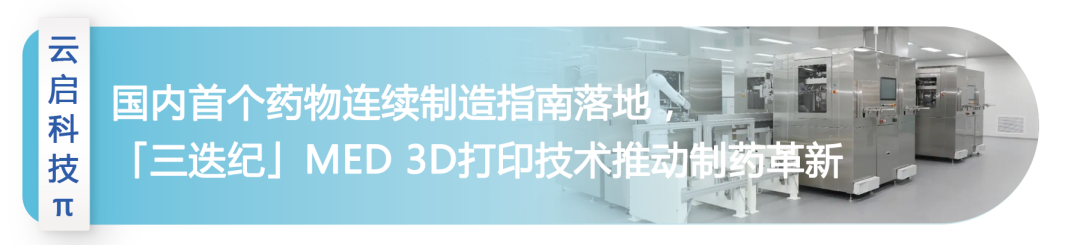
We've designed and built a MED 3D printing continuous, large-scale production line, currently providing samples for late-stage clinical studies and post-approval product supply. Our production line has a "modular" character, allowing module combinations on demand like "building with Lego." Additionally, this line features modularity, high precision, high throughput, continuity, and automation — from raw materials entering the line to finished product, we're talking minutes. Such continuous, large-scale production provides flexible means for "capacity adjustment."
"The Other Side of Entrepreneurship": 3D-printed drugs can flexibly customize output and design tablets according to patient needs. So in the future, could everyone potentially have their own customized 3D-printed drugs?
Senping Cheng: Personalized medicine is one of the important development directions for 3D-printed drugs. We estimate personalized medicine is still 10 to 12 years away from implementation. What's the foundation for this? First, sufficient data accumulation from many cross-disciplinary fields after digitalization, making this scientifically feasible. Second, breakthroughs in regulatory pathways. Third, changes across the entire commercial distribution chain. Of these three, the last is relatively the easiest; the first two are comparatively slower. Triastek has chosen to first achieve commercialization of this emerging technology through scaled 3D printing production and sales, rather than personalized medicine, because personalized drugs require a longer timeline to realize.
But we're already seeing more countries and regions begin to recognize the potential of 3D-printed drugs and establish relevant industry standards. We've already participated in developing U.S. standards for 3D-printed drugs. My co-founder and Triastek's Chief Scientific Officer, Professor Xiaoling Li, was selected for the U.S. Pharmacopeia's standards development team — a six-person team that also includes pharmaceutical representatives from Aprecia and Merck. Going forward, this team will develop the overall framework for standards, with different research institutions gradually adding content.
When Triastek was founded, we positioned ourselves as a global pharmaceutical company, aiming to stand upstream in the entire industry chain, pursuing technology commercialization through patent portfolios and participation in setting industry standards. Today, the company has 200 patent applications, accounting for nearly 20% of the entire field. We hope through these efforts to help 3D-printed drugs reach patients faster and better.

Taking the leap, together with a team that believes
"The Other Side of Entrepreneurship": Why did you decide to enter the 3D pharmaceutical printing track in 2015?
Senping Cheng: For any emerging technology to achieve industrialization in pharmaceuticals, it generally takes 30 to 50 years. Pharmaceutical 3D printing first emerged in 1996, so it's been nearly 30 years. Including America's Aprecia and us now reaching industrialization, there are roughly 60-plus relatively active research institutions and pharmaceutical companies globally still exploring this field, in early technology development and some proof-of-concept research stages.
The entrepreneurial idea originated from a conversation with my co-founder and Chief Scientific Officer, Professor Xiaoling Li. Professor Li is a close friend, and he believed 3D printing could become the next generation of formulation technology — an idea that deeply moved me. We both knew this project would be extremely challenging, but we also realized that if successful, it could be revolutionary for pharmaceutical companies, patients, and even regulators. So we decided to "take the leap" and do it.
Professor Li has worked in pharmaceutical formulation for over 30 years, with considerable accomplishment from academia to industry. What's rare is his ability to bridge theory with industrial practice, blending imagination, creativity, and theoretical knowledge exceptionally well. He personally loves engineering, and can integrate pharmaceutical knowledge, industrial application, and the underlying technology that engineering requires.
For me personally, this project is an entrepreneurial venture that's very broad in scope yet extremely deep in vertical expertise, involving many dimensions — from science and technology to regulation, business, and capitalization. It's a long-distance project that can take a team through countless challenges over 20 to 30 years, and that deeply appealed to me.
"The Other Side of Entrepreneurship": What does the name "Triastek" mean? What expectations for the company does it embody?
Senping Cheng: Triastek is a name I deeply cherish; it carries three layers of meaning. First, "Trias" sounds like "3D." Second, the Triassic period represents the superposition of three rock types, similar to the layer-upon-layer process of additive manufacturing. Third, the Triassic was a geological era 250 million years ago, metaphorically suggesting that we Triastek people are prepared — or have the ambition — to usher in a new epoch for pharmaceutical formulation.
Professor Li and I share very similar entrepreneurial philosophies. Together we defined company success as requiring three conditions to be met. First, actually developing the technology and advancing the industry. Second, using this technology to develop many products that are truly meaningful and valuable for patients globally. Third, through this work, cultivating a group of professionals who genuinely contribute to society.
Pharmaceutical 3D printing remains an emerging track. We're shouldering the mission of pioneering a new field, which demands high innovation and creativity from our team. We fully leverage the innovative and creative capabilities of young people. At the same time, our management includes very senior colleagues and advisors who provide direction at the strategic level. Yunqi Capital has also brought us new perspectives at the technical and commercial levels, helping me and the company step outside the pharmaceutical industry box to view this project with fresh eyes. Yunqi partner Michael, whether in macroeconomic and capital-raising advice or in permeating commercial thinking, has genuinely given me tremendous help and influence. And we all know many founders, myself included, have very strong viewpoints and aren't easily swayed by others' opinions. But Michael's approach to giving advice is to give me ample freedom, subtly permeating many of his ideas in a gentle way — and afterward, I often find many of these ideas are indeed forward-looking and strategic.
"The Other Side of Entrepreneurship": Share with us what you've been reading lately.
Senping Cheng: I often describe myself as "pseudo-literary, truly entrepreneurial." Entrepreneurship is the source of achievement and happiness; literature and art are more about spiritual enrichment, and also serve as excellent stress relief. I recommend three books: The first is Country Driving, which I read many years ago, written by a New Yorker correspondent based in Beijing — his Chinese name is He Wei (Peter Hessler). His perspective portrays China's social progress and development through depicting ordinary people's lives. The second is a serious literary work called The City of Wen, by Yu Hua. I was quite moved after reading it. It tells of a northern youth who travels south with his child, searching for his wife's supposed hometown. It made me think — perhaps many people spend their entire lives carrying love, kindness, and meaning, searching for a "City of Wen" in their hearts. So where is the City of Wen? There is always a place in this world called the City of Wen. The third book is art-related, a lighter read called Think Like an Artist, written by the editor-in-chief of BBC's arts channel. In it he summarizes many core elements behind successful artists: imagination, creativity, and certain work habits. So I think whether for art or science, this is fundamentally connected. Imagination and creativity are human gifts, and simultaneously the driving force behind miracles happening.