What Real AI Problems Did Post-'98 Founders Debug Over Hot Pot? | Y Transformers Beijing Recap

The hot pot bubbles, but the thinking bubbles even more.
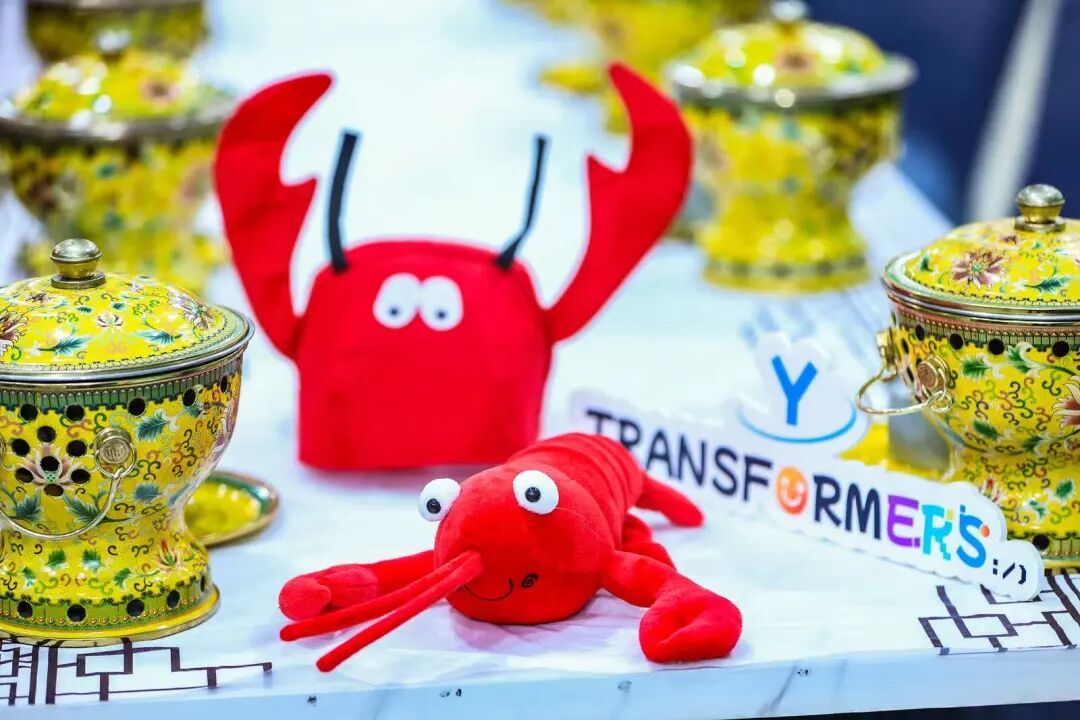
How will the AI Native generation use silicon-based intelligence to change the world?
Since launching Y Transformers, an investment program for founders born in 1998 or later, we've seen hundreds of applications with fascinating answers: someone teaching AI to mix cocktails, someone building a cultivation simulation game with AI, someone else seriously training "digital horticulturists" for plant factories...
We've also hosted offline gatherings in Shanghai and Shenzhen, meeting face-to-face with young changemakers trying to find their own answers, and building a space where post-98 founders can find co-founders and resources.
Last Friday evening, Y Transformers came to Beijing, setting up at Origin Community in Zhongguancun. Together with Zhongguancun Science City, Silicon Star, and Origin Academy, we co-hosted a hotpot dinner bringing together nearly 50 changemakers. Over bubbling broth, they talked about what they're building, pitfalls they've hit, and opportunities emerging on the horizon.
Three hours of "AI blind box" interactions — young builders active in AI gaming, embodied intelligence, AI comic dramas, enterprise financial management, and more — covered everything from models and agents to going global, compute, ethics, and entrepreneurial dilemmas, with a freestyle rap thrown in midway.
It was like running a live multi-turn conversation, laying all the hard-won lessons, judgments, and wild ideas on the table.
Before the hotpot started, we served an "appetizer." Yi Han, executive director at Yunqi Capital, briefly updated everyone on Y Transformers' latest progress. This investment program designed exclusively for post-98 founders has now reviewed 200+ early-stage entrepreneurs. Founders cluster between ages 21 and 27, with backgrounds spanning R&D, current students, and design/art creators, working across hard tech and creative companionship.
So far, Yunqi's Y Transformers program has invested in 5 projects. "We provide the first check, and we share ideas together," Han said.
After the appetizer came the "main course." Each participant's dedicated showtime began with answering a question card drawn when they sat down. Hardcore judgments, scalding lessons, bold ideas — the exchange bubbled alongside the broth. Below are excerpts of the highlights.

Distribution Matters More Than Parameters
Distribution: The Invisible Ceiling for Most AI Products
Alex, 22 years old, 12 years of coding experience, 8 years of OC (original character) creation, dropped out at 19 to start a company, and raised millions in funding. A typical AI Native builder who "dares to mess around" and "loves to mess around."
Facing the question "For AI products, which matters more — capability or distribution?" Alex didn't hesitate: distribution. "More important than capability is territory. No matter how strong your capability, without your own distribution territory, your product just becomes a fragile tool."
Sora, which suddenly announced a full shutdown on March 25, is the perfect cautionary tale. "Capability maxed out, but users took videos they generated and posted them straight to TikTok — doing the marketing for someone else." Alex said this is precisely why his own startup focuses on community ecosystems.
He's using AI to bring users' virtual characters to life — able to converse, interact with each other, and have tailor-made mini-games — bringing joy and resonance to creators in Mecoland, this playground he's building.
What Happens When You Try to Cram Everything Into a Small Model?
What happens with overfitting in model training? Lei Chen, a master's student at Tsinghua University, offered an analogy: "Imagine a suit that clings to every muscle — looks perfect when you're standing still. But the moment you raise your arm or turn around, it rips — because there's zero give. Models are the same: stick too close to training data, and they collapse in new scenarios."
Chen is vice president of Tsinghua University's Student General Artificial Intelligence Research Association and also interns at a leading edge-side model company. He shared an experience from when his team was developing a proprietary edge-side full-modality model: they wanted to achieve long context, instruction following, and real-time full-modality interaction simultaneously, but compute only supported 9B parameters. "A 9B plate, trying to cram everything in — either it doesn't learn or it learns too rigidly."
The team ultimately chose to push full-modality interaction to its limit within that 9B constraint. They agonized, then found peace: "Doubao can do real-time voice, but what we achieved is proactive interaction — the model itself judges when to speak. This capability, we're currently the only ones with in the open-source community."
Skill Is an Intermediate State, Not the Endgame
Facing the question "Which skill has AI actually replaced for you?", Fei Song, who is leading a team developing the full-modality agent "Infinite Alignment," didn't stop at the functional level. In his view, Skills need to be unpacked: one category patches around models' still-immature reasoning capabilities — format constraints, task decomposition, context slicing and management. These Skills are essentially engineering patches; as long-horizon task reasoning and context management improve, they'll gradually be absorbed by the model itself. Execution certainty shouldn't long-term depend on bolt-on Skills, but should become internal to the model.
But another category of Skills comprises interfaces for agents to interact with the real world — calling databases, APIs, file systems, external services. These won't disappear as models get stronger, because they solve "system boundary" problems rather than "reasoning capability" problems. Therefore, Song's team wants not to keep stacking patches outside the model, but to raise the model's own capability ceiling inward, building a "native agent" whose skeleton is model comprehension and reasoning, capable of growing naturally. In his view, once patch-type Skills are absorbed by the model and interface-type Skills settle to the bottom layer, an agent's true competitive advantage may no longer lie in the skill library itself.
AI Doesn't Lack Capability; It Lacks Usage
Chengxing Xie, a PhD student at Tsinghua University, has long worked on LLM post-training and optimization. Beyond continuing to "race on tech," he's recently turned attention to a more practical problem: AI capability is already very strong, it can help many people do many things, but somehow not that many people are actually using it. "I'm wondering if I can build some products that get more people to actually use AI."
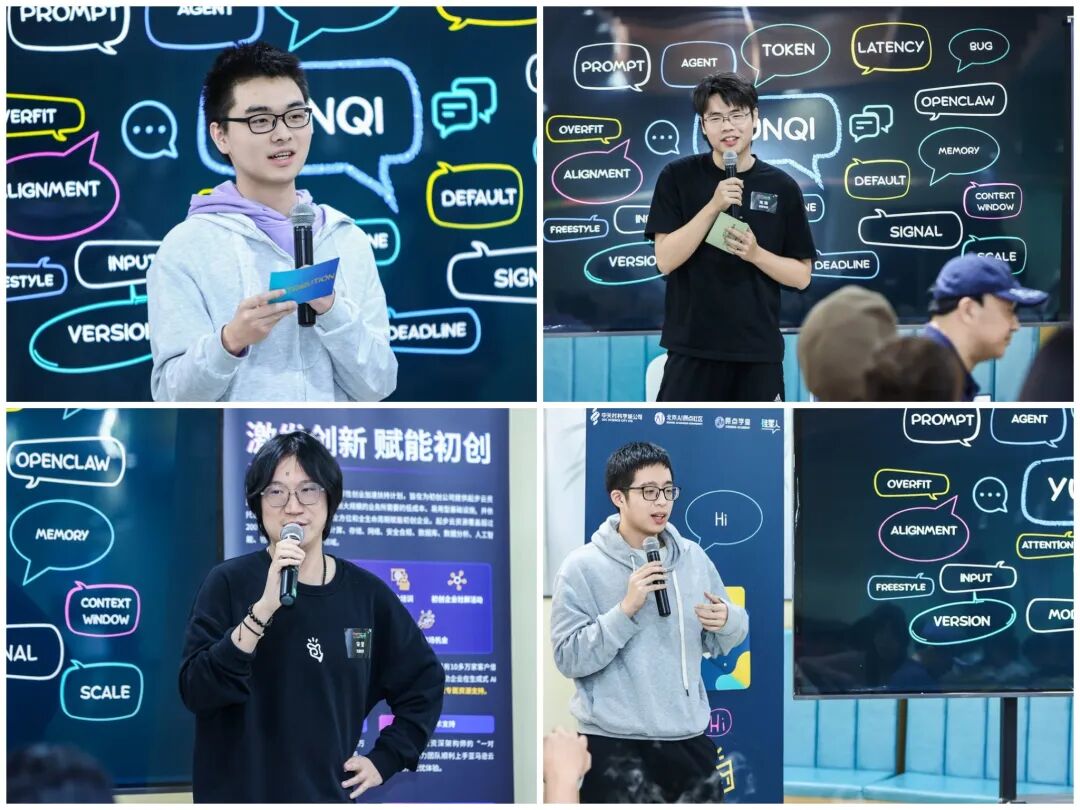
Debugging With Real Money
Agent Pitfalls: Not Just Expensive, But Uncontrollable
"What was the most expensive single token burn?" This question hit a pain point for Guangfu Hao, a comic drama agent entrepreneur: at peak development, his 5-6 person team saw individual daily Agent consumption hit $100 per person. Using agents to replace human labor is the trend, but agents themselves are no small expense.
More unpredictable than the cost is loss of control. Hui Liu, a serial entrepreneur recently obsessed with "crayfish configuration," told a乌龙 story that had literally happened that day: he'd simply wanted to add a WeChat plugin to his own crayfish setup, but instead of continuing configuration in the existing environment, the agent created an entirely new "cloud crayfish" on its own initiative, conveniently configuring the plugin there too. Only when that WeChat crayfish "didn't recognize him" did he realize: bad news, the agent hadn't followed the plan; good news, he'd accidentally acquired a new cloud crayfish.
This illustrates a typical agent risk: you think it's doing A, but based on its own understanding it produces a "similar but not the same" B, using your account and permissions. The visible cost is compute and billing; the more hidden cost is losing control of both process and outcome.
Sparsification Cuts Inference Costs From the Foundation
Mingyang Xu, a Peking University master's student graduating in 2025, also ran the numbers: current large model inference costs mean most use cases lose money, "basically only quantitative trading can earn back the API fees." What he wants to do is attack costs at the root: researching attention sparsification. The logic comes from an intuition: "The real world is sparse — most of the universe is vacuum. The human brain is sparse too — it's in a standby state the vast majority of the time. But current models are all dense computation. That doesn't make sense." Someone from the audience chimed in: "Get those prices down already!"
After Breaking Down, Slowing Down Turns Out to Be the Fastest Path
Has your entrepreneurial journey had a moment of breakdown? Sophie, who founded an AI global growth marketing startup less than a year ago, resonated with many young founders.
Her breakdown wasn't about business, but about people. "I couldn't give employees enough returns yet, and one day I just burst into tears." What she didn't expect was her employees comforting her back: "I'm here for you as a person, not your money." Because of that sentence, she understood one thing: slowing down is actually the fastest path.
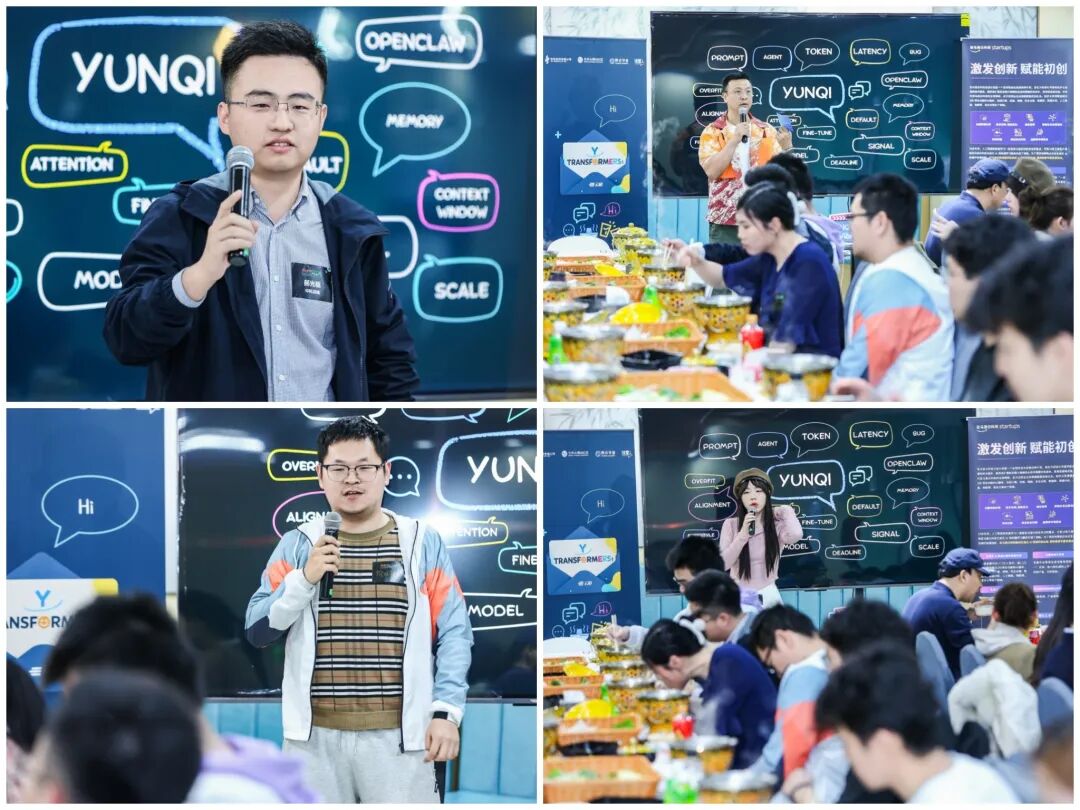
Prompts Without Standard Answers
Science Fiction Is Science Fiction; Brain-Computer Interfaces' Real Value Is in Medicine?
Beyond sharing his comic drama agent startup, Guangfu Hao, who is pursuing a PhD in brain-computer interfaces, also discussed his home field. Regarding various sci-fi imaginings of BCIs, he brought everyone back to reality with a set of numbers: the human brain has 80-100 billion neurons, synaptic connections in the quadrillions, while current BCI maximum channel count is only 3,000, monitoring just a tiny fraction.
"The sci-fi scenarios people imagine don't exist." Greater value likely lies in medicine — deep brain stimulation, waking vegetative patients, treating epilepsy. What Elon Musk is doing is just the most basic visual reconstruction.
AI's Most Important Capability Is Self-Improvement
Han Zheng, an AI product manager, is working on Xiao Ai (Xiaomi's voice assistant) and miclaw. Her team requires product managers to hand-build a deliverable product module from 0 to 1 in 4 hours. Asked what the most important "heartbeat signal" is, her answer: self-improvement. "Learning and improving from user feedback — that's the most important active task for an agent."
Does Entrepreneurship Have a Deadline?
Xuan Wang, serial entrepreneur and COO of Keda Zhiling, drew this card. He's been through the full cycle from founding to successful exit and back to starting from zero. The answer was simple: "As long as the entrepreneurial spirit is still alive, there's no deadline."
In the Future, Will Humans Take Over AI or AI Take Over Humans?
As the event wound down, discussion slid toward ultimate questions. One entrepreneur shared a detail: he recently chatted with a 14-year-old, asking where their meeting ideas came from — the kid said AI; how to present the PPT? Also AI. "In fact, we actively give our time to AI. Our decision-makers hate deciding, so in the future the crayfish tribe will just manage us."
Another guest laughed and rebutted: "AI can't eat hotpot for me — it has no sense of taste. But humans can eat hotpot for AI — touch, taste, atmosphere, formed into data transmitted to AI, which can then simulate it for another BCI user. So we still have value: we can eat hotpot."
Finally, someone pulled back to a historical dimension: "Human lineage evolved over millions of years, but the nations, laws, ethics we're familiar with today — at most five thousand years of history. And many specific concepts — privacy rights, intellectual property, 'what counts as human capability' — are really just consensus formed in recent decades. Technologies like brain-computer interfaces challenge precisely these youngest, most fragile consensuses."
On AI's ultimate questions, this hotpot table couldn't provide answers. But the fact of sitting together and seriously discussing them is itself a kind of answer.
What Y Transformers wants to do has never been to provide answers. It's to put these still-generating questions on the same table.
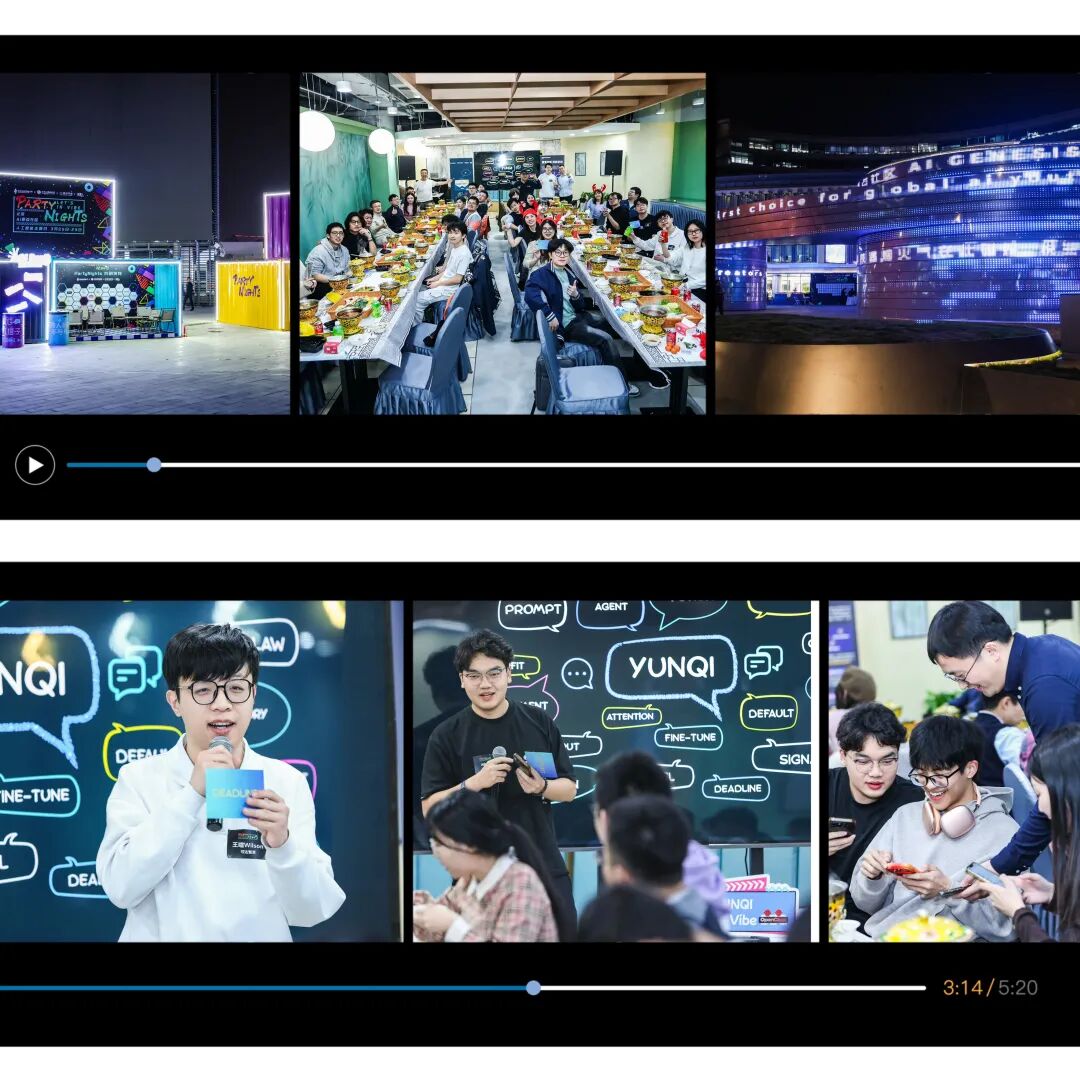
There was also a delightful little彩蛋. Congsheng Xu, a young partner from Shanghai Jiao Tong University, while sharing his experience in embodied intelligence and community-building, casually mentioned he also enjoys DJing and rap — and the next second got现场 cue'd into a freestyle segment. With his authorization, we share this very Y Transformers moment from the night 😄
Today, more and more post-98s are making their own attempts with AI — not waiting for paradigms, but making the paradigms happen. What we want to do and can do is simply push this one step further: first-check funding, and helping each other get seen earlier.
Yunqi Capital's post-98 investment program Y Transformers continues. If you're also using AI to do something "still hard to articulate, but really want to try," come find us for a chat.
We'll save you a seat at the next gathering.