A Conversation with Neolix's Yu Enyuan: Fresh 1 Billion Yuan Raise, How a Logistics Veteran Built an Autonomous Vehicle | Yunqi Capital's Doers Series

How does an atypical founder with a logistics background develop autonomous vehicles?
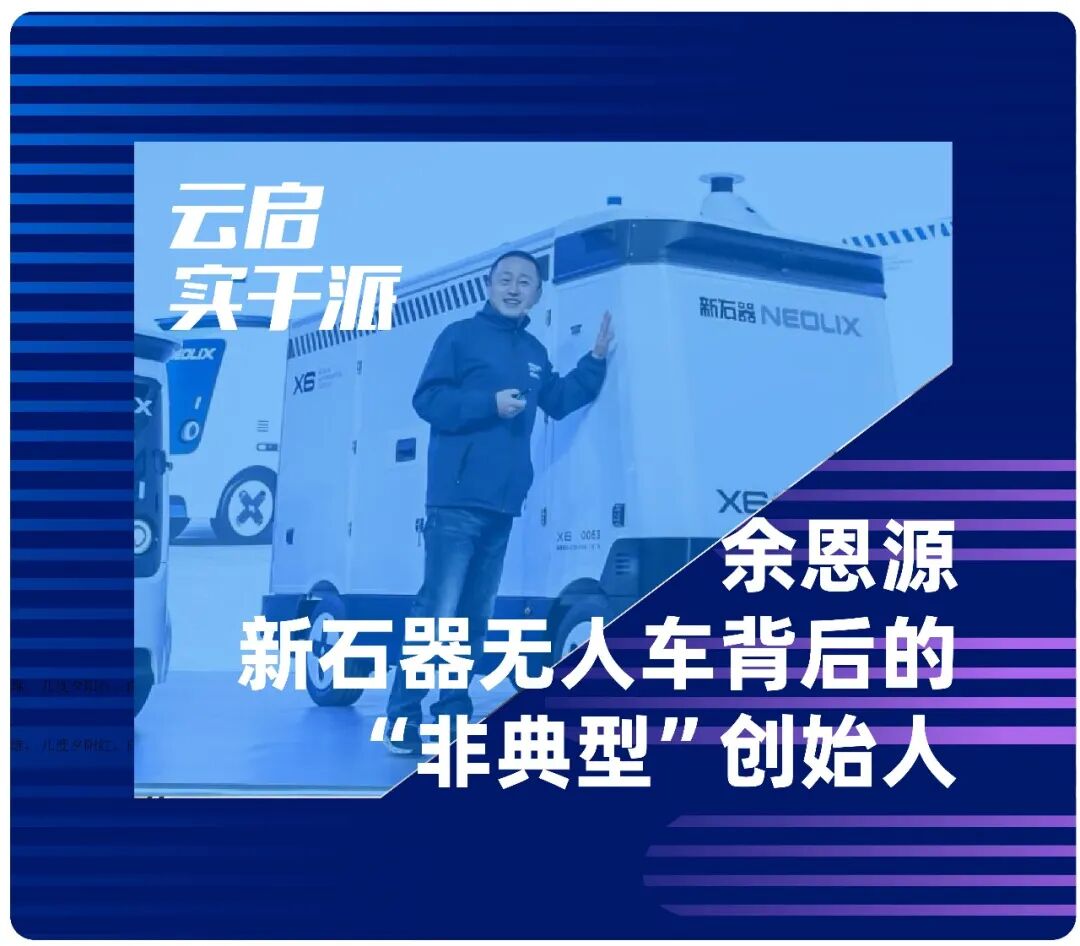
How does a founder with an atypical background in express logistics develop autonomous vehicles?
Recently, Neolix founder Enyuan Yu — whose company is a Yunqi Capital portfolio company and just announced a new 1 billion RMB funding round — sat down with financial media outlet LatePost to discuss the technical details, commercial deployment, and competitive landscape of autonomous delivery vehicles.
Grounding technology development and real-world deployment in the operational workflows and pain points of the logistics industry may be one of Yu's greatest strengths. In this edition of "Yunqi Doers," we take you inside the story of this founder and his journey to commercialize autonomous vehicles.
This article is republished with permission from LatePost AUTO.
Author: Qianming He
Editor: Manqi Cheng

In the autonomous delivery vehicle industry, the typical founder profile is a graduate from a top university who developed autonomous driving technology at a major tech company.
Enyuan Yu, founder of Neolix — which recently announced a 1 billion RMB funding round — is an outlier. Before founding Neolix in 2018, he worked as a courier, developed handheld data terminals for the express delivery industry, invented parcel lockers, and even experimented with drone delivery.
Most autonomous delivery companies use technology to enter the logistics business; Yu stood inside the logistics business and reached for the technology.
Neolix initially focused on hardware, using Baidu's Apollo open platform for its autonomous driving technology. It wasn't until two years after founding that the company invested in building its own autonomous driving team.
"I don't chase 'fancy' software, algorithms, or technology. I chase product performance," Yu said — a philosophy born from his logistics industry experience, and one that meant Neolix had "fewer talking points for fundraising and publicity compared to peers" in its early days.
Regardless of background or path, Neolix has reached an inflection point for the autonomous delivery vehicle industry. The signals Yu sees are:
- Policy support: Government discourse has shifted from "whether to open up road rights" to "how to open up road rights."
- Customer demand: The logistics industry can no longer cut costs through organizational efficiency alone and is now placing bulk orders for autonomous delivery vehicles.
- Technology maturation: Autonomous driving technology can now operate safely and stably on fixed routes, and hardware costs have dropped significantly.
By the end of 2024, Neolix had deployed over 2,000 autonomous delivery vehicles. Yu said the company has already received orders for more than 20,000 new vehicles this year, with plans to deploy over 10,000 nationwide. Counting passenger vehicles, heavy-duty trucks for trunk routes, and specialized vehicles for ports and mining sites, no L4 autonomous vehicle company has yet reached this scale. He believes this will be the industry's tipping point: "Technology and systems will both achieve economies of scale."
Neolix also faces competition: peers like Jueying Intelligence, White Rhino, and Cainiao Logistics are expanding rapidly.
Yu said his logistics background and past unconventional choices are Neolix's competitive advantages. For example, transportation in the logistics industry involves not just moving goods but also loading, unloading, and handling. Neolix has continuously iterated its production line, building the capability to mass-produce autonomous vehicles at low cost.
In January this year, Yu spoke with us about how Neolix is pushing toward deploying 10,000 autonomous delivery vehicles, how it's responding to industry competition, the impact of autonomous delivery vehicles on the logistics and express delivery industry, and the challenges facing autonomous driving technology — the most mature application in embodied AI after more than a decade of development — as it breaks through the 10,000-unit deployment mark: as more vehicles hit the road, the scale of data processed by models expands, and the frequency of edge cases rises exponentially, they must ensure safety.
10,000 Units: The Inflection Point Arrives
LatePost: You've said that deploying 10,000 vehicles this year is the tipping point for the autonomous delivery vehicle industry. Relative to the millions of tricycles, vans, and other vehicles you aim to replace in the freight market, 10,000 is almost negligible. Why is it a tipping point?
Yu Enyuan: Two dimensions. First, reaching 10,000 units represents an inflection point for algorithm and system stability, hardware reliability, and overall dispatch capability. This is what we call the scaling effect.
Second, surpassing 10,000 means the market has moved past the zero-to-one phase. Passenger vehicle companies typically use 100,000 units as a benchmark. Their logic: China's passenger vehicle market is 200 to 300 million units. 100,000 is roughly 0.5‰. We're similar. China has about 20 million urban delivery vehicles of various types. When I sell 10,000, that's also 0.5‰ — no longer a number that disappears after the decimal point.
LatePost: The autonomous delivery vehicle industry has been developing for nearly a decade since 2016. Why is the inflection point arriving now?
Yu Enyuan: Several factors aligned. First, government attitude. Before 2024, the discussion was whether to open up road rights. By late 2024, it became how to open up road rights.
Behind this shift are two drivers. One is the arrival of the AI era — autonomous vehicles are a crucial application and represent new productive forces, which the government has already defined them as. The other is the logistics industry's need to cut costs. Further reductions through organizational efficiency have limited room, so it comes back to a revolution in productivity tools: how to use AI, which means autonomous vehicles, to reduce logistics transportation costs.
LatePost: How low can costs go?
Yu Enyuan: We've roughly calculated over 70% cheaper. This is the second factor behind the inflection point — product and technology costs have also reached a tipping point.
You can check Lalamove or DiDi Freight for the average cost per kilometer for a delivery task from here (Jiuxianqiao) to Yizhuang, then compare it to our autonomous vehicle operating costs. We're basically 70% to 80% cheaper. Why? Simple — machines replacing humans has two advantages. One is eliminating labor costs, no driver needed, which is obvious. The second reason most people don't think of — machines can carry more cargo. The driver's cabin on a cargo vehicle is more expensive than my autonomous driving module. Without a cabin on a goods-carrying vehicle, cargo volume increases while cost decreases.
LatePost: But your main customers are express delivery companies, whose shipping costs are much lower than Lalamove or DiDi Freight. For example, sending a package from Yiwu to other cities can cost less than 1 RMB per order.
Yu Enyuan: We'll drive prices down further. If an autonomous vehicle travels about 10 kilometers and can transport 1,500 packages per day (note: one "package" means one parcel; depending on the vehicle model and parcel size, one autonomous vehicle can typically carry 200–1,000 packages per trip), we calculate the transportation cost per package at roughly 0.06 RMB, down from the current 0.15 RMB — a 0.09 RMB reduction.
LatePost: Which segment is this? Delivering to doorsteps?
Yu Enyuan: Mainly from (express distribution) hubs to (delivery) stations. Not the segment where couriers ride tricycles to deliver to doorsteps.
In Beijing and Shanghai, station-based delivery isn't as prevalent. Elsewhere, 80% of packages already go to stations; doorstep delivery costs extra.
The logistics industry has seen three waves of automation. The first was hub automation — installing automated sorting equipment. The second was station-ification and unmanned operations — the industry built hundreds of thousands of stations to solve the last-mile delivery problem. Now stations are also adopting automated technology, pushing toward unmanned operations.
After these two waves, the critical point is the middle transportation segment, about 10 kilometers, using autonomous vehicles — this is the third wave. Connecting all three waves improves overall operational efficiency. That's the big-picture logic: if both ends are unmanned but the middle still has people, it's a paradox.
LatePost: Even with such cost reductions, it seems not all express companies are eager to deploy autonomous delivery vehicles at scale.
Yu Enyuan: It's a competitive strategy question — it depends on who's more motivated. The more a company wants to be number one, the higher its motivation.
I think the logic is this: if express delivery prices weren't already so low, autonomous vehicles might not be spreading so quickly. With shipping costs already driven down to 0.5 RMB, express companies are extremely hungry for new efficiency tools.
This is our strategic opportunity. We've already received massive orders, exceeding our imagination — over 20,000 units. For example, one company approached us to order over 10,000 vehicles at once; the agreement should be signed in the next couple of days.
LatePost: With such a large one-time purchase, what gives customers the confidence to trust you?
Yu Enyuan: Most importantly, we care about customer experience. Let me give an example. We have a customer scenario at a large logistics hub processing 1 million packages per day for forwarding. We need 60 autonomous vehicles to transfer these packages to hubs within a 10-kilometer radius, with only 10 minutes from unloading to loading. This is already deployed in Suzhou and Hefei.
This isn't a common scenario, but it represents your ability to deeply integrate with "Mount Everest"-level customer demands. When scaling down to individual hub applications with 5 to 10 units, it becomes very straightforward.
LatePost: From order to deployment, what other challenges remain?
Yu Enyuan: Deploying 10,000-plus autonomous vehicles at scale — such a complex autonomous driving network — has no global precedent. Compared to our current 2,000-plus deployed vehicles, the data scale is different, leading to exponential increases in model complexity and corner case frequency. Hardware quality and reliability must also improve by an order of magnitude. We must ensure safety, robustness, reliability, and usability. This is an enormous challenge.
LatePost: Neolix has already deployed over 2,000 vehicles. What lessons have you learned?
Yu Enyuan: Deployment and operational efficiency are key to success. If delivering one autonomous vehicle requires sending a sedan to collect mapping data, you can imagine the cost with your eyes closed. We're now pushing for autonomous vehicles to collect their own maps, so express hub managers can learn to deploy them themselves, very efficiently — possibly completing setup in a day.
LatePost: What variables exist in this process?
Yu Enyuan: The biggest variable is safety, especially driving safety.
LatePost: Have you had any serious safety incidents?
Yu Enyuan: No. Our internal data shows that over 80% of safety incidents are passive — for example, hard braking causing rear-end collisions from following vehicles. This is something we're continuously optimizing.
LatePost: Why the hard braking?
Yu Enyuan: With no one in the vehicle, ensuring absolute forward safety makes the strategy easily become aggressive, causing sudden braking. This is long-term optimization work. As autonomous vehicles consume more data, they'll become smoother. Our internal curves show rear-end collisions are dropping sharply.
LatePost: How are you reducing them? By adding more people to write rules, or following the passenger vehicle trend toward new data-driven systems?
Yu Enyuan: Model-based solutions can already handle over 90% of problems. Going forward, we need more data, more compute, efficient training, and model optimization. For this, we believe adding people doesn't help. Our team has entered a relatively stable period — algorithm staff won't be increasing.
"Can't Just Focus on Big Cities — Both Matter"
LatePost: For your 10,000-plus autonomous vehicles, will you concentrate operations in specific regions or disperse across many cities and areas?
Yu Enyuan: Our view is to walk on two legs — both concentrated and dispersed.
We must operate in major cities. We're already deployed in Hangzhou, Suzhou, Hefei, and Shanghai. This year our goal is to push each city to 500 or even 1,000-plus vehicles, creating a high-density network in each. Then we'll also spread to scenarios with just ten units in a county or rural area.
To surpass 10,000 units and cross the zero-to-one threshold in both commercial scale and technology, both scenarios must work well. This prepares us for 100,000, 1 million, 10 million units, and for going overseas.
LatePost: Does express delivery really need so many autonomous delivery vehicles?
Yu Enyuan: Autonomous vehicles won't just do express delivery in the future. There are over 100 urban delivery scenarios — fresh food supply chains, grocery shopping, wholesale markets, etc. — potentially demanding tens of millions of units. In county and rural scenarios, you'll never have network effects because there's no work at night.
Only in sufficiently dense cities can networks form, allowing daytime express delivery and nighttime fresh food delivery. So cities can't be ignored — if you always do rural包围城市 (surrounding the cities from the countryside), the network won't emerge.
LatePost: How many vehicles in a city are needed to form a network?
Yu Enyuan: Express delivery is a good indicator. Basically, population times 20% equals express volume; for major cities it's probably over 40%, then divided by 1,500 (note: calculated based on one vehicle transporting 1,500 packages per day) gives vehicle demand. For example, Beijing would need roughly 4,000 to 5,000 units.
LatePost: Since you believe county and rural scenarios will never have network effects, why enter them at all?
Yu Enyuan: Unit economics are higher in counties and rural areas.
LatePost: Competition in autonomous delivery vehicles is fierce now. Many companies are pricing transparently — for example, Jueying Intelligence claims a down payment of just 3,980 RMB, while Cainiao's Xiaomanlv announced 150,000 RMB for five years including vehicle and maintenance. Does this mean a price war is coming?
Yu Enyuan: I think the price war has already started. And we started it. The reason is simple: looking at hardware configuration, our costs are roughly 40% to 50% lower than competitors'. After reaching 10,000 units, we'll push down further.
LatePost: How did you achieve such lower costs? And how can you reduce further?
Yu Enyuan: We started with multi-lidar, multi-sensor solutions. Today we've simplified to one lidar plus 12 cameras, basically achieving end-to-end perception.
When we can scale to 10,000 units with sufficient data, we'll know which product features matter and which don't. We can make bold moves — the entire product and technical design will undergo a major iteration.
LatePost: Another competitive factor is that large companies won't buy from just one supplier. For example, SF Express is a major customer of yours but also invested in your competitor White Rhino. How do you more deeply bind major customers?
Yu Enyuan: I don't think you can bind them. Whether an autonomous vehicle company can grow and truly create industry value depends on how quickly it can reduce large-B (major customer) sales to a small proportion.
The commercial path must start with large-B customers because they have high requirements for road rights, operational quality, and efficiency, and offer sufficient demonstration value.
But you must seize the time to expand toward small-B (small-scale customers) and scattered-B (fragmented customers like express station franchisees). They have high requirements for engineering standardization but low customization demands — that's where pricing power emerges.
LatePost: In your previous public remarks, you often mentioned road rights as important for autonomous delivery vehicles, and Neolix holds the most permits. Are road rights an advantage in autonomous delivery vehicle competition?
Yu Enyuan: I don't believe road rights will become a competitive advantage, nor will they be exclusive. But we respect road rights. We designed road rights into our products from the start.
We currently have three products: one with 3m³ payload (X3), corresponding to tricycles and mini-vans, slightly more capacious than mini-vans, obtaining road rights for core urban areas.
Another with 6m³ payload (X6), corresponding to small, medium, and large vans, obtaining road rights for urban peripheries and smaller cities.
And a 12m³ one (X12), corresponding to Iveco-style vehicles and light trucks, likely for deployment in outer suburbs or relatively enclosed scenarios in the future.
LatePost: The logistics industry is somewhat winner-take-all, with limited numbers of large companies; as an upstream supplier to express delivery, will market concentration for autonomous delivery vehicles be high or low?
Yu Enyuan: I can't judge yet. I often say we and our competitors are "chicks pecking at each other" — none of us are strong yet.
On Market Competition and Demand Shifts
LatePost: When Neolix publicly debuted in 2018, you were quite unusual — making hardware and even manufacturing your focus, taking over Li Auto's SEV production line, while relying on Baidu's Apollo for software capabilities. Competitors all started by researching autonomous driving software.
Yu Enyuan: They all came from internet and tech backgrounds, with core capabilities concentrated in software. I entered the logistics industry in 2009, developed handheld data terminals, invented parcel lockers, and experimented with drone delivery. I approach things from an industry perspective, looking at how to do things well.
LatePost: The day before Neolix's autonomous vehicle debut, Li Auto founder Xiang Li posted on Weibo saying "The grey-robed wizard SEV has departed, returning as the white-robed wizard." Without their SEV project, would you still have prioritized the factory first?
Yu Enyuan: Yes. Without their production line, I would've found a low-speed elderly vehicle line at worst. That's a matter of method and path — the goal never changed.
The factory is part of R&D. When I design a vehicle, I simultaneously design how it's produced, calibrated, and tested.
Without this closed loop of production processes, vehicles delivered to customers might open up to find disconnected wires. When this industry produces millions of vehicles per year, factory standardization will be extremely important.
LatePost: Starting in 2020, Neolix also began developing its own autonomous driving technology. Why this shift?
Yu Enyuan: When working with Apollo, we were still using industrial PCs with 5 lidars on the vehicle — the technology wasn't at a productizable stage, so building an algorithm team was pointless.
Later we saw next-generation autonomous driving technologies, like visual sensor and lidar fusion, becoming practical, so we began investing ourselves. I'm not from a scientific background either — how to make useful products is my only criterion.
Actually, any company with product as its goal will take this approach. I don't chase fancy software, algorithms, or technology. I chase product performance.
LatePost: During the pandemic we saw many news stories about unmanned vehicle delivery. You told one of your investors, Xiang Li, that the market was launching. What did the pandemic mean for you?
Yu Enyuan: My feeling was that good social services would accelerate road rights opening. During the pandemic, we did various public welfare activities, which greatly moved local governments and increased social acceptance, bringing great hope for road rights opening.
LatePost: Neolix's deployment grew from 200-plus to 2,000-plus autonomous vehicles after this?
Yu Enyuan: That was 2023 and 2024. We saw large-scale openings in many cities, especially Hangzhou. In September 2023, we pulled our entire 100-plus R&D team to Hangzhou for a two-month闭关 (closed-door retreat) to adapt to local roads and scenarios.
Not Stealing Couriers' Jobs — The Vision Is a Freight Network
LatePost: Do you see your logistics background as an advantage or disadvantage in the autonomous delivery vehicle industry?
Yu Enyuan: A double-edged sword. The disadvantage is we definitely have fewer talking points for fundraising and publicity — we have to explain for a long time. The advantage is that the needs we see and the products we make may be incomprehensible to competitors.
For example, that cage vehicle product. Have you seen it?
LatePost: I saw reports where you called it "a container on land."
Yu Enyuan: Yes. To this day I find many competitors still don't get it. Actually, I see transportation as divided into three actions: besides basic transport, there's loading, unloading, and handling. If you solve automated transport without solving automated loading and unloading, you won't go far.
LatePost: But the more successful you are, the fewer jobs there are in the express delivery industry. When people talk about autonomous vehicles, the first impression is that they'll take people's jobs.
Yu Enyuan: In the logistics industry, there's no such thing as autonomous vehicles replacing people. I was a courier. Couriers work 365 days a year, 10 hours a day — 4 hours in transport, 6 hours delivering packages and providing service. For them, those 4 hours are unreasonable: they have costs but create no value. We're working to eliminate this segment so they can spend all 10 hours serving people.
LatePost: Won't their income decrease?
Yu Enyuan: No. All couriers currently face a biggest problem: delivery fees keep dropping, so income keeps dropping. Under the past work model, their income would keep falling.
Now couriers want to increase service time, increase service variety, and there may be other commercial possibilities in the future.
LatePost: But with improved efficiency, you won't need as many people.
Yu Enyuan: China still has a shortage of couriers. Logistics industry volume keeps rising, but the industry's work intensity makes it hard to attract people. If you improve human efficiency, increase their income, and make the work less grueling, the industry actually becomes easier to recruit for.
LatePost: What kind of business do you think autonomous delivery vehicles will become?
Yu Enyuan: An autonomous vehicle version of Lalamove or DiDi Freight. Express companies' typical usage scenario is 8 daytime hours. Once vehicle scale grows, a transportation network project will form, allowing unified dispatch of vehicles' idle time.
This prospect is already very clear — the more we look at it, the more excited we get. We may not necessarily build this platform ourselves, but we'll push for its emergence.