Deep Dive: a16z's Global Top 100 AI Apps — New Patterns and Trends | Yunqi Techπ

It's not just about who's fastest — it's about who can stick around.
The generative AI story is no longer just about "who's running fastest" — it's about "who's still standing."
Recently, a16z released the latest edition of its GenAI Top 100 Consumer Apps (5th edition). Updated regularly since 2023, this ranking has become a go-to barometer for tracking where generative AI applications are heading globally.
Which products are becoming part of everyday life? Which trends are reshaping the competitive landscape? In this edition of Yunqi Tech π, we break down the key takeaways.
Yunqi Key Takeaways
On the day the list dropped, we sat down with the #1 ranked player — ChatGPT — to highlight what matters:
- The GenAI application ecosystem is shifting from "wild growth" to "steady-state evolution." Incumbents are solidifying their positions, but mobile remains fertile ground for new entrants.
- The tech giants' maps are becoming more multidimensional. Big tech is no longer playing as a monolithic force; increasingly, it's operating as an application matrix. For startups, this means staying alert to the threat of being "dimensionally crushed" by giants, while also figuring out how to build moats in niche scenarios the giants haven't covered.
- Chinese AI products are gaining serious traction overseas, particularly in image editing, video editing, and social. Meitu's suite and ByteDance's apps dominate traffic entry points, and startup products including Yunqi portfolio company MiniMax's video app Hailuo AI have made consecutive appearances.
- Vibe coding is moving from fringe experiment to mainstream use case, with deeper user engagement than expected and early validation of platform retention. This once again underscores the importance of paying attention to edge signals in early-stage investing and entrepreneurship.
- Looking at the list structure, applications have expanded well beyond the single chatbot format into far more diverse use cases. Verticalization and experience optimization will be the keys to the second half — simply stacking large model capabilities is no longer enough to win users.
For more data details and trend observations, see below.
Reprinted from "Founder Park"
Original title: a16z Global AI Top 100: DeepSeek Growth Slows, "Built in China, Used Globally" Becomes the New Normal
Six months after its last release, a16z has published the fifth edition of its Gen AI Top 100 Consumer Apps ranking. Compared to the fourth edition released in March, one central observation stands out: after a period of explosive growth, the entire Gen AI application ecosystem is stabilizing.
In this edition, 11 new apps appeared on the web ranking — down from 17 new entrants in the fourth edition, a clear slowdown in the "churn rate." Mobile saw somewhat more change, with 14 new apps entering the top 50.
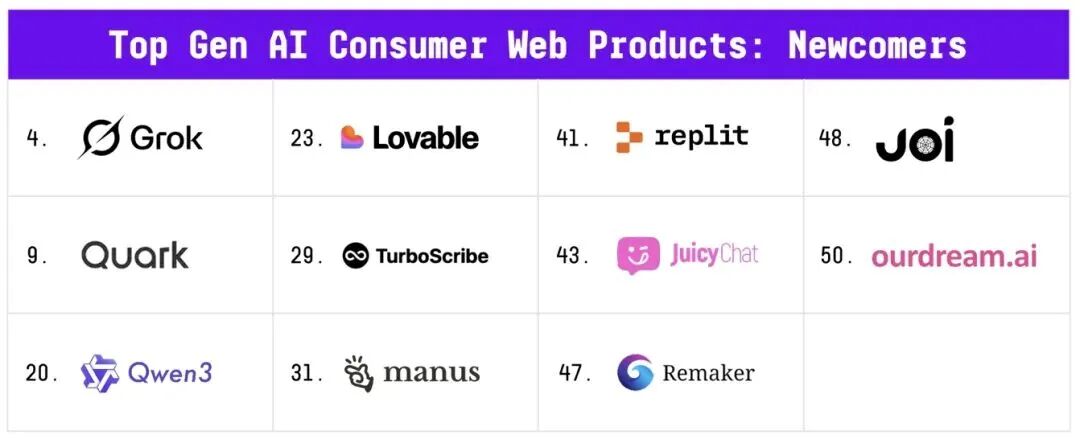
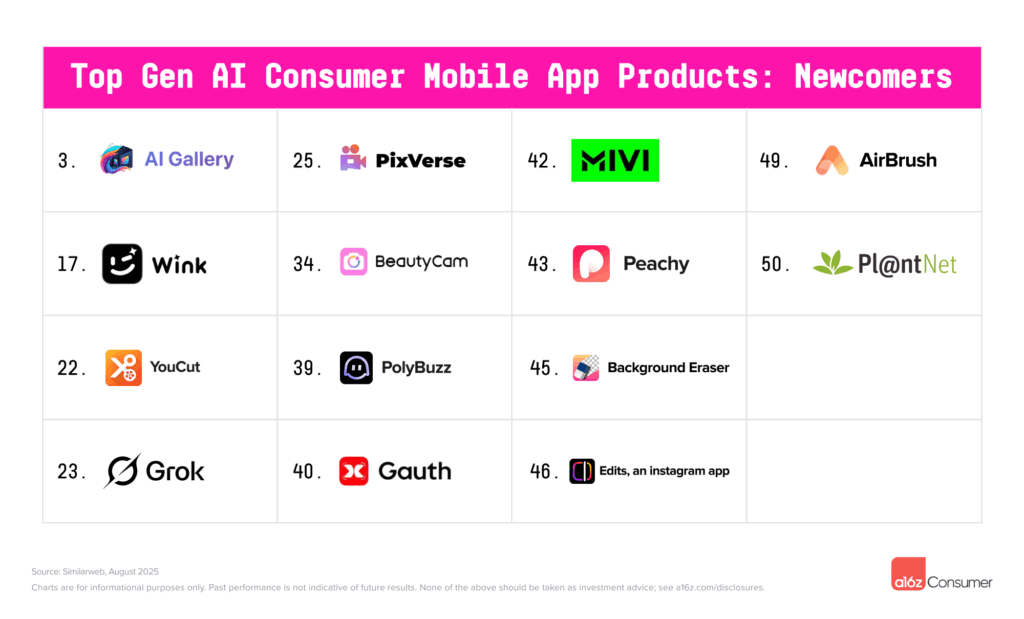
The latest Top 100 features numerous Chinese AI apps. Here's a quick rundown (possibly incomplete):
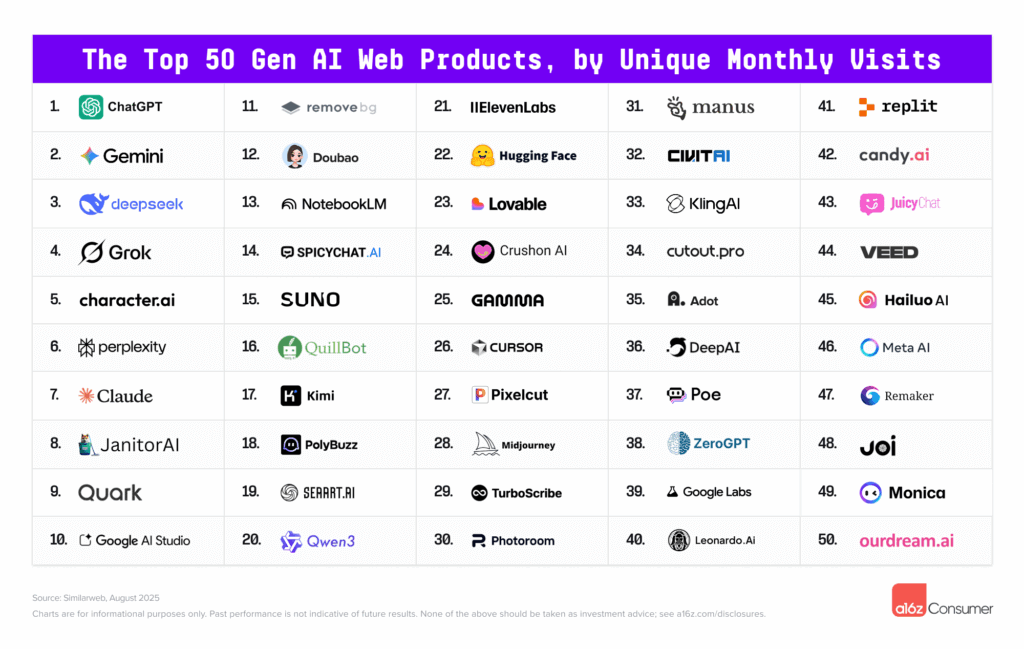
Web: DeepSeek (#3), Quark (#9), Doubao (#12), Moonshot AI (#17), Qwen (#20), Lovable (#23), Manus (#31), Keling AI (#33), Hailuo (#45), Monica (#49), SeaArt (#19), Cutout Pro (#34)
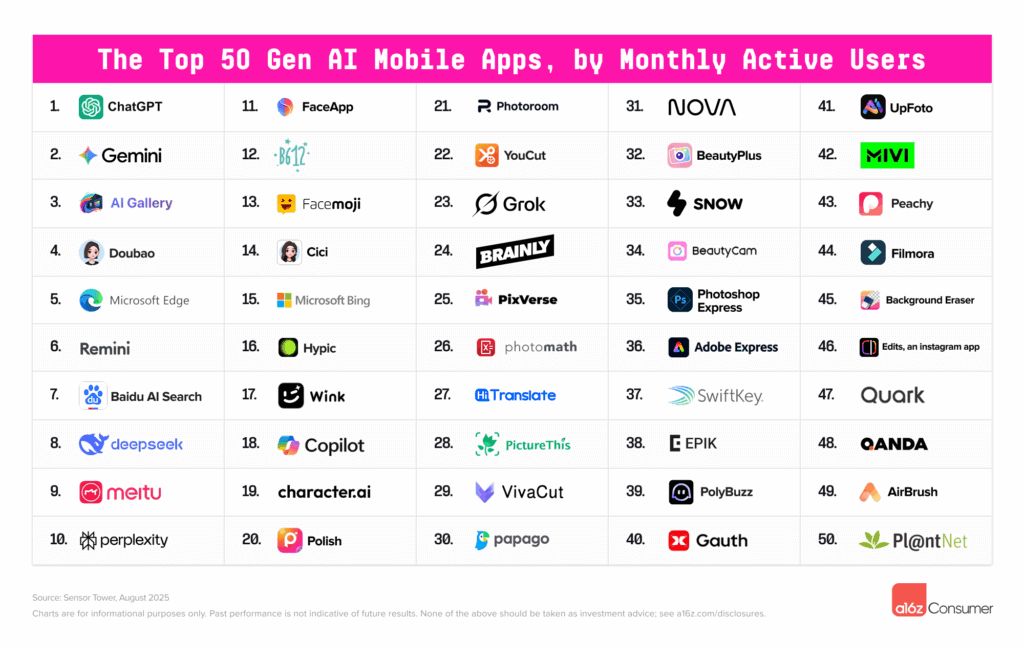
Mobile: Doubao (#4), Baidu (#7), DeepSeek (#8), Meitu (#9), B612 (#12), Facemoji (#13), Cici (#14), Hypic (#16), Wink (#17), BeautyPlus (#32), BeautyCam (#34), Gauth (#40), Quark (#47), Airbrush (#49).
From this Top 100, a16z identified several core trends:
Google's products are growing rapidly, with four making the web ranking. Gemini's web traffic has reached 12% of ChatGPT's; on mobile, monthly active users are approaching half of ChatGPT's. Gemini's usage is particularly concentrated on Android, where nearly 90% of its MAUs come from Android devices.
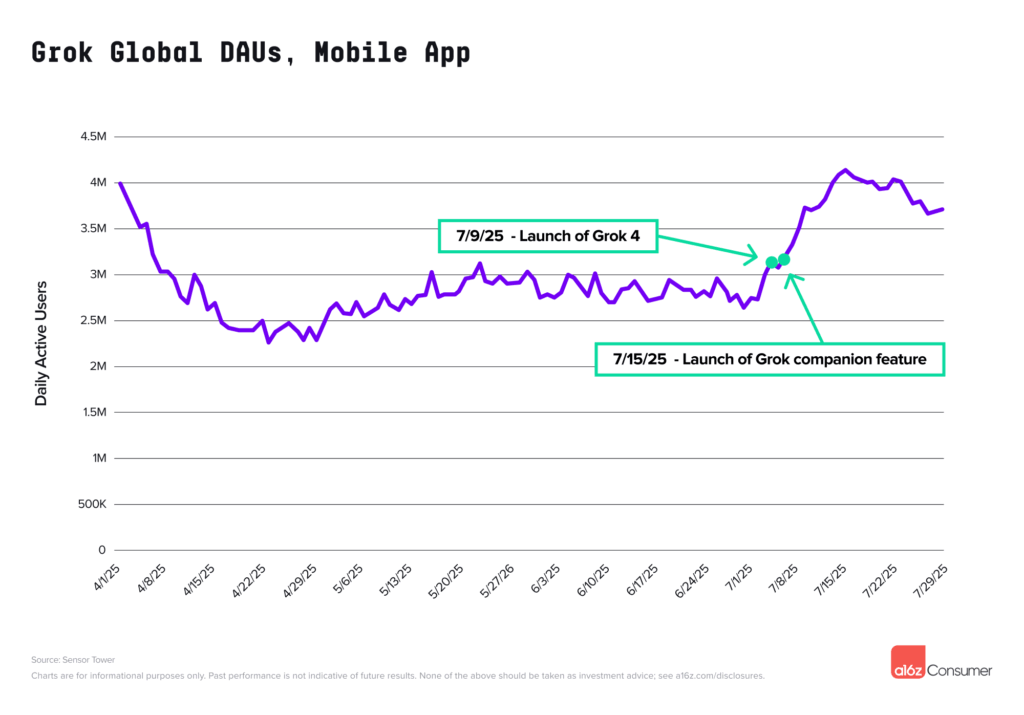
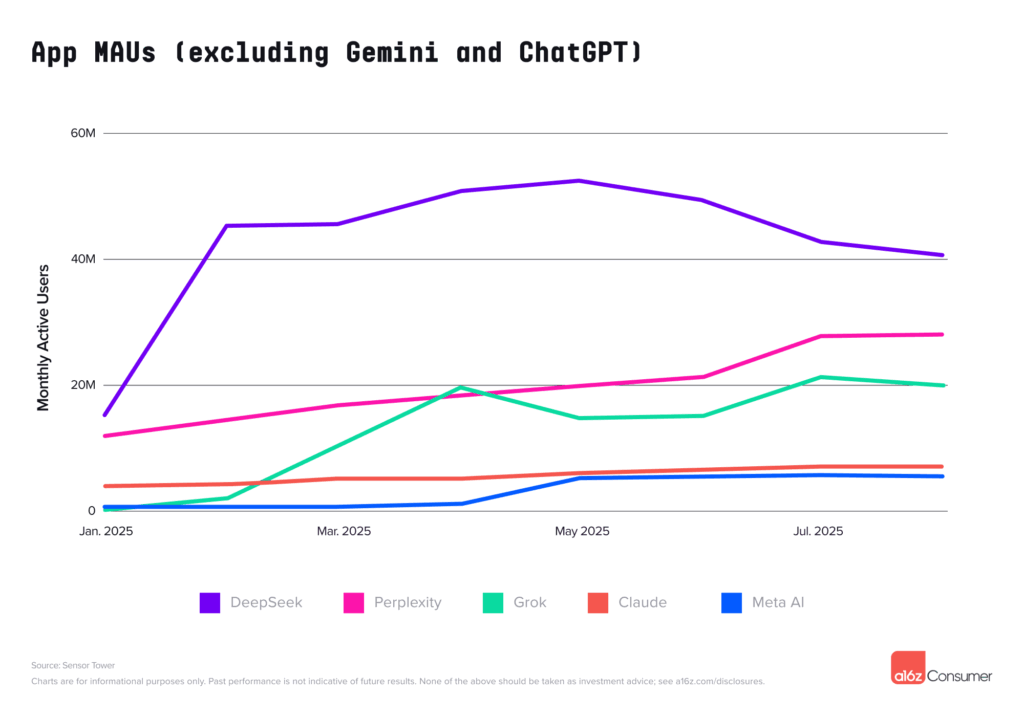
In July, following the release of the new Grok 4 model and the launch of AI companion avatars, Grok's mobile user base surged nearly 40%, with MAUs exceeding 20 million. By contrast, general-purpose assistant Meta AI has grown more slowly.
DeepSeek's growth has slowed significantly. On mobile, DeepSeek's MAUs have fallen 22% from their peak. On the web, the decline is even steeper — down over 40% from its February 2025 peak.
"Built in China, shipped globally" has become the new normal for AI apps. A substantial portion of the web ranking consists of products developed in China and then "shipped" overseas, with the vast majority of users coming from other countries. On mobile, Meitu alone has five apps on the list, and ByteDance has launched multiple products targeting global markets.
Vibe coding apps show exceptionally high user stickiness. For one top vibe coding platform's US user base, revenue retention remained above 100% months after signup. These apps are also driving traffic growth in adjacent tools.
Across all five a16z rankings, 14 apps have appeared every time. Only 5 of these own their own foundation models; the rest rely on APIs or open-source models.
a16z also continued its "Brink List" of near-misses — 5 apps each on web and mobile that are poised to break into the Top 100. For example, Lovable made the previous web Brink List and shot up to #22 in this edition's main ranking. From the last mobile Brink List, PolyBuzz and Pixverse also graduated to the main list.
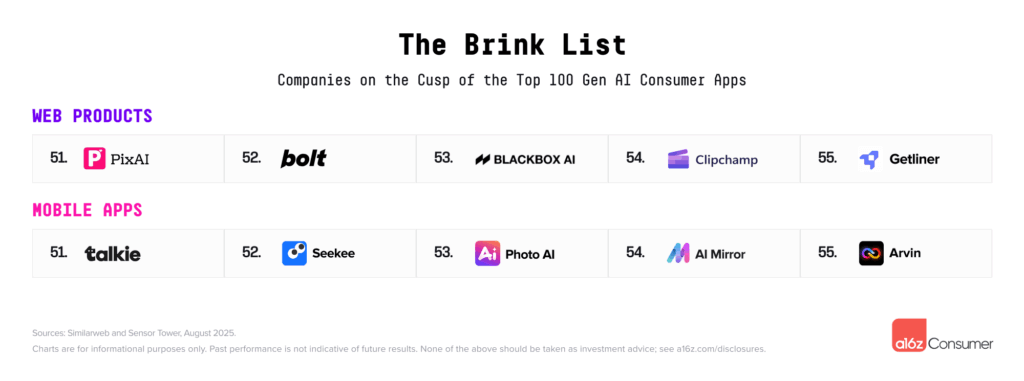
Top 100 Ranked Apps
Web:
Mobile:
Fifth edition of The Top 100 Gen AI Consumer Apps:
https://a16z.com/100-gen-ai-apps-5/
Methodology note: The ranking covers the top 50 AI-first web products (by monthly unique visitors per Similarweb) and top 50 AI-first mobile apps (by monthly active users per Sensor Tower). Products that added significant generative AI features but are not AI-native, such as Canva and Notion, are excluded.
01 Google Mounts a Full-Scale Challenge to OpenAI, Mobile MAUs Approach Half of ChatGPT's
The report shows Google placed four products on the web ranking — the first time they could be ranked and listed separately. Google's general-purpose LLM assistant Gemini ranks second, behind only ChatGPT, with web traffic at 12% of ChatGPT's.
On mobile, the gap is narrower. Gemini again ranks second behind ChatGPT, with monthly active users approaching half of ChatGPT's. The data shows Gemini's usage is particularly concentrated on Android devices, where nearly 90% of MAUs come from Android, compared to 60% for ChatGPT.
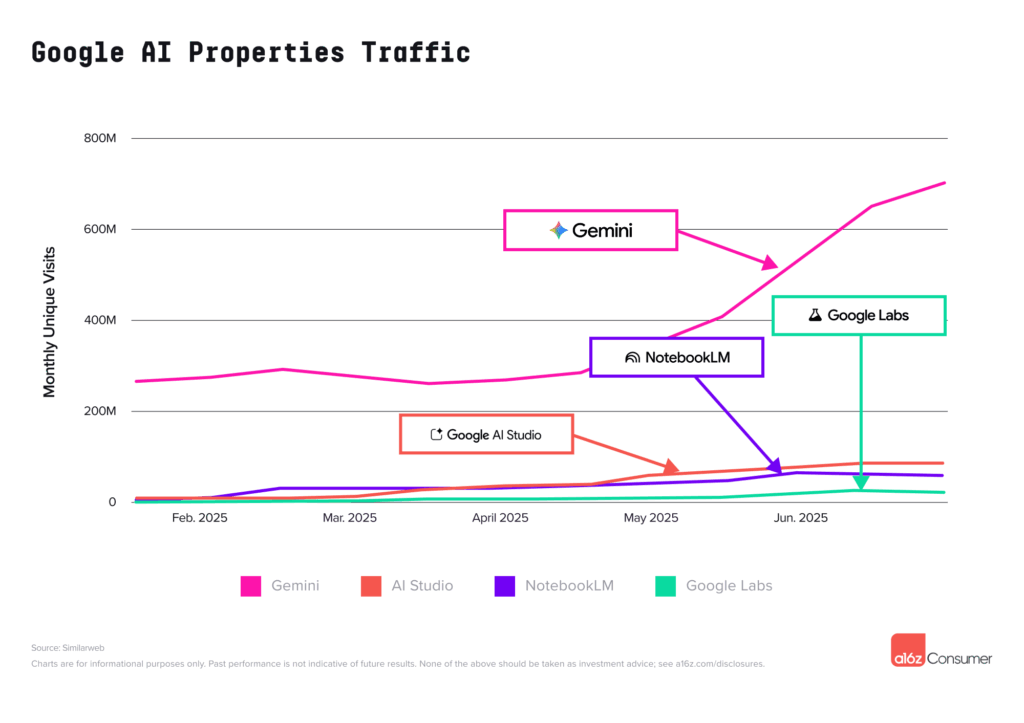
Beyond Gemini, three other Google products performed strongly: AI Studio for developers, personal knowledge base tool NotebookLM, and Google Labs as an AI experimentation platform.
AI Studio debuted in the top 10. It offers developers a sandbox environment to start building with Gemini models, including multimodal capabilities (e.g., conversational and real-time data streaming via Gemini Live).
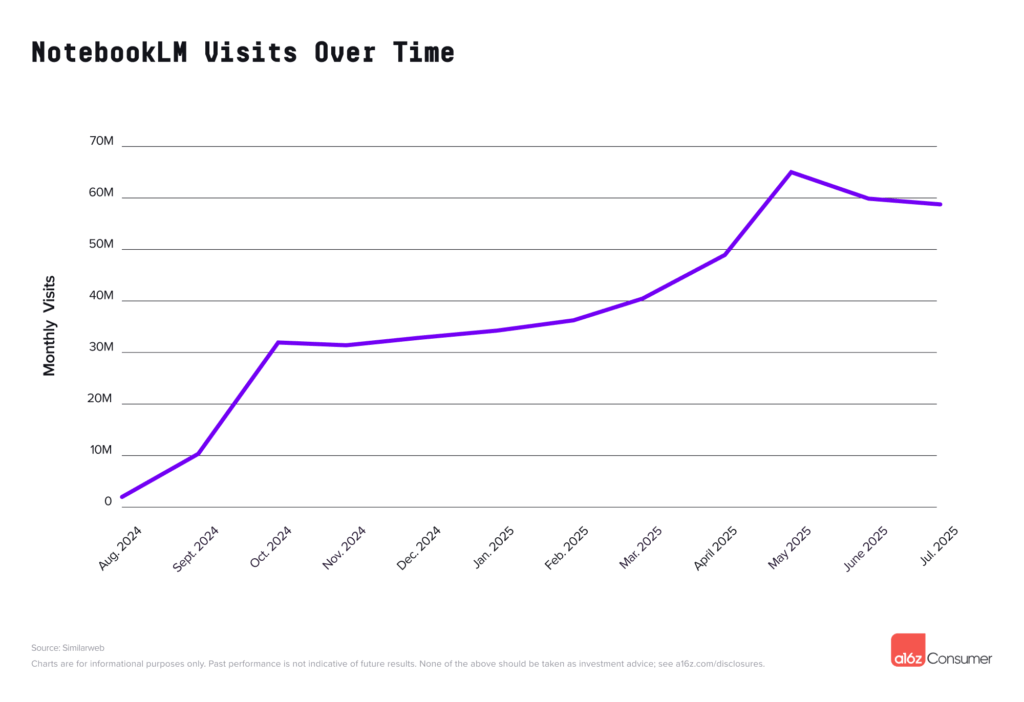
NotebookLM ranks #13. It went viral nearly a year ago and has grown steadily since, with only a slight summer dip (likely due to temporary churn among academic users).
Google Labs ranks #39. After Veo 3 launched in May 2025, Google Labs traffic spiked over 13% — its largest single-month increase in the past year.
02 Grok Mobile MAUs Exceed 20 Million, DeepSeek and Claude Growth Slows
In the general-purpose LLM assistant race, ChatGPT remains ahead, but Google, Grok, and Meta are closing the gap.
The report specifically notes that X's assistant Grok ranks #4 on web and #23 on mobile. Grok's mobile growth has been especially explosive — going from no standalone app at the end of 2024 to over 20 million MAUs today.
With the July 2025 release of the new Grok 4 model and the launch of AI companion avatars, Grok's mobile user base surged nearly 40%.
By contrast, Meta AI's growth has been more muted. The general-purpose assistant ranks #46 on web and failed to make the mobile ranking. Meta AI first appeared in late May 2025, but its growth has been far slower than Grok's — especially after users discovered in June that some of their posts were appearing in public feeds.
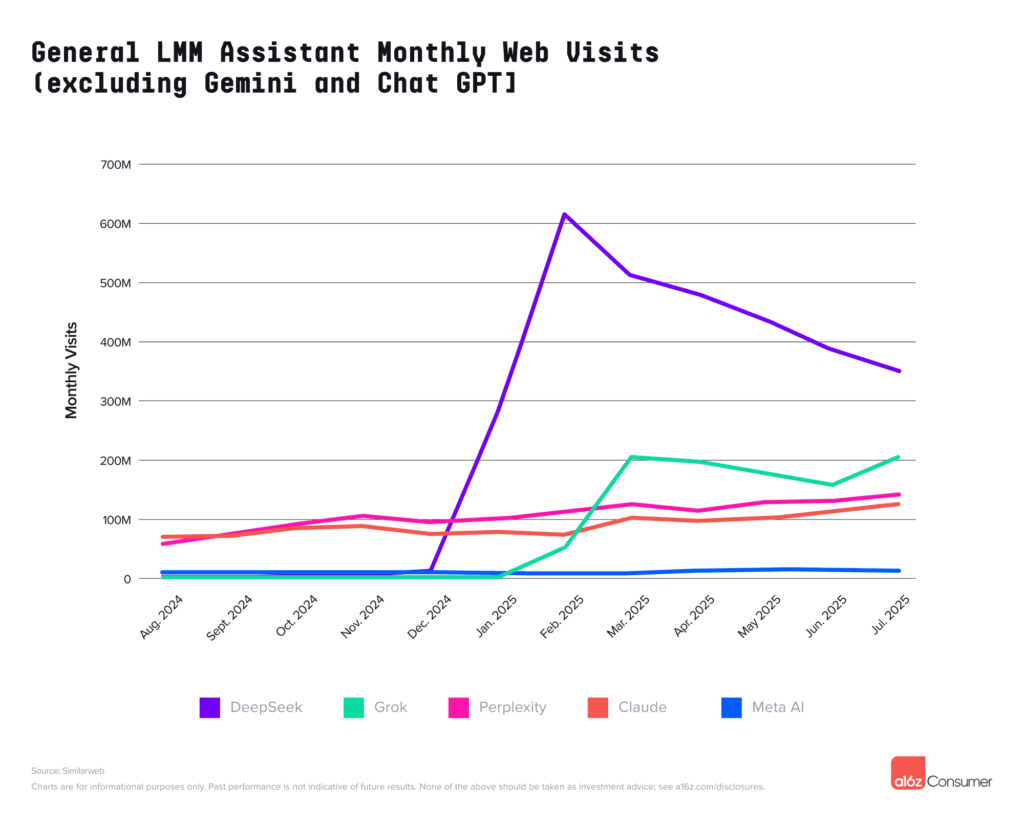
On mobile, DeepSeek and Claude have seen significantly slowed growth, while Perplexity has maintained strong momentum. DeepSeek's MAUs have fallen 22% from their peak. On the web, DeepSeek's decline is even more severe — down over 40% from its February 2025 peak.
On the web, Perplexity and Claude continue to grow.
03
"Built in China, Shipped Globally"
Becomes the New Normal for AI Apps
The report finds that Chinese AI applications are rising rapidly on the global stage.
Among the top 20 on the web ranking, three products primarily serve the China market (Chinese-language sites with over 75% of traffic from China):
Alibaba's AI assistant Quark (#9);
ByteDance's general-purpose LLM product Doubao (#12);
Moonshot AI's Kimi (#17)
a16z attributes this mainly to China's massive domestic market and restricted access to certain overseas LLM assistants.
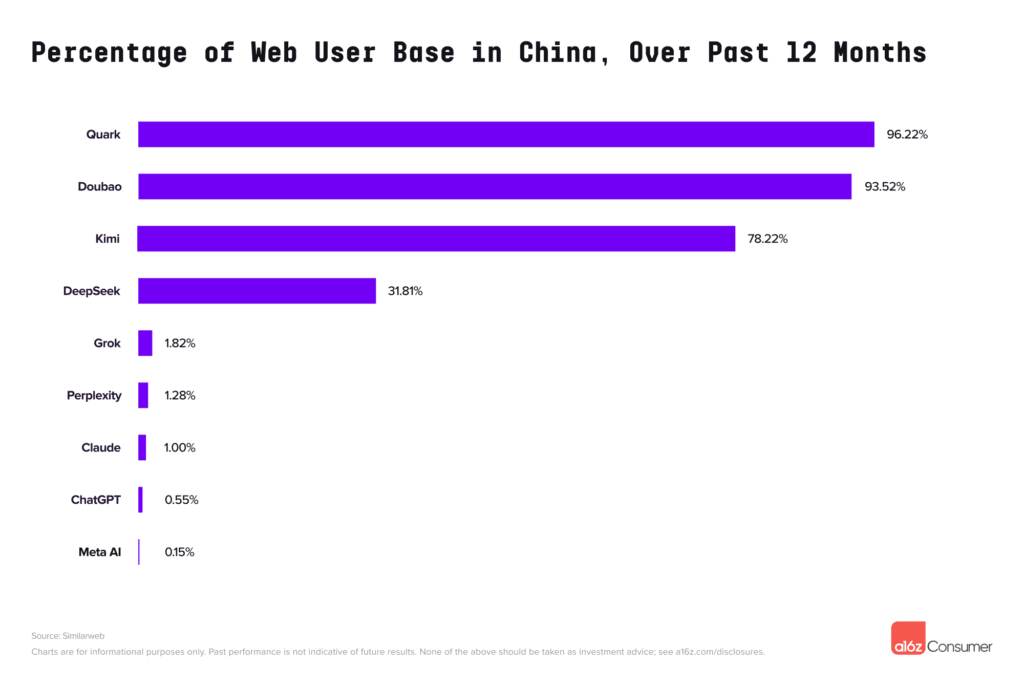
The report also finds that "built in China, used globally" is a significant trend. A substantial portion of the web ranking consists of products developed in China and then "shipped" overseas, with the vast majority of users coming from other countries. These include: DeepSeek, Hailuo and Keling AI (video generation), SeaArt (image generation), Cutout Pro (image editing), and Manus and Monica (prosumer/productivity tools).
Manus is a telling example. The company recently announced annualized revenue of $90 million. Manus's traffic sources are remarkably diverse and geography-agnostic: Brazil ranks first, followed by the United States.
This phenomenon is equally visible on the mobile ranking. Among the mobile Top 50, 22 apps were developed in China, but their primary users are spread globally — only three are mainly used in China. In photo and video editing especially, Meitu alone contributes five ranked apps: Photo & Video Editor, BeautyPlus, BeautyCam, Wink, and Airbrush. ByteDance has also launched multiple products for global markets, including Doubao and Cici (general LLM assistants), Gauth (edtech), and Hypic (photo/video editing).
It's also worth noting that many Chinese models are distributed through partnerships with US-based platforms — offering subscriptions through platforms like Creado or Hydra, or listing models on developer platforms like Fal.ai and Replicate. This means their actual influence may be even larger than the ranking directly reflects.
04
Three Categories Dominate:
General Chat Assistants, Creative Tools, and AI Companions
The ranking is dominated by three main product categories: general chat assistants, creative tools, and AI companion apps.
Notably, three companion apps are new to this edition's ranking: Juicy Chat, Joi, and Ourdream. Meanwhile, Character.ai, Janitor AI, Spicy Chat, Poly.AI, CrushOn.AI, and Candy.AI remain on the list. The substantial share occupied by companion apps underscores AI's massive potential in meeting users' emotional needs.
"Creative tools" also remain a core pillar of AI applications, spanning image, video, and audio generation. Ranked apps include Midjourney, PhotoRoom, Leonardo, Cutout Pro, Veed, and ElevenLabs.
05
The "Vibe Coding" Segment Emerges,
With Exceptionally High User Stickiness
In a16z's March 2025 Top 100 ranking, the vibe coding segment was just emerging. At that time, only one app — Bolt — made the web list. This time, Bolt entered the Brink List, while Lovable and Replit made the main ranking for the first time.
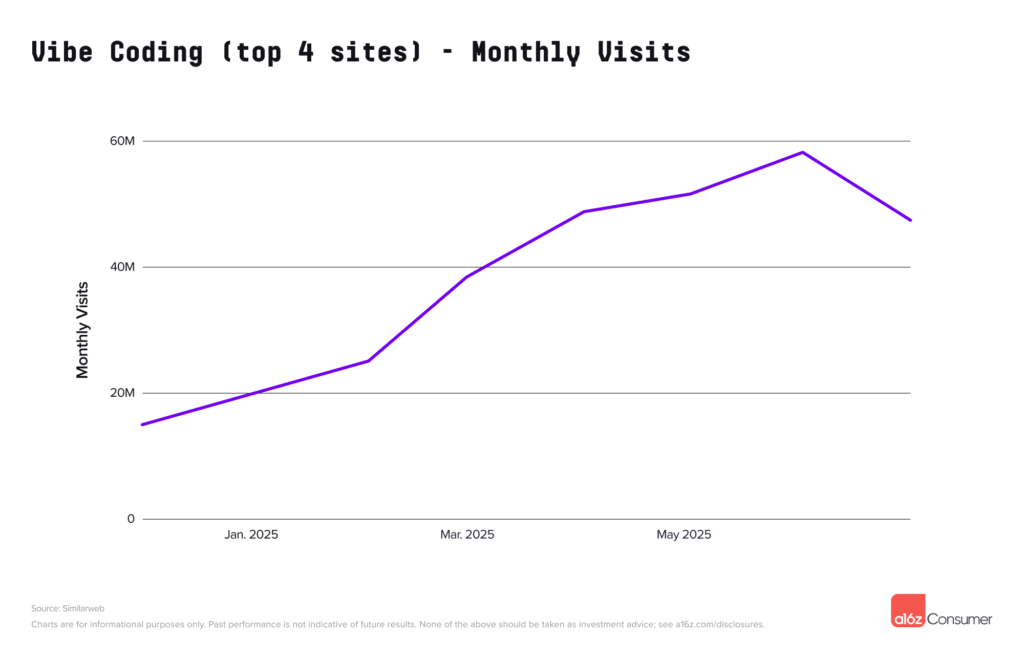
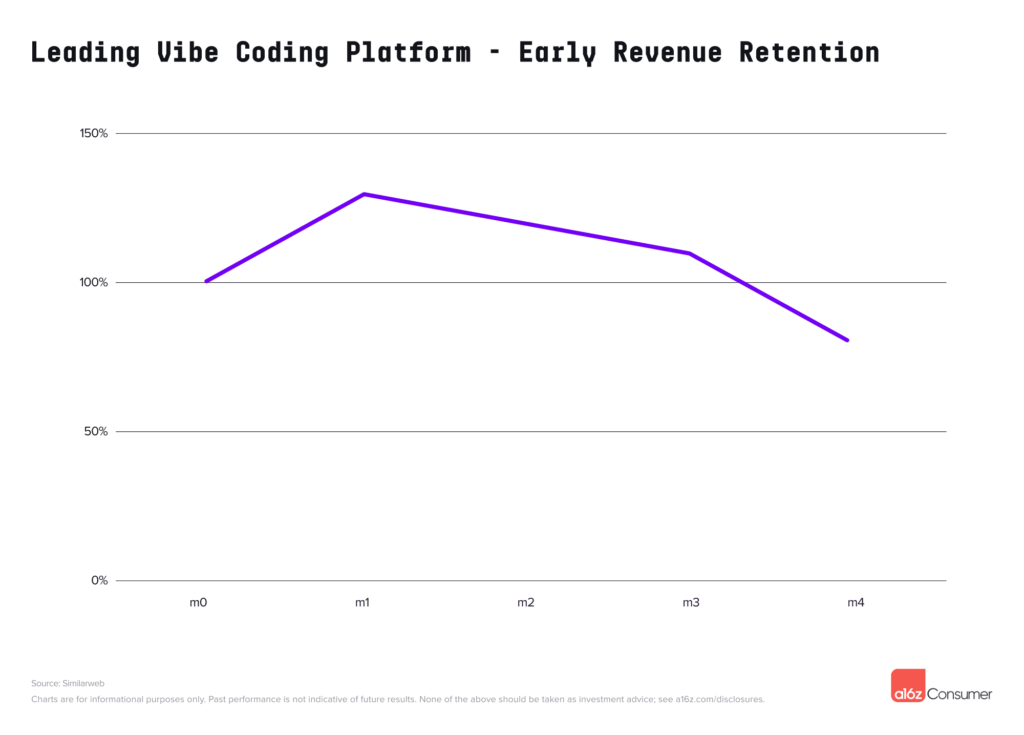
Vibe coding apps show exceptionally high user stickiness. The report cites data from Consumer Edge showing that for one top vibe coding platform's US user base, revenue retention remained above 100% months after signup — meaning that even accounting for churn, the user cohort's total monthly spending continued to grow.
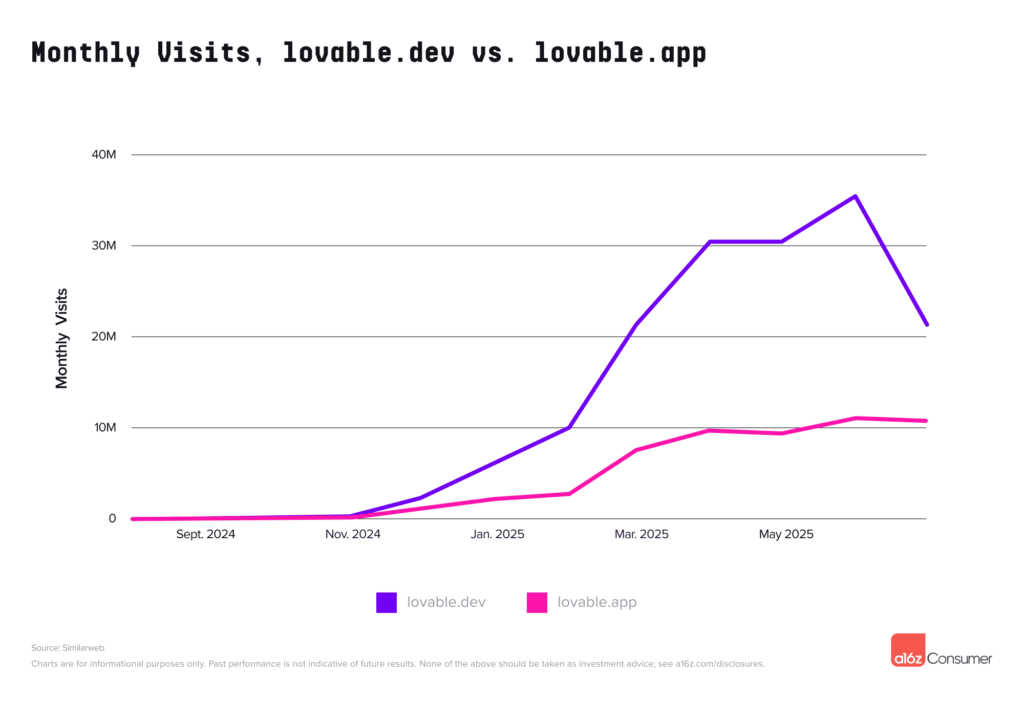
These apps are also driving traffic growth in adjacent tools. Database provider Supabase, for example, has seen traffic growth that closely tracks the rise of core vibe coding platforms — showing significant acceleration over the past nine months compared to prior years.
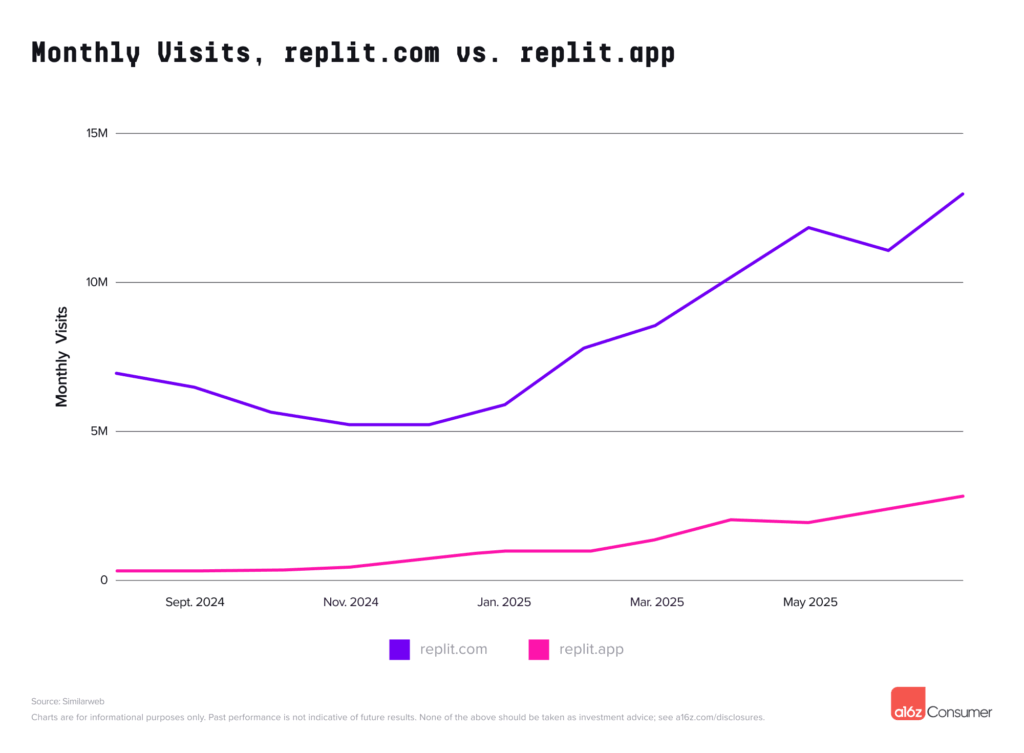
a16z believes the vibe coding space still has real room for growth and new product opportunities.
06
14 Companies Become Ranking "Evergreens,"
Only 5 Self-Develop Models
Across all five a16z rankings, 14 companies have appeared every time. The report calls them "All Stars."
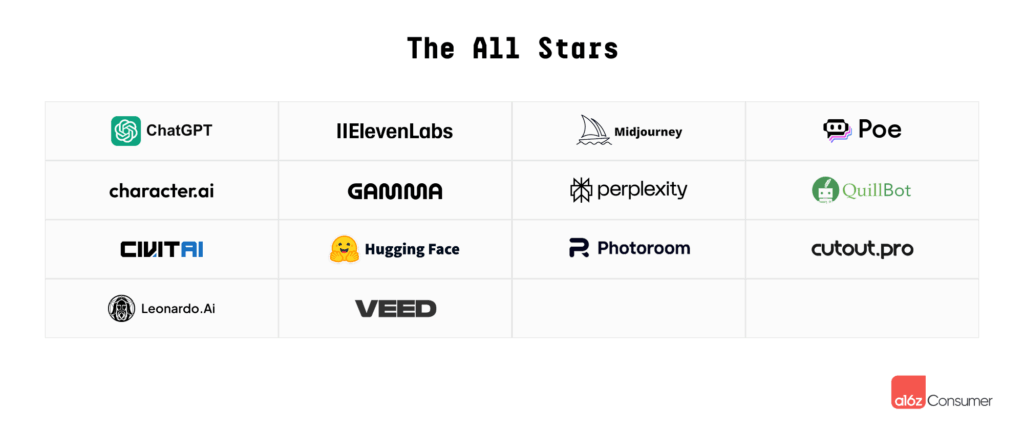
These 14 span general assistants, emotional companionship, image generation, image and video editing, voice generation, productivity tools, and model hosting.
The report finds that among these 14 "All Stars," only 5 own self-developed foundation models, 7 rely on APIs or open-source models, and 2 are large model aggregation platforms.
This reflects that in consumer AI, product experience, user interface (UI), and workflow design matter just as much as proprietary large models.
These 14 "All Stars" come from the US, UK, Australia, China, and France. All except Midjourney and Cutout Pro have received venture capital funding.
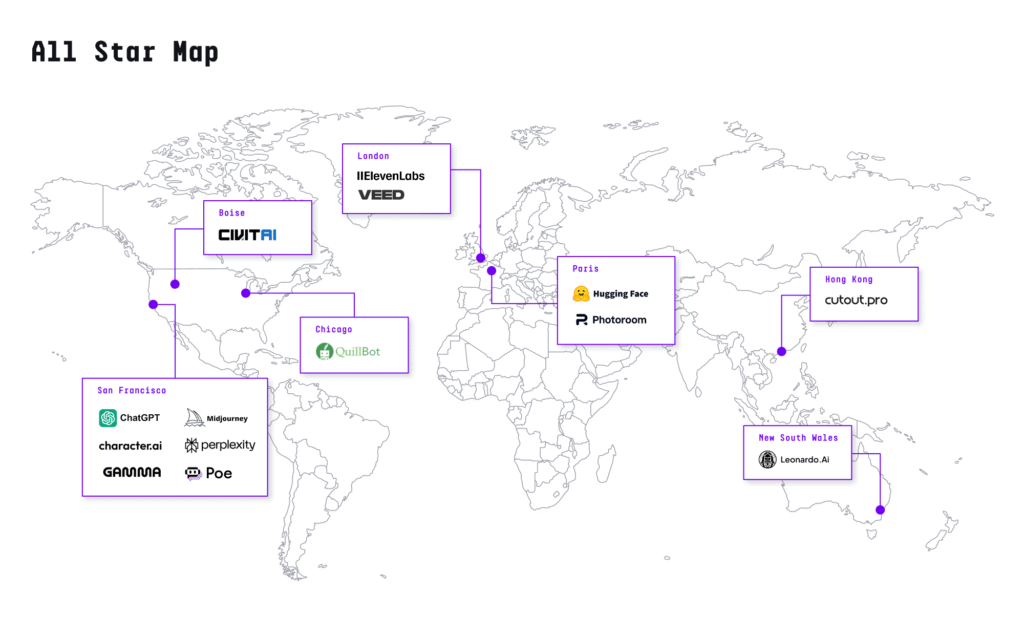
Additionally, if the first ranking is excluded, 5 more companies would qualify as "All Stars": Claude, DeepAI (general assistant), JanitorAI (emotional companionship), Pixelcut (image editing), and Suno (music generation).