Agent Updates: What's Actually New This Time for OpenAI? | Yunqi Capital Tech π

Waiting for the Agent Application Breakout Moment
Manus, the invite-only sensation, has triggered another wave of intense debate about Agents both inside and outside the industry. Meanwhile, across the ocean, OpenAI — widely seen as having lost its absolute technical edge — unveiled a brand-new Agent development tool this week.
This marks OpenAI's third Agent tool of 2025, following Deep Research and Operator, designed to help developers build smarter AI applications. In this edition of Yunqi Tech π, we break down what this new tool is all about.
Originally published by Silicon Star Pro under the title "OpenAI's New Agent Development Tool Wants to Own the Entire Agent Ecosystem." Author: Zhou Yixiao
The Agent boom shows no signs of slowing. OpenAI announced a suite of new API platform capabilities under the banner "new tools for building Agents," squarely aimed at defining the next generation of AI application development standards.
A particularly significant change is the introduction of the new Responses API. This fresh API provides the building blocks for Agents capable of searching the web, reviewing files, and executing tasks on a user's computer.
OpenAI had previously launched Agent features like Deep Research and Operator. But industries and application scenarios vary enormously — enterprises and developers need to build different Agents for different needs. The Responses API addresses this by supplying modular building blocks.
The Responses API comes equipped with a web search tool powered by the same search model used in ChatGPT. When working with GPT-4o and GPT-4o mini, developers can use this tool to retrieve real-time web information with cited sources.
It also features Computer Use functionality, leveraging OpenAI's Operator model to analyze screens and execute tasks on behalf of users. Additionally, there's a document search tool for rapidly retrieving information from large document collections. OpenAI positions this for customer service reps quickly finding FAQ answers, or legal assistants pulling historical cases.
For developers, Responses means being able to ask AI far more complex questions with minimal code. Tasks that once required a hundred lines of code can now be done in three. The API also offers greater transparency into what the model is doing — which tools it calls, why it calls them, and what decisions it makes before and after each call.
The API is now available to all developers, billed at OpenAI's standard token and tool rates.
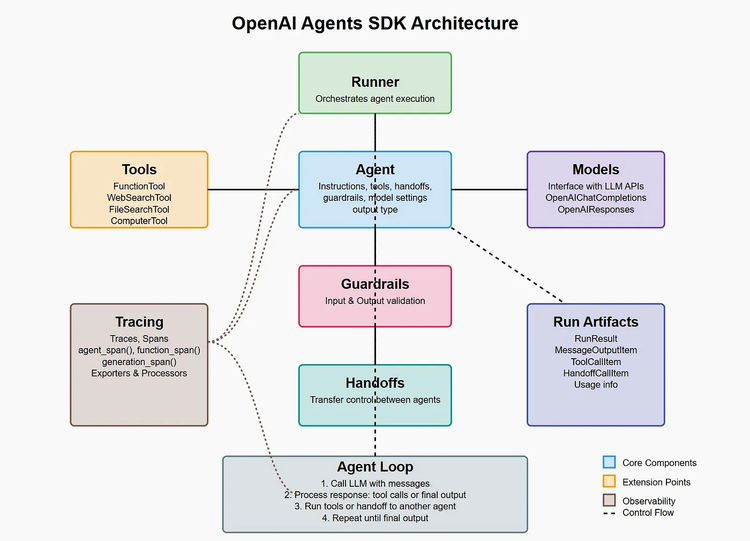
Beyond the Responses API, OpenAI also released the Agents SDK, an open-source tool for "orchestrating" workflows involving single or multiple AI Agents.
If the Responses API is the basic unit for completing specific tasks using models and tools, the Agents SDK enables multiple such units to work in concert, tackling more complex challenges.
Currently over three million developers use OpenAI's APIs. The widely adopted Chat Completions API embeds ChatGPT-like functionality into their own applications. Responses API and Agents SDK complement this existing toolkit. While Completions focuses primarily on text-based conversation, the Responses API can be understood as an upgraded version of the Chat Completion API.
Responses maintains backward compatibility with software built on Chat Completions. OpenAI will continue supporting the Completions API — new models will still see updates there when their capabilities don't depend on built-in tools or multiple model calls. But to access those convenient tools, developers will need to upgrade to Responses. The OpenAI API team anticipates most developers will migrate to Responses in time.
Slated for retirement is the Assistants API, a beta introduced at OpenAI DevDay 2023, which the company plans to replace with Responses API by mid-2026.
APIs must anticipate what developers will need years down the line. It's not hard to decode OpenAI's core priorities for future functionality. The new API dramatically expands developers' capacity to build Agents, paving the way for AI engineers, AI designers, AI auditors, and AI accountants. These tools offer more than technical convenience — they reflect OpenAI's platform strategy.
Keeping Developers on OpenAI's Platform
The improvement of large model reasoning capabilities has fueled the rise of Agent applications like Manus, which demonstrate abilities ranging from gathering materials and analyzing stocks to automatically browsing resumes and conducting structured screening. In this update's official blog post, OpenAI offered two new definitions of Agents: "We view Agents as systems that can independently accomplish tasks on behalf of users."
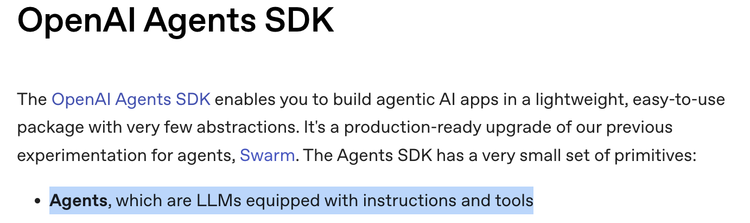
A more concrete definition comes from the SDK documentation: an Agent is a large language model equipped with instructions and tools. This hints at OpenAI's approach to implementing Agents — essentially, LLMs enhanced with specific instructions and granted access to tools.
In the AI market, OpenAI's Chat Completions API has become the de facto industry standard. Numerous companies have offered compatible interfaces to lower switching costs for developers, establishing it as the universal benchmark for AI application development.
Yet competition hasn't let up. With the rise of Agents, the competitive landscape is being reshaped — Google and Anthropic have already entered the AI Agent race.
In November 2024, Anthropic launched MCP (Model Context Protocol), an open protocol enabling AI Agents to seamlessly access tools and databases without writing custom code for each system. Its core mission is solving the isolation problem between AI models and data silos, replacing fragmented custom integrations with a unified protocol. MCP uses a client-server architecture: AI applications (like Claude Desktop or IDEs) connect via MCP clients to MCP servers, which provide access to data sources or tools.
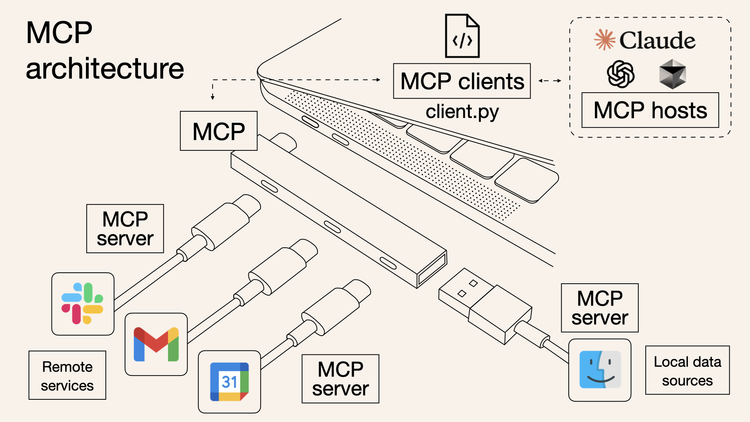
As of March 2025, MCP has made significant headway: over ten tools (including Claude Desktop, Cursor, and Continue) have integrated it; the community has contributed more than 1,000 MCP servers covering file systems, GitHub, Google Drive, and more; Microsoft partners Block and Apollo have adopted MCP for internal systems. Gartner predicts that by 2026, 30% of enterprise AI projects will use standardized protocols (like MCP) to integrate external resources.
MCP's distinctive feature is its focus on enabling AI Agents to call tools and data sources from external systems. OpenAI's Responses API, by contrast, emphasizes integrated development, directly providing well-packaged functional modules.
Comparing the two: OpenAI's API is a proprietary solution; MCP is an open standard. Both aim to enhance AI system capabilities, but they differ in implementation approach and application layer. Developing with OpenAI's Agent tools is like building game expansion packs within a specific game engine — powerful, but locked to that ecosystem. MCP resembles an open network protocol: any system following the standard can communicate, regardless of programming language or platform. This represents more parallel evolution by two companies responding to the same industry trend.
By introducing the Responses API, OpenAI streamlines workflows for tool use, code execution, and state management. With these capabilities, OpenAI envisions Responses API becoming the foundation for Agent applications, eliminating the need for multiple external integrations.
Facing competition from domestic rivals and Chinese competitors alike, OpenAI needs to keep developers building on its platform. With its technical advantage no longer absolute, OpenAI appears to have elevated building a developer ecosystem to a core strategic priority.
This is only the first step in OpenAI's comprehensive effort to build an AI Agent platform. The company says it plans to roll out more tools and integrations in the coming months to help developers deploy, evaluate, and scale Agent applications more effectively.
A decade ago, application development required substantial technical investment. Then Apple and Google democratized it, sparking an explosion of millions of apps. Today, that playbook is being rerun in AI — technologies like MCP and Agent SDK are dramatically lowering the barrier to building Agent applications. Perhaps a similar explosion is just around the corner.