Leading the Angel Round for "Poko Robotics": A Deep Dive with Huazhe Xu on Home Robotics and the "Real Ticket" to Physical AGI | Yunqi Attent!on Podcast

From Smart "Hatching" to Home Embodiment: Stubbornly Original in the AI Wave
From isolated breakthroughs in the lab toward generalizable intelligence in the real world. By 2026, embodied intelligence will begin leaping into the more challenging — and more imaginative — arena of the home.
Recently, Yunqi Capital led the $10 million angel round for home-robotics startup Poké Robotics, marking one of the first investments from the SJTU–Yunqi AI Angel Fund.
Founder Huazhe Xu joined Yunqi's brand podcast "Attent!on" for a deep conversation with his first investor — Yunqi's newly promoted Executive Director Yu Sang. As fellow 2012 classmates in Tsinghua's Department of Electronic Engineering, they witnessed the dawn of AI 1.0 together, and reconverged a decade after graduation on the frontier of embodied intelligence.
This episode traces the technological paradigm shifts that shaped their technical convictions and career paths, from AlexNet to embodied intelligence entering the home — spanning more than a decade of key technical variables, personal choices, and unfiltered reflections. Stories and substance, shared with you.

What You'll Hear

- Reconnecting ten years after Tsinghua: a post-'90s embodied intelligence founder and investor on the AI transformations they've lived through
- Technical path deconstruction: reinforcement learning, world models, online learning — which is the fundamental solution to "physical intuition"?
- Defining the home robot: how to build a proactive household member? How to handle entropy-rich environments and privacy concerns?
- Rejecting the "distillation" follower strategy: how can Chinese embodied intelligence build a moat around original intelligence?
- The scientist-founder's "personal marketization": is building in public the right move?
- Commercial exploration: beyond the mass-production noise, why do the important things that look unimportant?
This Episode's Guests

Huazhe Xu — Founder of Poké Robotics; Assistant Professor, Institute for Interdisciplinary Information Sciences, Tsinghua University
Yu Sang — Frontier tech investor and Executive Director, Yunqi Capital
01 The Long Technical March: From AlexNet to Physical-World AGI
Yu Sang:
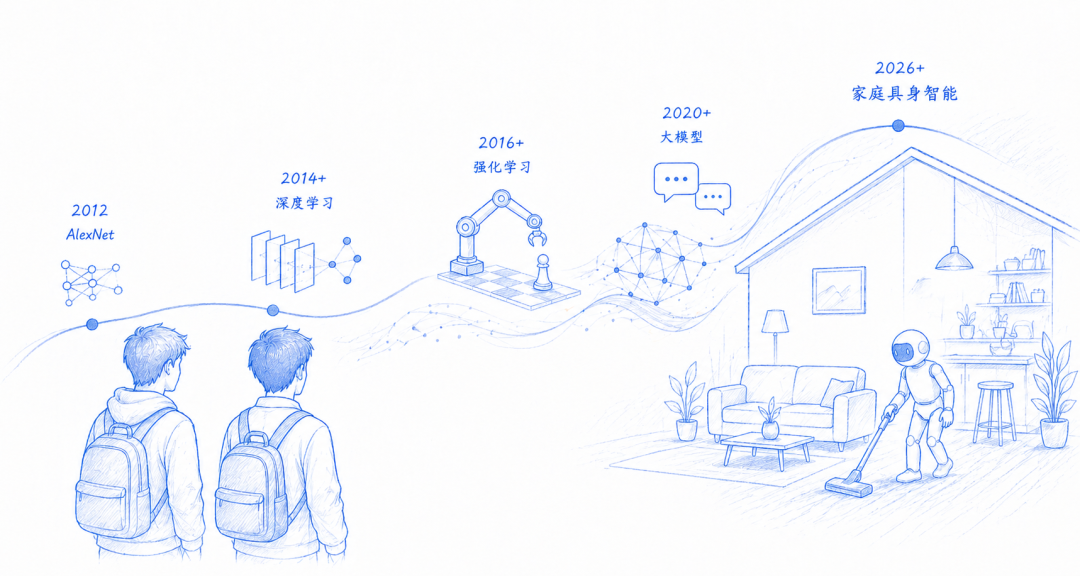
Huazhe and I both entered Tsinghua's Department of Electronic Engineering in 2012 — the same year AlexNet won ImageNet by a landslide, with Hinton and OpenAI's Ilya among its authors. If you trace the AI wave back to the 1.0 era, 2012 is where it begins. We encountered that wave from that starting point, passing through NLP, autonomous driving, and large models before converging on embodied intelligence. Huazhe, what was your understanding of AI when you first enrolled in 2012?
Huazhe Xu:
The only term I'd heard was "neural networks" — I came across it casually in a computer lab during high school competition training. The world was already undergoing a paradigm shift in 2012, but we were still grinding through calculus problems.
Yu Sang:
We weren't the only ones who were late to notice — the entire academic community was. Before 2012, if you put "neural network" in the title of a top-conference paper, it would get rejected 100% of the time. Everyone thought neural networks were just crude overfitting. Starting in 2012, CNNs exploded into the spotlight, breaking through multiple technical barriers, and people gradually saw the potential.
Huazhe Xu:
Thirty years east of the river, thirty years west. In AI you probably divide that by ten — the cycle turns roughly every three years. What was interesting later: once neural networks became hot, papers without "deep learning" in the title couldn't get accepted.
Yu Sang:
From 2016 to 2019, computer vision and object detection developed extremely rapidly, and then there was AlphaGo defeating Lee Sedol. You were at Berkeley then — were you among the earliest Chinese researchers to deeply study reinforcement learning?
Huazhe Xu:
Yes. Berkeley had several very well-known reinforcement learning researchers — Stuart Russell, Pieter Abbeel, Sergey Levine. Before AlphaGo, reinforcement learning was somewhat marginal, only good for games like Reversi; people thought it was niche and useless. After AlphaGo it exploded, and suddenly everyone thought reinforcement learning could solve everything. But looking back, what reinforcement learning got right at that stage was simply defining the problem correctly: getting machines to make decisions actively, to interact with the world proactively. The right problem definition existed, but compute and infrastructure hadn't caught up yet.
Were there any massive applications from that period? No — it was all about playing games, simulating robots. But it shaped my conviction — I trained with it, used it, knew that this thing could work. That has had enormous influence on my technical judgments today. If I had only started looking at reinforcement learning after large models became hot, I would have missed a lot of foundational thinking.
Yu Sang:
From 2019 to 2022, people didn't get the robot boom they had optimistically expected; there was actually some disillusionment. What were you going through then?
Huazhe Xu:
2019 was genuinely a low point. ImageNet had been benchmarked to its ceiling; people added all kinds of tricks, and the moment you switched to real-world scenarios, everything failed. The prevailing assumption was that AI had a fixed upper bound, so everyone went looking for application outlets in security, facial recognition, smart cities.
But two seeds were quietly planted then. One was an ETH paper using deep reinforcement learning to get quadruped robots running in real environments — something only someone who understood both robotics and AI could pull off. That later evolved into the Spring Festival Gala robot dog dances, and today's embodied intelligence wave.
The other was the scaling law — that group at OpenAI kept insisting: more data, better results. By 2021 and 2022, Fei-Fei Li started talking about foundation models. Those at the absolute cutting edge of research could already feel something breaking through the soil. The closer you were to that circle, the earlier you sensed it. Often, the most important seeds are planted at the lowest points.
02 Reinforcement Learning, World Models, and Technical Path Selection
Yu Sang:
How did Poké Robotics choose its technical path?
Huazhe Xu:
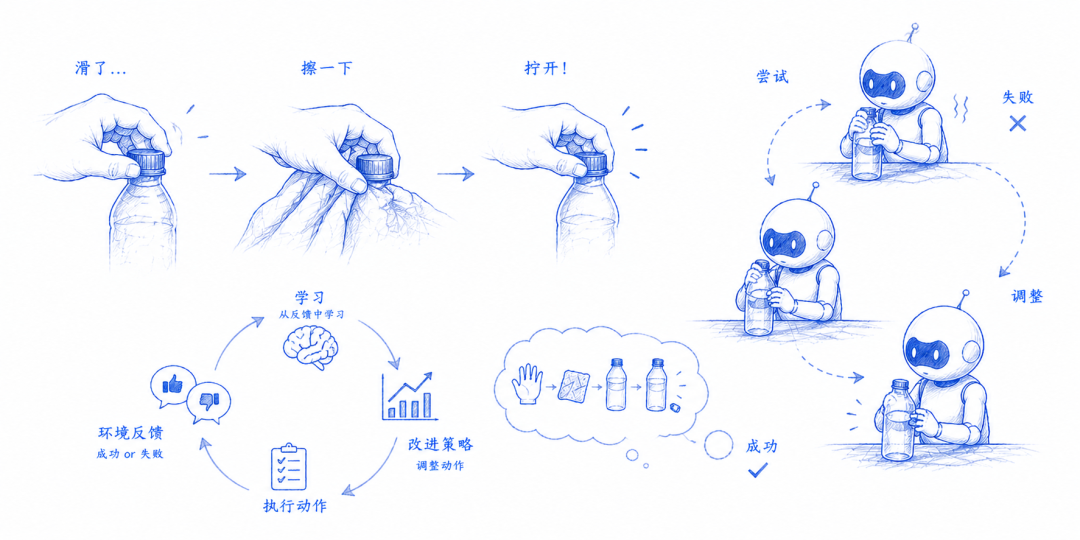
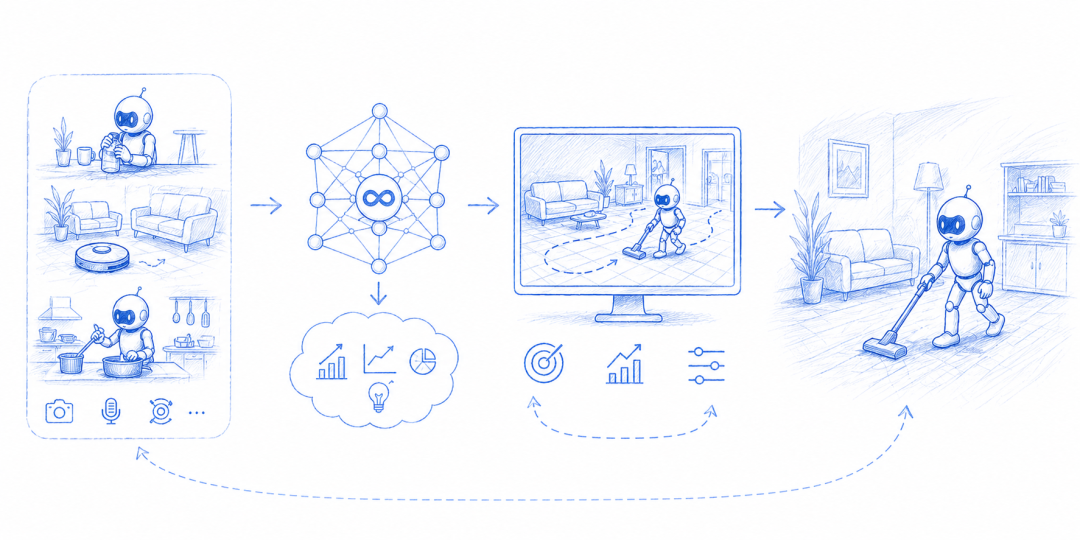
Three main lines. First, reinforcement learning — more specifically, how to leverage failure data, how to get robots learning from feedback, including whether we can scale up autonomous trial-and-error by robots. Second, a world model-based architecture: rather than using VLM as the backbone, we build more on predictive models, doing embodied world models and action prediction. Third, online learning — not shipping with the best possible model and then locking capability in place, but getting better with use, leveling up every few months. An agent that learns new things and forgets old ones falls far short of what we expect from truly intelligent robots.
Yu Sang: To build world models you also need feedback from the world — data, technology, and scenarios forming a closed loop before you can actually build the model.
Huazhe Xu:
Right. Each robot's world may differ, so putting actively-interacted data into the world model is crucial. This is more like intuitive physics — before rubbing a plastic bag, you might breathe on it or rub your hands on your clothes because they're dry. Without interaction with the world, you can't predict that future.
Yu Sang:
Today reinforcement learning is increasingly discussed in embodied intelligence. Why is it critical?
Huazhe Xu:
First, it defines the problem correctly. Robots need to participate in physical change to learn true intelligence. You can recite texts with eyes closed and hands still, but pouring a glass of water or playing a piece of music is impossible without extensive practice. Every robot's body is different; only through repeated interaction can it understand subtle physics — hand slipping, wiping it on your clothes before twisting the cap open. We don't think about such things, but robots need interaction to acquire them.
There's also the data problem. Current embodied intelligence training is still dominated by demonstration data, and failure data is widely ignored. Those "wrongs" closest to the edge of "right" are the most important data for helping models establish correct boundaries. Reinforcement learning makes full use of this data. In Pi 0.7's recent update, they added failure data to pretraining and scored it 1 to 5 — you need to know not just what's right and what's wrong, but more importantly which wrongs are closest to right.
Yu Sang:
Large models are rapidly improving in coding and agent capabilities. How might these intersect with embodied intelligence?
Huazhe Xu:
Two kinds of intersection. One is at the essence level — there are two AGIs in this world, digital-world AGI and physical-world AGI, and the pursuit of online learning is similar, the methodology consistent. The other is direct application — agentic capabilities can be deployed on robots, autonomously decomposing and calling modules to complete zero-shot tasks in agent form: go somewhere and press a button for me, turn off the lights, grab something.
03 Why the Home? Why Now?
Yu Sang:
Previously it seemed no one had firmly stepped forward to say they were choosing the home as their赛道. How did you think about this?
Huazhe Xu:
Three layers of logic. First, personal — my long-term dream has been to build a robot that serves every ordinary person, and that means it must be in the home. Second, AI-level — where there are people, entropy naturally increases; the home produces the broadest, hardest data, so model boundaries become widest. Third, commercial — ToC is always a sufficiently large market, and more likely to give birth to a truly great company.
Yu Sang:
What exactly is your home robot product?
Huazhe Xu:
It has both tech-product and consumer-product attributes. Several core points: home-adapted, meaning stable, safe, and family-friendly; capable of doing work, because without this you're forever limited to navigation and patrol; and proactive — current washing machines and refrigerators have fixed functions, entirely human-controlled. This robot is general-purpose and proactively takes initiative, a completely different experience. For example, you casually toss dirty clothes on the floor, and it may make the decision itself; when it can't decide, it asks you, turning it into your multiple-choice question rather than your generative problem.
Yu Sang:
Is it a nanny, or a family member?
Huazhe Xu:
A nanny-type family member. Your relationship with a nanny is: here's what you should do daily, and here's your pay. But with family members you can be completely casual — "I'm exhausted, go get me water," "I'm too lazy, do this for me" — things you'd only say to someone close, you can say to the robot completely. But it's still fundamentally serving you, so it's not fully equivalent to a family member.
There are also many customization possibilities — appearance, personality, proactivity level. For instance, seeing a pair of smelly socks on the floor: should the robot wash them directly, ask you, or ignore them? Some people want it to minimize questions and act on its own judgment; others want it to check in about everything. These are all adjustable.
Yu Sang:
How do you see the timeline for home embodied intelligence? Where is embodied intelligence today, and how far from truly entering homes?
Huazhe Xu:
Embodied intelligence is hard to grade like autonomous driving because it's too broad. If you must categorize, look at how complex an impact it has on the physical world: having a good platform for teleoperation is L0, having good motion control to autonomously perform choreographed actions is L1, being able to do simple physical interactions like navigation, obstacle avoidance, and button-pressing is L2, with increasingly complex interactions above that.
The two ultimate generalization challenges: cross-task and cross-embodiment. We're still quite far from truly general-purpose robots. But entering homes may not be that far — entering the home is fundamentally a product problem, not requiring AGI; at some point product experience becomes good enough, and that's the moment for home entry.
Yu Sang:
What variables are starting to unlock today?
Huazhe Xu:
One is data — from teleoperation data to ego data, embodiment-free collection methods have enabled significant growth in data volume. Another is at the model level: the use of reinforcement learning, development of world models, and online learning — all advancing simultaneously. 2026 will be a very different year.
04 Putting Yourself on the Market
Yu Sang:
You're among the most influential content creators in embodied intelligence. Why do this?
Huazhe Xu:
The core is "marketization" — not product marketization, but personal marketization.
Putting yourself in public, letting people evaluate you, you get feedback you normally wouldn't hear. After entering the workforce, few people proactively give you negative feedback; acquaintances especially won't tell you what you're doing poorly. But the market has no emotional connection to you — its feedback is sharper, more pointed.
Another aspect is information equity — in a sense we all possess information privilege. If people without access to these channels can also know, perhaps they can do as well as we have.
Yu Sang:
There's also an important byproduct — you've built strong influence not just in academic circles but in industry circles within the embodied space. Embodied innovation has no predecessor's experience to draw from, and young talent is increasingly important; this influence is a crucial lever for recruiting.
Huazhe Xu:
Indeed. Several colleagues at the company now joined through connecting with me on social media.
Yu Sang:
At the end of 2025 or start of 2026, you published an article on Zhihu about embodied intelligence in 2025: "no overnight success, but increasingly feeling a future calling," and mentioned many scholars saying everyone has a responsibility to push one step further. What was your mindset then?
Huazhe Xu:
Half self-encouragement, half wanting to nudge people. At the time, looking at some American companies, AI capability was rising very fast — Pi 0.7 demonstrated cross-embodiment generalization, 1X said they could complete very complex tasks with only one hour of post-training data. But looking at many domestic embodied intelligence companies, everyone seemed to have shifted focus to mass production. Mass production matters, I acknowledge that, but you can't stop doing AI because of mass production, or take the mass production route by distilling others' models. We have excellent supply chains, excellent robots — China is fully capable of building the best physical-world AGI models.
Yu Sang:
That article nudged us too. In the large language model phase, America's compute supply was 10x China's; but in embodied intelligence, China's hardware supply chain manufacturing capability and agile responsiveness may be 10x America's. That's why we've consistently insisted on investing in intelligence when investing — intelligence is the most critical watershed and core moat in the embodied space.
Huazhe Xu:
We'll keep pushing — starting from the results we want, from the intelligent robots we pursue, and therefore doing what we do, rather than starting from competition.
05 Entrepreneurship Is Mobilizing Everything You Can Mobilize
Yu Sang:
How has the overall entrepreneurial experience been?
Huazhe Xu:
The overall experience has been excellent — possibly one of the best decisions of my life. I enjoy that feeling of being fully drained — mobilizing all my brainpower thinking about how to train models, where technology should go, how data should be cleaned; mobilizing all my relationships to see what collaborations are possible; brainstorming with the team; and fundraising. Many people see pitching as asking for favors, but I don't see it that way — being able to deliver a pitch to someone highly capable is itself a privilege. There are difficulties too, negative feedback everywhere. But if everything succeeded immediately, it means you chose the wrong difficulty level. I've always picked "difficult" when starting games.
Yu Sang:
Making home embodied intelligence happen won't be easy; in three to five years many major companies may jump in. What do you think must be held to most core from day one?
Huazhe Xu:
Technically, insist on originality. When you're far behind the leaders, following yields high returns; but when you're within millimeters of the top players, there's little left to learn from them — it's more about whether you can enlighten yourself first, break through to the next realm before they do.
Commercially too. People paying you — what does that represent? It means what you're building has real value, not just value you feel, or value you predicted.
And keep doing important things that look unimportant. After starting a company, outside things all look huge, inside things all look tiny. But whether the company runs well often hides in those seemingly small things. Constantly remind yourself not to be dragged around by first impressions.