Investment Logic and Business Thinking on AI Agents | Yunqi Capital Research Report

From Model to Execution: Building the Next Stage of AI

In the first half of 2025, high-profile general-purpose and vertical Agent startups have continued to emerge both domestically and globally. How should we understand AI Agent's overall position in the coordinate system of technical evolution? How do we seize independent entry-point opportunities under the dual squeeze of "LLM evolution" and "platform agentification"? How do we build product moats for AI Agents? Amid the frenzy, clarifying the essence and trends behind the phenomena matters for both the investment and startup sides.
This edition of "Yunqi Research" will explore these questions, sharing Yunqi Capital's commercial thinking on AI Agent investment.
Understanding the Significance of Agent:
Bridging the "Last Mile" Between LLM Capabilities and Real-World Complex Tasks
The Executor of LLMs, and the Starting Point of AI Application Engineering
Over the past three years, LLM application forms have evolved from Chatbot to Copilot to AI Agent. What we see is not merely a shift in interaction patterns, but a crucial evolution in AI capabilities: from "Generative AI" toward "Agentic AI."
We believe AI Agents are no longer static, rule-based software (or hardware) applications. They are a critical component of generalized AI applications, featuring self-iteration, environmental perception, task planning, and dynamic execution — the key form in which LLM capabilities truly land.
Current mainstream Agent systems can be decomposed into four core components:
AI Agent = LLM + Planning + Tools + Memory
Each element establishes the capability boundary of an Agent system:
- LLM provides language understanding and generalized generation capabilities;
- Planning enables the Agent to generate task plans based on goals and break down subtasks;
- Tools are the action interfaces through which the Agent invokes external capabilities to complete specific operations;
- Memory includes short-term and long-term memory, supporting continuous task processing and context state tracking.
Agent Architecture Is Still Evolving
The specific architecture of Agents is still evolving — from the earliest single-Agent designs to the currently popular multi-Agent collaboration, with more possibilities waiting to be explored in the future.
Agent Landscape and Market Opportunities
As LLMs and related infrastructure mature, AI applications built on Agent frameworks are experiencing explosive growth. From an analytical framework grounded in C-end user demand and B-end organizational structure, Yunqi Capital attempts to structurally categorize current domestic and international AI Agent companies by user type (C/Pro/Enterprise) and task complexity (basic/medium/complex):
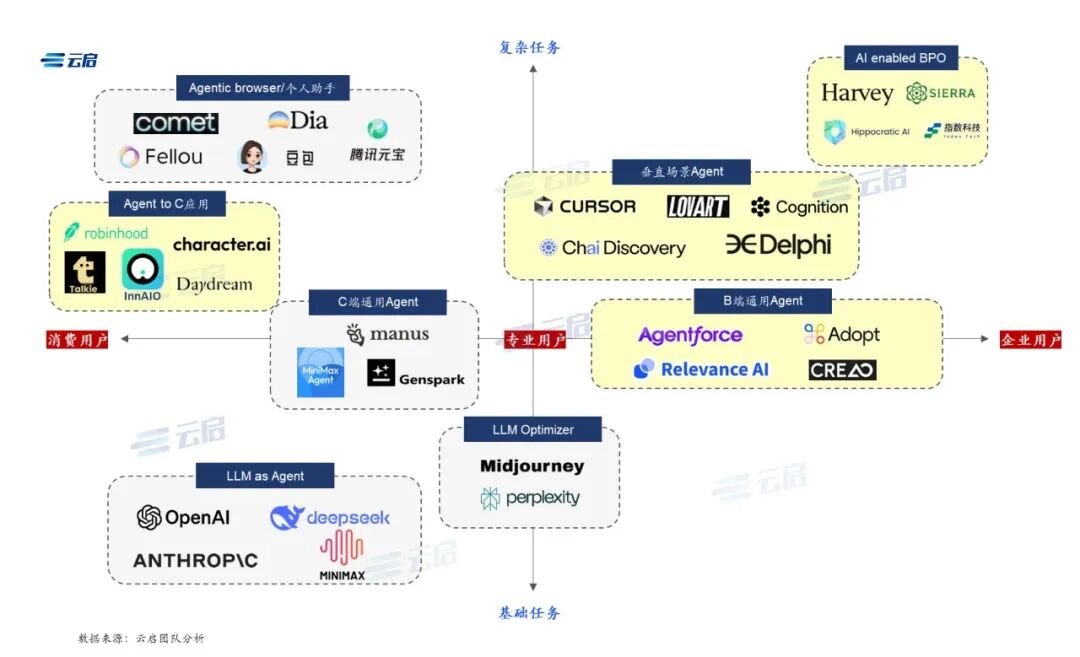
Regarding AI Agent investment strategy, we see three $10 billion-plus opportunities:
- Unstructured data entry points under LLM capabilities (new multimodal data entry points);
- New independent entry points in consumer internet (relatively long decision chains + strong front-end interaction + readily available back-end infrastructure);
- Emerging internal entry points and external service opportunities after enterprise organizational structure is profoundly reshaped (the traditional in-house vs. outsource logic driven by human labor will be disrupted).
Who Still Has Independent Entry-Point Opportunities for Agents?
Re-stratifying from C-End to B-End Scenarios
C-End: A Demand-Oriented Analytical Framework
- General-Purpose Agent
C-end general-purpose Agents, such as Manus and MiniMax Agent, represent the most capital-attention-grabbing and market-heated track in H1 2025. Most task scenarios concentrate on professional user front-end interaction, data analysis, document generation, personal assistant, and other medium-complexity tasks. General product design, convenient external tool invocation, and process visualization interaction have indeed completed the last mile of LLMs solving certain complex tasks, validating the user value of C-end general-purpose Agents in general-population tasks.
We also believe C-end general-purpose Agent development will revolve around 1) continuous unlocking of personal permissions and historical data and 2) improvements in foundational LLM capabilities. In the long run, this model will face challenges from LLM-as-Agent (which has successively launched related features) and Agentic Browser (personal data permissions, OS-level permissions, and giant distribution capabilities).
- C-End Vertical Agent
As LLMs and C-end general-purpose Agents become increasingly capable with ever-broader boundaries, a more fundamental question demands consideration: beyond the chatbot main entry point, which scenarios offer independent entry-point opportunities for C-end Agents?
We have already observed that large numbers of simple, standardized, and high-frequency tasks are being replaced by LLM chatbot entry points (search, translation, even essential consumer e-commerce, etc.), eroding the platform-internal membership and advertising business models of consumer internet.
Yet one category of scenarios retains the traits for vertical Agent independent entry points: relatively long decision chains + strong front-end interaction + readily available back-end infrastructure.
Typical directions include:
AI Hardware (Multimodal Entry Point), occupying unstructured data entry points through LLM multimodal understanding and generation capabilities + complete back-end Agent capability closed loop for full decision-making. Examples include meeting records or full-scenario translation entry points + subsequent vertical scenario Agent solutions;
AI Brokerage (Overseas), generating investment target portfolios based on investment themes or market events (not merely advice), combining historical data backtesting verification, reconstructing a new generation of brokerage interaction and order-placing experience; overseas brokerage-related infrastructure is relatively mature;
Personalized E-commerce, cutting into optional consumer e-commerce markets through front-end personalized interaction or personalized category customization;
Beyond these, we also track other vertical scenarios such as AI Gaming, Knowledge Search, and more.
Pro Users: Coding Agent
For professional-user Agents, such as programming and design categories, commercialization often progresses rapidly, benefiting from high willingness-to-pay among professional customers and community propagation effects. Coding Agents are particularly important — rather than saying Coding Agents are productivity tools for developers or business personnel, it is more accurate to say they are the "fuel layer" for all future Agent applications.
B-End: An Organizational-Structure-Oriented Analytical Framework
Enterprise organizational structure is being reconstructed alongside technological upgrades; we believe AI Agents will profoundly reshape enterprise organizational forms.
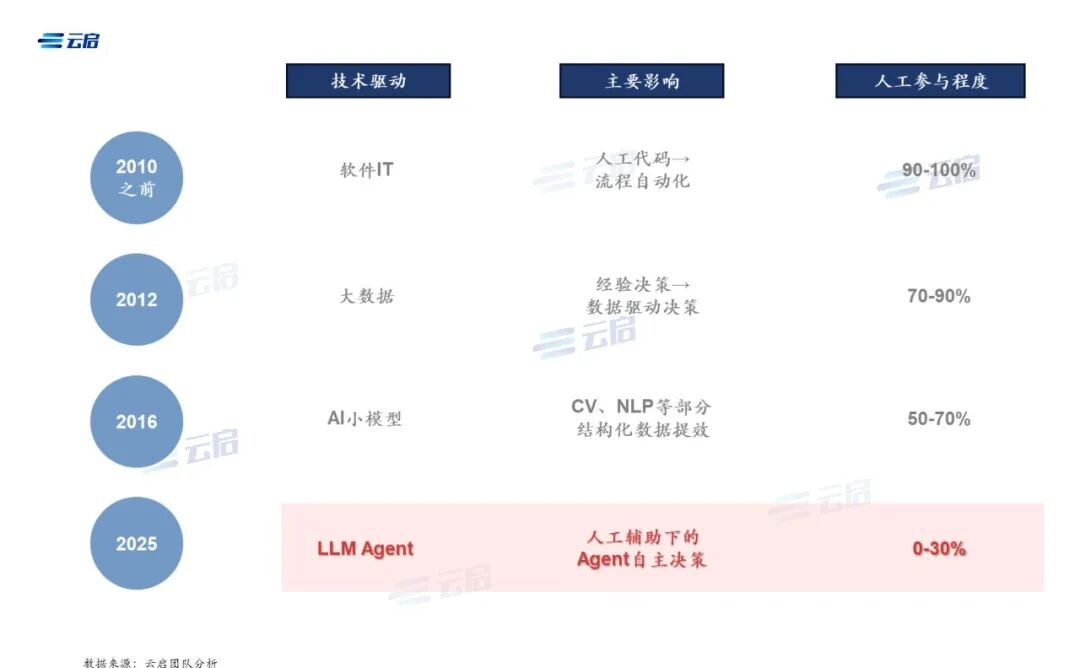
While simultaneously reshaping upstream and downstream value chain interest distribution
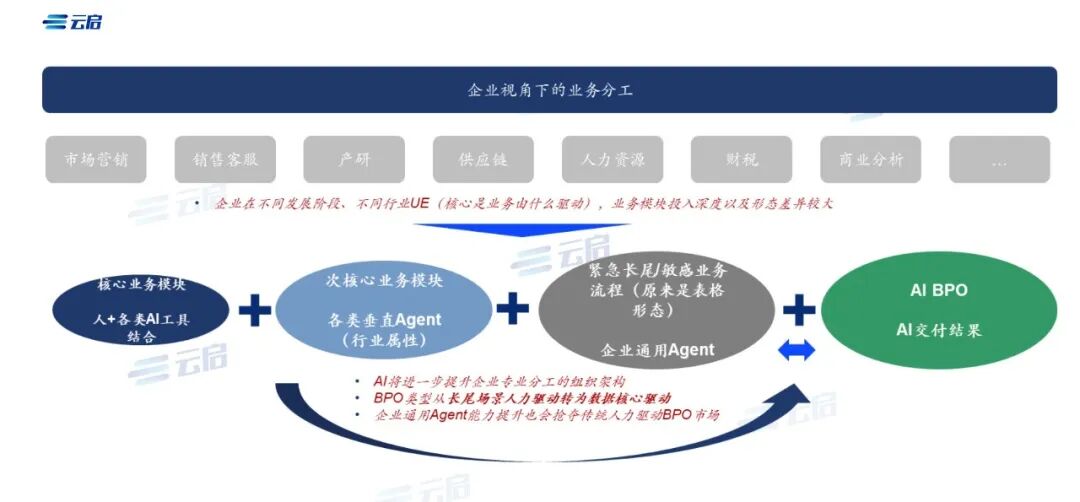
We believe that under technological leaps, future enterprise organizational forms will present a structure of "core business modules + sub-core vertical Agents + enterprise general-purpose Agents + AI-enabled BPO," with increasingly lean headcounts. Taking consumer electronics enterprise organizational structure as an example:
-
Small Core: Composed of a small number of key personnel + AI tool combinations, bearing core enterprise value
- Including core product strategy and brand strategy
- Marketing strategy planning and organizational structure planning, etc.
-
Sub-Core Business Modules: Selecting various vertical Agents according to industry characteristics
- Marketing materials, placement strategy and optimization
- Customer service systems and ticket allocation
- Supply chain organization optimization, etc.
-
Enterprise General-Purpose Agent: Replacing portions of non-standard outsourcing and internal spreadsheet roles, undertaking large volumes of long-tail or sensitive tasks unsuitable for outsourcing through Agents
- Recruitment processes
- Financial processes
- Various operations (market research, customer needs, etc.)
- Business analysis and various report generation, etc.
-
AI-Enabled BPO: External service providers delivering results through AI
- Software and hardware design and development
- Talent search
- Tax and accounting agency, etc.
On the enterprise side for AI Agents, we believe startup opportunities include:
-
Vertical Scenario Agents, with multiple vertical scenario unicorns already emerging globally, such as ElevenLabs, Clay, Sierra, Harvey, Hippocratic AI, etc., primarily providing tools and delivering results through LLM multimodal, unstructured data understanding and generation capabilities. (Yunqi Capital's team has been automatically tracking the long-term dynamics of over 100 global vertical Agent enterprises through Agent products — welcome to exchange with us.)
-
Enterprise General-Purpose Agent (Enterprise OS Entry Point), where Notion, Lark Sheets, and other office collaboration tools once undertook large volumes of non-standard, long-tail tasks in enterprises. However, through Yunqi Capital's actual testing, using portfolio company Creao.ai's enterprise general-purpose Agent platform, simply calling Notion sheet template descriptions through prompts, one can generate a complete application with internet connectivity + front-end and back-end interaction capabilities + AI copilot through natural language interaction in one or multiple rounds within 10 minutes at extremely low cost, achieving "disposable software" for massive long-tail tasks within enterprises. Such sheet collaboration was previously uncovered by standardized software, while Agents are now "automating and productionizing" these long-tail tasks.
-
"General-purpose Agents" also divide into C-end and B-end. Because the task complexity and system dependency degrees they execute are completely different. C-end Agents lean more toward front-end operations, such as invoking browsers and completing lightweight executions, naturally adapting to existing tool chains. In B-end scenarios, however, Agents must handle tasks embedded within enterprise internal systems, databases, workflows, etc.
-
AI-Enabled BPO, which we believe is the most sensible business model in AI Agent entrepreneurship, targeting fully competitive markets and embedding into inherent processes. However, AI BPO should not narrowly focus on traditional BPO tracks — the best opportunities may not originally have been in BPO. If it is merely labor-intensive BPO driven by unstructured business being redone by AI, the significance is limited; this falls into the B-end general-purpose Agent market, replacing intermediate forms like Notion/spreadsheets. We believe markets worth redoing are: 1) knowledge-intensive, 2) possessing private data moats, and 3) capable of forming data flywheels, such as legal, medical, biomedicine (AI4S), circuit design, patent filing, etc.
Vertical Agent UE Evolution and Moats
From Task Replacement to Model Evolution
AI agent business models remain in early stages of evolution, with UE performance diverging significantly across different industries and application paths, thus implying opportunities for entirely new business paradigms and ecological niches.
We use the four traditional components for measuring enterprise models — revenue, gross margin (COGS), operating expenses (OPEX), and cash flow (CCC) — to deconstruct the commercial evolution logic of vertical Agents:
- Revenue Level: Whether Agent enterprises can participate in outcome-based pricing is core to determining their ceiling. One path is "cost reduction," such as lowering labor costs and improving efficiency, with revenue typically tied to customer cost savings; the other is "revenue growth," such as opening new markets and mining long-tail demand, with opportunities for performance-sharing or outcome-based billing (e.g., taking a percentage of recovered funds after successful debt collection), offering higher revenue leverage and valuation elasticity.
- COGS Structure: Compared to traditional SaaS, Agent applications must bear significant model inference costs, which with increasing modality complexity often reach approximately 30% of expenses. Therefore, the ability to compress and reuse inference costs directly impacts UE quality.
- OPEX Spending: Sales expenses are particularly critical for early-stage Agent projects. Some vertical scenarios involve high education costs and deployment barriers, combined with low labor replacement rates, making early customer acquisition difficult and conversion costly. This also means teams with professional know-how and strong implementation capabilities possess greater competitive advantage.
- CCC and Valuation Path: Delivery model (tool-based or outcome-based) affects revenue rhythm and cash flow structure. If "post-recovery revenue sharing" can be achieved like insurance brokerage, CCC is shorter and valuation more stable; conversely, if substantial service resources must still be pre-invested and integrated delivery paths followed, the valuation model more closely resembles BPO companies.
The most critical watershed lies in: whether AI Agents can continuously generate user behavioral differentiation and task feedback differentiation, thereby building a data-business flywheel mechanism. If a virtuous cycle of "the more it's used, the more accurate; the more it's used, the stronger" can be established, not only does UE advantage become prominent, but structural barriers can be built toward platform-type or ecosystem-type evolution.
Returning ultimately to the essence of moat judgment. Borrowing Warren Buffett's classic "four elements" (intangible assets, switching costs, network effects, cost advantages), different Agent models each have their strengths and weaknesses:
- ToC General-Purpose Agent
- B-End General-Purpose Agent
- Vertical Industry Agent
- AI-Enabled BPO
Against the backdrop of open LLM capabilities, Agent applications are blooming everywhere, but the ultimate question returns to the commercial essence of "whether one has the ability to cross cycles." Which teams can combine industry know-how with AI-native capabilities to run out positive UE and deep moats across different paths will become the true winners.
Conclusion
The key to AI Agent landing is whether it can continuously form user behavioral differentiation and task feedback differentiation, thereby building a data-business flywheel mechanism. If a virtuous cycle of "the more it's used, the more accurate; the more it's used, the stronger" can be established, not only does UE advantage become prominent, but structural barriers can be built toward platform-type or ecosystem-type evolution.
We look forward to the AI Agent era, where startups can form business models with deeper moats, such as stronger IT switching costs and cost advantages brought by data flywheels, network effects brought by multi-Agent linkage, thereby breaking free from the disorderly involution due to product homogenization and effective TAM shrinkage due to price wars that have plagued the hardware and software industries in the past.
(: Yunqi Capital team continues to track AI Agents. Welcome to leave a message and exchange with us on technology and entrepreneurship topics.