What's Still Missing When AI Enters the Physical World? A Look Back at the Attention WAIC Special Session

After talking with six guests, there's still no standard answer for how "done" world models are
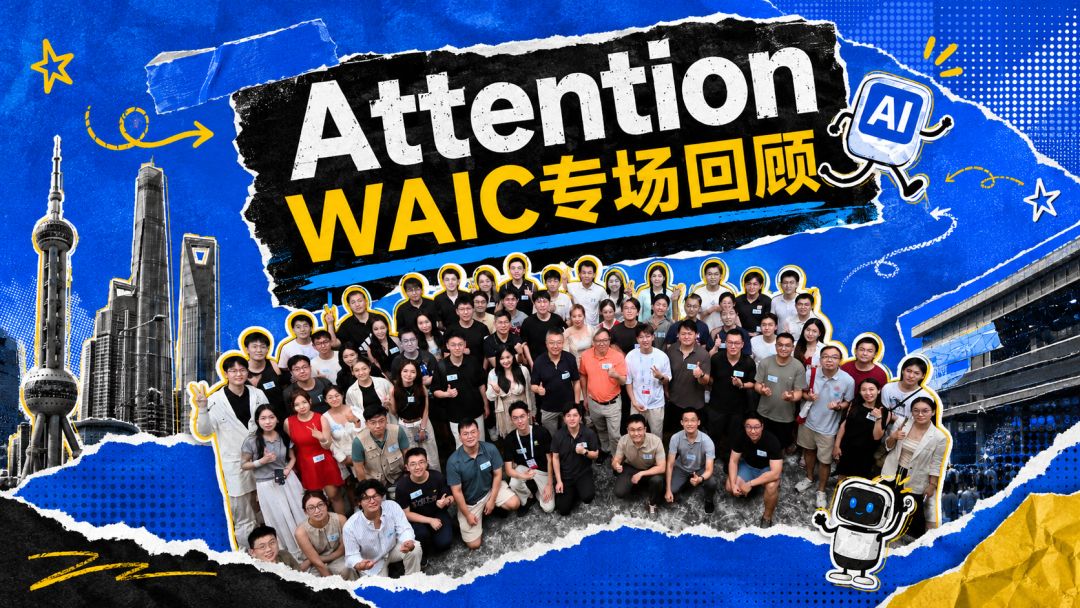
Before the event, we asked: "How cooked is the world model?"
After three talks and one panel, that question became even harder to answer simply. Because even though everyone was talking about "world models," the speakers were chasing fundamentally different problems: some focused on building environments where robots could train and fail repeatedly, others on predicting future states after taking action, and still others on how world models could close the loop with action models, reinforcement learning, and real-world data. Technical approaches are still diverging. The industry has yet to reach consensus on how to define world models, how to build them, or what "done" even looks like.
But one trend is becoming unmistakably clear: the next frontier for AI is the physical world.
On July 18, Yunqi Capital partnered with NICE Academic to host "World Model BBQ" during WAIC. After opening registration, they received over 500 applications. The original plan was 40 seats; more than 100 people showed up, setting a new attendance record for the venue's series. Michael Mao, founding managing partner of Yunqi Capital, also came to join the conversation.
The crowd mixed professors, PhDs, and young researchers from universities and research institutes with founders, corporate researchers, and engineers working on world models, embodied intelligence, robotics, and AI for Science. These different backgrounds and perspectives collided, pushing the discussion from model architecture toward data loops, product deployment, and the choice to start a company.
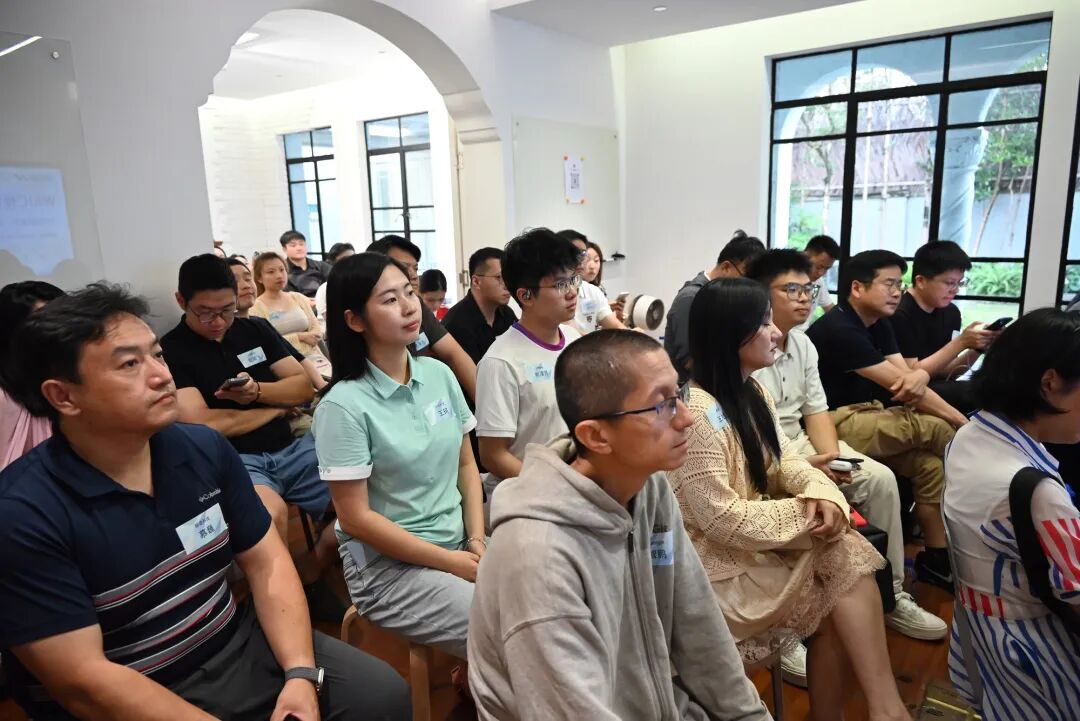
In the three talks, Siheng Chen, associate professor at Shanghai Jiao Tong University's School of Artificial Intelligence; Yang Li, assistant professor at SJTU's School of Computer Science; and Zhecheng Yuan, chief scientist at Poke Robotics, spoke respectively on digital agents empowering embodied training, multi-agent decision-making in open worlds, and robotic manipulation capabilities.
In the panel that followed, Hongyuan Lu, founder of FaceHeart; Yingtian Zou, founder of Sreal AI; and Zhaoxi Chen, CEO of Ropedia — three founders who had made the leap from researcher to entrepreneur — extended the discussion to technical roadmaps, commercialization, and the researcher-turned-founder path, under the moderation of Yu Sang, executive director at Yunqi Capital.
Through these sessions, several key questions came into sharper focus: How can world models help train robots? How do you foresee the future after taking action? And how far do models need to go before a robot can actually reach out and get to work?

Build a Training Ground First
Then Train Thousands of "Little Brains"
Siheng Chen, associate professor and doctoral advisor at Shanghai Jiao Tong University's School of Artificial Intelligence, brought the problem from the digital world into the physical one. His talk was titled From Digital to Physical? Thoughts and Experiments on Empowering Embodied Robots with Digital Agent Technology.
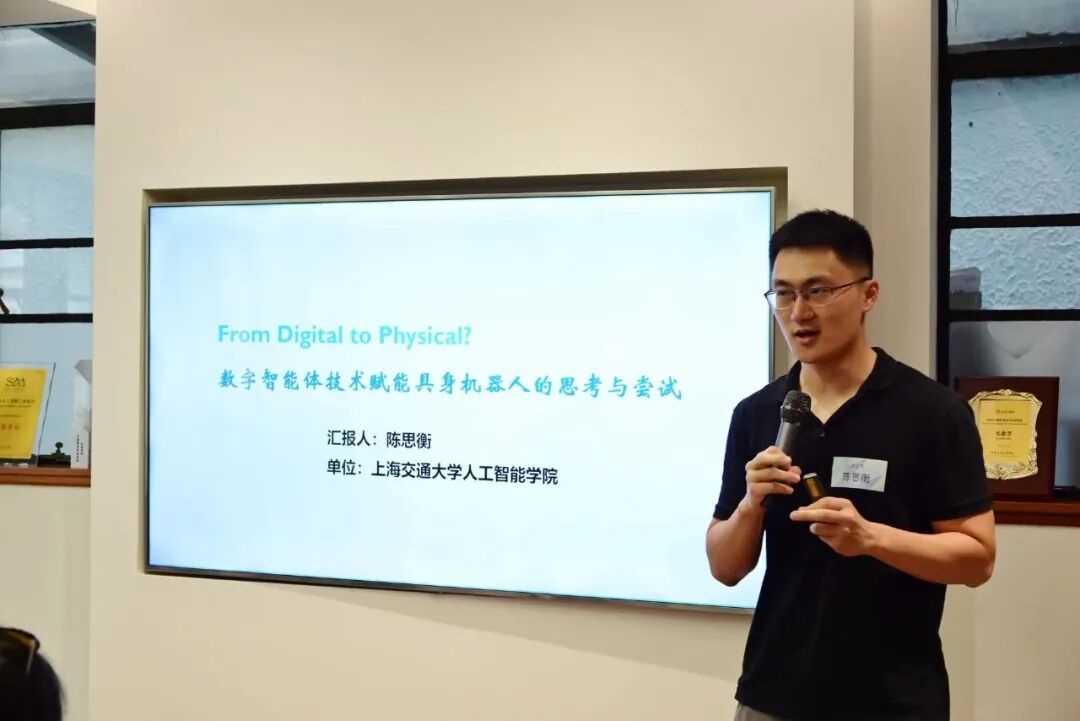
Today's digital agents have gradually settled into a relatively clear working pattern: a "brain" that handles overall planning and orchestration, calling on different sub-agents and tools to complete complex tasks. Chen proposed that a similar architecture could be ported to embodied intelligence — with a high-level EmboBrain responsible for task understanding and decomposition, and low-level VLA tools handling specific actions like walking, opening doors, and grasping objects.
For example, instructing a robot to fetch a can of Coke from the refrigerator. For a human, this is one thing; for a robot, it's a chain of interdependent tasks: first plan a route, avoid obstacles, walk to the fridge, then open the door, identify the target, and complete the grasp. Each step requires a reliable specialized model, and the brain needs to know when and in what order to call them.
The question follows: where does a "brain" that understands the physical world go to train? Real environments can hardly accommodate the low-cost, high-frequency trial-and-error that robots need. So he built EmboMatrix, an embodied decision-making training ground. It can generate spatial layouts consistent with human common sense, and through multi-agent social simulation, let different "residents" generate needs based on their personalities and preferences — thereby batch-producing complex, diverse training tasks, with efficient simulation and precise rewards.
In EmboMatrix, EmboBrain develops embodied decision-making capabilities through extensive interaction. Facing long-horizon tasks, a planning-capable VLM first breaks the goal into a limited set of sub-tasks, then calls different VLA tools to execute them. The team also developed TAPT (Tool-Aligned Post-Training) to train a set of VLA tools with distinct strengths and clear boundaries.
But when embodied intelligence needs hundreds or thousands of skills, having humans train each "little brain" one by one becomes prohibitively expensive. So Chen and his team went further, proposing EmboCoach: a digital agent that reads task documentation and code, autonomously completes strategy design, debugging, and improvement, and validates in both simulation and real hardware in a closed loop. Entering the real-hardware VLA fine-tuning stage, RoboCoach can also adjust training strategies based on failure cases from simulation.
This sketches out a path with considerable imagination: first use AI to build the training ground and train the embodied "brain," then let AI batch-train "little brains" for specific tasks, ultimately pushing Physical AI R&D from linear projects toward autonomous iteration.
What World Models Need to "See"
Is the Future After Action
Yang Li, assistant professor at Shanghai Jiao Tong University's School of Computer Science, pushed the world model discussion from "generating the next frame" to "supporting the next action" in his talk, Embodied Multi-Agent Decision-Making for Open Worlds.
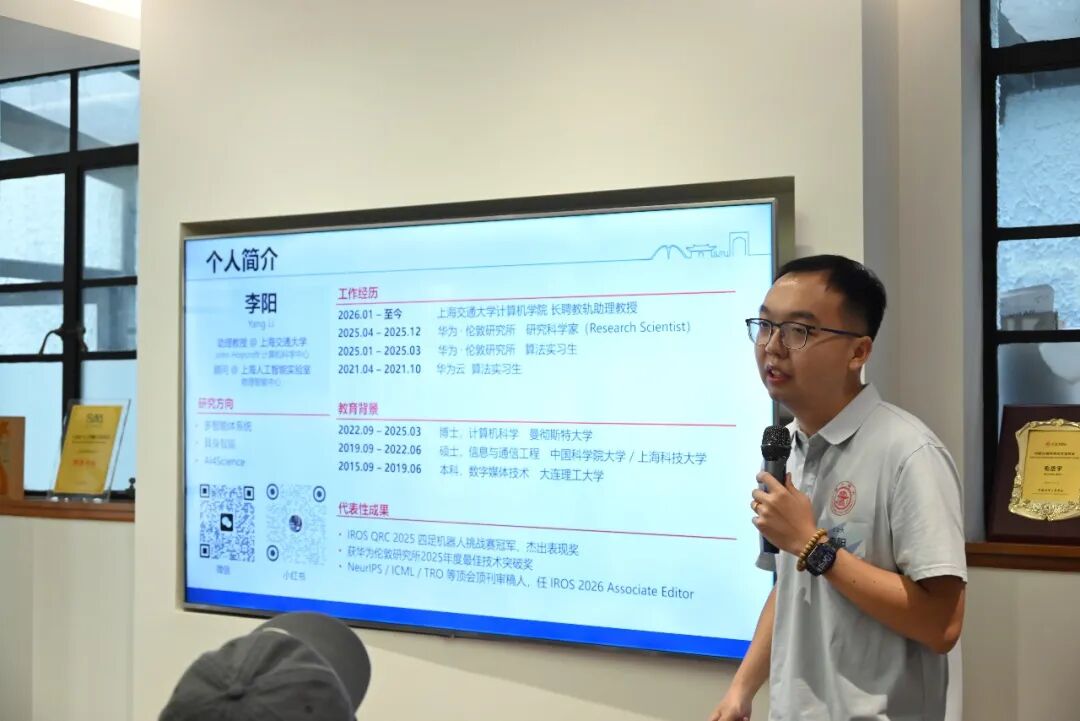
In his view, when multiple robots enter real environments together, complexity escalates rapidly: they may carry different sensors and bodies, need to coordinate with unfamiliar teammates; scenes, tasks, and even adversaries can change at any moment; post-disaster rescue, lab monitoring — these tasks often last days or even weeks. Robots must maintain long-term, stable autonomous behavior without continuous human instruction.
This redefines the goal of world models. For robot navigation, whether the texture on a wall in the image looks realistic doesn't matter; what matters is whether the robot can judge where obstacles are, what consequences each alternative path leads to, and whether the next action is safe and effective. In other words, world models need to predict not pixels, but the future that decisions depend on.
Toward this goal, Li introduced DF3 (Decoder-Free World Models). It predicts future features directly in the encoder space of a vision foundation model, eliminating the video generator, latent space decoder, and task decoder — concentrating computation on information that actually affects decisions. Compared to baseline methods, DF3 achieves a 70% reduction in latency, 67% reduction in peak GPU memory usage, and 41% reduction in prediction parameters, at only a slight cost in prediction accuracy — bringing world models within the compute budget of robot edge devices. In the decision loop, it functions more like a "predictor" plus "discriminator": first imagining what future states different actions might reach, then choosing the more suitable path from multiple options.
After foreseeing the future, robots still need to answer "what should I do next." Li's PEPA is a personality-driven persistent autonomous embodied agent, seeking an "organizing principle" for long-term autonomous behavior. Here, personality goes far beyond chat style or interaction manner — it's a goal-generation mechanism: personality shapes value preferences and intrinsic rewards, which in turn determine what goals the agent generates each day and what actions it takes; memory and reflection then write the day's experiences back into the system, keeping long-term behavior both consistent and continuously adaptive. In experiments, robots with five different personalities all completed 24 hours of autonomous operation by day three, displaying markedly different behavioral patterns driven by their respective values.
This embodied multi-agent research was also brought into autonomous scientific experiments. Li and his team connected agent systems, robots, and different chemistry equipment through a unified embodied science interface. In an organic wastewater degradation experiment, the system completed 15 rounds of iteration in 45 hours, achieving 99.7% degradation efficiency — equivalent to roughly 30 days of work by two graduate students. Currently, Li is introducing multi-agent collaboration into a real high-throughput catalyst experiment platform, accelerating the search for high-activity catalysts among 1.6 billion high-entropy alloy combinations. This work is ongoing.
From DF3's "predictable future," to PEPA's "organizable long-horizon," to the embodied science agent's "verifiable discovery," the "future" that world models foresee has already moved past the next frame, beginning to cover the results of continuous action and even a complete experimental closed loop.
From "Can Predict" to "Can Work"
Manipulation Still Lies Between
Zhecheng Yuan, chief scientist at Poke Robotics — a portfolio company of the Yunqi–SJTU AI Angel Fund — focused on the point where robots most directly connect with the physical world: manipulation. Speaking from the company's hands-on experience, he delivered a talk titled Manipulation: The Next Big Thing on the Road to Physical AI.
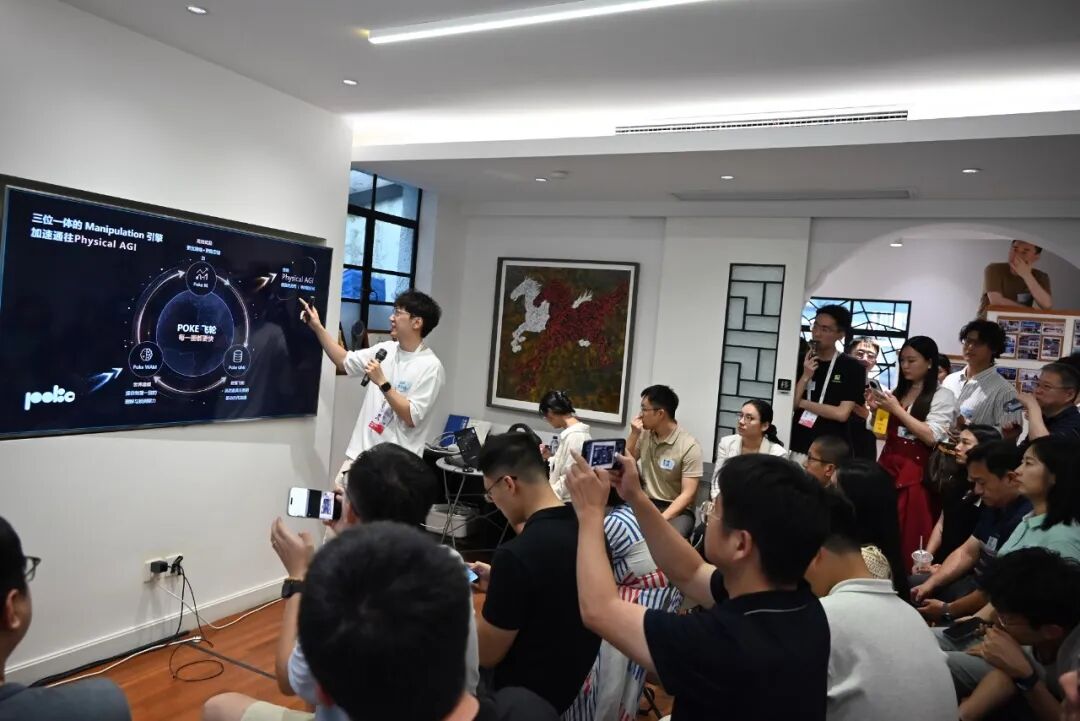
Robots that can run, jump, and pull off extreme stunts still have a considerable distance to travel before entering production and daily life, before truly substituting for human labor. Yuan believes breakthroughs in manipulation capability depend on three interlocking elements: a foundation model that understands the world, a reinforcement learning mechanism that can continuously learn from real feedback, and high-quality, high-efficiency data collection. Together they point toward the endgame of Physical AGI — his slide summarized it as "ultimate dexterity, absolute generalization."
What kind of world model do robots need? He walked through the main current approaches one by one: 3D reconstruction offers clear geometric expression, but geometry doesn't equal physical understanding — it doesn't know how objects will change under force; JEPA/latent-space methods train efficiently, but physical semantics are hard to verify; handcrafted physics engines have explicit rules, but the rules are never complete; video generation achieves high visual realism, yet lacks physical relationship modeling, easily producing anti-physics phenomena. His judgment: WAM (World Action Model), which balances prediction and control, is the optimal path for embodied manipulation.
But mainstream WAM still has problems. It first uses a video model to predict the next frame, then uses an inverse dynamics model to back out the action from the two consecutive frames — yet the image itself can produce "physical hallucinations": the phone is clearly on the table, the gripper is about to grasp, and in the next frame the phone has vanished into thin air. This barely matters for watching video, but for the robot's next action it could be fatal.
Poke WAM addresses this with Action Forcing: using an IDM-DM loop, in an iteration of "predict observation → back out action → correct observation," it continuously pulls generation results back toward directions more consistent with physical laws. In a clothes-folding comparison against two mainstream video generation models, Poke WAM's output was physically more consistent with real footage. Yuan recalled that when he first saw the exported video, he repeatedly asked colleagues if there had been a mistake.
In the demo video he showed, a robot autonomously completed the long-horizon manipulation task of making mapo tofu: tofu placement was random, utensil positions varied, and the single robot could still grasp precisely — while needing to judge when to add ingredients, when to stop stir-frying, and autonomously turn off the heat upon seeing the water boil.
"A demo working once isn't special. If you can do it continuously, and demo it live, that's real skill." This also captures the distance between a robot demo and genuine capability.
To turn one-time success into repeatable, stable execution, Poke built the full-stack real-hardware reinforcement learning system Poke RL, enabling historical data to continuously become training assets: the TRFO algorithm creates a real-hardware environment optimization engine through off-policy data utilization and dynamic advantage-function weighting; a task-agnostic reward mechanism needs only pass/fail binary labels; chunk-level action blocks support long-horizon operations; and a multi-task unified architecture lets one brain master multiple skills. In the demo video he showed, you could clearly see the value function scoring each state of clothes-folding in real time: the value drops when a piece of clothing is finished, then rises again when a new piece is thrown on the table.
On the data side, the self-developed Poke UMI glove and dexterous hand handle high-quality data collection, covering fine operations like opening bottles, holding cards, and hooking kettles. Poke WAM handles understanding and prediction, Poke RL handles learning from feedback, and Poke UMI handles data supply — the flywheel formed by these three, in his words, "spins faster every cycle."
When World Models
Hit the Startup Front Lines
The final panel was moderated by Yu Sang, executive director at Yunqi Capital. He has long focused on embodied intelligence and its upstream and downstream sectors, and this time he pushed the discussion from technical roadmaps into the startup arena. Coincidentally, all three founders shared a common experience: they had all made the transition from academia to entrepreneurship. Hongyuan Lu, founder of FaceHeart, received his PhD from The Chinese University of Hong Kong; Yingtian Zou, founder of Sreal AI, is currently an associate professor at Shanghai Jiao Tong University's School of Artificial Intelligence; and Zhaoxi Chen, co-founder of Ropedia, has research experience at Tsinghua University and NTU's MMLab.
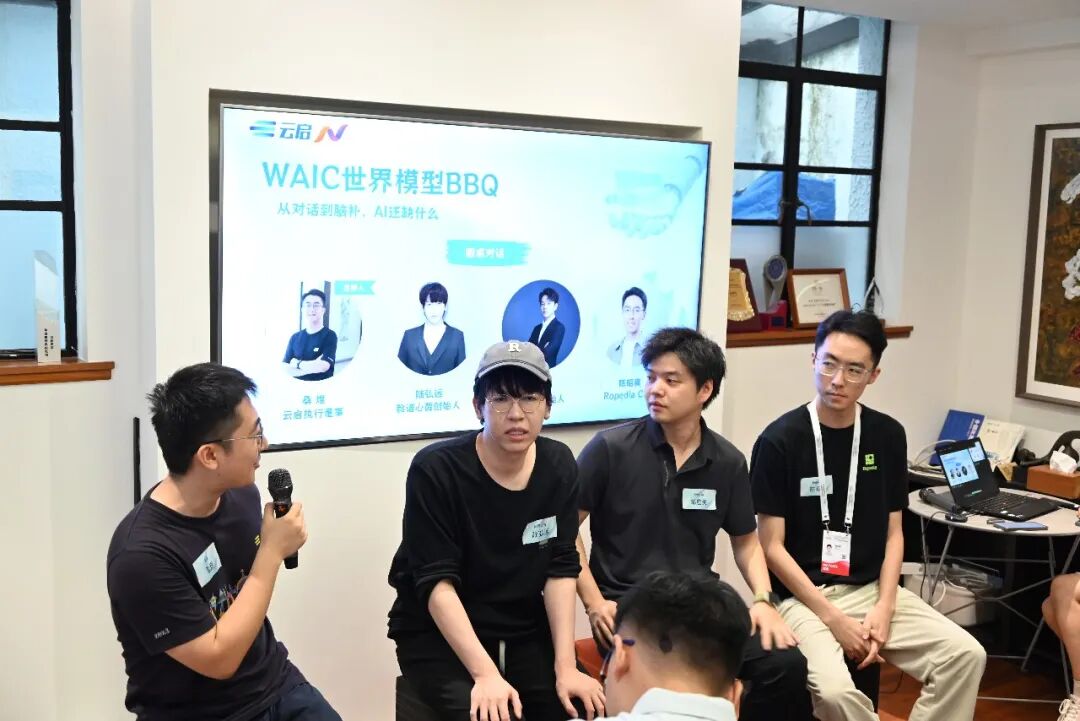
Opening the panel, Yu Sang cracked a joke: "If you feel any speaker wasn't sharp enough, or wasn't telling the whole truth, you can clink glasses with them extra hard during BBQ later."
The panel started with a basic question: What is the core capability of world models?
One guest summarized world model development in three stages: early on serving reinforcement learning, letting agents simulate futures in "imagination"; then moving toward spatial intelligence, focusing on consistency in 3D space, observation perspectives, and memory; as AI enters the physical world, models must also understand dynamics, predicting how an action will change the environment.
The relationship between video generation and world models was also a recurring topic. One guest put it bluntly: "The most confusing thing right now is that people treat video generation as World Model." Video can generate realistic scenes, but for robots, how objects change under force and whether actions can reach expected states matter far more. World models ultimately must serve prediction, planning, and execution.
The discussion then moved to generalization and data efficiency. Autonomous driving, dexterous manipulation, gripper manipulation — scenarios differ, yet startup data and compute are limited. If you have 20 tasks, which deserve priority? Which data can transfer to more scenarios? Task scaling, relevant case retrieval, supervised training signals, and high-transfer-value data filtering were all directions mentioned. Compared to a one-time demo, whether a model can cover more tasks with limited data and support longer-horizon action comes closer to the real problems startups face.
In the commercialization segment, the discussion shifted from "what can the model do" to "what should the company do at this stage."
One guest used "immersed, yet detached" to describe the founder's state: deep in technology, product, and customers, while preserving independent judgment. "The non-consensus within consensus — that's where the 100x, 1000x opportunities might lie."
But beyond long-term judgment, companies must solve immediate survival. World model R&D demands heavy investment with long validation cycles. One representative line from the event: "Doing world models, you can't do something that looks small right now."
Take the gaming industry: the stronger world model capabilities become, the more likely they are to move from underlying tools into content production, transforming how existing companies work. This imaginative space also makes some industry clients more cautious about partnerships. On how startups survive the early stage, guests mentioned data services, model capabilities, and hardware-software integration as options. They don't form a fixed path, but reflect the same practical problem: in the journey toward long-term goals, companies still need to find a way to survive their current stage.
On the experience of going from researcher to founder, one guest reflected on his previous experience building edge models. After the product entered the consumer market, if the team used user likes as feedback, the signal was too indirect to effectively validate model performance. In his words, the core problem then was "verification wasn't good enough."
Guests also noted that a key reason world models have attracted attention is their potential to provide robots with simulators carrying direct reward signals, letting agents interact and trial-and-error repeatedly. Once in real applications, teams can also collect task-related data from user interactions, feeding it back into model training to form a continuously iterating closed loop.
On the new lab, guests mentioned that the difficulty researcher-founders face isn't "not understanding commercialization." Define the product too small, and it may limit fundamental capabilities; set the target too large, and you endure a longer landing cycle. As agents enter company workflows, permission management, information security, and context alignment become new organizational challenges.
This panel arrived at no unified entrepreneurial roadmap, but put several real problems on the table: how to choose technical paths, where to allocate limited resources, how models can obtain real feedback, and how companies find their own rhythm between long-term goals and stage-by-stage survival.
From Conversing
to "Mental Simulation," to Actually Doing
After the substantive sessions, the mapo tofu on screen gave way to skewers and beer on the table. People began mingling, exchanging WeChats, exploring collaboration opportunities, even recruiting... The discussion of world models continued from stage to tableside.
If asked again "how cooked is the world model," the answer might still vary by technical approach. But the evening's discussion offered at least three more concrete yardsticks: can it understand physical laws, can it predict the consequences of actions, and can it stably complete long-horizon tasks in real environments.
From conversing, to "mental simulation," to actually doing — each step AI takes toward the physical world multiplies the difficulty. And precisely because it's hard, it's all the more necessary to bring researchers, founders, and investors to the same table, breaking fuzzy concepts into concrete problems, and grounding future imagination in today's practice.
This is also what Yunqi hopes to keep doing: paying attention to the technological variables unfolding now, and to the people willing to build the future step by step.
About "Attention"
"Attention" is a series of brand events created by Yunqi Capital for tech entrepreneurs and the industrial ecosystem. It evolved from Yunqi's signature "Yunqi BBQ" event series, launched when the firm was founded in 2014, aimed at building deep exchange with tech entrepreneurs and fostering an entrepreneurial community. Since its upgrade in 2023, "Attention" has embraced the philosophy that "attention is all you need," focusing deeply on frontier topics including AI agents, embodied intelligence, AI hardware, and globalization. The events have been held in Beijing, Shanghai, Shenzhen, Hangzhou, and Silicon Valley, with nearly 70 sessions to date attracting over 10,000 participants, continuously providing AI entrepreneurs and high-potential founders with idea exchange and resource connections — striving to become a deep ecosystem platform for frontier AI innovators.