We Backed a Xiaohongshu Hackathon Hit: How AI-Native Hardware and Software Break the "Buy-and-Abandon" Curse | Y Transformers

The Real Entry Point for AI Products
The product world once circulated a rule of thumb: only when 30-day retention exceeds 10% can you talk about breaking one million DAU.
How hard is that bar to clear? According to data from mobile marketing analytics platform Adjust, the global average 30-day retention rate for mobile apps is 6%. In other words, 94 out of 100 users disappear within a month.
In the hot AI emotional companionship赛道, most products fare even worse: users download on some curious night, use it once, and never open it again. Many high-profile AI companion apps quietly vanish not long after launch.
Can this seemingly locked-in script be rewritten? Yunqi Capital's branded podcast Attent!on drops a new episode, with Y Transformers lead investor Hao Liang in conversation with NoonWake founder & CEO Bill Wu (Shawn) — a 50-minute deep dive into the key that unlocks this puzzle.
In just a few short months, 30-day retention has surpassed 15%, with DAU breaking 50,000. Bill Wu and his first AI product "Wanxiang Youling" have found their own rhythm.
In 2025, Bill Wu left Xiaomi, where he led a team of nearly a hundred people, to found NoonWake and enter the AI general psychological companionship赛道. This is the Beta of a larger era — anxiety diffuses globally, the need for emotional companionship is obvious, and many have entered. Bill Wu found a particular angle: using a light, flexible framework for interpreting the world to build inner certainty for young people living with uncertainty. And this angle naturally carries what he sees as the critical entry point for AI products: the real context of a person's world.
By late 2025, Yunqi investor Peter came across Shawn on Xiaohongshu, initially following him for his sharp entrepreneurial "hot takes." After deeper understanding of the team and product, NoonWake became one of the first projects Yunqi's Y Transformers backed.
In just a few months, from domestic "Wanxiang Youling" to North American "Starot", to the desktop AI product "Good Luck Calendar Machine" that won second place in the hardware category at Xiaohongshu's hackathon, NoonWake has built a cross-region, cross-form AI native hardware and software product matrix. Supporting all this is Bill Wu and his 4-person team, plus that repeatedly validated judgment: the real context of a person's world is the true core asset for To C products in the AI era.
In this conversation, you'll hear:
- Why "real context" is the core proposition for AI native products, and how it fundamentally differs from user tags in the mobile internet era
- How a 4-person team uses AI to drive AI, achieving rapid product iteration — from identifying a problem to shipping a fix, sometimes in just one night
- Where the biggest differentiation lies between this generation of AI native hardware and the previous generation of software-hardware integrated products
- Under the wave of globalized emotional consumption, how NoonWake uses one product logic to simultaneously cover young users from different cultural backgrounds
The people in this conversation:
Bill Wu (Shawn)
CEO & Founder, Noonwake.ai
Hao Liang (Peter)
Executive Director at Yunqi Capital, Lead Investor of Y Transformers
01 Where Users Tell AI the Truth Is Where the Opportunity Lies
Peter:
On the surface, this is an AI emotional value product. But I want you to reposition it — in your mind, what is the core of this product?
Shawn:
We can't simply define it as a general psychological product, or an emotional product — like early Cezi, or those emotional apps young people play with now. We still have to answer a more fundamental question: what is the user's real purpose in coming here?
Our conclusion is that this product's core PMF lies in — it provides a different framework for interpreting the world. This framework exists independently of current scientific views, yet it is logically self-consistent and unfalsifiable. These two points together give it tremendous spiritual energy.
In the post-AI era, anxiety is globalized, diffused, and spans all ages. Globally, the distress and pain that large numbers of young people face cannot be answered by traditional scientific values. But if you look at the world from a different angle, much of the present suffering can find a kind of resolution. This can tremendously help users move forward. It's like how Labubu exploded overseas — there's an emotional logic behind it.
So we prefer to define this company as: a company selling emotional support and emotional value to global young people. That's our first logic.
Peter:
Why is this scene particularly suitable for AI? Many people are also doing AI companionship, AI social — what's the essential difference between you and them?
Shawn:
This is what we thought through most clearly when choosing this direction, and also what we feel most differentiates us from other teams.
I've used Replika, I've used Eve — these AI social or AI companion products. When using them, you notice a problem: in social or companion scenarios, people wrap context around the AI. They might disguise themselves, presenting a more desired version. Simply put, they don't necessarily tell the truth.
But once you can't get real context, none of your subsequent actions can work.
In our general psychological, emotional companion scenario, it's completely different. Users come here to discuss their most authentic pain points, their most real current problems. They're unlikely to lie to AI — because they came here precisely to seek a real answer. This itself is the most effective real context.
Our judgment at the time was: context is everything. Context is the absolute core of all To C AI products. Without vertical, real context, you can't do anything. And the general psychological companion scenario is the entry point we found with the lowest cost and highest quality for obtaining real context.
02 Mobile Internet Wanted Scale; AI Wants Real
Peter:
The mobile internet era also did user tags, behavioral data, recommendation algorithms — those were also real context, right? What's the essential difference between how the two eras obtain user information?
Shawn:
The previous generation of mobile internet operated on a highly centralized data logic. For example, broadly collecting certain context tags from ten thousand users, aggregating these tags to a centralized algorithm platform, then matching two sides — goods or content on one side, users on the other. Whether short video, e-commerce, or O2O, the essence was this connection logic.
This model has a fundamental problem: it extremely relies on platform scale effects. Small platforms simply can't run, and the ultimate outcome is monopolistic giants. Moreover, this approach's satisfaction of individuals is never personalized enough — you're collecting data from ten thousand people, and the conclusion aggregated from that is definitely not tailored for any single person. If you have to accommodate everyone, you can't truly accommodate anyone.
The AI era is different. Each person's context can be very small, but extremely personalized, extremely real, customized just for you alone. It's discretized, decentralized, with no central node.
Everybody's AI service can be very personal, very different. This is the most fundamental difference in product logic between the two eras.
Peter:
How did your judgment about "real context" form step by step?
Shawn:
Speaking of which, this became clear through a journey from the mobile internet era.
Working in big companies for many years, you find the core is always doing the same thing: how to efficiently obtain user information, then distribute content based on this information. Basically all mobile internet era products were doing these things.
By late 2023, we started engaging with ChatGPT and discovered a paradigm shift in technology. Things that previously only platforms could do now became a product paradigm usable by individuals. Following this line of thought: since it's extremely personalized usage, the quality of input context becomes extremely important. What kind of context quality is higher?
At first I thought it needed to be clear enough, structured enough. But later realized this judgment was wrong — AI can actually recognize very messy expressions, that's not the problem. What truly matters is: whether the context you input is real. If it's not real, nothing can proceed from there. You can express very messily, but this mess must be a true reflection of your current state. This judgment only became truly clear around the second half of 2024.
03 Humans Find Bugs; Agents Fix Them Overnight
Peter:
I've been using "Wanxiang Youling" these past few months, and clearly feel the iteration is very fast. Your team only has four people, with just one or two related to development — how do you achieve this speed?
Shawn:
Our internal workflow is already completely different from when we were at Xiaomi or Tencent, hard to describe with traditional organizational structures.
Let me give a very concrete example. Say you feedback that some problem's answer is too generic. We'd directly describe this bug in text on Lark. After description, the first Agent combines our user logs and buried point data, analyzes the problem itself, writes logs, and files the bug. Then a second Agent fixes the bug filed by the first Agent. A third Agent evaluates the fix result — judging whether this change truly fixed the issue.
You know what the result is? Basically a problem raised the day before can generate 10-15 fix proposals that same night. The next morning, 12 of those 15 are already fixed. This iteration speed is something we completely couldn't have imagined before.
We internally call this system Harness — with evaluators, generators, multi-Agent collaborative architecture. But frankly, the essence is still based on deep understanding of the business, calling different AI tools to complete. Tools are means; judgment of the business is the core.
Peter:
The Spring Festival operation was an extreme test of this logic, right? Can you elaborate?
Shawn:
That was indeed quite interesting. During Spring Festival, all four of us took vacation, with no full-time operations staying behind. But users were still there, and emotional needs were actually stronger during Spring Festival.
We gave AI full authority to run Alibaba's SMS permissions, Spring Festival-related content operation permissions. We had a bottom-line expectation in mind, but gave a relatively large operating space — like maximum spend, maximum reach.
Unexpectedly, AI ended up sending SMS to nearly a hundred thousand users, repricing some previously underperforming content, and doing secondary recall. That day's revenue was nearly 100,000 RMB. The cost wasn't low either, but at that moment we felt this thing truly worked. Later we organized the entire process into a reusable operational workflow, which we use repeatedly.
04
The Essence of Hardware Is Letting Users
"Speak Truth Without Pain"
Peter:
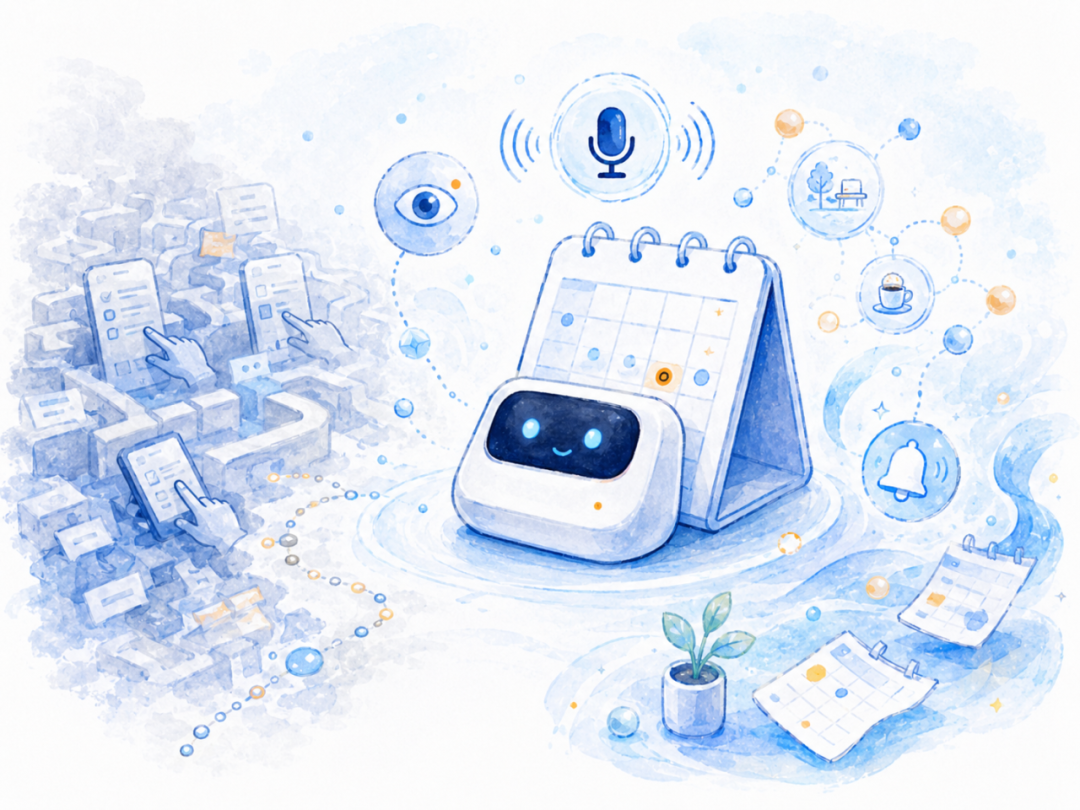
Your team participated in Xiaohongshu's hackathon in April, going from 0 to 1 in 48 hours to create "Good Luck Calendar Machine," winning second place in the hardware category. With an already well-performing software product, why do hardware? What value does hardware actually carry in the entire user journey?
Shawn:
Still returning to real context — all decisions ultimately circle back here.
Hardware's core value lies in its ability to very elegantly, painlessly collect users' real context. Let me give a familiar example — Plaud, an AI recording product. Can its function be implemented on a phone? Absolutely, Tencent Meeting or Lark Meeting can both record. So why did Plaud sell out?
Because sticking it to the back of your phone and tapping lightly to start recording creates far less friction than unlocking your phone, finding the recording app, and long-pressing to start. Just this difference in friction makes users willing to truly, continuously use it. Hardware makes context collection elegant enough.
The calendar machine follows the same logic. Software products require users to continuously input actively — something I'm following changed today, I have to manually update in the app. But if there's a hardware on the desk, continuously communicating with you through camera and voice, it automatically tracks changes in this thing, automatically forms memory, automatically pushes reminders for node changes. You don't need to do any extra actions. This is what hardware can do that pure software cannot.
Finally, our design conception is that hardware can provide the only product capable of end-to-end problem solving.
Peter:
You ultimately chose the "calendar" form — how did this choice come about?
Shawn:
Behind this choice was a very practical consideration. We're doing the global market; if we design a set of hardware based on each local culture, supply chain costs and complexity become hard to bear. So we wondered: is there a form that naturally adapts to different cultural carriers?
Calendar is such a thing. Regardless of country or region, people's attention to the time dimension is universal. Everyone's life revolves around changes happening at different time nodes. This carrier itself naturally adapts to globalization.
As for the specific content it carries — domestic is one cultural narrative, North America might be astrology and tarot, the Middle East another system — that's a software-level matter, flexibly replaceable. Hardware is universal; software is localized. This combination means we don't need to redesign a supply chain for each market.
Peter:
What's the biggest difference between this generation of AI native hardware and the previous generation of software-hardware integrated products?
Shawn:
I think this is a question worth thinking through clearly. On the surface, the previous generation also did software-hardware, this generation also does software-hardware, but the driving logic of the two is completely different.
Previous generation software-hardware was essentially a commercial choice, not demand-driven. Take Xiaomi TV — hardware gross margin is extremely low, now black electronics gross margin doesn't exceed 3%, so what drives profit? Subsequent continuous software service charges, advertising, memberships. Or conversely, first having large software user base, then pulling a portion to buy high-margin hardware products. Either direction, the driver is business model, not product experience itself.
This generation of AI native hardware is different. It starts from demand — not finding new commercialization paths so doing hardware, but having to make software-hardware integrated to give users better experience. Only when software and hardware become one can you elegantly complete context collection in a vertical scenario, smoothly complete the entire product loop. This is what truly qualifies as AI native hardware. So I believe this generation is the real software-hardware product.
05
The Real Moat Is Memory
Peter:
Five years from now, where is this company's moat?
Shawn:
We believe there are two moats, and neither is technology.
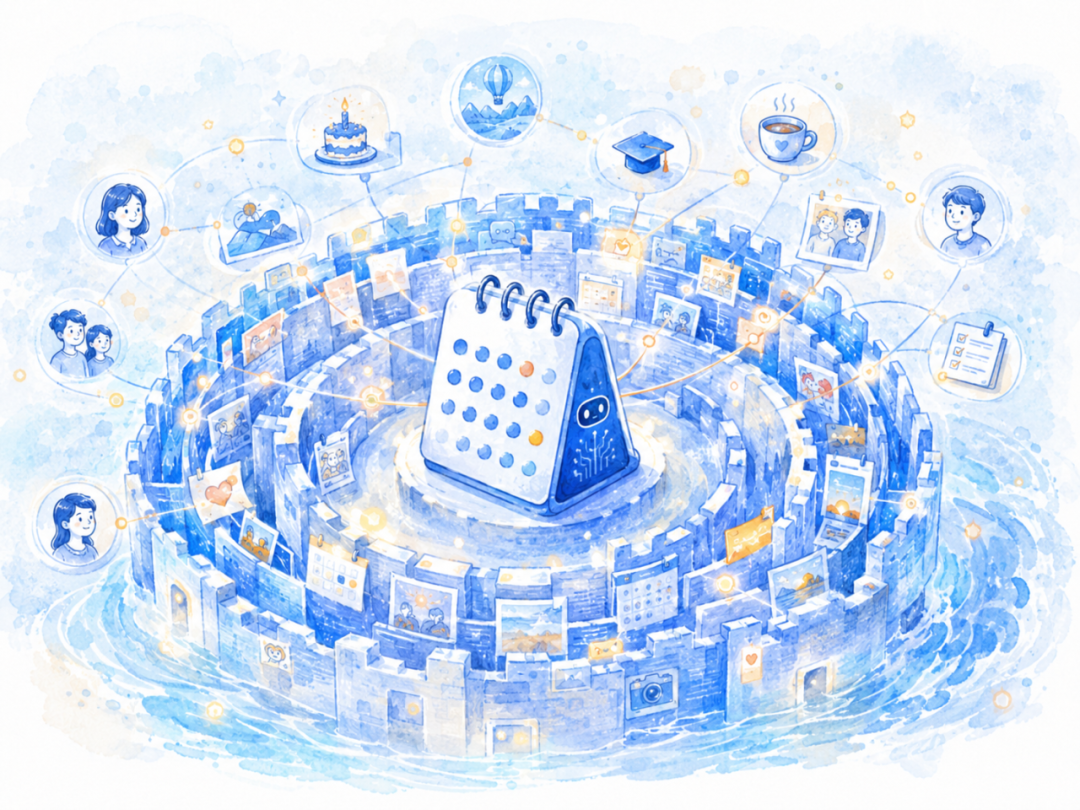
The first is social relationship chains. We hope to accumulate real social relationships between users through emotional economy as the bond. For example, I pay attention to the daily combined chart between me and a certain friend, what will happen to each of us at present — once this relationship chain forms among users, with everyone using it, migration cost becomes very high. And this has a good window — globally, there's currently no team faster than us doing this.
The second is long-term Memory accumulation. Once users form long-term memory on our product, with the calendar covered in nodes of all their matters, this memory itself is a migration barrier. Unless a competitor is ten times better and ten times cheaper, having them abandon all data and start fresh is something that makes very little sense.
You mention technology moats, like we have some SOTA-level memory capability — such things have very short timeliness, will eventually be surpassed, someone will eventually achieve it. But relationship chains and long-term memory are hard to replicate. Our rapid small steps are attempts to build these two lines.
Shawn:
Yunqi sent us an offer very quickly at the time. I'd like to understand, from an investor's perspective, why did you move fast at this point?
Peter:
First is still the industry logic itself. This赛道 fits a category of opportunities we've been watching (Agent replacing professional services) — needs that have existed for thousands of years, with enormous markets, globally common, but almost entirely driven by human labor and strong trust, never truly standardized. When AI enters such industries, the transformation space is huge.
Second is frequency. This industry was naturally low-frequency before, use once measure once. Can AI change this? When Shawn first talked with me, he could explain from underlying logic why this product could become high-frequency, and why users would be willing to continuously pay for AI. Being able to clearly articulate the underlying logic of these two questions was a very important reason for our decision to move.
Finally is the macro environment. Anxiety diffuses, emotional consumption rises, young people's demand for psychological companion experiences is rapidly increasing. Looking from a more macro perspective, you'll find this demand is common among young people globally. This is definitely a pro-cyclical industry, and a very long cycle...
For more content, welcome to listen to the full audio version of the program.
🎁To let everyone personally experience the emotional value brought by "real context," Shawn brings exclusive experience benefits for this episode's listeners — participate in Xiaoyuzhou program comment section interaction for a chance to receive:
$2
$2*$2***