Yunqi Capital Leads Tens-of-Millions RMB Angel Round in YOOUSI, Betting on New AI Manhua Drama Ecosystem | Yunqi Capital

How AI Is Reshaping Motion Comic Production

AI animation technology company YOOUSI (优时映画) recently announced the completion of a tens-of-millions-of-RMB angel round, jointly invested by Yunqi Capital and BAce Capital.
Founded in 2017, YOOUSI is dedicated to reconstructing the manga-to-animation production workflow through AI, improving both the efficiency and cost structure of high-quality content creation. The company is currently focused on Japan's manga-drama consumer market while accelerating its international expansion.
For more details on this funding round and YOOUSI's business, join us in this edition of "Yunqi Capital's Portfolio Spotlight."
➤ ➤ Yunqi Capital's Investment Thesis
"Among the many AI applications targeting consumer-facing markets, animation is one of the sectors most profoundly impacted by productivity revolution. Market demand is clear and the addressable market is vast. The manga-drama subcategory, in particular, aligns with short-video platform distribution models and the evolution of user emotional expression — it's entering a phase of explosive growth.
Yunqi Capital is bullish on the 'manga-drama + AI' opportunity over the long term. AI's transformation of traditional manga-drama production not only significantly reduces costs and improves quality, but also enables scalable production, creating the potential for a global content platform.
The YOOUSI team has deep roots in manga and manga-drama, with substantial industry experience and sharp market insight. Through refining their vertical AI pipeline, they've built formidable engineering and technical art capabilities, demonstrating exceptional productization and execution."
The following is adapted from 36Kr.
This funding round will primarily support building a top-tier team, upgrading core technology, and advancing overseas market expansion. Meanwhile, the company is actively pursuing a new funding round aimed at accelerating international expansion and building a global animation technology ecosystem.
How long does it take for a manga you love to be adapted into animation?
In Japan, where the animation industry is highly mature, the typical timeline from manga release to anime adaptation is one to two years. First, the manga needs to earn reader acclaim and demonstrate market potential. Then it waits for investors or animation studios to step in, initiating planning and negotiations with the magazine holding the copyright. Once partnerships are secured, investors, publishers, animation studios, and advertisers form a production committee to begin animation production.
One to two years is a considerable wait. In an era where short-video platforms deliver fresh stimulation daily, fans' enthusiasm gets quickly fragmented and diluted. Shortening this cycle and increasing output would naturally provide a significant boost to the entire industry.
A company called YOOUSI is using AI tools to compress the animation adaptation cycle to one to two months. Founded in 2017, this Chinese company is a new type of AI animation technology firm integrating "AI creative tools, global distribution, and original animation content." Through proprietary AI tools combined with human voice acting, they bring manga to life as one-to-three-minute video episodes. This format, distinct from traditional animation, is called "manga-drama" (漫剧).
YOOUSI CEO Ze Yuan explains that the company began creating original manga content in 2017, accumulating a portfolio of proprietary IPs and externally acquired ones. In 2018, YOOUSI started developing AI tools, attempting to drive content through technology, and by around 2023 had built out a mature system.
To date, YOOUSI has launched nearly 100 productions. As AI tools have iterated and improved, content quality has risen substantially: recent works approach traditional animation standards in scene transitions, character movement fluidity, and shot composition, while maintaining significant cost advantages.
A 36Kr author reviewed YOOUSI's recent and early works, noting clear quality improvements. Early productions resembled "motion comics" — while character lip movements, expressions, and actions changed according to plot, backgrounds remained static with limited shot variety, similar to Japan's early "PowerPoint anime." Recent works, however, rival traditionally produced animation in scene variation, character movement fluidity, and shot composition richness.
Technical upgrades have elevated content quality while keeping overall production costs efficient. Yuan notes that even after accounting for IP acquisition, production, and voice acting costs, YOOUSI's content costs remain far below traditional industry benchmarks.
Yuan states that the company has already demonstrated strong commercial returns on content production. Multiple released manga-dramas have achieved profitability, with some significantly outperforming expectations and showing clear amplification effects.
In terms of business model, YOOUSI initially focused on long-form video platforms as primary distribution channels, gradually expanding to short-video and emerging traffic platforms. This year, through deep partnerships with Ocean Engine and Douyin, the company successfully produced some of the industry's first representative works with extended lifecycles and scalable revenue, further proving the commercial potential of "AI + manga-drama" across multi-channel distribution. For example, Forced to Become a Villainous Son-in-Law became the industry's first manga-drama to surpass one million RMB in paid traffic spend, with a lifecycle exceeding five months, validating manga-drama's commercial potential across both long-form and short-form video platforms while generating substantial revenue sharing and traffic returns for the company.

However, the domestic market is not YOOUSI's primary focus. Given higher traffic acquisition costs and lower user ARPU domestically, the company is currently targeting Japan's manga-drama consumer market. "Japanese animation platforms have ARPPU around 200 RMB, while domestic platforms are only around a dozen or so," Yuan said.
YOOUSI is accelerating its internationalization strategy, with Japan as its first priority overseas market — a highly mature and competitive market with extremely high demands for quality, narrative pacing, and viewer experience, making the barrier to entry very high.
To validate the manga-drama model, the company spent two years conducting multiple rounds of testing and iteration, optimizing content, production workflows, and distribution strategies.
Yuan stated that the company has validated manga-drama's acceptance in core animation consumption markets: test results show their content performance approaching top-tier live-action dramas on platforms, while commercially they've explored per-episode payment models aligned with Japan's mature manga industry pricing. This not only proves manga-drama's commercial potential, but also indicates its viability as an emerging content format.
To support this strategy, YOOUSI has built three core systems:
Content Creation and Production System: The company has developed rapid development and batch production capabilities, significantly improving efficiency while maintaining quality;
AI-Driven Animation Creation Tool System: The proprietary Inkverse toolchain enables intelligent, cost-efficient drawing and production, allowing continuous content upgrades within controllable cost structures;
Content Globalization and Multi-Language Distribution System: With offices in Changsha, Hangzhou, Tokyo, and Bangkok, the company has established distribution networks covering core markets, with multi-language simultaneous release and global distribution capabilities.
Currently, YOOUSI's team is largely in place, with technology, content, and distribution teams operating in coordination. This year, the company will further expand team size to match overseas market expansion and platform-building needs.
Going forward, YOOUSI will build its own manga-drama platform in Japan, deeply entering the world's most important animation consumption market and driving a comprehensive upgrade from "content export" to "brand globalization."
In December 2024, the Association of Japanese Animations (AJA) released its latest Animation Industry Report 2024, showing that among TV anime that premiered in 2023, there were 232 new works and 68 continuations — the lowest total in a decade. Meanwhile, average episode counts per work have declined in recent years. At the same time, Japan's manga industry market size has expanded for multiple consecutive years, with numerous IPs still awaiting animation adaptation.
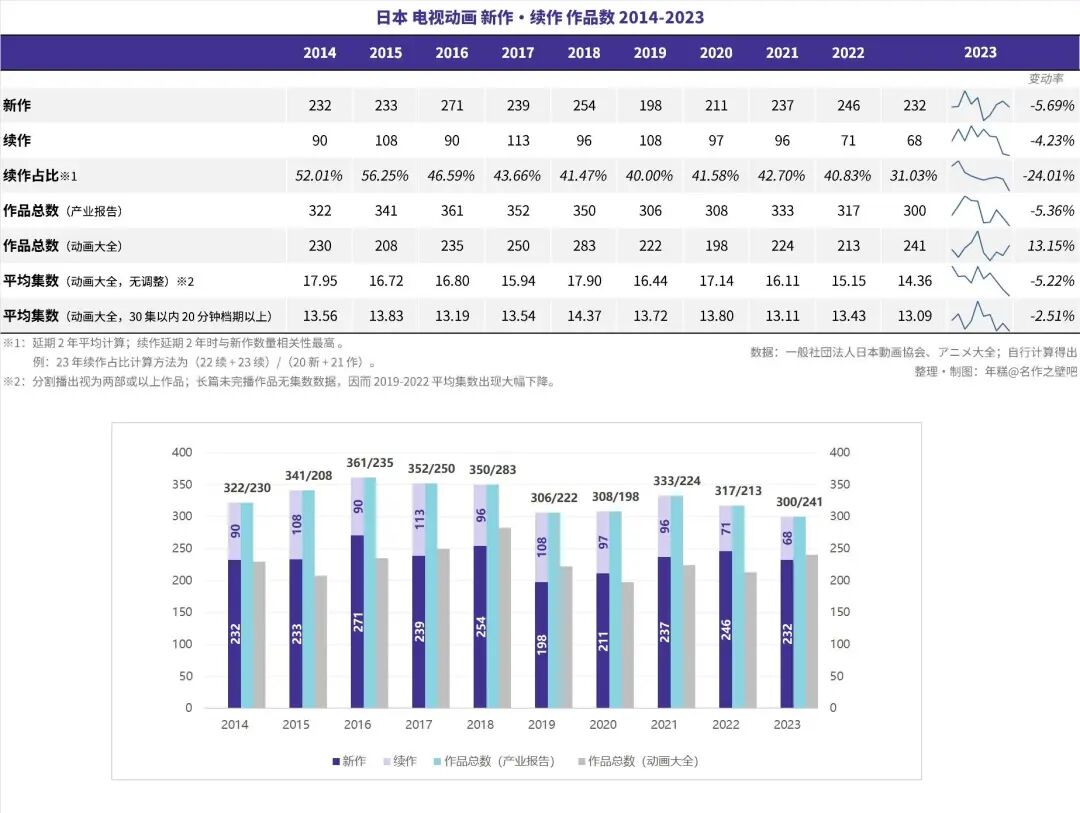
Image source: Animation Industry Report 2024
Yuan stated that against this industry backdrop, AI tool applications can effectively help stabilize animation content quality, alleviate talent pressure, and improve efficiency. "Compared to the domestic market, overseas markets have distinct characteristics: the domestic market focuses more on traffic acquisition and quick payback, while overseas users prioritize content quality — as long as the work is excellent enough, users are willing to pay and stay engaged long-term," Yuan said.
Therefore, YOOUSI aims to adopt a long-term operational approach, continuously expanding overseas markets and establishing stable content ecosystems and sustainable business models.
YOOUSI has established a strategic partnership with SB Creative, a SoftBank subsidiary in Japan, formed a joint venture with Thailand's T&B Global Media Group to drive co-creation and regional market expansion, and entered a strategic partnership with Xingyue Culture (a Yuewen ecosystem company), with both parties collaborating deeply across IP development, content production, and overseas distribution to jointly advance the development and distribution of animated short dramas in global markets.