Yunqi Capital Research | AI Applications 2025: New Technologies and Trends Analysis

Looking at Direction from First Principles
In 2025, large model capabilities continue to evolve, and AI applications are entering an accelerated deployment phase. The rise of Chinese applications on the global AI stage, the progression of AI Agent technology from research labs into enterprise workflows... AI is transforming from story into reality. Yet at the same time, innovation, differentiation, and commercialization remain persistent challenges for AI applications.
This edition of "Yunqi Research" shares in-depth research on AI applications from the Yunqi Capital team. Research-driven, direction-focused — let's decode the opportunities and challenges behind this intelligence revolution together.
Core insights in this article include, but are not limited to:
- Technology inflection point — models return to pre-training, context window expansion redefines AI capability boundaries
- Application evolution — from LLM to autonomous agents: parsing the five-cycle evolution path of AI applications
- Enterprise deployment — deep RAG and business integration: the critical engine for enterprise AI application deployment
- Ecosystem evolution — MCP standardization: new infrastructure for Agent interconnectivity
- Commercial implications — rapid growth, high human efficiency: lessons from AI Native applications
AI Dynamics: New Observations
New Inflection Points in Models and Applications
Model Layer
· Pre-training returns to the spotlight, foundational intelligence becomes the core objective again
OpenAI's slow progress in pre-training, combined with the viral success of DeepSeek's reasoning model R1, had once shifted industry focus toward post-training. But as reasoning depth and multimodality become new battlegrounds for AI capability competition, leading companies are returning to large-scale, systematic pre-training routes — Anthropic's release of Claude 3.7 being a case in point. Compared to the alignment and instruction-tuning emphasis of the past half-year, leading AI companies are repositioning "building intelligence itself" at the core.
· Context window expansion, a leap in model memory
Since 2025, model token limits have exploded. Gemini 1.5 Pro, for instance, officially claims processing capacity at the 1-million-token level, capable of easily digesting complete codebases, lengthy academic papers, even entire novels — making it one of the longest-context mainstream models known to date.
This breakthrough significantly enhances advanced capabilities like document Q&A, multi-turn conversation memory, and full-project code comprehension, while also delivering economic optimization. It reduces processing costs for complex tasks and cuts token consumption from repeated context description. As AI applications grow more complex and token usage continues rising, context window expansion is creating a "win-win" of improved intelligence and cost optimization.
· New paradigms emerge, training modes continue iterating
New paradigms in large model development are also taking shape in industry practice, such as online learning, long context/memory, and more. Though next-generation model architectures remain unknown, industry experimentation is revealing new possibilities for emergent model intelligence.
Application Layer
· Chinese applications' share among global top AI apps rises significantly
In Q1 2025, a16z's TOP50 global AI applications list included 19 applications from Chinese companies, nearly 40% of the total — significantly higher than in previous periods. These span not only large model applications but also pure-play application scenarios, reflecting China's rapid rise in the global AI application space.
· The ultimate form of Agent: intelligent systems that deeply understand user needs
AI Agents are gradually evolving into intelligent systems capable of deeply understanding user needs. They integrate computer operations, web search, and various software functions/data, progressively automating execution of complex tasks. Through bidirectional drive between model intelligence and task execution, enterprise AI Agents are gradually deploying and continuously advancing AGI (Artificial General Intelligence).
· Current challenges: reliability, generalization capability, and cost issues
Despite their powerful potential, AI Agents still face practical challenges. Insufficient reliability, weak generalization capability, and mismatched efficiency and cost remain pressing problems. For example, Manus charges $200 per month in subscription fees, with high token consumption during use. This exposes enterprises to substantial risk and cost pressure when investing.
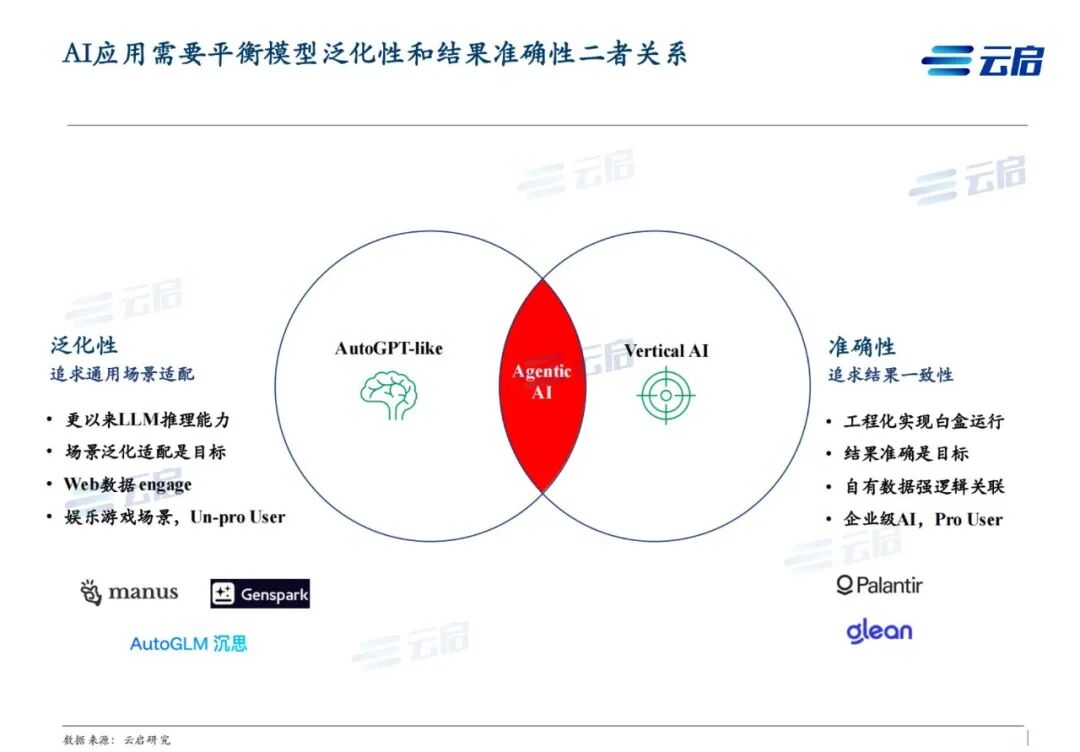
As applications increasingly pursue balance between generalization and consistency, underlying models remain the core dependency for application development in the long term. Whether many applications succeed or fail often depends on their specific usage patterns and the depth of model training.
The Essence of Application Innovation:
New Capabilities, New Interactions
As AI technology continues evolving, both AI-enhanced applications and native AI applications are emerging in abundance. In a competitive landscape where differentiation is the "must-have" for breakthrough, what kind of AI application can truly refresh user experience? We analyze this from the perspective of AI technology evolution and the underlying architecture of AI applications.
From the Underlying Architecture Perspective
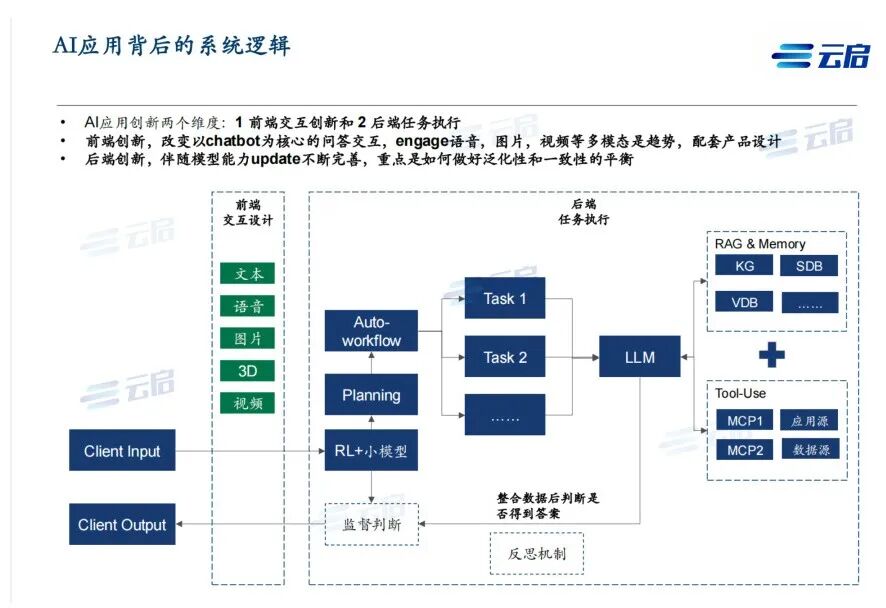
Current AI applications generally adopt a "frontend + backend" dual-layer architecture. The frontend, or user interaction layer, centers on intelligent dialogue while integrating diverse interaction modes including text, voice, images, and video. This is the layer directly connected to users' AI functionality. Innovation in frontend interaction patterns represents an important dimension of AI application innovation — for instance, flexible combinations of multimodal input and output delivering entirely new user experiences. A typical example is NotebookLM, which generates content in podcast format for users.
The backend is where AI applications' true "brain" resides, involving concrete task execution. In the backend workflow, user input is first passed to a "reinforcement learning + small model" combination to complete the critical step of user intent understanding. Then it enters the planning phase, generating automated workflows and executing tasks in sequence. These tasks are driven by large language models (LLM) as the core engine, complemented by two major component categories: first, RAG and memory modules (including knowledge graphs, various databases, etc.); second, rich tool-use capabilities (such as MCP components, application interfaces, and data sources).
Ideally, this system should incorporate two closed-loop designs: "supervisory judgment" and "reflection mechanisms," enabling self-evaluation and adjustment based on execution results. But in reality, most applications remain at the stage of "output results and stop," lacking effective feedback and adjustment mechanisms.
Therefore, continuous updates to backend model capabilities represent another dimension of AI application innovation. Among these, achieving balance between generalization and consistency is the key focus for model capability optimization.
From the Technology Evolution Perspective
From 2023 to present, as AI technology capabilities have progressively iterated, AI application product forms have evolved through five cycles:
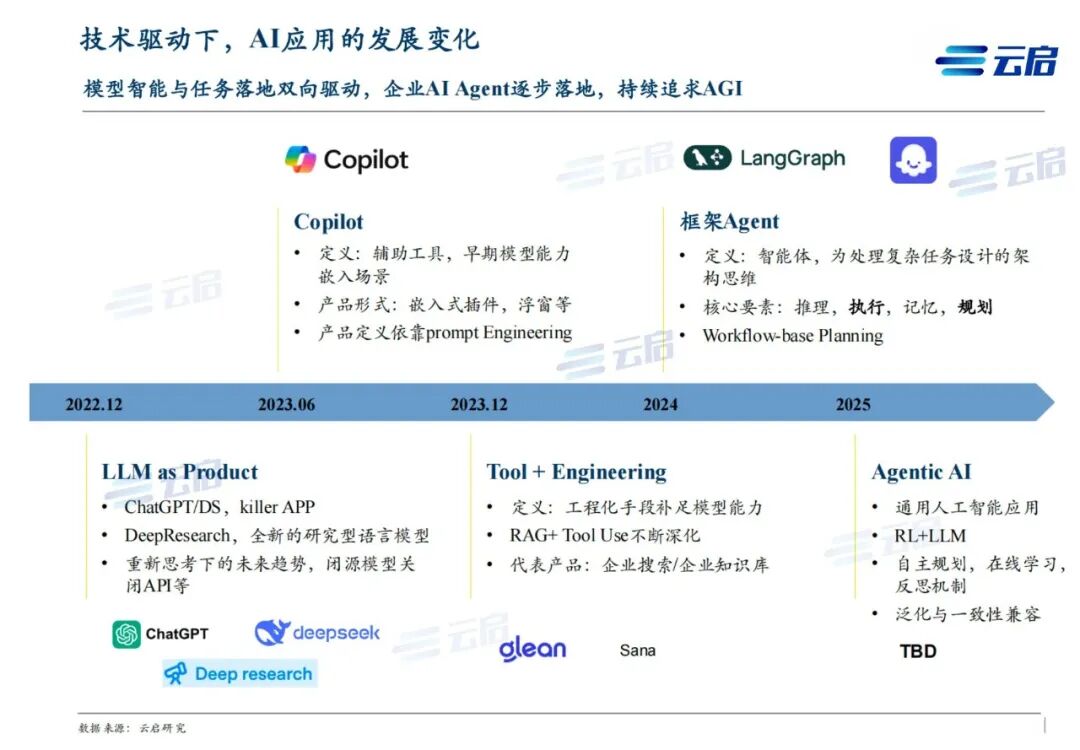
· LLM as Product
At this stage, AI technology was primarily applied through large language models (LLM) as products, such as ChatGPT, DeepSeek, etc., widely used in text generation, search engine optimization, and other domains.
· Copilot
Refers to embedding early model capabilities into specific scenarios, primarily as embedded plugins, floating windows, and similar forms. Product definition relied mainly on prompt engineering, with intelligence level depending on how well user intent could be translated into prompts that models could understand and generate ideal outputs from.
· Tool + Engineering
Engineering methods compensate for model capabilities; RAG + Tool Use continuously deepens, with representative products like Glean, Sana, and other enterprise search and enterprise knowledge base solutions.
· Framework Agent
Refers to designing a structured thinking framework around the Agent to specifically handle complex, multi-step reasoning tasks. At this stage, stronger reasoning, execution, memory, and planning capabilities enable applications to break down steps independently, remember intermediate states, and flexibly adjust actions during tasks.
Such agents are typically based on "workflow-style planning" — like building an assembly line, dividing complex tasks into different nodes to complete step by step. Representative applications include LangGraph, Coze.
· Agentic AI (Autonomous Agent)
By 2025, the Agentic AI cycle has arrived. Reinforcement learning + large language model (RL + LLM) enables autonomous agents to complete tasks independently and self-evolve across multiple domains. The viral Manus in Q1 initially defined the Agentic AI approach, but we can foresee that future Agentic AI should take a more general form not entirely based on workflow.
The evolution across these stages implies a consistent logic: balancing generalization and result accuracy is core to quality AI applications.
Key to Enterprise Application Deployment:
Business Understanding and Deep RAG
Enterprise scenarios with solid digital foundations represent vast "fields" for AI technology deployment. Currently, enterprise-grade AI applications are transitioning from proof-of-concept to actual deployment, yet still face numerous challenges in combining AI capabilities with real business operations. Below we focus on enterprise-grade applications, analyzing how the capability emphasis of enterprise software in the AI era has shifted from two angles: the evolution foundation of enterprise software stacks and key deployment capabilities.
Evolution of Enterprise Software Stacks
Each evolutionary stage of enterprise software technology stacks demonstrates varying degrees of technical capability liberation and business focus shift. Specifically, enterprise IT architecture has progressed through the following development stages:
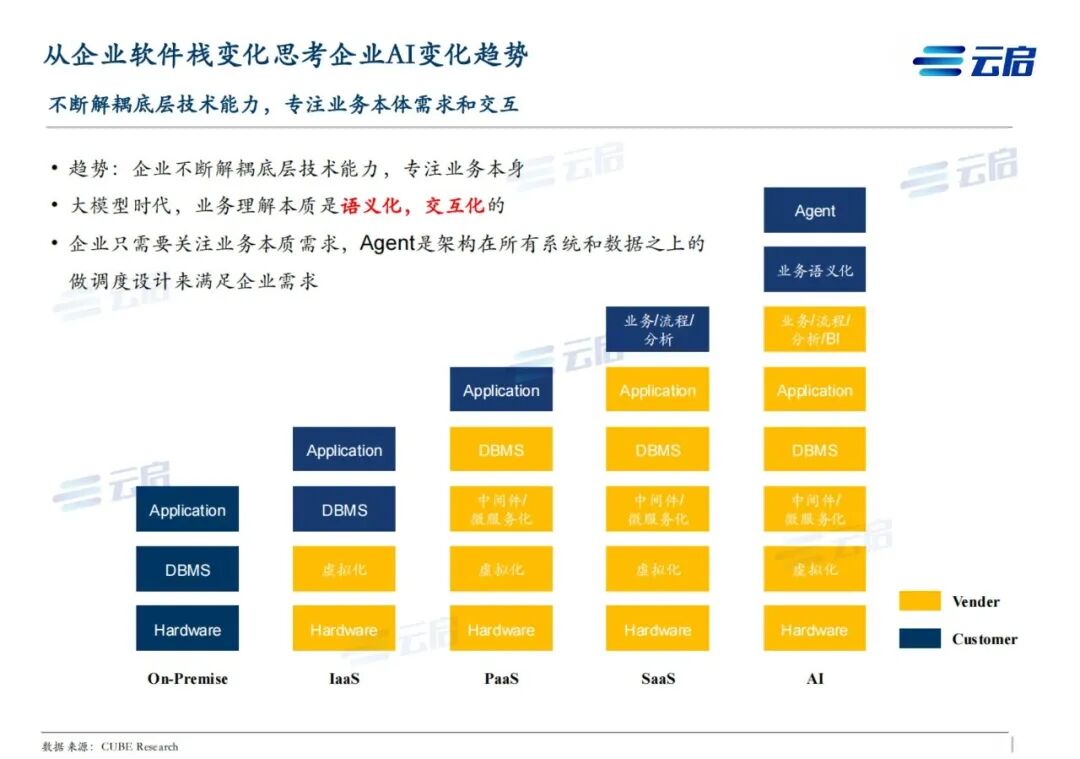
· On-Premise Era: Enterprises needed to purchase hardware, deploy databases (DBMS), and application systems themselves; the entire technology stack was self-managed by the customer.
· IaaS Era: The hardware layer was virtualized; enterprises no longer directly managed physical devices, with hardware and virtualization layers taken over by IaaS providers, though enterprises still needed to manage database and application layers.
· PaaS Era: Middleware and microservices were platformized, database management was also incorporated into PaaS scope, and enterprises primarily focused on application definition and business process/analysis.
· SaaS Era: The application layer was standardized; enterprises only needed to define how business used these applications, without concerning themselves with application development and maintenance.
· AI Era: The interaction mode between enterprises and systems undergoes qualitative change. Enterprises no longer need to find and invoke various functions and services through traditional interfaces, but achieve semantic and interactive business operations through Agents. This also means enterprises no longer need to focus on underlying technical details, but can concentrate attention on essential business needs.
The above evolution reveals the core trend of enterprise AI transformation: as underlying technical capabilities are continuously deconstructed, enterprises can focus on essential business needs and interaction.
In the large model era, what business needs to understand is essentially semanticization and interactionization. Enterprises only need to focus on essential business needs, while Agents serve as a fine-tuned layer built atop all systems and data, specifically designed to meet enterprise-specific needs. This trend also creates substantial vendor opportunities.
Core Capability for Enterprise Application Deployment: RAG
RAG (Retrieval Augmented Generation) addresses the core pain point in large model applications: how to make AI understand enterprise-specific knowledge and generate valuable outputs based on it. We believe RAG is the core capability for enterprise application deployment.
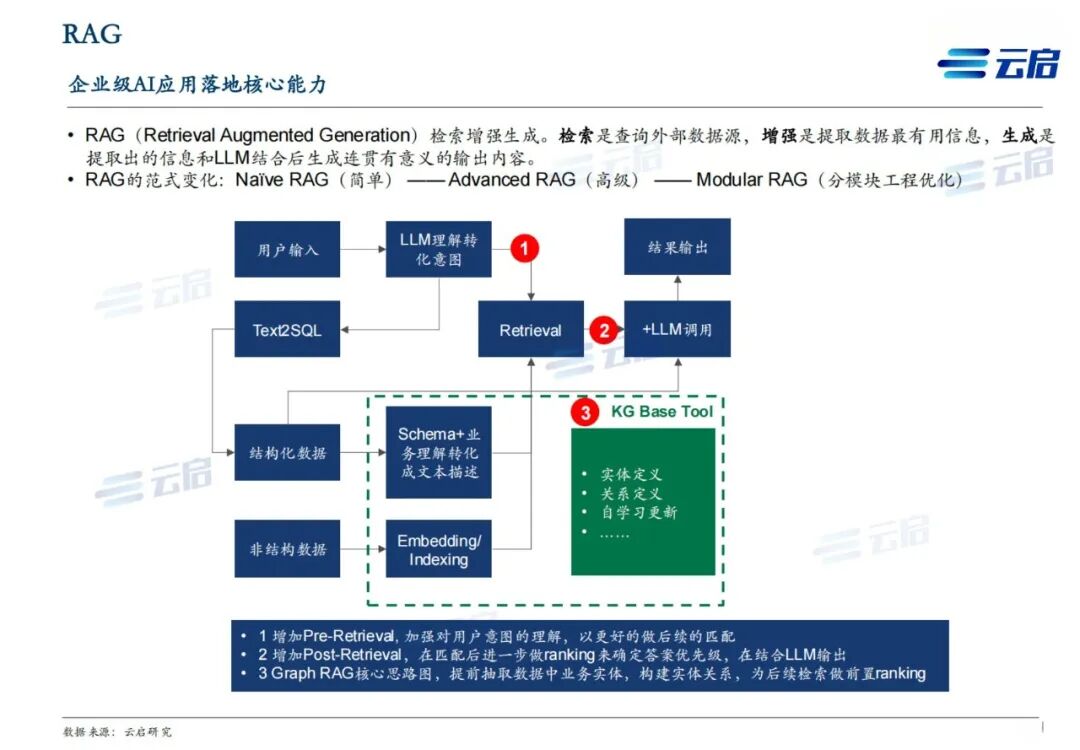
RAG's core process mainly involves three stages: Pre-Retrieval stage, understanding user intent and converting it to queries; Post-Retrieval stage, ranking and optimizing retrieved results, then combining with LLM output; Graph RAG, converting physical data into knowledge graphs, constructing relationship networks, and optimizing ranking through hierarchical structures.
Examining RAG implementation paths, we find that different data types require differentiated processing strategies: for structured data (such as enterprise sales records, financial data), the Text-to-SQL path tends to be more efficient. Such data inherently lacks semantic characteristics; direct SQL queries are more accurate and responsive than general vector retrieval. For unstructured data (such as product documentation, customer feedback), embedding vectorization is needed to establish semantic mapping relationships. Matching between user queries and enterprise knowledge bases is no longer simple keyword correspondence, but deeper semantic understanding.
Notably, to address enterprise data dispersion and heterogeneity, knowledge graphs are introduced as core RAG components — entering the Graph RAG stage mentioned above — enabling the system to establish entity relationships and significantly improving retrieval quality in complex business scenarios. To excel here requires deep industry know-how, connecting enterprise proprietary knowledge with AI capabilities.
Agent Ecosystem Evolution:
Changes Brought by MCP
As the importance of industry know-how becomes increasingly prominent, the trend toward interconnectivity in the Agent ecosystem is also creating more fertile ground for innovative AI application deployment. A landmark milestone was Anthropic's release of MCP (Model Context Protocol) in November 2024.
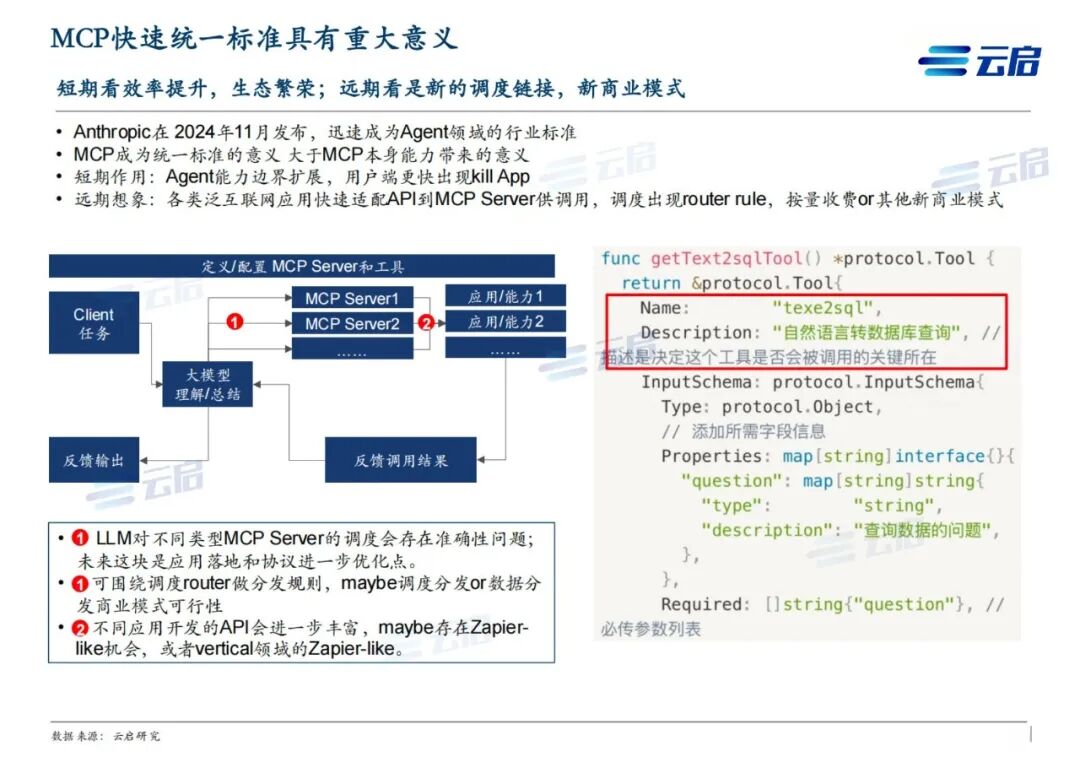
MCP aims to provide developers with unified interfaces for accessing large models, thereby simplifying integration between different AI systems and data sources. This protocol has been adopted by leading tech giants globally including OpenAI, Google, Alibaba, and Tencent, rapidly becoming an industry standard in the Agent domain.
In technical architecture, the MCP system defines and configures MCP Servers and tool libraries. Client tasks can be distributed to different MCP Server nodes, which then invoke corresponding application capabilities to form complete processing workflows.
We believe MCP's significance as a unified standard outweighs the significance of MCP capabilities themselves.
In the short term, MCP standards can improve system efficiency and promote ecosystem prosperity. It provides a more lightweight tool invocation method, lowering the barrier for Agents to call complex tools, expanding their capability boundaries, and theoretically benefiting killer app emergence. This standardization process also provides developers and enterprises with a more unified, efficient development environment, pushing the entire Agent ecosystem toward greater maturity.
From a long-term perspective, MCP standards will provide foundational architecture support for innovative scheduling models and entirely new business models. Various general internet applications can quickly adapt APIs to MCP Servers for invocation, achieving flexible routing rule distribution, and supporting diverse business models including usage-based pricing and advertising.
But notably, several technical challenges remain in the current architecture: LLM scheduling accuracy across different MCP Server types; further optimization points at the application layer and protocol level that need deeper consideration; micro-distribution rules for unified scheduling routers, scheduling distribution or data distribution business models that await exploration; and APIs from different application developers will further enrich, potentially creating opportunities similar to Zapier in the future, or spawning Zapier-style integration platforms in vertical domains.
The Answer to Commercialization:
Lessons from Rapid Growth of AI Native Applications
AI innovation is ultimately a practical science. After analyzing technology evolution and ecosystem development, we return to the market itself, capturing commercialization patterns for application globalization from the market growth of AI Native applications.
From a product growth cycle perspective, we find that AI Native applications grow significantly faster than SaaS, with remarkably high human efficiency. Top SaaS companies generally achieve human efficiency in the hundreds of thousands of dollars range, while top AI Native application companies can reach millions of dollars in human efficiency.
From a sub-sector perspective, AI coding tools such as Cursor, Lovable, and Bolt.new show particularly strong growth momentum. These companies excel not only in marketing strategy but also in product capability and competitive moats.
Additionally, AI application growth trajectories display distinct phase characteristics, accompanied by shifts in growth strategies. This means different growth stages (0-1, 1-10, 10-100) require differentiated strategies and corresponding product categories.
· Early stage (6-10 months): Rapid growth period, from product launch to reaching $10 million ARR, corresponding to approximately 50,000-100,000 paying users
· Mid stage ($10-30 million ARR): Entering plateau period, where user scale expands to approximately 300,000, with growth rate constrained by market capacity and product maturity
· Late stage (above $30 million ARR): Need to shift from PLG (Product-Led Growth) to SLG (Sales-Led Growth) strategy to seek breakthrough
Finally, we summarize three common elements typically found in phenomenal products as reference for application entrepreneurs going global:
· Product positioning — Overseas markets prefer products with minimalist design but extreme functionality;
· Market timing — Seize market windows, leveraging model iteration upgrade hotspots for rapid promotion;
· Growth strategy — Special attention needed on traffic, word-of-mouth, reviews, and iteration.