Let's Talk "Truth" in AI-to-Consumer Products: Why Did Duolingo Take Off? How Are Gen Z Building AI Hardware? | What's Next Event Recap

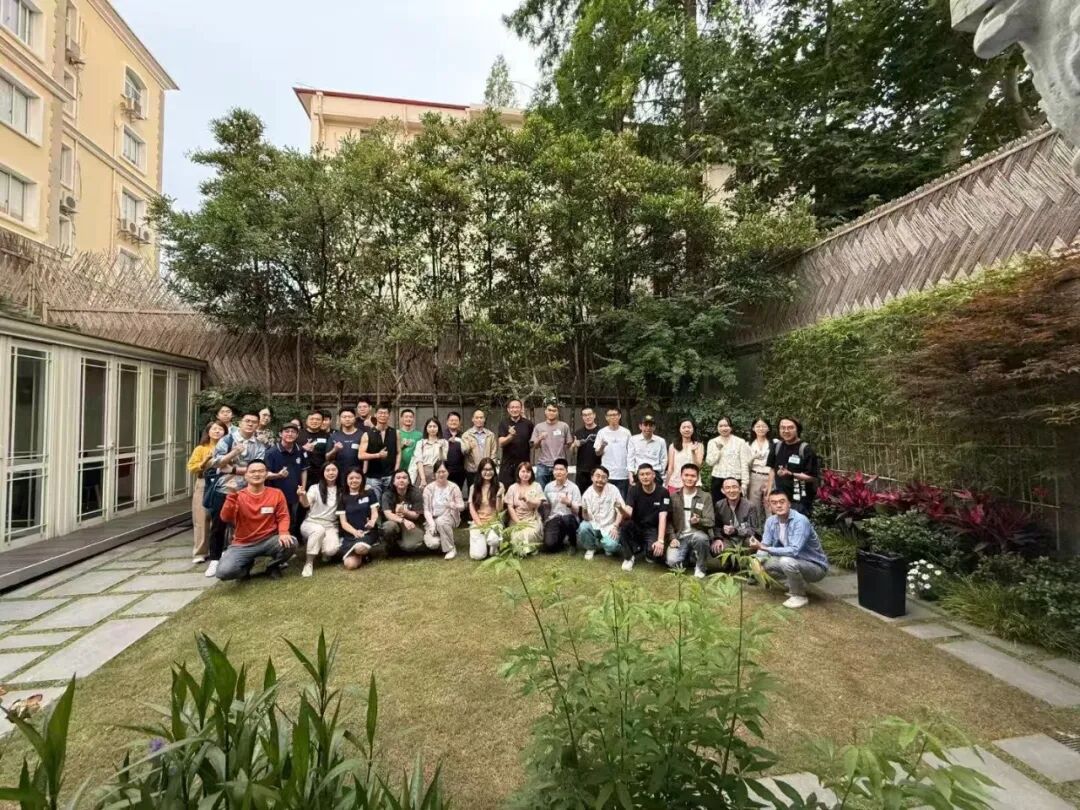
On May 25, the **"What's Next: Finding Next-Gen AI Entrepreneurs"** event series — AI2C session, co-hosted by **Yunqi Capital**, the Shanghai Jiao Tong University Industrial Technology Research Institute (ITRI), and DataWhale, was successfully held in Shanghai. **More than 30 entrepreneurs actively seeking GenAI innovation opportunities** joined **Yunqi Capital investors** with deep expertise in AI venture capital and the **SJTU ITRI team**, an AI-native incubator,
On May 25, the "What's Next: Finding Next-Gen AI Founders" AI2C session — co-hosted by Yunqi Capital, Shanghai Jiao Tong University's Industrial Technology Research Institute (ITRI), and Datawhale — was successfully held in Shanghai. Over 30 entrepreneurs actively seeking GenAI opportunities engaged in deep discussions with Yunqi investors steeped in AI venture capital, the Shanghai Jiao Tong University ITRI team specializing in AI-native incubation, and founders who have accumulated hands-on AI2C innovation experience across software and hardware.
Five-plus hours of speaker sessions and BBQ networking left attendees saying they "lost track of time." Below, we've excerpted the highlights to share with you. (PS: The series continues — we look forward to meeting more AI founders offline.)
01
Consensus and Co-Building: A New Paradigm for 0-to-1 AI Entrepreneurship
"Mobile internet restructured productive relations and economic organization. AI operates more deeply on the supply side, with the potential to fundamentally reshape supply structures in certain industries." In his opening remarks, Mao Chengyu, Founding Partner of Yunqi Capital, dissected how this wave of AI entrepreneurship differs from the mobile era.
He noted that from large models to embodied intelligence, AI agents, and other emerging trends, AI entrepreneurship is entering a new stage driven by deep technology and diverse stakeholders. Yet higher technical barriers, more complex commercialization paths, and a more volatile macro environment also pose greater challenges for AI founders. Against this backdrop, he encouraged entrepreneurs to focus on real demand, match their own capabilities, assemble the right team, and start with small, solid entry points.
To help more AI founders cross the "0-to-1 valley of death," Yunqi has partnered with Shanghai Jiao Tong University, the university's School of Artificial Intelligence, and ITRI to establish an AI angel fund. Mao Chengyu stated: "With the dual engine of industry and technology driving forward, I believe we'll see a cohort of truly influential AI companies emerge."
Su Peng, Head of the AI Middle Platform at Shanghai Jiao Tong University ITRI and Shanghai Lead for Datawhale, detailed ITRI's exploratory path toward "AI-native incubation." The "AI-native" incubation philosophy means embedding AI throughout the entire entrepreneurial process — from idea generation and MVP iteration to market validation and growth operations — achieving full-chain AI empowerment. To support the growth of AI-native teams, ITRI is building three core platform capabilities:
-
AI Middle Platform: Creating a "technical co-founder" by modularizing and agent-izing capabilities like policy matching, patent applications, and competitive analysis, available for flexible use by startup teams;
-
AI Talent Pool: Gathering cross-disciplinary "multi-skilled" talent and bridging the path from "wanting to do" to "able to do";
-
Community Co-Creation Mechanism: Launching the "Super Individual Lab," collaborating with open-source communities like Datawhale and wteam to explore AI-driven individual entrepreneurship and new paradigms of diverse collaboration.
Su Peng noted that ITRI will link on- and off-campus research and industry resources to help more AI-native projects move from 0 to 1, from lab to market.
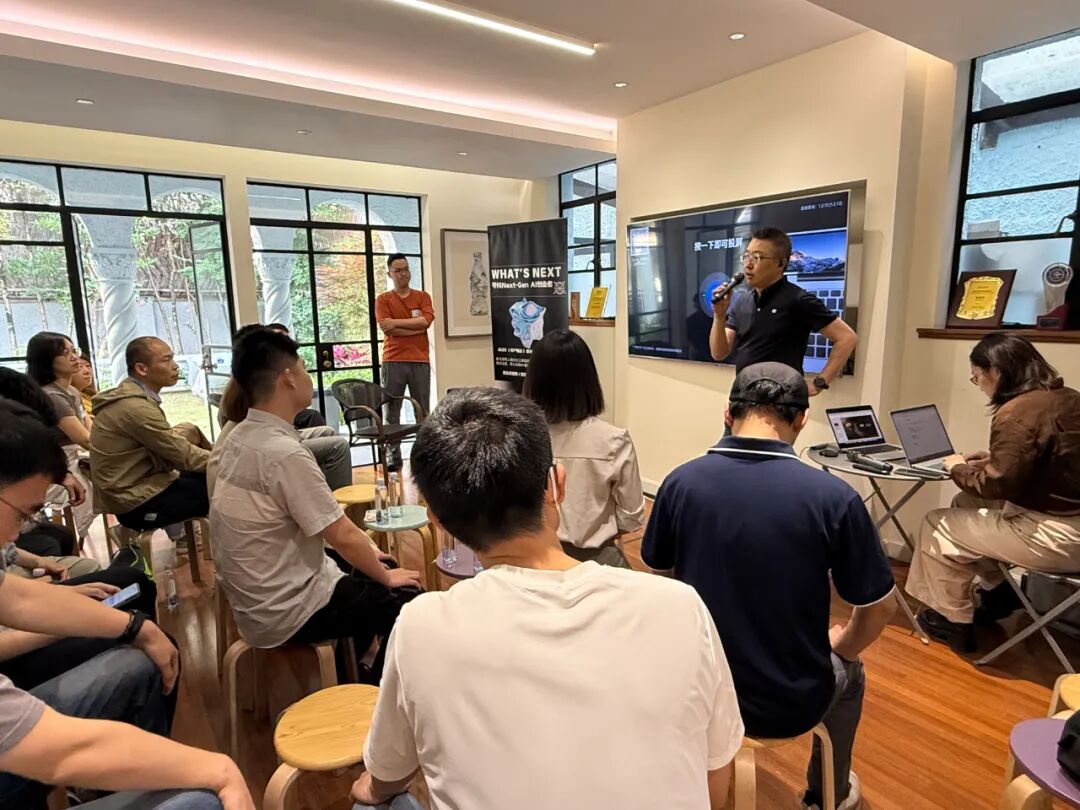
Mao Chengyu, Founding Partner of Yunqi Capital
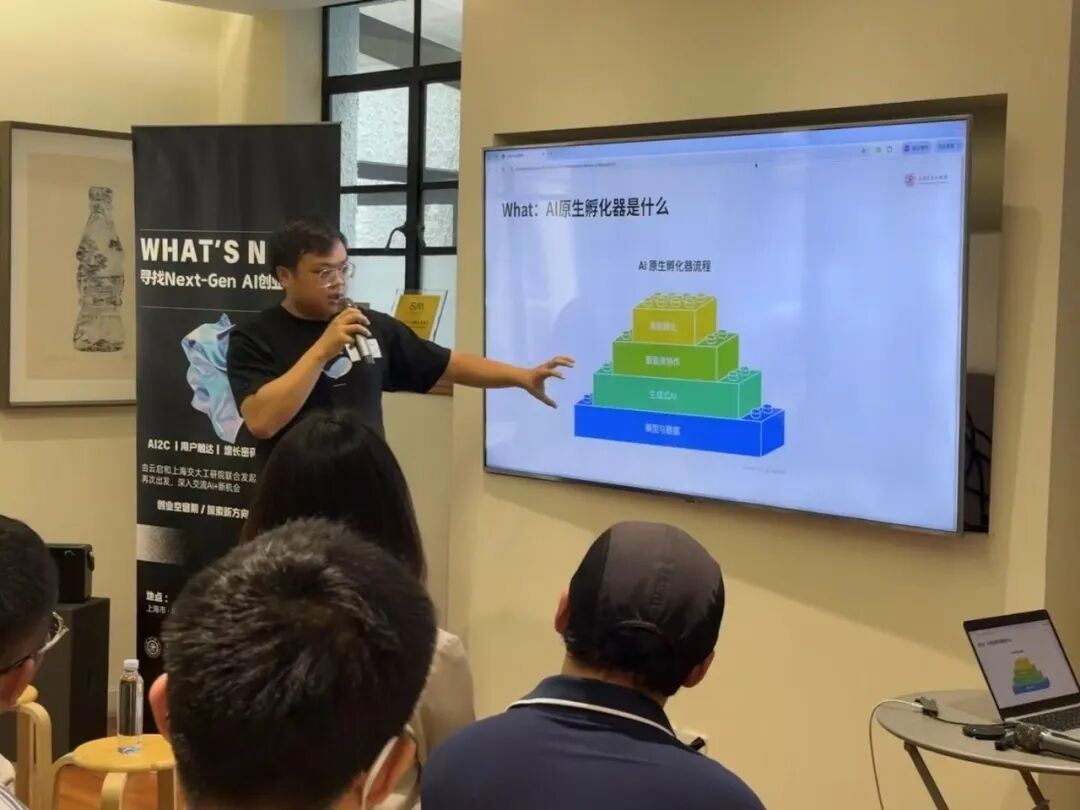
Su Peng, Head of the AI Middle Platform at Shanghai Jiao Tong University ITRI and Shanghai Lead for Datawhale
02
Software to C: The Product Logic of Unified Knowledge and Action, Lessons from EdTech
What judgment and execution does it take to build AI products that truly reach consumers and create lasting value? This was a central question the AI2C session sought to address. To explore it, we invited two AI founders — one focused on software, the other on hardware — to offer diverse perspectives.
Zheren Hu, Co-founder of Liulishuo, was an early practitioner in AI+education and also worked in AI investing at a VC firm. By analyzing the global success of Duolingo as an AI education blockbuster, he examined logical pitfalls and growth pathways for AI applications in education.
Why did Duolingo reach a $25 billion market cap while Liulishuo didn't? Hu opened with this pointed question. A key reason, he argued: Duolingo is fundamentally a gaming company that enjoys SaaS valuation multiples.
Specifically, Duolingo's competitors aren't New Oriental or Coursera, but TikTok and Instagram. Its core business logic is competing for user time — closer to an entertainment company in educational form. Yet its subscription-heavy business model and growth curve simultaneously earn it SaaS valuations higher than either gaming or education companies typically command.
Drawing from Duolingo's success and his own experience in AI education as both founder and investor, Hu shared several insights with the entrepreneurs present, excerpted below:
- Finding growth strategy requires unified knowledge and action
If you're building a tool product, you must understand whether you're making an "education tool" or a "user time killer." If you want high valuations, you need to be clear whether you possess the compounding attributes and growth path of a SaaS model. Don't chase SaaS valuations while operating with education industry tactics — that's not growth strategy, it's cognitive dissonance.
- AI education products can't talk growth without real learning outcomes
Duolingo succeeded, yet most users' language proficiency plateaus at A1-A2 "beginner" level. This reveals the boundary of AI automation plus gamification in education — there's still considerable distance between "easy to use" and "actually effective." Founders designing products must consider how to balance user retention with genuine progress.
- Education entrepreneurship must return to user needs and business fundamentals
Whether building an "AI tutor" or "AI content tool," real AI2C products need to return to two origins: Who is the user? What are they truly willing to pay for? Education isn't an industry easily disrupted wholesale; large models can't shake its fundamental business nature or user needs. "Selling anxiety" remains an important path to stimulating demand. The path of AI entrepreneurship can't just stare at AI or industry labels. The real difficulty lies in whether you know you're building a company or telling a story."
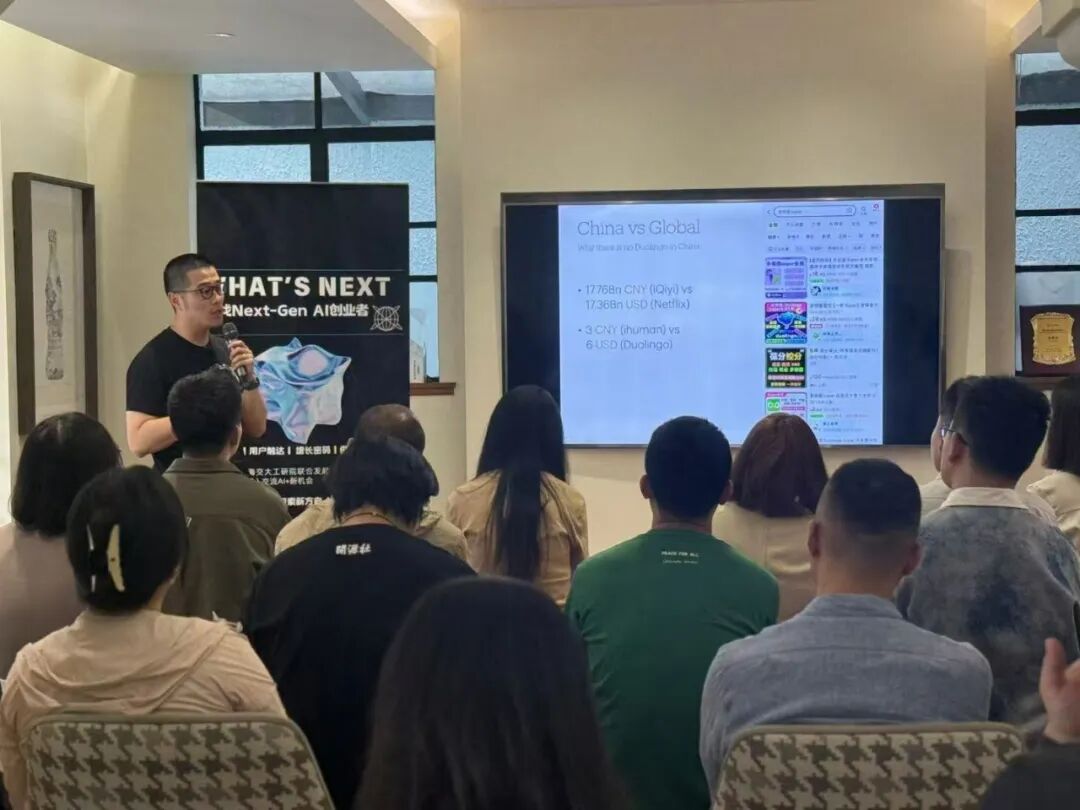
Zheren Hu, Co-founder of Liulishuo, delivering his analysis
03
AI+Hardware's C-Consumer Breakthrough: A Gen Z Founder's Practical Perspective
As one of the youngest speakers at the event, post-00s entrepreneur Tong Zhou, Co-founder & COO of sleep tech brand Mengli, offered a perspective on AI+ hardware to-C entrepreneurship: in the AI wave, how to use aesthetics, insight, and spatial imagination to build differentiated C-consumer hardware products.
Mengli is an AI hardware brand focused on bedroom intelligence, dedicated to covering the full sleep cycle. It has currently launched two core terminal products: a bedside lamp and a sleep aromatherapy diffuser. Zhou shared key practices from Mengli's product development and early-stage launch for hardware founders' reference:
- Scenario lock-in: Start from concrete life scenarios, building unique moats through "technology + design + emotional value"
Zhou believes future scenarios are essentially the relationship between people and space. Mengli chose "pre-sleep space" as its entry point, finding actionable scenarios from users' micro-behaviors (like listening to ASMR, light sensitivity), using an "embodied intelligent bedside lamp" to redefine the human-space relationship.
- Product definition: Space as intelligent agent, hardware as embodied channel
Mengli's product core isn't any particular sensor or light fixture, but rather the cognitive framework of "spatial embodied intelligence": making space like a biological organism with a closed loop of perception — understanding — action. This concept was heavily inspired by Li Auto's spatial design — not simply making a "smart device," but constructing a proactively serving scenario ecosystem.
- Core moat construction: AI, cognition, aesthetics
Zhou believes AI's core change to hardware is shifting human-machine interaction from active to passive. China doesn't lack computing resources or technical talent; what's missing is the ability to transform these capabilities into products that truly move people.
Products are a fusion of a founding team's cognition of the world, so cognition of how the world will change over the next decade is a core moat.
Another core moat is "aesthetics." In Gen Z's life attitudes and consumption habits, the priority of "aesthetic" elements is gradually increasing. People probably won't pay for ugly products. For example, behind Pop Mart's explosive popularity is the generalization of aesthetics and youth consumption symbols — consumption symbols are the manifestation of the correlation between aesthetics and consumption habits.
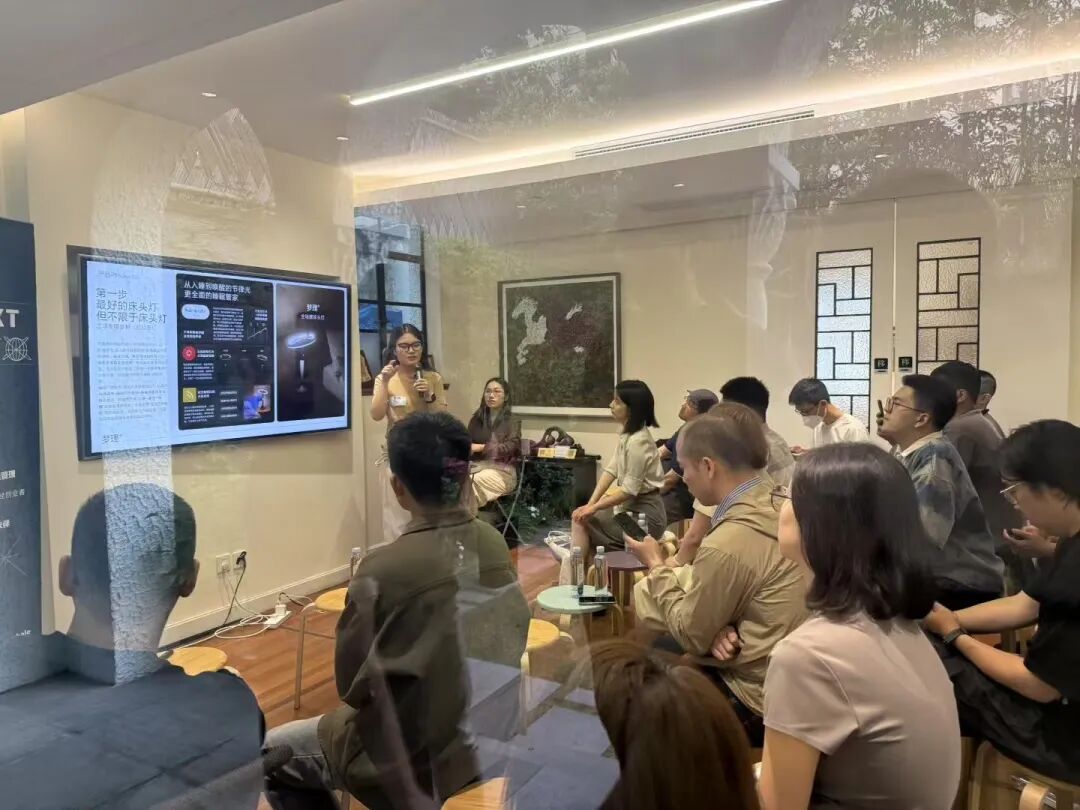
Tong Zhou, Co-founder & COO of Mengli, introducing his entrepreneurial journey
04
Open Mic & BBQ: More Exchange, More Collision
In Yunqi's signature offline session formats — "Open Mic" and BBQ — attending founders spoke freely and engaged deeply. Some are exploring AI-enabled possibilities in computer vision, real estate data management, elder care, travel, job seeking, and other directions or domains; others are still searching for their entrepreneurial direction. In just a few minutes each, they shared their experiences, ideas, questions, and reflections, leaving behind quite a few memorable lines. Excerpts:
"Good AI hardware doesn't rely on tech stacking, but on commanding a price and reaching overseas users."
"Give you a game, you think it's fun, you play it. AI entrepreneurship is sometimes just that simple."
"The essence of entrepreneurship is being unwilling to take orders, wanting to mess around with something yourself."
"You think you're building a product, but it's actually just a feature."
"AI capability is only the final link; product logic always starts from user pain points."
"Understanding the other party's needs and articulating your own value — that's the foundation for building trust in entrepreneurial communication."
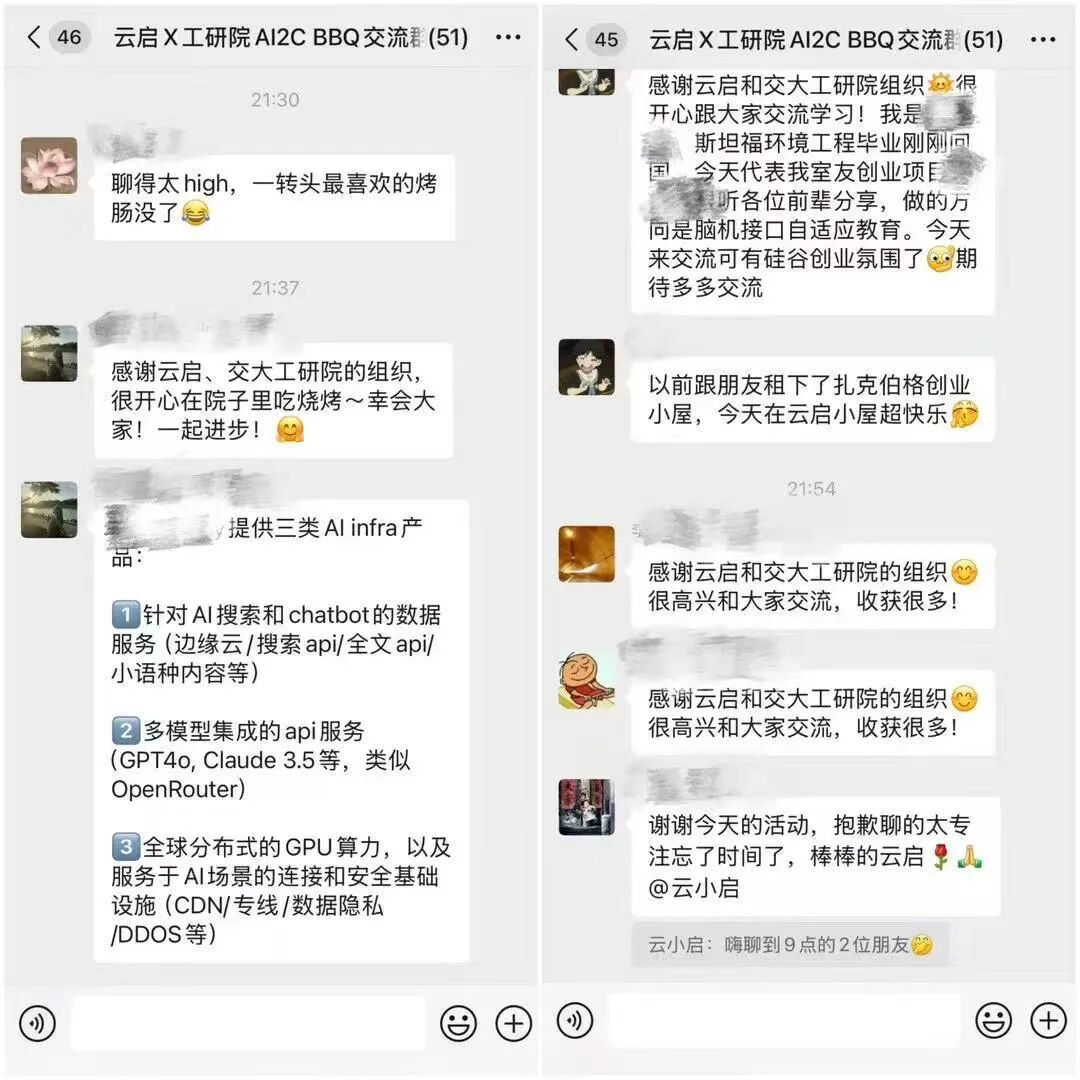
Late into the night of the event, attendees still sat in the courtyard facing their laptops, talking earnestly, losing track of time and forgetting about the BBQ skewers. We're glad to have built this platform for imaginative, creative, action-oriented founders. The "What's Next" series looks forward to meeting more entrepreneurs.
More event highlights 👇
About Event Partner Shanghai Jiao Tong University ITRI
Shanghai Jiao Tong University Industrial Technology Research Institute (ITRI) is an AI incubator and accelerator jointly established by Shanghai Jiao Tong University and Shanghai's Xuhui District Government. ITRI operates in an integrated tripartite structure with the university's School of Artificial Intelligence and Shanghai Algorithm Innovation Research Institute, building a full-chain innovation path from "0 to 1," "1 to 100," and "100 to N." It opens new pathways for regional original innovation, technology transformation, and industrial clustering, achieving a self-sustaining cycle of industry-research translation. ITRI connects on- and off-campus, domestic and overseas, and across (AI) industry boundaries, with focused breakthroughs in embodied intelligence, AI globalization, and AI for Science/Engineering. Through services including an AI globalization accelerator, AI community, AI empowerment middle platform, and AI talent pool, it fosters an innovation micro-environment that encourages "seeking truth, not hierarchy" and champions "AI Native" thinking, empowering young people who "always believe" to find breakthrough paths in complex industrial ecosystems. Ultimately, it aims to unlock the critical pathway for industry-research translation and achieve value co-creation among universities, local governments, and industry.