How Europe's Fastest-Growing AI Startup Landed $120 Million in Revenue in 90 Days | Yunqi Tech π

When will the fabled "breakout year for AI applications" actually arrive? There's no consensus yet. But the critical question of commercialization is already being explored and tested across AI applications in several verticals — customer service, law, programming, and beyond.
When will the fabled "breakout year for AI applications" actually arrive? There's no consensus yet, but the critical question of "commercialization" is being actively explored and tested across AI applications in niche sectors like customer service, law, and programming.
Swedish AI startup Lovable is one such case. In 90 days, this AI-powered no-code app development platform, run by a team of 15, reached $17.5 million ARR (roughly 120 million RMB) — a clear success from a product-growth perspective.
Recently, Lovable founder Anton Osika sat down with 20VC to discuss the business strategy, technical logic, and industry trends behind it. This edition of Yunqi Tech π shares the highlights with you.
Source: WeChat account "Silicon Rabbit" Author: Silicon Rabbit (compiled from the 20VC podcast) Original title: "15-Person Team Hits 120 Million in 90 Days! How Did This European AI Company Crush ChatGPT?"
Fifteen people. Ninety days. 120 million in revenue.
Over 25,000 new products created daily. Half a million users accumulated in just three months. Thirty-day retention at 80% — even surpassing ChatGPT at one point.
This isn't another Silicon Valley myth. It's the Swedish AI startup Lovable once again proving how AI is reshaping industries across the board.
Lovable uses AI plus low-code to turn app development into "building with blocks." Ordinary people can transform ideas into applications within seconds using simple prompts. Lovable itself reached $17.5 million in annual recurring revenue in just three months, adding $2 million net per week — roughly $300,000 per day.
In 2023, Anton Osika founded Lovable and became its CEO. He was among the core initiators of the Stockholm AI community. Lovable wasn't his first venture. In late 2020, he founded Depict.ai and served as CTO, applying machine learning to e-commerce.
Lovable founder Anton Osika recently joined 20VC for an interview that deeply examined how the company achieved these staggering results in 90 days, and the business strategy, technical logic, and market trends behind it.
Anton offers distinctive perspectives on AI technology and entrepreneurship, known for uncovering young talent and executing rapidly. He also shared hard-won lessons from his startup journey: why he prioritizes raw talent over credentials in hiring, and how to build a superstar startup in Europe rather than Silicon Valley.
➤➤➤
Podcast Highlights
-
Minimalist product philosophy: Focus on only three core features and nail the key experience. Avoid "feature creep" by aggressively saying no to unnecessary complexity. "Make the product feel more like Apple" — clean, smooth, intuitive.
-
MVP execution: Build core functionality in a single weekend, polish over a few more weekends, launch fast, and let user feedback drive iteration.
-
Product advantage: The biggest challenges in AI code generation are "quality" and "reliability." Lovable continuously optimizes algorithms and engineering architecture to give users confidence in AI-written code.
-
Homepage design: Drop users straight into the prompt box, letting them immediately experience the magic of AI-generated software.
-
Fundraising strategy: Rejected Y Combinator (YC). Only work with "the right" investors. Don't take money indiscriminately.
-
Business model: Monetize through subscriptions plus ecosystem, charging SaaS-style. But may introduce value-based pricing in the future, where users pay for actual usage.
-
Industry trends: OpenAI leads in brand recognition and consumer mindshare but lacks clear product direction. Anthropic has stronger positioning in AI ethics and enterprise markets, with more stable technology. Grok focuses more on commercial opportunities.
-
Global competition: European entrepreneurs more easily fall into "self-limiting" thinking, but Lovable's success proves you can build world-class tech companies outside Silicon Valley. European startups also need to learn "storytelling" and adopt Silicon Valley-style market tactics to capture user mindshare.
➤➤➤
Full Interview Transcript
Harry: I've spoken with several investors from your first company, Depict. What was your biggest lesson from Depict, and how did it shape your thinking about Lovable?
Anton: At Depict, we were expanding extremely fast because we genuinely love moving quickly. We were relatively inexperienced but had a lot of high-potential talent. I think it's important to seize many opportunities and find what works early on. Once you have more people, you have to follow up and maintain everything — you need to be more focused. We tried too many things at Depict. But as macroeconomic conditions worsened, we couldn't sustain our initial growth trajectory.
Harry: Gmail founder Paul Buchheit said a product needs three great features, and if it's simple, that makes it amazing. Do you share this view of combining product simplicity with functional depth?
Anton: Yes, I think at the product level, you should be as stripped-down as possible, making it feel more like the user experience of Apple products. Do what you want to do brilliantly. Don't say yes to everything.
Harry: Were there any moments that reshaped your thinking about Lovable?
Anton: Strong execution, and focus on talent — these are the two most important things for almost any company.
Especially talent — it's the most important element of culture. Who you work with every day, who you interact and collaborate with.
Harry: So you prefer talent over extensive experience. How has your hiring experience been on this front?
Anton: I think experience can be a bad thing in certain situations. You generally want ambitious people who have a lot to prove, who are more open about how teamwork should function. When people are young, the best people we can hire — many roles are well-suited for newcomers. Some newcomers are quite excellent. They haven't done many projects yet, but have the potential to grow into founders.
Harry: Would you hire them even if they haven't done something similar before?
Anton: In most cases, yes. Some positions, like engineers — they need to understand software engineering. They need deep experience in that domain to guide junior employees on what appropriate work looks like.
Harry: Were you always certain you would succeed? When you were young, did you believe you could achieve something?
Anton: No, I didn't think so. I was always frustrated that people around me didn't understand things as quickly as I did. But at some point, I suddenly realized I was being naive. I would record what might happen in the future — I think this is one of my superpowers that led to my success, though I didn't know how it would materialize.
Harry: How did you earn your first money?
Anton: I was always obsessed with computers as a kid, loved organizing parties. I noticed many neighbors, friends, and family had computers. When they ran into maintenance issues, they needed my help, and paid me after I fixed things. Repairing computers became my side hustle as a teenager.
Harry: Wow, you fit all the characteristics of successful founders I mention on the show. First, making money early. Second, being good at games. Both are very, very apparent. So where did the idea for GPT Engineer as a side project come from?
Anton: We had a saying — let GPT Engineer start as a side project.
The idea originated in the spring after ChatGPT launched. A year before the launch, I sensed that as data increased, the scale of these models would create a massive wave. I was traveling with my wife at the time — travel makes you more creative.
No one was talking about AI agents then. On the plane, I started writing extensively, thinking many things should connect — you basically put large language models in a "for" loop, and you could have AI do many agent-like things.
When I returned to Sweden, I thought: where do I apply this? Obviously, software engineering. I'd been discussing this with people, but felt no one truly had the imagination I envisioned.
I first built an initial version using ChatGPT or the API, then built an agent that wrote code. I put the two together, worked furiously over coffee, and ended up with version one (V1) — I had the agent write and create a Snake game, and you could get a running Snake game on your computer.
Harry: How long did it take you to build that first version of the agent during that coffee-fueled session?
Anton: I think roughly one weekend, then a few hours of polishing. Then two more weekends of refinement.
Harry: For many founders listening, what's the biggest lesson or advice from building many different V1s?
Anton: For most first-time founders, I would truly focus on users and user problems. And think: how can I make one person love what I built in V1? That's my advice. But in reality, I just posted a video on Twitter, millions of users started using it, studying it.
Initially, I had no idea I would build a company around this. I just found it fun... It was an open-source project. I started by building a community to continue working on this open-source project.
Later I told my then-co-founder: this can absolutely become huge. I'd been thinking about doing something else, and this seemed like a good option for me. Maybe it was time to find a good replacement for my CTO role at Depict.
Harry: Months passed, the community kept growing. What happened next?
Anton: I found a great person to take the CTO role. Meanwhile, I decided I wanted an amazing co-founder — the most efficient, no-BS, least-bullshit engineer and entrepreneur. He had sold a company I'd previously wanted to partner with. I went to his apartment and said, let's plan the future. Then I got him on my team, and together we built the first version of Lovable.
Harry: And you had your co-founder. When did you plan to launch Lovable? How was progress at the company?
Anton: We launched Lovable a year after we started building. In the meantime, we released a waitlist preview version of the app called GPT Engineer. During this period, we gathered user feedback and attracted some brand attention.
I think the first version was quite good — some people really loved it. But the important "aha moments" didn't resonate with enough people.
Over the next year, as we kept iterating on the product, we bundled all of this together into Lovable. I wanted to build a SaaS business where users build their entire SaaS company and make money through our AI.
Harry: You mentioned the waitlist version. Do you have any important lessons or advice on how to do a waitlist well?
Anton: Waitlists are useful because you can precisely control how many people you want to recruit and do user interviews with. So I think just getting enough people on the waitlist is fine.
It's a great way to filter for the people you want to interview. Like, who should you probably talk to, who should you have conversations with, who do you want to sell to, who can get the most value from your product — then filter for those people and talk to them.
Harry: When you're doing user interviews and gathering user feedback, do you have any important lessons or advice on how to do that well? What questions are good? What questions are bad? Any lessons learned?
Anton: For us, there were two different types of user interviews.
There's one type where you just watch them use the product, then ask them things like, how well do they understand the product, and so on. This is more like a UX interview.
The other is understanding whether they've just tried the product. We'd ask them, you've tried the product. Why are you interested in this? And ask what problems they're facing in their business, trying to figure out what the biggest pain point is that they really want to solve. If I can show customers that I can help them launch their first version faster with AI, I think I can get more customers.
Harry: How does Lovable change team structure?
Anton: Harry, if you want to create a personal website for yourself, it's incredibly efficient — you have no team, just you. You just create it with AI. But that's not a team. When you have existing software and you want to iterate and change that software, AI might completely mess it up and break your entire codebase. So you need to work with a software engineer who knows how to improve things and always maintain product quality.
Harry: You mentioned that it took people some time to find that aha moment. How important is the timing of the aha moment?
Anton: I think if we could speed up the aha moment, our conversion rate could double.
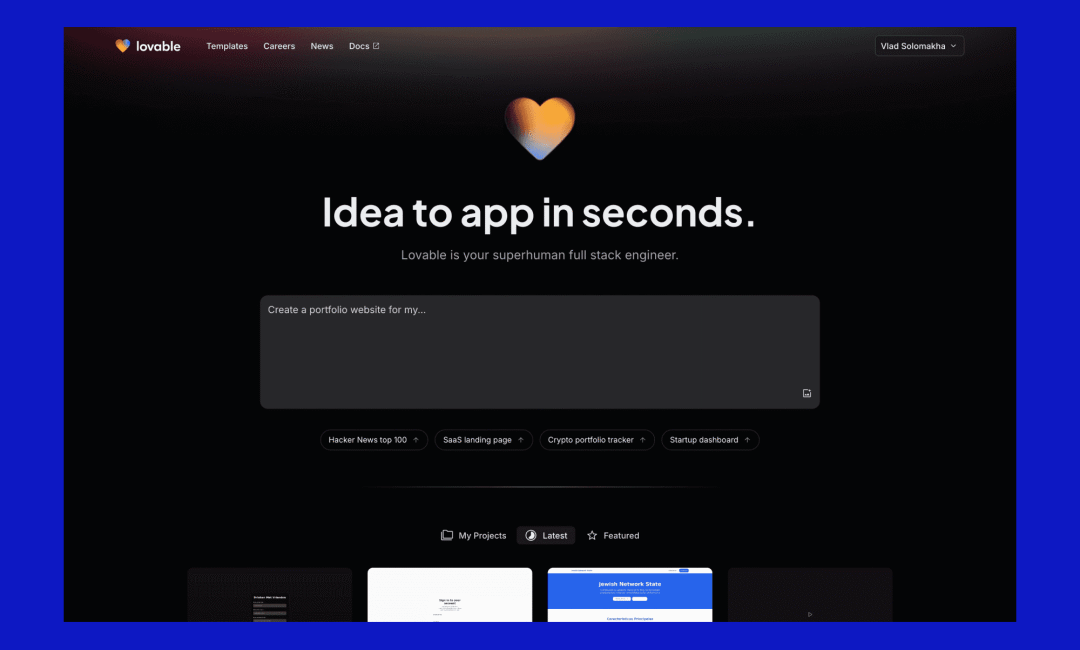
When you come to Lovable, you just see a prompt box. It's incredibly engaging. You don't land on a landing page — you see a prompt box. And for those who enter the prompt box, you get to an aha moment very quickly. That's what I'd recommend. Just give users something interactive with instant reward.
Harry: You mentioned the prompt box itself. Many guests on previous episodes have said that the biggest mistake ChatGPT made was making chat the default UI for the future of AI. Do you think prompts in our products today are the default UI design for the AI era?
Anton: I think yes. Prompts can do almost anything — just prompt and explain your idea through text input. It's also very easy to implement and iterate on. Over time, it will become more advanced and not just about prompting. People are still building interfaces for creating software, and no one knows what that interface will look like. But I think prompts will always be around.
Harry: You rejected YC. Why did you reject YC?
Anton: We felt that in the best case, YC would dilute us a lot. And in the worst case, going to San Francisco and experiencing YC would be distracting.
Harry: When did the seed round start? Was it after launch or before launch?
Anton: The seed round was before we launched the first waitlist version of the product.
Harry: How did the seed round go before launching the waitlist version of the product?
Anton: The advice I've always followed is to work with investors you like. I knew some people from before who I thought were great, and I wanted them by my side whether things went badly or well.
Harry: How large was this round?
Anton: We got $3 million first, then added some more. We did get a lot of cash because you never know what will happen in the market. So we raised quite a substantial pre-seed, almost $8 million.
Harry: Would you advise founders to raise quite a substantial pre-seed if they can? If the money is on the table, would you say take it?
Anton: It depends on how you want to operate. Like, if you enjoy talking to investors — at the time I said no, I just want to build the technology. If you raise a large pre-seed, you have time to figure these things out. If you enjoy talking to investors, I think you should do that, and I'd do more iterative, smaller raises.
Harry: A lot of founders today are very sensitive to dilution from day one in a way they never were before. Like 10% is the maximum they're willing to give up in a round. How do you think about dilution sensitivity?
Anton: I met a very smart person who said, no, dilution doesn't matter that much. It all depends on the size of the pie. Combined with my own view: minimize dilution. This is my life's work. So that's my main thinking right now. That's why we raised this round the way we did.
Harry: When did the product launch? How did the launch go?
Anton: We launched with Lovable on November 21st last year. That was just four months ago.
Harry: So you launched from day one of the company's founding. That's crazy? How did it go?
Anton: We had paying users on the early version, then we launched. I don't think it was one of those amazing launches. We kept improving the product quickly, the product started accelerating, and growth started accelerating. We were growing $1 million in ARR per week.
That number kept growing, kept accelerating. We ran into a lot of scaling issues and then patched things up.
When we saw this explosive growth, we had to take a lot of quick fixes on the product side.
Harry: So you rewrote the product as quickly as possible to keep it stable?
Anton: Yes, so it took a little over eight weeks. I mean, it's not completely done even now, but we spent eight weeks on it.
Harry: You mentioned something like a million a week. How much are you growing per week now?
Anton: Two million per week.
Harry: What do you think is the most common cause of slowing down in a company's development process? For founders listening, what should they watch out for that happens frequently?
Anton: The reason product development slows down is usually that your product is complex and has too many requirements. Harry, you said earlier that a good product should have three great things, and I think that's usually very wise. Simplicity guides product direction and lets you know where you're going and what you're doing.
Harry: Looking back at Lovable's development since founding, where did you invest time and energy from a product perspective? In hindsight, what shouldn't you have done?
Anton: At Lovable, we spent a lot of thought on community and community features inside the product. I think this might have made sense if we saw growth slowing down. But growth isn't a problem right now — you don't need community features to drive growth. So I think that was a complete waste of energy.
Harry: Do you believe "build it and they will come" is actually true today?
Anton: If you're absolutely convinced you have very strong conviction about an untapped potential product, and you have the ability to demonstrate the product's strength, users will come, and it will work.
But in most cases, just building it and expecting users to come is too risky. You can build it and make them come, or try to make them come — the risk is much lower.
Harry: Nick Revolu talked on one episode about how the most successful founders he's invested in are between 30 and 35 years old. They don't have the naivety of very young founders, but in some ways they don't have obvious fatigue, or rather, you know when you're young you have more energy than older founders. Given your age now, how do you think about this?
Anton: I think energy is very important, and I think naivety is one of the benefits. But I also make mistakes, even lots of mistakes. This is also my first time being a manager.
Harry: What's the biggest mistake you've made?
Anton: Thinking we should change the culture, become bigger, grow more slowly, or add more management layers. When we had 40 people, that was my biggest mistake.
Harry: Why did you think that?
Anton: My co-founder and other executives we talked to said, oh, now you have to hire executives and so on. That was a bad idea.
Harry: So you started hiring executives?
Anton: Yes. The people I hired didn't work out, and it slowed me down.
Harry: So when you think about this, what advice would you give other founders? Don't believe the bullshit that you can't scale without executives?
Anton: Many founders hire talent like mercenaries, maybe technically skilled people, but they operate within their own domains. I hire generalists and empower them as much as possible. If you have a lot of super smart generalists, adding executives on top of them is high risk with questionable reward.
Harry: When you're scaling users so quickly, growing revenue so fast, does company culture break at some point?
Anton: Usually I think it does. Or rather, it changes, it evolves. This is something I'm very mindful of, and it's why I'm so scared of adding too many people.
Harry: What are you worried about?
Anton: The most important thing for everyone in our company is to lead by example — showing how much you care about the product, the users, the team, and how the team is doing. Setting the example, making sure others care as much as you do. This comes from ownership of the company culture and the team. If there are too many people, it usually gets diluted, and that's the root cause of culture breaking.
Harry: We have teams scaling, user base scaling, revenue growing. We're actually making a lot of money right now. Why do a Series A?
Anton: We can accelerate by adding an investor who is a partner and can help us find more great people on the committee.
Harry: In the US, you have quite a few competitors. When competitors have a lot of money, do you have to raise too?
Anton: I don't think so. We can be self-sustaining. When you can do most things on your own, you never need to raise. But your competitors can outspend you on talent, customers, and marketing. I'm not afraid of any of that. The only thing that matters is execution. So if you can out-execute me, then I'll be scared.
Harry: Where can you improve your execution? What do you think you could do better on?
Anton: I think it's doing fewer things. I think we can do fewer things at Lovable. A lot of people have great ideas, and every idea is great, but you can only have so many, and you should only execute on a subset.
Harry: We talked about team and culture. You've been very passionate about building in Europe, keeping the team in Europe, being a European company. A lot of people tell me that staying in Europe is deliberately not doing what's best for your career. You'd be more successful if you were in Silicon Valley. What do you say to them?
Anton: Talent and culture matter most, and Europe has more raw talent. The culture isn't like America's, but I have to say, American culture is more conducive to startup success — that's well known.
Harry: What specifically do you think that culture is?
Anton: It's an atmosphere around ambition, growth, and making entrepreneurship go smoothly. In Europe, people live a work-life balance. In Sweden, we talk about Jantelagen — the idea that you shouldn't think you're better than others.
Harry: What do you say to someone who says you'd be more successful in Silicon Valley?
Anton: As a founder, you have more degrees of freedom to leverage that talent to succeed.
Of course, there are many benefits to being in Silicon Valley too. I think building in Europe is a bit like choosing hard mode in a video game. I'm happy to play hard mode and show that you can build an alternative kind of company, in Europe, that is lovable.
Harry: How do you respond to people who say Lovable can't build sustainable revenue on AI, and that it doesn't have stickiness?
Anton: Our first-month retention is better than ChatGPT paid customers' first-month retention. So it's about 85% and climbing. Some people come in and churn their credit card because they want to try it, want to learn — that's perfectly natural.
Harry: What do you do to meaningfully improve retention?
Anton: The simplest thing we can do is deliver more of the important aha moments — make sure all of our users get more important aha moments about how to use the product.
The most important one is: when you feel stuck and the AI doesn't understand you, as a user, there's a lot you can learn to solve this. It's about how you prompt, how you understand why the AI isn't working, and explain or clearly articulate the problem you're seeing. The problem you discover might be something you run into when building more complex features, which might require hiring an engineer to make a small tweak to the codebase. This is something our users should know, but probably not every user does.
Harry: What's your key metric today? If there's one number the whole team focuses on, what is it?
Anton: User count, the team using what they built end-to-end, and watching what users are building. That's what we focus on.
Harry: What's the number today?
Anton: So we have almost 40,000 paid users.
Harry: Do you care about time from start to creating a website?
Anton: We care about it as something we can improve, but it's not something we have to focus on. We're just making the core AI part better — that's what we focus on.
Harry: Whose models are you using right now?
Anton: We use all of OpenAI's models, Google Gemini, and the main tool for writing code is Anthropic's Claude model.

Harry: Hypothetically, you have $60 billion Anthropic, $300 billion OpenAI, and $50 billion Grok. What do you buy, what do you sell?
Anton: I care about where the best talent is. I think Elon is very good at attracting talent, so I'd buy Grok. I think they're also good at finding commercial opportunities. Even though Anthropic is my favorite — I love the culture and leadership there. I'd short OpenAI. Even though they've performed well in this messy situation, they haven't proven over the past year that they can have clear product direction and focus.
Harry: The two most important things in the next wave are building brand and getting consumer recognition, and launching consumer-facing front-end products. OpenAI has done this well — when you look at brand, everyone's mom knows ChatGPT. They don't even know OpenAI, but they know ChatGPT.
Anton: I think we're still in the early days of AI. If you look at enterprise revenue, Anthropic has almost caught up to OpenAI from nothing, with absolute dominance. I don't know what Grok will do here, but I expect Grok will, like OpenAI, lose all their best talent to Anthropic. I think Grok might change things here.
Harry: I spoke with a very smart friend earlier who said the biggest concern is that open-source or a large company with massive distribution advantages enters and wins the market. What do you think about that? Is that a concern?
Anton: Large companies move very slowly in many areas. So they'll never have the best product in the market. Some of these large companies have distribution advantages, but overall, this will be a growing market, and as a startup, you can easily take the best position in certain market segments.
Harry: I imagine one of the real transitions you have to face is moving from PLG and a kind of pro-sumer product to enterprise. How do you think about that transition? Given the speed of revenue growth, isn't that a concern?
Anton: If we're going to do enterprise, I'd want to do it well. But we're not doing enterprise for now. What we want is to become the best place for developers to build products, and to delight millions of the most talented developers. If we succeed at that, then it'll be a good transition into many other areas, including enterprise.
Harry: As we look ahead, if you had to choose, what are you most worried about? Regulatory challenges, competition, or hype cycles?
Anton: I think if some competitor is very, very good at marketing, that would worry me.
Harry: How important is building brand?
Anton: Brand is a product of the product. There are other factors. Product is the most important. Then good product plus awareness creates brand. I think that's enough. So it's more of a downstream effect or something.
Harry: When you're adding $2 million in ARR per week, you'll have more and more investors wanting to give you money. What do you think? What makes it worth taking versus a distraction?
Anton: Stop reaching out to me — it's a distraction. It becomes worth it when we know exactly how we want to spend the money. Or it's a partner we really want to work with, and we'd never regret saying yes to them.
Harry: What would be a huge boost to the company?
Anton: Hiring one or two more perfect technical product people.
Now for the rapid-fire round —
Harry: What do you believe that most people around you don't?
Anton: That we have very smart models today. I think that's where people disagree with me. Models are smarter than humans, but models don't have as good memory as we do, they don't have enough context.
Harry: Given where things are today, how quickly will we scale context and memory?
Anton: What needs to scale is the process of deciding what to store in memory. I think that's what has to scale. It has to store all of this stuff. Like my conversation with Harry has to be stored in the system somehow. My childhood almost has to be stored too. I don't know. This will take years.
Harry: If you could buy and hold one public company stock for 10 years. Which would you buy and hold?
Anton: Talent is the key factor. First one that comes to mind is Tesla. Their positioning outside of software is also interesting.
Harry: What's the most important trait in a founder?
Anton: I think it's judgment, especially judgment in picking talent. I like people who hire people who can see potential in employees.
Harry: What's your biggest weakness as CEO right now?
Anton: I'm not as good at multitasking as I wish I were.
Harry: If Lovable fails tomorrow, what would be the reason? Like, investors write a pre-mortem — what would be the reason Lovable doesn't work out?
Anton: The only thing I can think of is that we lose momentum and excitement. That's what's driving us forward today.
Harry: What have you changed your mind on in the last 12 months?
Anton: You don't need to depend on one foundation model provider. They're all going to be great. There won't be just one winner here.
Harry: What's your favorite failure?
Anton: My favorite failure is when the fit didn't work, so I could do more things.
Harry: What do you care most about in the world today?
Anton: I wish the entire leadership class were true idealists who could be kinder to people who disagree with them. But the leadership class in the world today is usually a bit corrupt and narrow-minded — that's what worries me.
Harry: What's your biggest short before going public?
Anton: Like a SaaS company with per-seat pricing, whose ICP will be replaced by AI SaaS that just replaces employees.
Harry: What's the future of pricing in an AI world?
Anton: I think it depends on how defensible the business is. If you're selling to enterprises that never change their SaaS software, you should try to do some value-based pricing. I don't know how you get value-based pricing right, I'd think about doing that. Beyond that, I don't think you should innovate too much on pricing — do something that's already been proven to work.
Harry: What are you most excited about over the next decade?
Anton: Hopefully AI can help us humans understand each other better, and achieve more win-wins. That would be amazing. I'm excited about that. Our leadership is actually being augmented by super-AGI.