The Most Intense Week in AIGC! AI's "iPhone Moment" Has Arrived | Yunqi Capital ChatGPT Special

AI Is Shifting Yet Again

This week, OpenAI, NVIDIA, Microsoft, Google, Adobe and others all launched their own AI services within days of each other — the one-upmanship seeming to broadcast the same anxiety:
"In this era of AI, if you don't want to be disrupted, you have to disrupt others first."
"Yunqi Tech π" continues its ChatGPT special series. In this issue, we share the latest AIGC developments announced by major tech giants. Enjoy!
Compiled from | QbitAI, Metaverse Post, ifanr ➤➤➤ The tech giants are going all-out around AIGC!
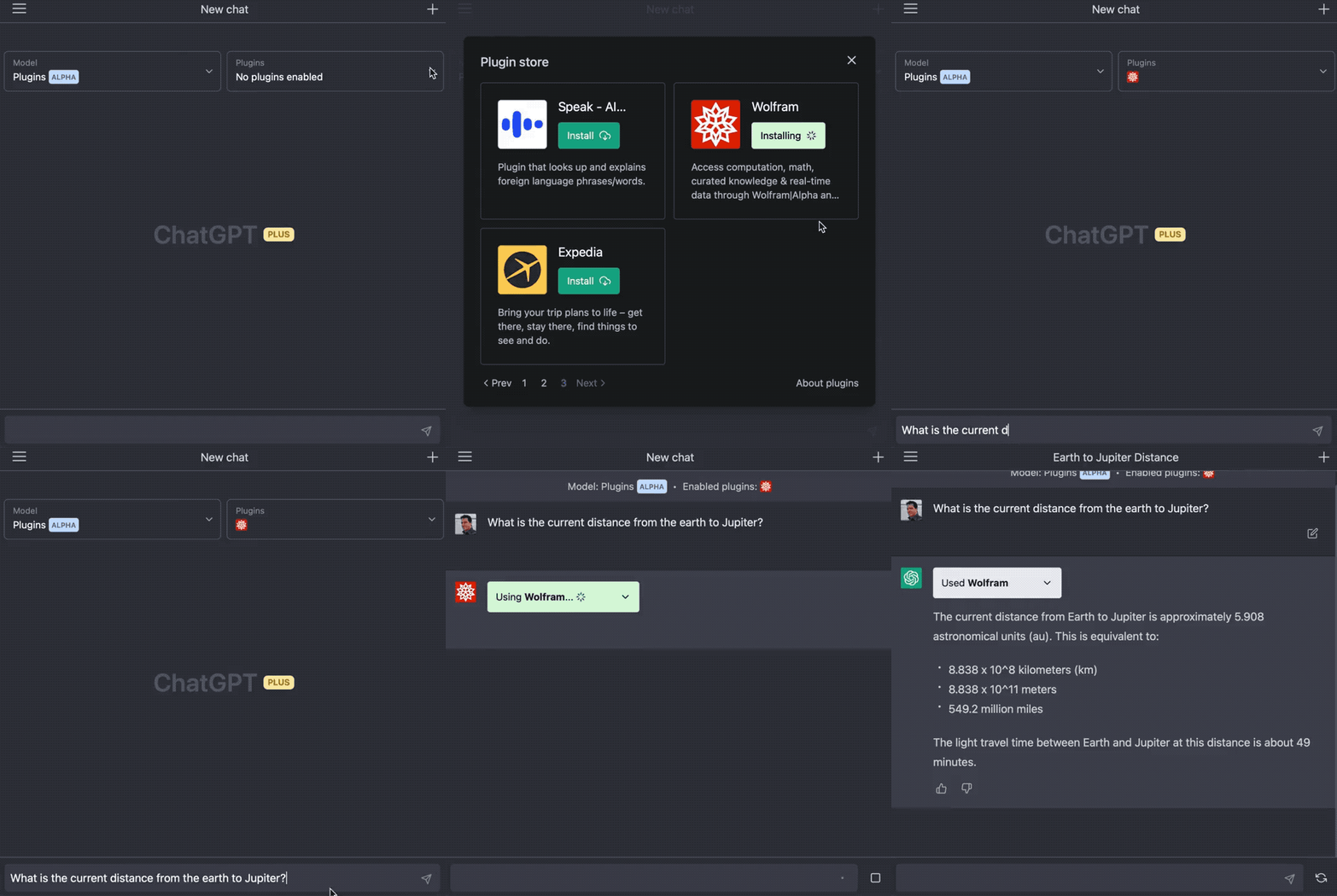
In the early hours of March 24 Beijing time, OpenAI announced ChatGPT plugins and opened access to two of its own: a web browser and a code interpreter.
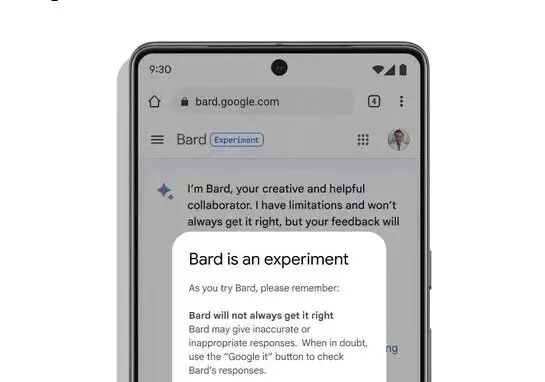
Three days earlier, Google had also suddenly announced it was opening its Bard AI chatbot to users for testing. The product, positioned as a ChatGPT competitor, had first debuted in February and was something Google had pinned high hopes on.
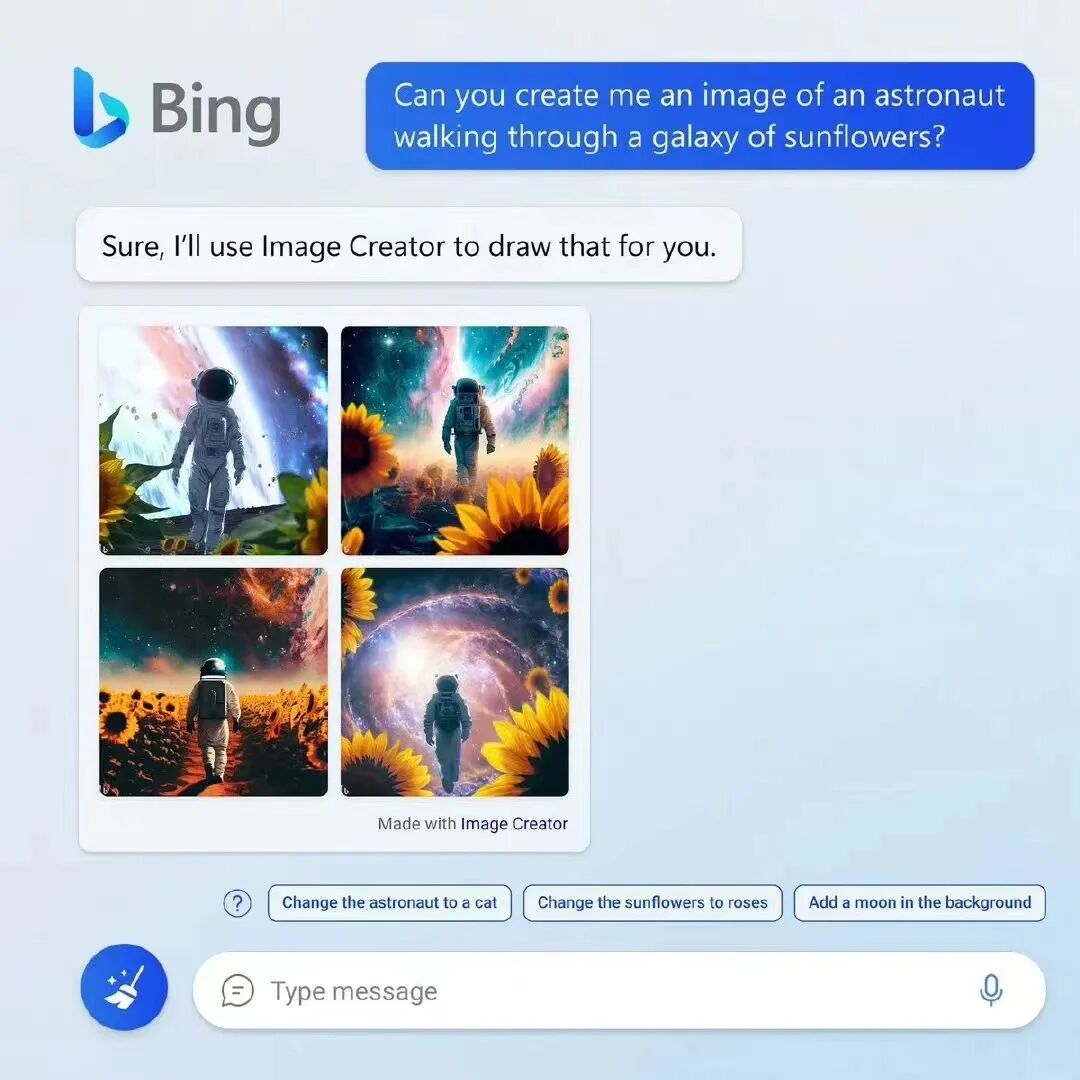
At the same time, Adobe released its generative AI tool Firefly, while NVIDIA CEO Jensen Huang announced a slate of new products in his GTC keynote address. Meanwhile, New Bing also got in on the action, announcing the addition of AI image generation capabilities.
Overnight, five tech giants announced their latest AIGC developments in quick succession. Combined with the recent releases of GPT-4, Microsoft 365 Copilot, and Baidu's ERNIE Bot, this "AI war" has entered a white-hot phase.

ChatGPT Drops a Bombshell Update!
Can Now Browse the Web for New Knowledge, Interact with 5000+ Apps
OpenAI just dropped another bombshell —
Announcing plugin functionality that gives ChatGPT the ability to use tools, browse the web, and run calculations.
In an official demo, once ChatGPT was connected to the math knowledge engine Wolfram Alpha, it no longer had to worry about numerical precision.
And it opened access to two of OpenAI's own plugins: a web browser and a code interpreter.
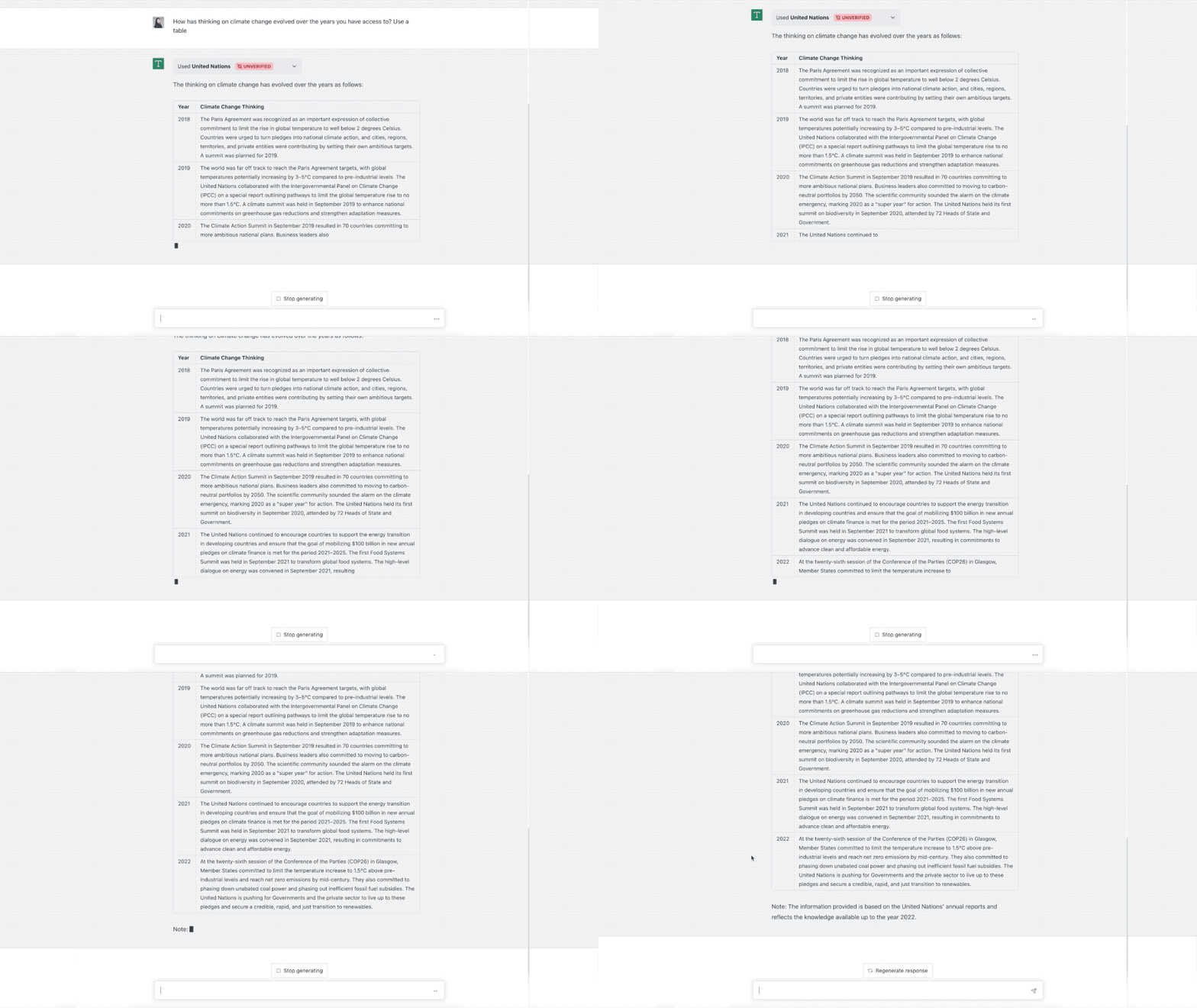
Previously, because it wasn't connected to the internet, users could only query information up to September 2021. But now it can not only retrieve the latest news directly, but also solve mathematical and scientific computing problems in one go!
It also supports individuals or enterprises feeding private data (documents, notes, emails, etc.) to ChatGPT, turning it into a "second brain" for people or an intelligent assistant for enterprises.

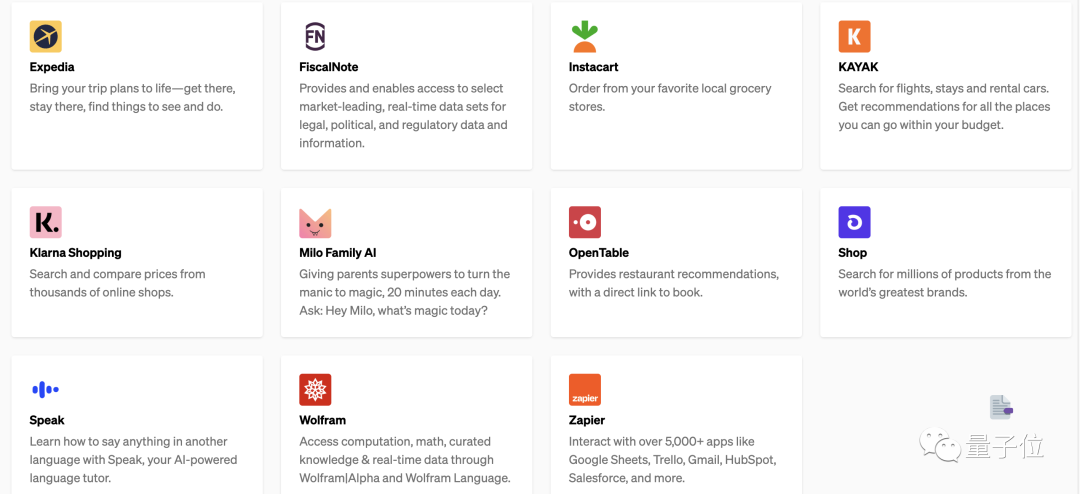
A fleeting three-page list of third-party plugins also includes:
- Letting ChatGPT look up vocabulary and phrases in languages around the world
- Letting ChatGPT query flight and hotel information to help plan business trips
- Letting ChatGPT access e-commerce data to compare prices or even place orders directly
- Letting ChatGPT connect to the automation platform Zapier, linking with virtually all office software to create your own custom intelligent workflows ...
And this is just the beginning — permissions and methods for creating plugins will also be opened to developers.
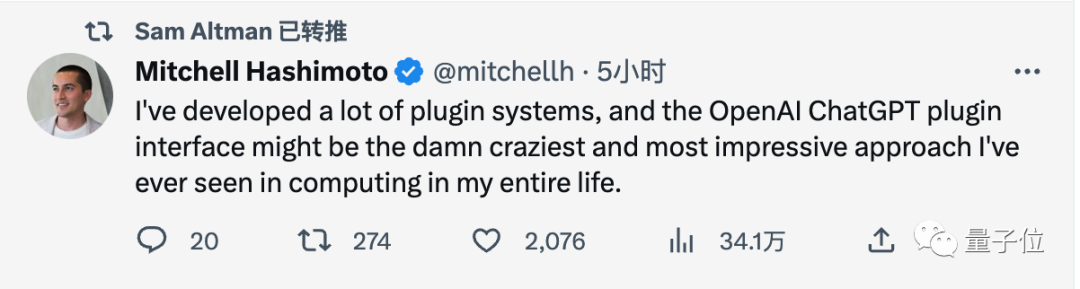
A veteran programmer marveled:
I've developed plugin systems for many software projects, and the ChatGPT plugin interface may be the most insane and impressive one I've seen in my entire life.
According to the official description, this plugin functionality is primarily a language model design tool with safety as a core principle. For now, OpenAI is still having users join a waitlist.
But they also said that although it's currently in Alpha, prioritizing a small number of developers and ChatGPT Plus users, they're making a promise:
Broader access is only a matter of time.
From the "initial capabilities" already demonstrated, ChatGPT now has three key abilities:
- Accessing the latest information, such as sports scores, stock prices, and breaking news;
- Retrieving information from knowledge bases, such as company documents, personal notes, and running calculations;
- Taking actions on behalf of users, such as booking flights or ordering food.
Currently supported third-party plugins include restaurant recommendations, travel planning, shopping, AI language tutors, online stores, as well as academic knowledge applications like Wolfram, and app libraries (interacting with over 5,000 applications, including Google Sheets)... Looking at it this way, it seems to cover nearly every aspect of our daily lives — clothing, food, housing, transportation, work, and study.
Beyond that, OpenAI also has two plugins of its own: a web browser and a code interpreter, and has open-sourced the code for a knowledge base retrieval plugin.

Can't Wait?
Google Forces Out Its ChatGPT Competitor
Strictly speaking, Bard isn't anything new.
As early as February 8 this year, Google had already shown off this chatbot, launched to compete with ChatGPT. What nobody expected was that the demo would turn into a "disaster" — Bard got its very first question about the James Webb Space Telescope wrong, forcing Google to hastily take down the official demo video.
As a product built to counter ChatGPT, Bard moved fast but was clearly underprepared, and "oversold" in its marketing. Reports noted that Bard was initially aimed at a limited developer audience, which should have required extensive testing time, but was ultimately rushed to market. The price: Google's stock plummeted 9% that day, wiping out $100 billion in market cap in a single day, and Bard's public rollout was forced to be delayed.
But with GPT-4 and other competitors closing in step by step, Bard still had to be pushed to market.
So on the 21st, news broke that Google was asking employees to ramp up testing, and sent emails to the Pixel Superfan community asking those users to join the testing pool.
So is Bard really ready?
From Google CEO Sundar Pichai's tweets, we know that this open access starts with users in the US and UK — users at other nodes can't join the waitlist. Additionally, Bard currently only supports English and lacks coding capabilities, so it won't respond to code-related queries.

Media outlets that have already joined testing also note that Google has placed limits on Bard's contextual conversation abilities, which will require more feedback to gradually strengthen.
From this, we can see that even after a month of refinement, Bard still bears traces of being "forced out the door."
But after all, Google has invested in AI for many years, its star product AlphaGo once had its moment in the sun, and the conversational AI model LaMDA behind Bard has also undergone long-term training. Bard is still worth looking forward to.

Getting Into AI Art Itself,
Is Adobe Once Again Changing the Design Industry?
Beyond chatbots, another hot direction in AIGC is AI art generation.
Just recently, the AI art tool Midjourney V5 officially launched. Its powerful drawing capabilities and ultra-high output efficiency caused a huge stir online.
Simply put, Midjourney V5 not only offers more diverse styles and more striking texture, but also solves the "hand problem" that has long plagued AI art.
Without specific labeling, the results are virtually indistinguishable from real photographs.

Image | A Chinese couple drawn by Midjourney V5
But as good as Midjourney is, there are still some barriers to using it, including hardware requirements, tuning parameters, and it also demands a certain level of artistic literacy from users.
So for ordinary users who want to experience simple AI creation, Adobe says: "We'll just integrate it directly into Photoshop!"
According to reports, this suite of AI tools is collectively called Firefly.
In the demo, Adobe showcased two products from this suite.
The first can generate images from text prompts, offering hundreds of styles for designers to adjust;

The second generates various text effects, similar to artistic typography.
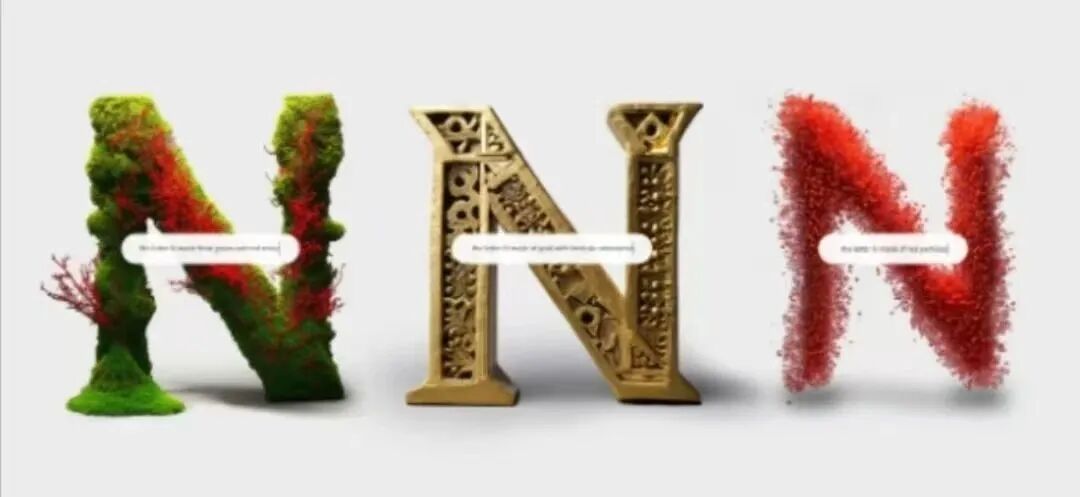
Interestingly, just as Microsoft stuffed GPT-4 into the entire Office suite, Adobe also plans to stuff the AI tool Firefly into the entire Adobe suite. The series is already integrated into Adobe's enterprise creative tool Adobe Express, and will subsequently be fully connected to Photoshop, Illustrator, and Premiere.
From the demo, Firefly may not be as stunning as Midjourney, but its practicality is maxed out. For ordinary users, if they master this suite of tools, it should be more than enough for daily needs. Adobe also stated that AI won't replace creative talent, but will enhance their competitiveness and creativity.

"The iPhone Moment of AI" Has Arrived,
NVIDIA Launches Multiple New Products
NVIDIA CEO Jensen Huang introduced the company's latest AI advances in his GTC 23 keynote address, and explained how these technologies will impact industries and daily life.
Jensen had a lot of substance and a lot of product releases. To put it simply: NVIDIA has once again left its competitors in the dust in the AI computing power race.
· Heavyweight Product 1: NVIDIA DGX Cloud
NVIDIA announced partnerships with multiple cloud service providers to launch NVIDIA DGX Cloud, allowing enterprises to access supercomputer-grade AI computing performance through a web browser without needing to purchase or own servers — simply using DGX Cloud infrastructure hosted through cloud service provider partnerships.
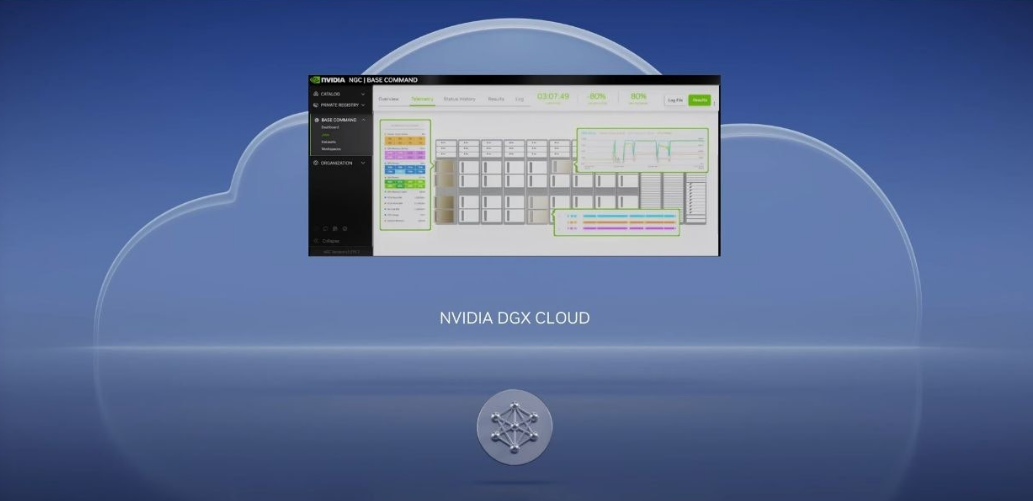
Simply put, DGX Cloud brings NVIDIA's powerful computing performance to the cloud platform. Enterprises can access AI supercomputer computing power through a web browser, saving the costs of procurement and deployment.
· Heavyweight Product 2: CuLitho Accelerated Computing Technology
NVIDIA announced it will collaborate with ASML, TSMC, and Synopsys to launch the CuLitho software library, using AI and machine learning technology to assist computational lithography, further advancing semiconductor lithography technology to enable chips with more compact transistors and wiring, while accelerating time-to-market and improving product energy efficiency.
According to Jensen Huang, this technology can speed up computational lithography by 40x. With GPU acceleration, the computational lithography work for producing photomasks can be reduced from weeks to eight hours. This technology will also be adopted for TSMC's 2nm process.
· Heavyweight Product 3: A Superchip Purpose-Built for ChatGPT
At last year's GTC graphics technology conference, NVIDIA released its first data center CPU Grace and next-generation high-performance computing GPU Hopper, and simultaneously used them to create two "Super Chips": one combining two Grace CPUs, and another combining a Grace CPU with a Hopper GPU. A year later, Jensen Huang finally unveiled the physical product.
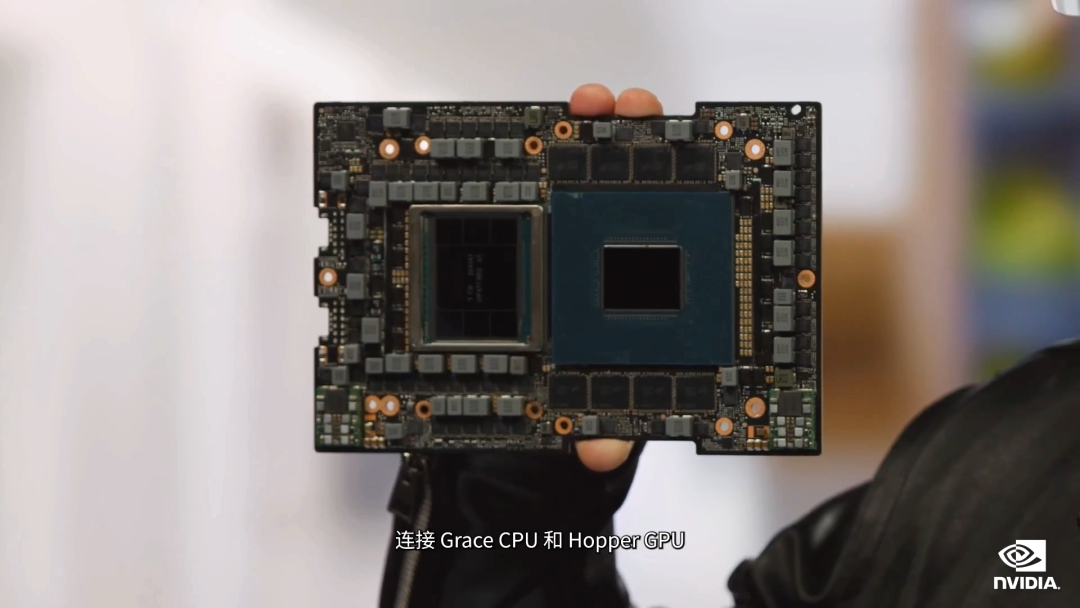
According to Jensen Huang, this product is exceptionally well-suited for processing large datasets, but he didn't reveal more specifications or performance details, only mentioning that the communication bandwidth between CPU and GPU is more than 10x that of traditional PCIe buses.
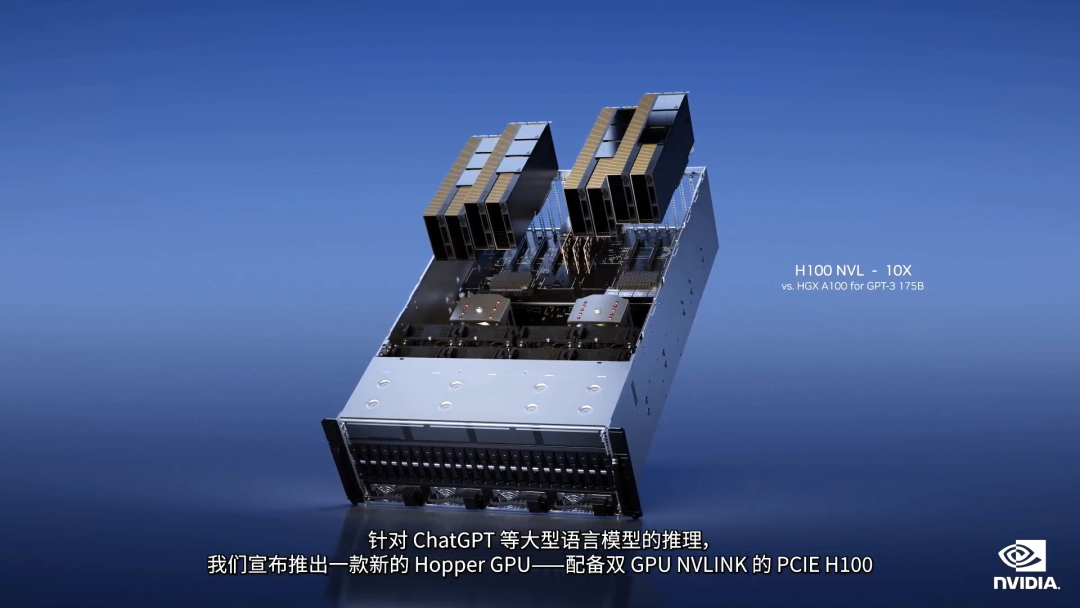
Additionally, for compute-hungry applications like ChatGPT, NVIDIA released the NVIDIA H100 NVL equipped with dual-GPU NVLink — a large language model (LLM) dedicated solution with 94GB of memory and an accelerated Transformer Engine.
Beyond these products, Jensen Huang also announced Picasso service, Omniverse, the quantum-class computing system DGX Quantum, digital twin factories, and more. All revolve around NVIDIA's latest AI technology, demonstrating the company's layout across numerous fields.
AIGC and artificial intelligence are hot spots in the industry, with significant future commercial value. This competition unfolds in fog, and proceeds in fog. The only constant is: "Everything is changing."