Apple's AI Report Card: How Much AI Is Actually in the iPhone 16? | Yunqi Tech π

Is the AiPhone Era Here?
After debuting Apple Intelligence at WWDC in June, Apple — long seen as a latecomer to the AI wave — finally unveiled its first suite of AI products at its new product launch event in the early hours of September 10 Beijing time.
What solution did Apple adopt for on-device model execution? How deeply are AI features integrated with the iOS ecosystem? What new capabilities will AI-enabled iPhones offer? This event provided preliminary answers to these questions.
How did Apple's first AI report card fare? Based on publicly available information, Yunqi Capital believes the highlights of this update include faster AI algorithm execution speeds, upgraded camera features, and AI note-taking capabilities. This continues Apple's consistent emphasis on user product experience. However, there are still no obvious AI traces at the most anticipated level of software ecosystem interconnectivity, and the overall implementation of AI features remains relatively restrained. More iterations are worth looking forward to.
For more details from this launch event, let's dive into this edition of "Yunqi Tech π."
This article is republished with permission from GeekPark.
Author: Yongyi Zhang
Editor: Zheng Xuan
Original title: The First AI-Era iPhone Is Here — Does That Mean the AiPhone Era Has Arrived?
In 2023, when ChatGPT surpassed one billion users and fundamentally transformed the world, the hardware sector as a whole actually remained in a lagging state: it wasn't until late 2023 that an increasing number of phone manufacturers began touting the concept of "AI phones."
But these updates, achieved merely through integrated software with little to no system-level involvement, not only failed to convince professional users — more importantly, the vast majority of ordinary users could hardly perceive any fundamental conceptual shift.
It was precisely because the industry had long remained in this state that Apple, as a giant spanning hardware, chips, and software in the smartphone domain, was widely seen as one of the few manufacturers capable of fundamentally changing this industry status quo and building a true "AI phone."
Indeed, at the September 10 early-morning launch event, Apple did treat "AI" as a major selling point for this year's hardware lineup, even proclaiming the iPhone 16 as "the first iPhone designed for Apple Intelligence."
But can the iPhone 16, alongside the Apple Watch and AirPods unveiled at the same event, truly lead the industry into the "AI era"?
01 Pricing: New iPhone Starts at ¥5,999
First, the essentials. This launch introduced the iPhone 16 / 16 Plus, iPhone 16 Pro / Pro Max, the AirPods 4 series, and the Apple Watch Series 10, while also updating the Apple Watch Ultra 2 and AirPods Max with new color options. Here are the official prices for this year's full lineup:
iPhone 16 starts at ¥5,999; iPhone 16 Plus starts at ¥6,999; iPhone 16 Pro series starts at ¥7,999; Pro Max starts at ¥9,999.
Both the iPhone 16 and iPhone 16 Pro series open for pre-order at 8 PM on September 13, with official sales beginning September 20. The Tmall Apple Store flagship store will同步开启首发现货预售 (simultaneously open for first-batch spot pre-orders) at 8 PM on September 13, with 24-month interest-free installments available across the entire lineup.
Apple Watch Series 10 is priced at ¥2,999, with pre-orders opening at 9 AM on September 11 and official sales on September 20. AirPods 4 standard edition costs ¥999; the active noise cancellation version costs ¥1,399; both go on sale September 20.
The Apple Watch Ultra 2 in black titanium and the new AirPods Max color options maintain the same pricing as previous versions, with sales starting September 20.
02 Hardware: Routine Updates, AI Is the Main Event
As the "first AI iPhone," the iPhone 16's hardware naturally features numerous customizations around Apple Intelligence — starting with the A18 Bionic chip built using second-generation 3nm technology.
The A18 Bionic features a six-core CPU, five-core GPU, and 16-core Neural Engine for faster AI performance. Apple also notes that the A18 includes a new memory subsystem enabling faster data transfer speeds.
What truly makes this chip "custom-built for Apple Intelligence" is its 16-core Neural Engine, whose on-device AI compute is up to twice as powerful as the previous-generation iPhone 15.
Beyond the Action Button from the iPhone 15 Pro series now coming to the standard iPhone 16 lineup, this year's iPhone 16 series also introduces an all-new "Camera Control" button integrating both press and swipe gestures, with sapphire crystal as its base material.
This button not only provides haptic press feedback through its motor, but can also distinguish between light and firm presses, enabling multiple operations similar to a DSLR shutter button — yet enhanced by the iPhone's intelligence and customizability.
But as an AI Phone, this dedicated button's purpose naturally extends further: it reflects the growing importance of the camera as a multimodal perception sensor following Apple Intelligence integration, giving users a rapid camera-launching option.
Regarding Apple Intelligence, Apple stated it will roll out via a beta release in October for the iPhone 16 series, which comes in five colors: deep blue, ultramarine, pink, white, and black.
As for the iPhone 16 Pro, beyond the black, white, and natural titanium from last year, this year introduces an all-new color — desert titanium.
The iPhone 16 Pro series is powered by the A18 Pro chip, also featuring a 16-core Neural Engine, with memory bandwidth increased by 17% over the previous generation to support Apple Intelligence's running speed.
In the Pro series' flagship imaging department, both Pro and Pro Max models this year feature the same 5x telephoto camera. The entire iPhone 16 lineup supports spatial video capture and the new spatial photos.
On the Apple Watch's tenth-anniversary product — the Series 10 — while there are no obvious exterior changes, it is Apple's first device with a wide-angle OLED display: in other words, the viewing angle is significantly broader.
It's also 10% thinner and 20% lighter than its predecessor — figures that may not sound particularly impressive, but for a device already as slim as the Apple Watch, each represents a very noticeable improvement: feedback from first hands-on impressions at the event confirmed this.
The Series 10 features major health monitoring upgrades. New underwater sports capabilities, including depth and water temperature measurement, provide more precise data for aquatic activities. Additionally, the watch introduces sleep apnea detection, using sensors and machine learning algorithms to help users monitor and improve sleep quality.
As another new product marking Apple's entry into the AI hardware era, the Apple Watch Series 10 features the S10 SiP chip with a built-in quad-core NPU. Beyond processing some Siri requests on-device, it can also perform neural network-based noise suppression for calls directly on the Apple Watch, bringing multiple on-device machine learning capabilities previously seen on iOS down to the Apple Watch.
The Apple Watch Series is also the first to play audio content directly, without requiring AirPods or other accessories. It supports charging to 80% in 30 minutes.
Additionally, as a major AI feature highlight of this Apple Watch update, sleep apnea monitoring makes its debut on Apple Watch.
According to data Apple shared at the event: approximately 80% of sleep apnea sufferers go undiagnosed — because they don't know they have the condition.
To enable Apple Watch to address this requires extensive clinical data support, with machine learning algorithm-equipped sensors detecting whether users experience breathing pauses during sleep — an easily overlooked health issue.
The concurrently updated Apple Watch Ultra 2 essentially only added a new solid black color option, made from recycled grade 5 titanium, with unchanged pricing.
Finally, the AirPods lineup: the entry-level product line welcomes the AirPods 4 series, touted as "the most comfortable AirPods ever," alongside an active noise cancellation version — meaning ANC and transparency mode are no longer exclusive to premium AirPods.
A major update — hearing protection features are here. According to launch data, over 1.5 billion people worldwide currently experience hearing loss. And this number is still growing, because hearing loss is often a gradual process — so gradual it's barely perceptible. Thus hearing protection is crucial for consumer electronics.
Following an update later this year, AirPods Pro 2 will be able to serve as a clinical-grade over-the-counter hearing aid; additionally, AirPods Pro 2 introduces features aimed at hearing protection and clinical-grade hearing tests, among others. AirPods truly seem to be becoming our "cybernetic prosthetics" step by step.
Compared to the comprehensive software/hardware updates across the AirPods lineup, the AirPods Max — which had generated the most pre-launch update predictions — saw only a modest refresh with five new color options and, finally, the unremarkable USB-C charging port.
03 Software: AI Everywhere
As the most frequently mentioned term at this event, Apple Intelligence's progress naturally drew the most attention: beyond the October beta release, Chinese is also among the first five languages to be supported alongside English, expected to arrive next year.
Moreover, to run multiple local models on iPhone, Apple has packed more powerful NPUs into both iPhone and Apple Watch chips this time around. But for more compute-intensive models that won't fit on iPhone, Apple simultaneously introduced Private Cloud Compute (PCC): essentially a private cloud computing concept, designed to extend the security and privacy of on-device compute to the cloud.
According to a technical blog Apple published after the event, in this process PCC ensures that personal data users upload cannot be accessed by anyone besides the user — not even Apple itself.
With the compute problem solved, the focus shifts to "what can Apple Intelligence currently do?"
Based on currently available information, beyond drafting and polishing your rough notes, generating social-media-style posts directly, and the Image Playground feature for generating images, Apple Intelligence's most competitive aspect currently remains its deep integration with the existing iOS ecosystem.
Take the built-in Photos app: if you have an impression of a previously captured photo but can't recall when or where you took it, simply describe the photo in the app, and it can use fuzzy semantic capabilities to find the corresponding photo or even video.
In the Mail app, beyond automatically displaying intelligent summaries of email content in the overview page, higher-priority emails are pinned to the top; and Siri, finally becoming truly intelligent, can even teach you how to use features on your iPhone.
This "intelligence" deeply integrated with existing iOS ecosystem features — while Apple wasn't the first to do it — does make it the manufacturer most poised to deliver a complete ecosystem solution.
Beyond software, Apple has also preliminarily demonstrated more possibilities for the "AI phone" in hardware: with the dedicated camera button on iPhone 16, you simply press it and the iPhone transforms into something like a Rabbit R1, but with vastly more powerful multimodal large model terminal capabilities.
In current demonstrations, such multimodal large model application scenarios include executing quick searches, scanning notes to ask ChatGPT for help, and when encountering an unfamiliar restaurant, simply raising your phone to photograph it and see review platform introductions and ratings appear.
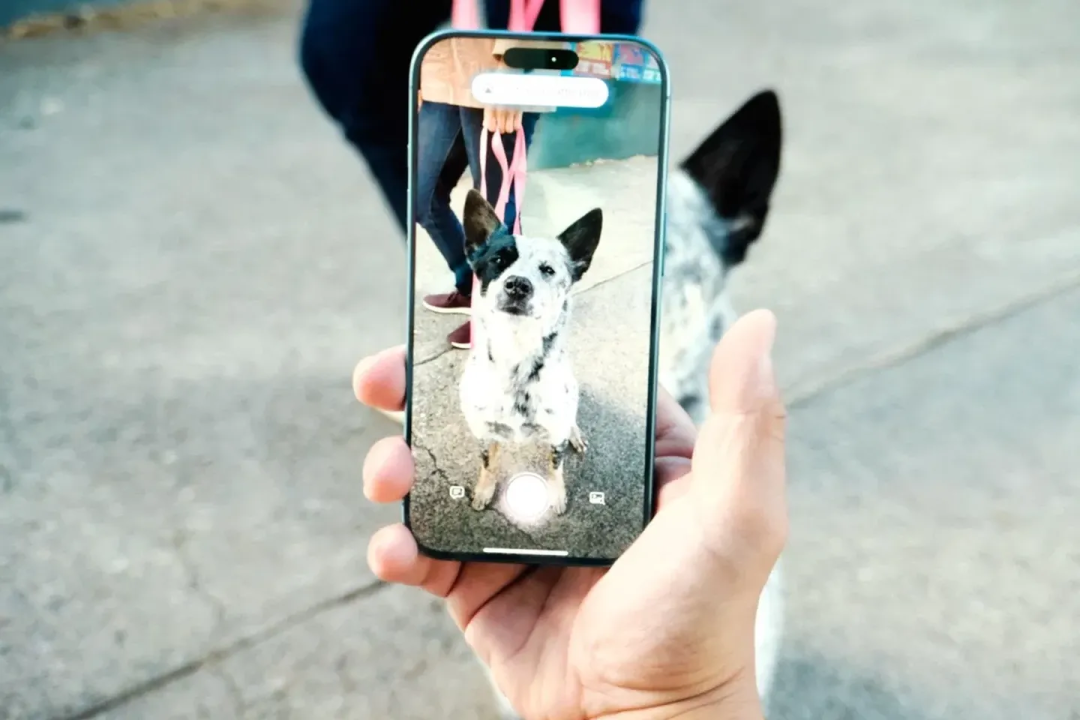
According to a case Apple demonstrated at the event: when you encounter a dog on the street whose breed you don't recognize, you can raise your iPhone, press the camera button directly, and ask Siri "What breed is this dog?"
This "intelligence" deeply integrated with existing iOS ecosystem features — while Apple wasn't the first to do it — does make it the manufacturer most poised to deliver a complete ecosystem solution.
Beyond software, Apple has also preliminarily demonstrated more possibilities for the "AI phone" in hardware: with the dedicated camera button on iPhone 16, you simply press it and the iPhone transforms into something like a Rabbit R1, but with vastly more powerful multimodal large model terminal capabilities.
In current demonstrations, such multimodal large model application scenarios include executing quick searches, scanning notes to ask ChatGPT for help, and when encountering an unfamiliar restaurant, simply raising your phone to photograph it and see review platform introductions and ratings appear.
According to a case Apple demonstrated at the event: when you encounter a dog on the street whose breed you don't recognize, you can raise your iPhone, press the camera button directly, and ask Siri "What breed is this dog?"
With abundant on-device AI compute, this capability will ultimately permeate every corner of the ecosystem: Apple similarly demonstrated multiple AI feature details at the event.
In the Photos app's "AI Mix" feature, you can separate every audio track in a video, manually select each track's intensity, and combine them into the "cinematic" effect creators want. In Voice Memos, you can hum over existing instrumental audio, and AI noise reduction will automatically filter out the accompaniment, leaving only your humming rhythm.
This随时随地记录灵感的方式 (anytime, anywhere inspiration-capturing method) previously required multiple professional devices; now all you need is an iPhone with built-in Apple Intelligence.
04 Conclusion
Even if you don't typically pay close attention to AI, it's not hard to see that this event devoted considerable time in every hardware segment to introducing Apple Intelligence-related features.
And as the "tech world's Spring Festival Gala," this iPhone launch may indeed have served to popularize the concept of "AI phones."
Beyond making more people aware of the changes this concept brings, through its "custom hardware + high-performance on-device compute + open software ecosystem" combination, Apple may truly be unfolding a future belonging to "AI hardware interconnectivity" before our eyes.