Nobel Prizes "Riding the AI Wave"? What Did They Actually Do to Deserve It? | Yunqi Capital Tech π

Everyone's trying to understand the nature of the world.
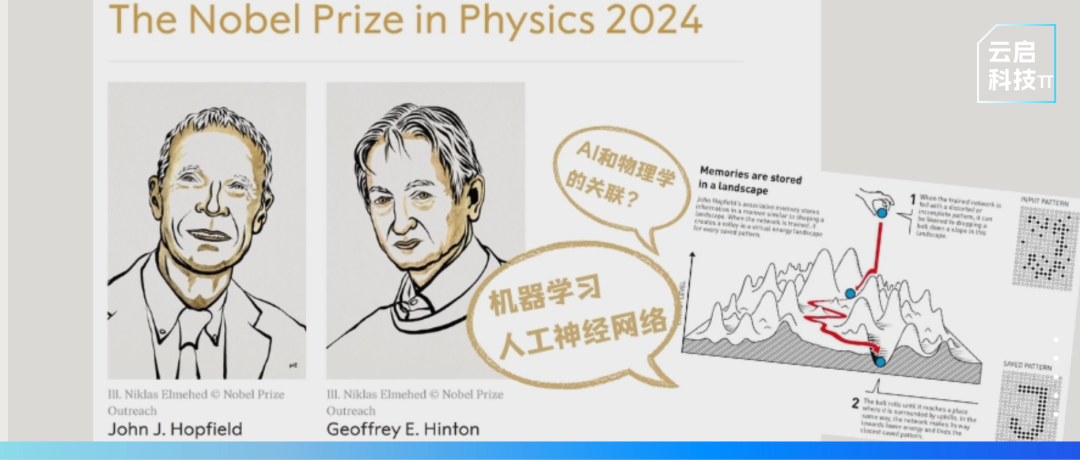
This year's Nobel Prize in Physics and Chemistry winners were announced over the past two days. The physics prize went to two AI experts for their outstanding contributions to machine learning and artificial neural networks, while the chemistry prize included two scientists who helped create AlphaFold, the AI protein structure analysis tool.
The "deep bond" between the Nobel Prizes and AI caught many by surprise. Particularly puzzling: what exactly connects artificial neural network research to the physics prize? The question has sparked considerable debate. In this edition of "Yunqi Tech π," we bring you some of the perspectives making the rounds.
This article is republished with permission from GeekPark.
Author: Xinxin
Editor: Jingyu
Original title: Why Did the Nobel Prize in Physics Go to AI Experts?

"How could I be sure it wasn't a prank call?"
That was Geoffrey Hinton's first thought when the Nobel Committee rang him at two in the morning.
The 77-year-old "Godfather of AI" was at a hotel in California with weak Wi-Fi and poor cell reception. He had been planning to get an MRI scan that day, a routine check-up.
It wasn't until he remembered the call was from Sweden, and that the speaker had a thick Swedish accent with several people in the background, that he accepted he had actually won the Nobel Prize in Physics.
The call from Sweden upended his plans for the day and marked global recognition for his years of research on neural networks and machine learning.
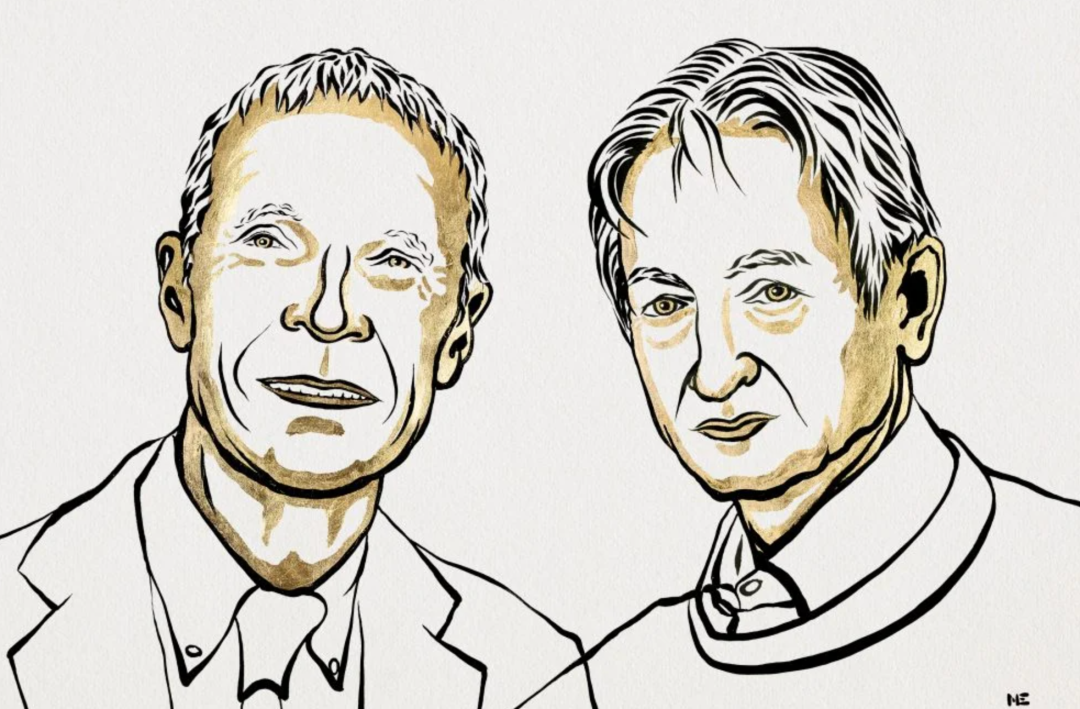
On October 8, 2024 Beijing time, the Nobel Prize in Physics was officially awarded to him and fellow scholar John J. Hopfield, honoring their foundational discoveries and inventions in machine learning and artificial neural networks. John Hopfield, at 91, was similarly "somewhat shocked" upon receiving the news.
01 Where Physics Meets Computer Neural Networks
Hopfield and Hinton both began doing important work in artificial neural networks back in the 1980s.
Artificial neural networks, as the name suggests, take inspiration from how the brain works. Scientists envisioned that neurons could be replicated as computational nodes, connected by links resembling synapses that transmit information. Such networks, once trained, can strengthen certain connections and suppress others, giving the system the ability to learn and remember when processing complex data — forming the foundation of modern artificial intelligence.
In the 1980s, Hopfield, who came from a physics background, began introducing physics concepts into artificial neural networks, particularly the spin glass model.
His breakthrough was developing an associative memory model capable of storing and reconstructing information, based on physical spin systems. This model allowed neural networks to self-correct from incomplete inputs and reconstruct original patterns — what became known as the "Hopfield network."
The core idea of the Hopfield network: each node is like a pixel in an image, representing an energy state in the system. The network's goal is to continuously adjust connection weights between nodes to minimize the system's energy, seeking the most stable, most energy-efficient state. The resulting output pattern is the reconstructed complete image. This mechanism not only enables machines to rebuild partially lost or damaged images, but also to extract complete information from partial inputs.
Building on the Hopfield network, Geoffrey Hinton then pushed artificial neural networks to entirely new heights.
At the time, Hinton used tools from statistical physics — particularly the 19th-century physicist Ludwig Boltzmann's statistical model — to develop the "Boltzmann machine," which could learn to recognize characteristic elements within certain types of data.
The Boltzmann machine's core lies in probability. Hinton recognized that patterns in data can be identified by calculating "likelihoods" — machines can learn which patterns are more likely to appear and which are relatively rare. A trained Boltzmann machine can recognize familiar features in information it has never encountered before.
In the 1990s, many researchers lost interest in artificial neural networks, but Hinton was among the few who persisted. After entering the 21st century, Hinton and his colleagues further advanced the field by pre-training through stacked Boltzmann machines. This pre-training provided a better starting point for the network's connections, optimizing the training process for recognizing image elements.
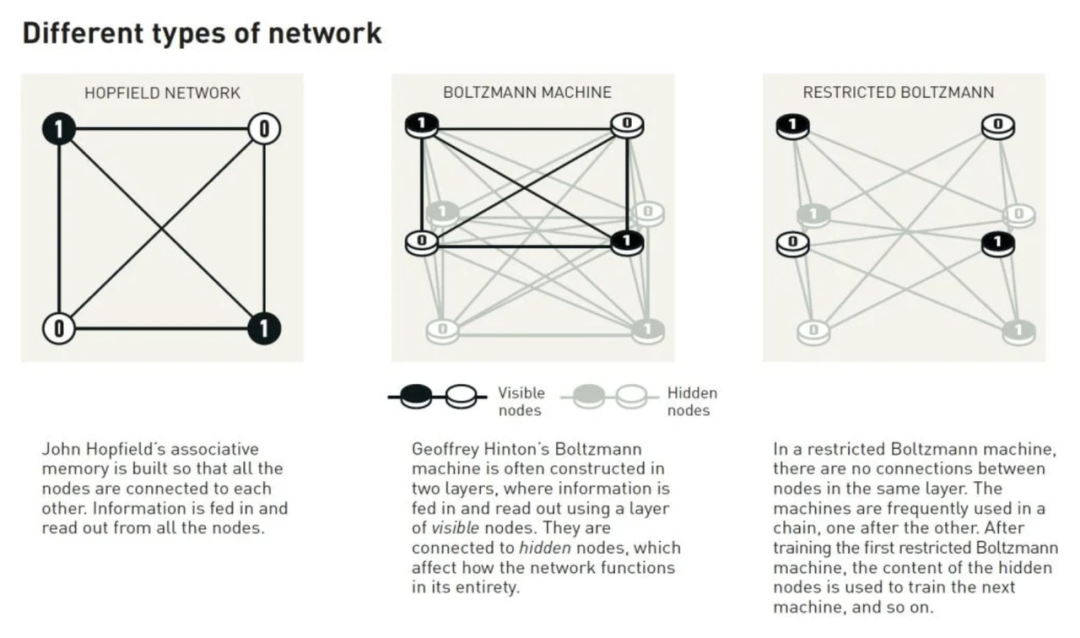
Hopfield networks and Boltzmann machines | Image source: Royal Swedish Academy of Sciences
Thanks to their work since the 1980s, John Hopfield and Geoffrey Hinton helped lay the groundwork for the machine learning revolution that began around 2010.
Looking back, their breakthrough contributions from last century in fact stemmed first from a deep understanding of complex systems in physics. It was their application of physics tools and concepts that propelled the development of machine learning and artificial neural networks.
Meanwhile, modern physics itself has benefited from artificial neural networks — as they gradually became powerful computational tools in physics, applicable to quantum mechanics, particle physics, and other fields.
The chair of the Nobel Committee for Physics noted: "The laureates' work has already brought enormous benefit. In physics, we use artificial neural networks in a vast range of areas, for example, in developing new materials with particular properties."
"Machine learning has long been used in areas that we may already be familiar with, as seen in previous Nobel Prizes in Physics. These include using machine learning to sift through and process the vast amounts of data needed to discover the Higgs boson. Other applications include reducing noise in gravitational wave measurements from colliding black holes, or searching for exoplanets."
"In recent years, the technology has also begun to be used to calculate and predict the properties of molecules and materials, such as calculating the structure of protein molecules that determine their function, or determining which new material might have the best properties for more efficient solar cells," the Nobel organization stated.
02 Physics and AI: Both Trying to Understand the Nature of the World
While John Hopfield and Geoffrey Hinton's contributions were inspired by physics, and their work in turn fed back into physics and other fields.
Still, unlike previous years, the 2024 Nobel Prize in Physics sparked considerable discussion and controversy. Netizens' main point of contention: do the two laureates' contributions actually belong to physics? Some even joked that the Nobel Committee was trying to "ride the AI hype train."
The outcry was so loud that the Nobel organization itself launched a poll: "Did you know that machine learning models are based on physics equations?"
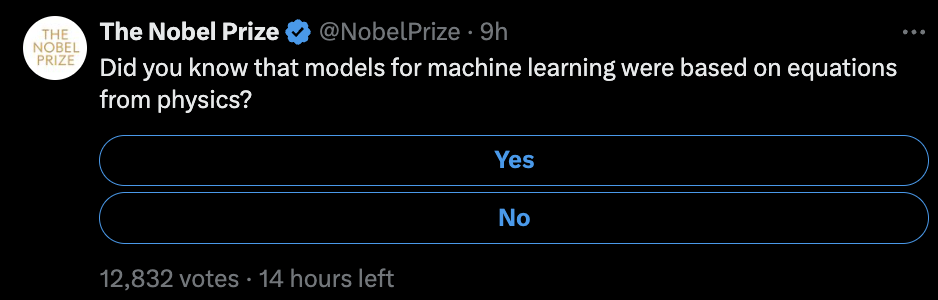
The Nobel organization asking netizens: Did you know machine learning models are based on physics equations? | Image source: X
In response, AI practitioners also weighed in. Here are some of their reactions:
Hongjiang Zhang, founder of BAAI, said: "Hinton's 2006 use of RBMs for DNN self-supervised pre-training, successfully training deep neural networks, could be called the harbinger of this AI revolution. Hopfield networks laid the foundation for RBMs. Next, let's see if AlphaFold can win the Physiology prize."
Zhifei Li, founder and CEO of Mobvoi, said: "Mathematical models used in physics and artificial intelligence are fundamentally both modeling — it's just that the former models the physical world, while the latter models intelligence. Doesn't that make it sound more reasonable?"
Kai Yu, founder of Horizon Robotics, also offered his perspective: "The purpose of physics research is to understand the essential laws of physical systems in nature, so that we can create and invent physical systems that don't exist in nature. For example, from birds we can study aerodynamics; based on aerodynamics we don't build birds, but airplanes and rockets."
"The purpose of artificial intelligence is first to study the essential mechanisms of intelligent systems in nature, and through this research, the goal isn't to invent biological brains, but to build new physical systems that could potentially be even more intelligent," Yu argued.
Yu also noted that this year's physics laureates had physics backgrounds and approached neural networks from a statistical physics perspective — one had even served as a physics professor at a world-renowned university. "Many of the early AI pioneers came from physics backgrounds."
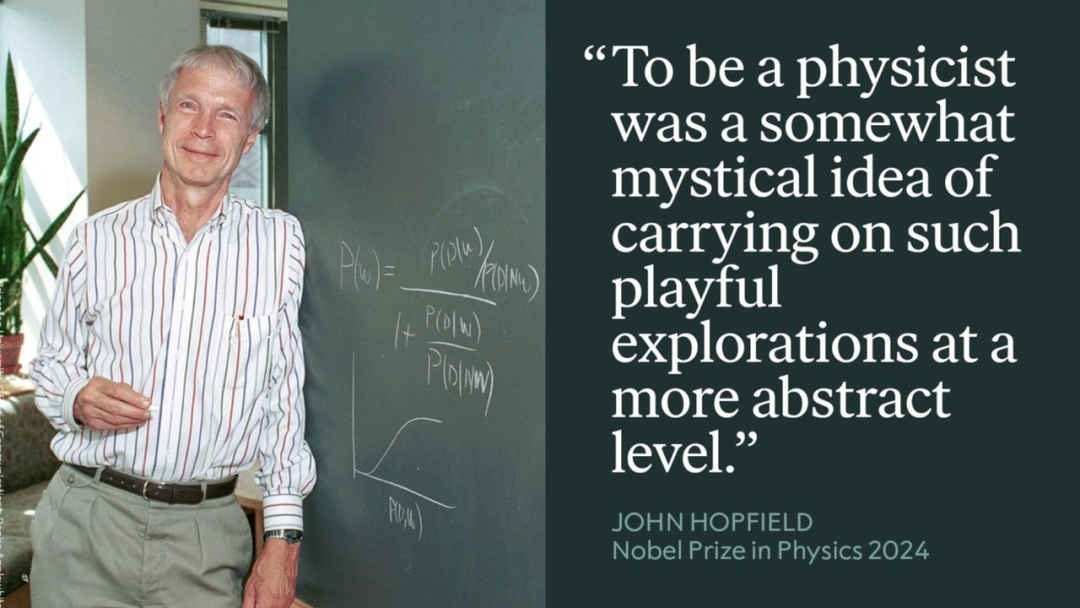
Hopfield, spanning multiple disciplines | Image source: Nobel Committee
Beyond the controversy, the achievements of John Hopfield and Geoffrey Hinton — and the fact that they received the Nobel Prize in Physics — demonstrate something beyond AI's current breakthroughs and popularity. They highlight that scientific breakthroughs need not be confined to single disciplinary definitions, and that interdisciplinary collaboration has its own power.
For instance, John Hopfield does hold a PhD in physics. His early career began at Bell Labs, initially researching condensed matter physics, but when he exhausted the problems in this primary field, he pivoted to new areas. In the late 1960s, he explored biophysics, applying concepts from solid-state physics to understand how biological systems synthesize proteins. In the late 1970s, he moved into neuroscience, bringing his theoretical physics skills to bear on problems of the brain — leading to the groundbreaking contributions described above.
What is physics? Hopfield once wrote in his autobiography: "For me — because both my parents were physicists — physics was not some subject. Atoms, the troposphere, nuclei, blocks of glass, washing machines, bicycles, phonographs, magnets — these were merely accidental objects of study. The central idea was that the world is understandable, that you should be able to take anything apart, understand the relationships among its parts, do experiments, and on that basis build a quantitative understanding of its behavior."
In his view, "physics is a point of view that the world around us is, through effort, creativity, and sufficient resources, understandable in a predictive and quantitative way."
As for Geoffrey Hinton, during his undergraduate years at the University of Cambridge, he sampled a series of disciplines — physiology, physics, philosophy — before obtaining a degree in experimental psychology in 1970. Before entering the University of Edinburgh in 1972 to pursue a PhD in artificial intelligence, he even spent some time working as a carpenter.
When Nobel staff asked him "How would you describe yourself? Do you consider yourself a computer scientist, or a physicist doing this work trying to understand biology?" Hinton's response was: "I would say I'm someone who doesn't know very well what field they're in, but wants to understand how the brain works. In my attempt to understand how the brain works, I helped create a surprisingly effective technology."
The message in Hinton's answer: whatever field you might classify him in perhaps doesn't matter. What matters is what he created.
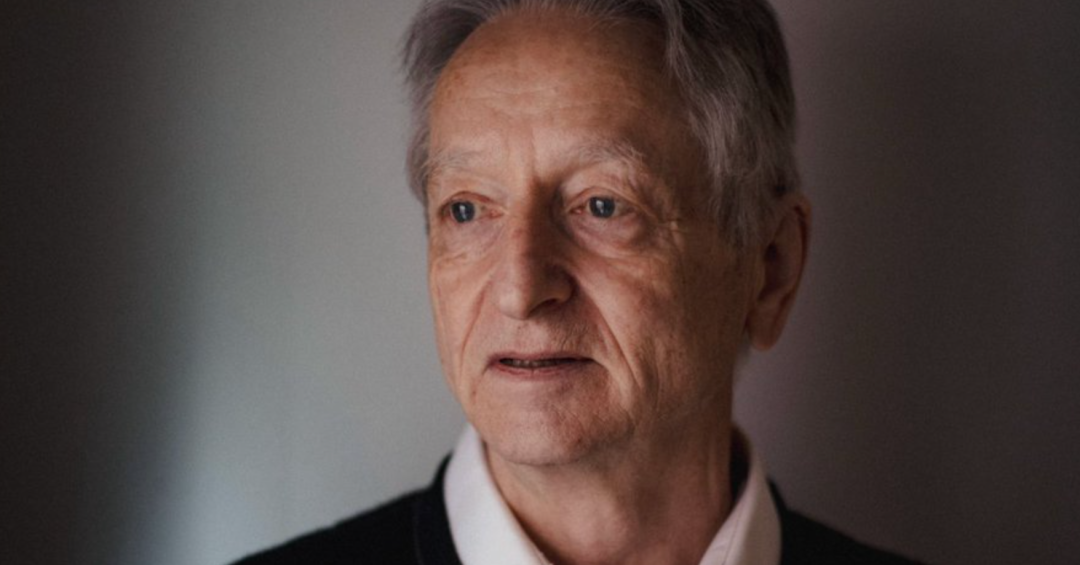
AI godfather Geoffrey Hinton | Image source: TIME100 AI
Moreover, prizes are established with their own historical contexts and limitations. Had the prize founders still been alive, they might well have been open to establishing a new disciplinary prize, or an interdisciplinary one. The purpose remains the same: to honor those who advance human knowledge.
Additionally worth noting: Hinton hopes that winning the Nobel Prize will make him "more persuasive," wishing that people will take his warnings about AI more seriously.
"On the existential threat of these things getting out of control and taking over, I think we're at a fork in history where, in the next few years, we need to figure out how to address this threat." This is the message he most wants to convey today.