Can a Robot Cook Wok Hei? A Conversation with Geng Kaiping of Zhigu Tiancheng | Yunqi Attent!on Podcast

How Did a Cooking Robot Become an Overnight Sensation?
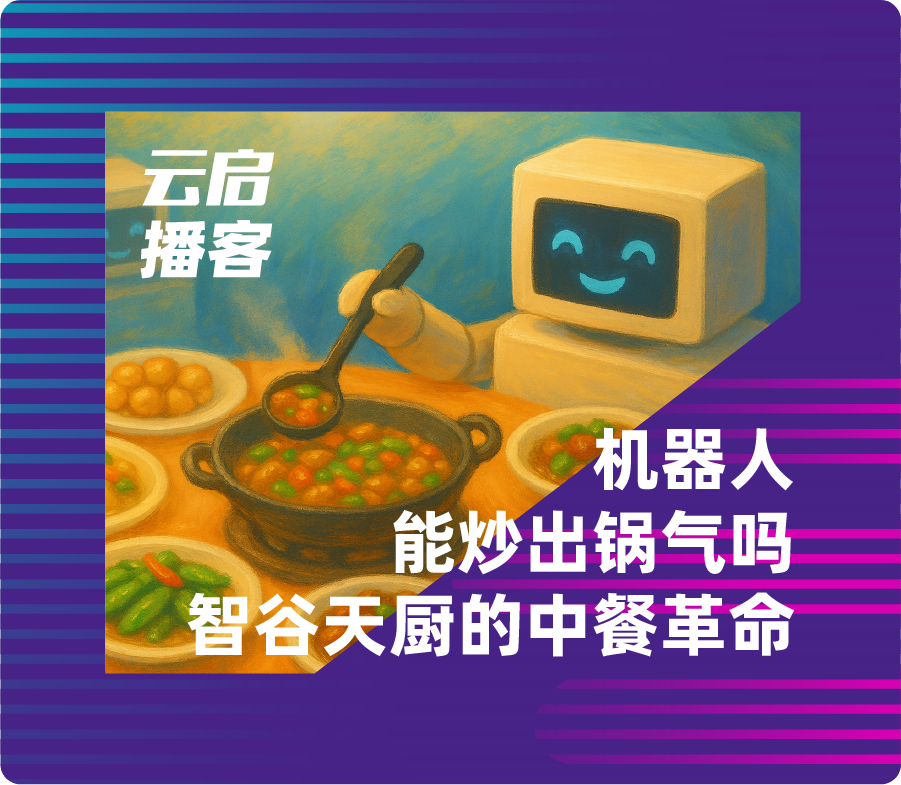
Recently, the hit variety show One Meal to Fame has reignited public fascination with "the warmth of home cooking." Meanwhile, on a parallel track, a cohort of "robot chefs" has been hard at work — merging wok hei with technology to help Chinese cuisine break its "standardization curse" and satisfy Chinese palates worldwide.
We recently spoke with an entrepreneur in this space — Kaiping Geng, founder and CEO of Zhigu Tiancheng, a Yunqi Capital portfolio company. In August, Zhigu Tiancheng clinched the "Technology Innovation Award" at China's first-ever Stir-Fry Robot Competition. This PhD, widely regarded as "the person who understands cooking best," shared with us the origin story of Zhigu Tiancheng and its stir-fry robots, and the intelligent revolution unfolding in Chinese kitchens.
Where exactly does Chinese food standardization fall short? How do stir-fry robots achieve "real cooking"? With the赛道 growing increasingly crowded, what constitutes a true competitive moat? This episode brings you up close with "the robot that understands warmth best."

Scan the QR code above or follow "Attent!on" on Xiaoyuzhou to listen to this episode
Guest
Kaiping Geng, Founder & CEO of Zhigu Tiancheng
Over ten years of experience in chain restaurant operations and stir-fry robotics. Founded Zhigu Tiancheng in 2018 (an early Yunqi Capital portfolio project). The company remains dedicated to R&D and innovation in intelligent cooking technology, with a core team of top-tier university talent. To date, it has filed for over 200 patents, certifications, and authorizations; its robots can cook more than 2,000 Chinese dishes; and it has successfully served nearly 100 top-tier chain restaurant brands, with products exported to Southeast Asia, Japan, Korea, Europe, America, and other overseas markets.
Linda, Managing Director at Yunqi Capital (Host)
Timeline
01:33 Getting to Know the Guest
PART 1 When Robots Enter the Kitchen
02:47 Stir-Fry Robots vs. Pre-Made Meals: What's the Difference?
05:07 B2B vs. B2C Differences
07:06 Deconstructing the Workflow: How Does a Robot Cook a Dish?
09:09 Heat Control and Seasoning, and Other Technical Challenges
14:23 The Role of AI Algorithms in Stir-Fry Robots
PART 2 Zhigu Tiancheng's Entrepreneurial Choices
18:41 Starting Point and Inspiration
23:55 How Was the Chinese Dish Database Built?
26:51 How Product Form Factors Adapt to Real Kitchen Scenarios
28:25 Zhigu Tiancheng's Market Choices
29:23 Case Study: Smart Cafeteria Transformation for a Corporate Headquarters
37:54 Diverse Commercial Practice: Distributed Scenarios and Chain Restaurants
41:58 Deep Dive: Go-to-Market Strategy Overseas
PART 3 Competition and Future
47:28 Technical Differences Between Zhigu Tiancheng and Overseas Products
50:27 Reading the Industry Landscape: "This赛道 Can't Have Many Players Coexisting Long-Term"
52:19 Zhigu Tiancheng's Moat
54:13 Reflections on Entrepreneurship and Visions for the Future
58:16 Join Zhigu Tiancheng
Below is an excerpt from this podcast episode (some text has been edited for clarity)

Not Just Heating Pre-Made Meals: How Do Robots Actually Work in the Kitchen?
Linda:
I'd like to start with something people often confuse. Could you, Dr. Geng, explain in plain terms what a stir-fry robot actually is? How does it work? And what's the fundamental difference from simply heating up pre-made meals?
Kaiping Geng:
In the narrow sense, pre-made meals are microwave food — what we call ready-to-heat food. The kind you see in convenience stores and supermarkets, reheated in water or by microwave. These products are pre-cooked in central kitchens, cold-chain packaged, then microwaved at the point of consumption.
What stir-fry robots do differs from pre-made meals in two crucial ways: "fresh" and "made-to-order."
"Fresh" means that even if the meat and vegetables come from a central kitchen or fresh distribution center, perhaps already sliced or diced, the ingredients are raw and uncooked. They go into the machine and are cooked from raw to done. "Made-to-order" means seasoning and stir-frying happen right there in the kitchen. This is what guarantees Chinese food has the color, aroma, taste, and presentation we expect. That's the essential difference.
Linda:
From a more professional perspective, homes are just one application scenario among many. From small restaurants to large cafeterias, from home kitchens to central kitchens, different scenarios impose vastly different requirements on stir-fry robots. Do these different scenario types differ significantly in overall needs, design approach, and pricing?
Kaiping Geng:
The differences are substantial. Let's categorize stir-fry robots into B2C and B2B. I'll focus on B2B.
B2B may seem like a single commercial category, but product differences across scenarios are actually quite large. There are central kitchens doing pre-production, thousand-person cafeterias requiring mass-scale efficient meal service, the takeout and fast-food赛道 where efficiency is paramount but menu flexibility is also needed, and casual dining and tea restaurants. The main difference lies in cooking efficiency — specifically, single-wok output efficiency. For casual dining and small-format restaurants, dishes are typically cooked to order one or two portions at a time during peak hours. For fast food, you obviously can't do this — you'd never satisfy white-collar workers at lunch, including takeout orders. Here you must balance quality and efficiency, with efficiency taking priority. For cafeterias, efficiency requirements are even higher.
So this manifests in output volume, heating power, machine size, and service model. For social dining, people typically order when they arrive. For fast food, you sell while replenishing. For group meals, by the time you get off work or out of class, the food is already prepared at scale in the cafeteria for thousand-person service. So product differences are substantial, and pricing differs greatly too.
Linda:
Let's pull back to the fundamentals. When a robot is cooking, how exactly does it handle the entire workflow from receiving orders, to prep, cooking, and plating?
Kaiping Geng:
For our B2B business, say in a restaurant, the basic flow is — actually you already mentioned the key steps. Whether it's in-restaurant ordering, QR-code ordering, or online takeout orders, everything funnels to a kitchen role called "da he" (production coordinator). They receive orders and assign tasks — which dish goes to which machine.
Before cooking, say today's menu has 16 dishes. How much inventory to prep for each? This has nothing to do with whether you're using machines or not. Any production method requires raw material planning. When the restaurant prepares inventory based on historical sales, we also preload the machine. This includes cooking process standards — for instance, what cutting dimensions, how thick to slice. Once all this is prepared, human intervention is minimal. Say I receive five orders for stir-fried pork with peppers. We select a five-portion program for that dish, load ingredients onto the machine's rack, and that's it — the rest is hands-off.
The machine's cooking basically has three core functions: heating, stirring, and dispensing. These are the three most essential functions in Chinese stir-fry cooking. Heating — you need to heat the wok before adding oil, get the oil hot, then add aromatics to bloom their fragrance, bring the wok temperature back up, then add main and secondary ingredients. Then liquid seasonings like soy sauce and sesame oil, and powdered seasonings like salt, sugar, and pepper. Finally, the machine automatically tips out the cooked dish, and a person simply takes it away.
So throughout the entire cooking process, there's zero human intervention. Automatic temperature control, automatic fire management, automatic ingredient dispensing — when to add salt, when to add soy sauce, when to add water, when to plate — all fully automated.
Making "A Pinch" Replicable: Conquering Heat and Seasoning with Sensors and Algorithms
Linda:
You just mentioned fire control (huohou). Is this one of the bigger technical challenges for stir-fry robots?
Kaiping Geng:
Fire control is actually a traditional Chinese simplification of cooking technique. In physical terms, it's two variables: temperature and time. At what time node, what's your wok temperature or oil temperature? Chinese cooking ingredients — main and secondary — are extraordinarily diverse, and different ingredients require different temperatures, with different timing for adding them. So temperature and time-point control is the core focus of cooking.
But traditional chefs rely on personal experience. So for dishes where precise fire control is especially critical, machines definitely outperform humans. Humans rely on experience — you need eight or ten years to even begin understanding fire control. And maybe today's physical condition is off, or mood is bad, and you miss it. I think this is a crucial point.
Then there's seasoning. Once you've mastered fire control, you start seasoning — this is where cooking's "a pinch" (shaoxu) concept comes in. A pinch of salt, a pinch of sugar. This inevitably creates "a thousand cooks, a thousand results." Change the person, and the dish may not work. This is a major reason many brands can't scale — poor standardization and stability. Without consistency, how do you build chains? Machines excel here. Soy sauce, salt, sugar — precise amounts. What you set is what you get.
So precision in fire power and precision in dispensing and seasoning directly determine consistency in doneness and flavor stability. These are two especially core points for us.
Linda:
From your perspective, which step is actually most challenging for the robot? In the actual cooking process, which technical piece is the hardest?
Kaiping Geng:
Overall, for the cooking itself, I believe sensors and AI algorithms are currently the more critical elements.
A core aspect of stir-frying is high-heat quick-frying. A wok of shredded potatoes may need to be fully cooked within ten seconds. Rapid cooking has two key points: temperature and time control, plus fast, even stirring. You add shredded potatoes — you can't have half raw and half cooked. The fire is intense, so you need rapid, uniform stirring for quick, even heat exposure. The first core point here is temperature sensing and control. Too high and it burns; too low and the fire's insufficient, causing water release and soggy texture.
Temperature is actually a temperature field — you certainly can't control it accurately with a single sensor. So you need multi-channel sensors, controlled holistically by algorithms. Because heating has thermal inertia; you can't wait until you hit the target to adjust — by then it's too late. So there's enormous scenario-based know-how here. I think this is a relatively important point in our vertical domain.
Linda:
So AI algorithms are very important in the core technology as well.
Kaiping Geng:
Absolutely, we're using them extensively now. Beyond temperature control and compensation, we've developed a new product with even better commercial prospects.
You'll notice the same mapo tofu is actually different in Sichuan, Beijing, Shanghai, and Guangdong. Regional variations are needed based on local flavor preferences across China's regions. That's one aspect.
Second, commercial restaurants and group meals differ in positioning and average ticket price, so requirements for meat-to-vegetable ratios and ingredient grades vary. At a nice restaurant, mapo tofu might sell for 48 or 58 RMB. At a fast-food place, maybe 18. These two formulations obviously differ. With such enormous variation, if you had an expert constantly adjusting programs and processes, it would be enormously time-consuming and labor-intensive.
We've developed an AI recipe generation algorithm. Starting from a base expert-system recipe, if you tell the machine: this time instead of one kilogram, you want 500 grams; for the meat-to-veg ratio, you want more minced pork, less Sichuan peppercorn, less salt. Input your requirements, and it generates your desired recipe with one click. Then the machine cooks according to your recipe, enabling fast generation of personalized, differentiated dishes.
From Inspiration to Implementation: Zhigu Tiancheng's Stir-Fry Robot Practice
Timing: Demand-Side and Supply-Side Both "Aligned"
Linda:
Dr. Geng was already getting excited telling us about Zhigu's products. But I'd like to pull back to your personal story. Take us from Zhigu Tiancheng's starting point — when did you first encounter the concept of stir-fry robots?
Kaiping Geng:
Actually, the stir-fry technique exists only in Chinese cuisine across global cooking systems. Other world cuisines — Turkish, Arabic, Western approaches — have no concept of "chao" (stir-fry). It's uniquely Chinese.
We entered this赛道 inspired by McDonald's success. Many have read McDonald's founder Ray Kroc's autobiography, made into the film The Founder. He was greatly inspired by the McDonald brothers' early success. We were too — how they standardized and scientized the entire first restaurant into a single-store model. That was hugely inspiring to everyone.
Chinese cuisine couldn't scale because we fundamentally lacked a standardization concept. "A pinch," experience, artistic soul, and so on. Back in the early 2000s, we realized Chinese food was an undervalued asset that simultaneously lacked standardization. Chinese food standardization is strictly more troublesome and difficult than Western food standardization, because stir-frying is the hardest of all cooking techniques. Though deep-frying, steaming, boiling, and pan-frying may be complex, stir-frying is unique to Chinese cooking and unavoidable. So we wondered: could we build a Chinese stir-fry robot?
So the earliest concept of "stir-fry robot" was actually proposed by our team in the early 2000s. Before that, no one had ever proposed this concept.
Linda:
I know you have over ten years of relevant industry experience, including several years at a major restaurant chain. I'm curious why you chose to go out on your own with this kind of robot in 2019?
Kaiping Geng:
We started wanting to do this in the early 2000s, but the first venture wasn't very successful — our timing was off. Too early, too difficult to land. But about this赛道, we were unwavering. I never gave up over the years. Food, clothing, housing, transportation — especially Chinese kitchen standardization and scientization, driving chain-ization and overseas expansion of Chinese food — this macro direction was definitely right. The key was finding the right timing.
In 2018-2019, I noticed several phenomena. First, China's restaurant industry had been workshop-style. After reform and opening, especially after the five-to-ten-year transformation by internet platforms like Meituan and Dianping on the marketing and settlement sides, including restaurant SaaS, digitization, and informatization, the restaurant industry began embracing technology. That was a very positive signal.
Second, we used to think with 1.4 billion people, kitchen labor was abundant. Some even said: won't you cause mass chef unemployment and social conflict? But by 2018-19, you saw young Chinese weren't entering kitchens anymore. Those without college degrees or good employment channels preferred what people jokingly called the "iron triathlon" — DiDi, food delivery, and courier services. Freedom, decent income.
What's the kitchen environment? High heat, high humidity, fatigue, grease, physical labor... So many young people stopped entering this industry. From then on, I saw our major clients struggling to hire. Stir-fry chefs, culinary schools — they couldn't recruit. This was a supply shortage.
On our product side, through service robots' large-scale deployment, especially in industrial scenarios, robot upstream and downstream components — motors, reducers, sensors — saw hardware costs drop dramatically. Our first venture: we'd build a device and price it at 200,000 RMB. Clients would ask: what kind of price is this? And back then, labor cost was just one or two thousand RMB — the math simply didn't work.
So demand-side, supply-side, various factors aligned. I estimated that starting around 2019, within about three years, China's restaurant industry would undergo massive transformation. The biggest change: labor shortage. Driving chain-ization and standardization development was the only choice. Without robots replacing labor or supply chain standardization, this path would be very difficult — I felt this was something with no alternative.
The Kitchen Logic Behind the Boxy Shape
Linda:
Hearing this, I roughly understand why Zhigu Tiancheng entered this industry in 2018-19. I truly admire your persistent belief in Chinese food standardization, the stir-fry robot赛道, and embracing technology.
You mentioned bits and pieces, but we'd love a comprehensive overview of what Zhigu Tiancheng does now. First, could you vividly describe what your company's stir-fry robots look like?
Kaiping Geng:
Externally, they resemble intelligent equipment — boxy and angular. This form factor is necessary for kitchen integration. But in terms of intelligence level, it's an advanced machine chef. As we mentioned, it can generate menus, output dish process standards, automatically control equipment, manage fire and seasoning, and cook different portion sizes — large, medium, small — based on your needs. Simply put, it's a highly skilled, emotionally stable, tireless, low-maintenance machine chef.
Linda:
Why is a boxy, angular form factor suitable for kitchen environments?
Kaiping Geng:
Because kitchen functions extend far beyond stir-frying. Broadly, there's storage — refrigerators, freezers for raw materials and equipment. There's sanitization and cleaning — dishwashers. And multiple cooking function combinations — steaming, boiling, deep-frying. So many devices and facilities must operate efficiently in a cramped kitchen where every inch counts. You need efficient layout and smooth workflow. If your machine is too distinctive, too mismatched with the kitchen, no one will use it.
Linda:
Understood — it has to integrate with all these functional products, so the cooking robot is essentially forced into a boxy, rectangular form. How many different cooking robot specifications do you have now?
Kaiping Geng:
We currently have five main models, standard specifications for different Chinese food scenarios, from small to large. Plus some derivative models. For instance, we have a domestic version, and for the US market, a US-standard version — over a dozen variants in total.
Customers and Markets: From Group Meals to Chains, Multi-Robot Coordination
Linda:
What are your main customer segments now?
Kaiping Geng:
Currently we focus on two main areas. Domestically, first, large-scale group meals — corporate, school, hospital, and government cafeterias; and second, large KA chain clients, what we call social dining. Stores, chains, large KAs. Overseas, we focus on Hong Kong, Macau, and Taiwan — where Chinese food and Chinese restaurants are most developed and labor costs highest. Singapore is a priority. Then Japan, Korea, Southeast Asia. Europe and America we're exploring, as the situation there is more complex.
Linda:
Europe and America might just be Chinatown.
Kaiping Geng:
Right, but Chinatown restaurants are very traditional, not chain-oriented, and not very large-scale.
Linda:
Could you share one or two implementation cases so we understand how robots work in these large cafeterias, universities, and hospitals you mentioned?
Kaiping Geng:
We partnered with a company's headquarters to transform their cafeteria. We didn't simply sell a few stir-fry machines — we co-created what we call a smart restaurant system. From operations dashboards, service dashboards, and management dashboards, to multi-robot dispatch, automated sales — connecting front-of-house and back-of-house end-to-end. The benefits for the client have been significant, and they've grown very fond of this kitchen. This case has become one of the must-visit spots for tourists visiting their company.
Linda:
If I were an employee, what would my experience be entering this headquarters cafeteria?
Kaiping Geng:
Let me describe a few scenarios. First, before leaving work, no need to head to the cafeteria yet. Open the mobile app — it tells you what each cafeteria is serving today, the TOP 10 dishes chosen by people who arrived before you, plus real-time queue and seating status at each line. This scheduling and information interaction happens before you even reach the cafeteria, helping you plan your timing and choices more intelligently. Enter the cafeteria, and based on queue and sales conditions, you choose among eight different lines, self-select dishes, then pay via facial recognition — very simple.
Because Gen Z demands equity — they want autonomy over their meals, not someone deciding for them. Maybe today they feel unwell and eat less; maybe they want something light, not greasy; maybe they're dieting and prefer salad greens. This brings happiness and freedom — spend what you want, eat what you want, choice returned to them.
Meanwhile, a huge pain point in group dining is that latecomers often get cold food. Or popular dishes run out — terrible experience. So we've built multi-robot dispatch for this client. In the front-of-house automated sales area, weight-based sensing triggers alerts when popular dishes hit 50% remaining. At 30%, it alarms, sending signals to the cooking area. The cooking station automatically dispatches machines — say, using Machine 2 to replenish Line 3's dish. Then AMR mobile arm robots transport ingredients from the raw materials warehouse to the cooking robots.
After cooking, AGVs (Automated Guided Vehicles) deliver to the sales lines. The entire process is multi-robot coordinated, nearly or fully unmanned, with high final efficiency. Employees always eat fresh — even if you're late, we dynamically replenish, so you get food freshly cooked, achieving what group meals have long pursued: "big-pot small-cooking," "small-pot fast-cooking." We always said group meal big-pot dishes weren't tasty, and indeed they weren't, given traditional cooking methods and service models.
For the full episode, subscribe to the "Attent!on" channel on the Xiaoyuzhou app~