"Yunqi Attent!on · Shenzhen" Meetup | After the Viral AI Hardware Flopped, Where Are the Real Heavyweights?

Let's Grab Coffee and Talk About the Present and Future of AI + Hardware
"Anything your phone can do, AI Pin can do." That was the flag planted by Silicon Valley startup Humane when it launched its AI hardware product AI Pin this April. But the device hit the market to a torrent of complaints. Many users reported that it fell far short of expectations, with one reviewer calling it "the worst product I've ever reviewed."
This may well be a microcosm of the innovation dilemma facing AI + hardware: limited capital in hand, facing multiple tests from software and hardware technology, competition from tech giants, and more — nailing it on the first try is no easy feat.
Even so, AI + hardware powered by LLMs holds vast opportunities that shouldn't be missed. Finding the key to solving pain points on the eve of this explosion of opportunity might let us get a step ahead and open the door.
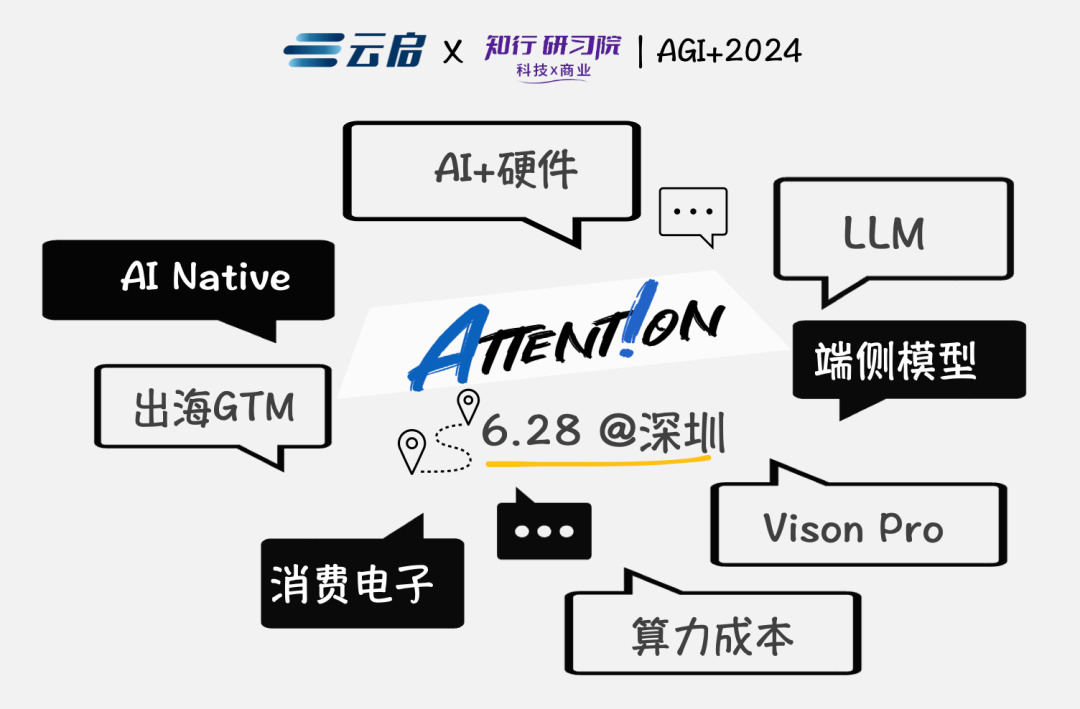
On June 28, the "Attent!on" Yunqi AGI+ Series Salon — Shenzhen will kick off in partnership with Zhixing Research Institute. We'll focus on "AI + Cross-border + Hardware = ?" and engage in deep discussions with frontline industry professionals from star startups and well-known tech hardware giants.
In late spring, as May turns to June, major tech companies at home and abroad are facing their "AI exams." OpenAI, Microsoft, Google, Meta, and Apple are going "hard and soft," delivering answers on both software and hardware layers. While Apple didn't bring disruptive innovation, Apple Intelligence represents a billion-level mobile device user base — perhaps this is where AI truly becomes more "useful."
Even before this, the sparks of AI + hardware innovation had begun to show. LLMs are being embedded by more and more innovative companies into "traditional hardware" like earphones, smart glasses, and cameras. People are discovering that the capability ceiling of smart hardware is visibly being raised by AI. We believe that with the combined effects of AI technology iteration and consumption-boosting policies, AI hardware — this potentially explosive category — has enormous room for imagination and cultivation.
But speaking of the present, the road of "AI + hardware" is no smooth path. A recent Wired commentary, "Generative AI Doesn't Make Hardware Less Hard," points out: "To create truly great new AI devices, you have to nail both the hardware and the software." This means entrepreneurs and practitioners must find a path that can truly move the market within a labyrinth of technical challenges and supply chain systems — clearly no easy task.
At the Shanghai stop of the "Attent!on" Yunqi AGI+ Series Salon, we sparked思辨 sparks with frontline industry professionals around AI technology and products. On June 28, the Shenzhen stop of "Attent!on" will focus on the fusion of software and hardware, with the theme "AI + Cross-border + Hardware = ?" to explore the opportunities and challenges of AI hardware.
We will partner with Zhixing Research Institute, an innovation enterprise empowerment organization founded by Jie Gan, early incubation investor of DJI and finance professor at CKGSB, to engage in deep exchanges with seasoned professionals from well-known companies including Huawei, Tencent, iFlytek, Kickstarter, Yuansheng Intelligence, Huohuotu, Timekettle, and Hive Box Technology.
Before we meet offline, we're sharing an excerpt from the Wired article mentioned above — see what thoughts the "failures" of viral AI hardware have sparked among overseas industry professionals.
More real questions and fresh insights — let's talk in Shenzhen! Registration details at the end of the article. Don't miss it.
The following content is excerpted and translated from Wired, "Generative AI Doesn't Make Hardware Less Hard"
Wearable AI devices from Rabbit and Humane were panned from the start. It shows that competing with tech giants remains an uphill battle in the ChatGPT era.
The road for AI hardware startups is not an easy one.
After years of R&D, startup Humane launched a $700 AI wearable device — the Ai Pin — in early April. Its selling point was that users wouldn't need to switch between different apps; the operating system could "find the right AI at the right moment" to play music, translate languages, even tell you how much protein was in a small handful of almonds. With no traditional display, the Ai Pin seemed poised to become the holy grail of breaking screen addiction, and smartphones appeared to be on their way out.
But the product was met with a flood of negative reviews. Wired's Julian Chokkattu gave the Ai Pin a 4 out of 10. Popular YouTuber Marques Brownlee called it "the worst product I've ever reviewed."
Another device, the $200 Rabbit R1, billed as a generative AI "pocket companion," had also generated considerable buzz but is now tagged with labels like "disappointing," "half-baked," "immature," and "unreliable." Wired's Chokkattu gave it a 3 out of 10.
The "failure" of early hardware is hardly unprecedented. Many startups overpromise in marketing and deliver underwhelming products. Competition in hardware is especially fierce in an era where tech giants dominate the ecosystem. It turns out that generative AI doesn't make hardware development any easier.
01 An Expensive Failure
"To create truly great new AI devices, you have to nail both the hardware and the software. And the question some startups face is, how much of the software layer is just surface-level?" said M. G. Siegler, partner at Alphabet's venture arm GV.
Siegler noted that tech giants now have even greater advantages because they can leverage their own infrastructure for development and can afford to lose money while iterating new versions. While startups are trying to go from zero to one with their barebones AI products, Meta, Google, Microsoft, and Apple can use existing teams and services to integrate AI assistants into various wearable devices.
"Big tech can try hardware products over and over, while startups may only get one shot," said Jacob Andreou, a Greylock investor who previously led product development at Snap. After releasing an expensive failed product, the odds of a small company securing follow-on funding aren't high.
AI hardware products from startups continue to emerge. Limitless AI recently released a clip-on pendant described as "a memory assistant that can transcribe recordings." Iyo, a smart earpiece incubated by Alphabet's X lab, will launch later this year, reportedly becoming "a therapist, coach, and mentor via voice control." And an AI compass called Terra uses APIs from Google and ChatGPT to guide users in walking and hiking. Its design will be open-sourced to encourage people to create their own versions.
Most of these startups are using artificial intelligence to provide screen-free interaction methods, hoping users can access information without opening numerous phone apps. Some companies are also betting that free open-source AI models will become more powerful and easier to customize and use in the future, or that with technological advances, cloud AI services will become faster and cheaper to access.
But even if they can develop hardware that solves problems and actually works well, startups still need to compete with tech giants — because the latter largely dominate how consumers interact with technology, while also needing to convince users to adopt new interaction patterns.
02 History Repeating?
Christina Warren, senior developer advocate at Microsoft GitHub and former tech journalist, said the current AI product "free-for-all" evokes memories of the 2010s consumer wearable device craze, plus gadgets funded on the crowdfunding platform Kickstarter. That wave was also driven by emerging, accessible technology. "Back then there was Google Glass, the Pebble smartwatch, the Oculus Rift headset, the Ouya game console — I even bought an Instagram photo printer," Warren said.
Many devices at the time were built on Android, using forked versions of the Android Open Source Project and creating their own launchers or user interfaces for their products — not unlike how today's device startups use APIs from ChatGPT and others, building their own software on top. "Android was probably the main technology driver for devices of that era, and Kickstarter became the economic engine guiding them," Warren said.
Most of the novelty products that survived the 2010s were developed or acquired by large tech companies. Warren noted that Pebble did a good job realizing its vision for an open-source smartwatch, but its technology ultimately made its way to Google through Fitbit's acquisition, forming a kind of wearable technology portfolio; VR headset maker Oculus was acquired early on to support Facebook's VR plans; Amazon essentially created the smart speaker category through Alexa; and Apple's premium smartwatch also found success. In this process, all three of these large companies achieved trillion-dollar market caps and invested more deeply in hardware development, even designing their own computer chips. For startups like Humane and Rabbit, simply slapping a "generative AI" label on their products isn't enough to meet the challenge.
Siegler believes that any AI hardware startup wanting to succeed today needs to consider its brand credibility and, most importantly, "keep it minimal." "If you start by saying you're going to create a better world, that's too grandiose. Smartphones already do a lot of these things. So you need to start with something as simple as possible — like developing a wearable device that calls on just one AI model and has just one specific purpose."
Certain dimensions of building AI wearables may become easier. Andreou believes some AI hardware startups may seek support from original design manufacturers (ODMs) to reduce some manufacturing costs. "You need one or two people inside the company managing hardware, and outsource most of the work to control costs," he said. He also predicts that hardware startups will increasingly adopt subscription models to boost revenue. Some companies have already tried this — Humane, for example, charges $24 per month — but the product itself has to actually work first.
Warren believes that for emerging companies with limited funds, running smaller open-source AI models directly on devices that require less computing power could also be a good option for embedding AI capabilities into products. "But the question remains, what kind of hardware are you actually building?" she said. Currently, some hardware manufacturers themselves don't seem to know the answer.
03 More Real Questions, Let's Talk in Person
In the AGI era, which has more promise: AI Native hardware or Smart hardware + AI?
Edge models or cloud models — how should hardware choose?
Going global or going local — how should hardware companies decide?
……
Event details and registration below. Limited spots — register soon!