"Startup Side B" Debuts | How AI + Robotics Are Reviving the World's Oldest Industry

Dare to imagine the beautiful; creativity can go wild.
"The Other Side of Entrepreneurship" spotlights tech ToB founders. In this series, we zoom in on Yunqi Capital portfolio companies on the front lines of industry —
to see how they're engineering the extraordinary behind the scenes of better living and more efficient production.
Architecture shapes humanity's relationship with space. For ages, it has not only addressed the fundamental need for shelter, but also showcased the pinnacle of human imagination, creativity, and execution in astonishing forms.
Construction's history rivals that of civilization itself. Now, this traditionally weighty, complex industry is being revitalized by new technologies like AI and robotics, becoming ever more "lightweight."
Starting from the endpoint of "solving humanity's essential needs for architectural space," our angel-round portfolio company "Yizao Technology" has built an integrated model of human-machine collaboration for design, optimization, and production — spanning AI-driven design through robotic direct construction — "top-down" integrating the entire construction value chain.
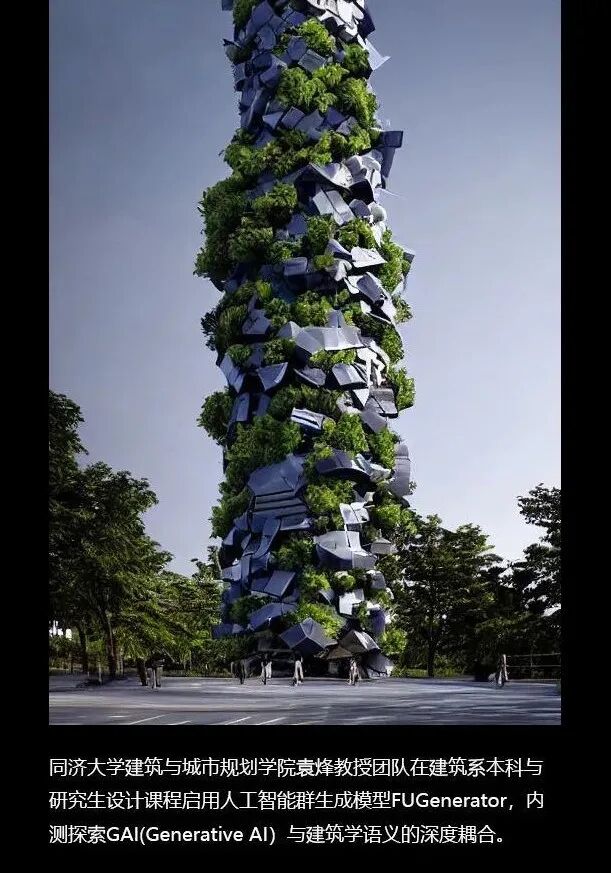
This May, Yizao Technology partnered with Tongji University to launch "FUGenerator," an AI algorithmic generation platform. FUGenerator serves early-stage architectural generative design, expanding designers' perception and creativity by sensing design intent and generating design solutions.
In this episode of "The Other Side of Entrepreneurship," we invited Li Han, Founder and CEO of Yizao Technology, to share how his team has rapidly and deliver high-quality "construction miracles" across landmark projects in Shanghai, Wuzhen, Chengdu, and beyond.

How do you address humanity's essential needs with quality?
"The Other Side of Entrepreneurship": How does Yizao Technology define the intelligent construction field under new technologies?
Li Han: We want to solve humanity's essential needs for architectural space. Construction is such an ancient industry, yet most buildings today aren't fundamentally different from those built 100 or 200 years ago.
Transforming architecture into a technology-driven, high-quality product that meets future needs is a complex process. Unlike the industrial mindset of "replacing humans with machines" or "upgrading old factories," we "top-down" reverse-integrate the entire construction chain. Through the integration of design data, from software platforms to hardware processes, combining tools like construction robots and AI software, we create integrated direct-construction solutions.
"The Other Side of Entrepreneurship": What challenges have you faced, and how did you overcome them?
Li Han: To achieve our ultimate vision, there are many intermediate steps — design, engineering, interaction, operations management, and more. To systematically reinvent an industry, every link must be gradually broken through. For now, intelligent construction is first solving cost reduction, efficiency gains, and improved building quality.
We've divided our R&D into three main paths. The first is the physical construction path. Our first product is a 3D printer, which is also a robot capable of virtual-physical symbiotic construction, doing an excellent job of merging virtual and physical. The second path is FURobot, a software platform that enables full integration of design data, factory data, site data, and robot data — an indispensable piece of infrastructure. The third path is omnidirectional perception. In the future, construction site operation models will differ greatly from today, with robots achieving self-perception and self-positioning. Overall, our main direction won't change, and we'll treat continuous innovation as a lasting principle.

AI + Robots: How to engineer construction miracles?
"The Other Side of Entrepreneurship": How exactly do AI and robots build houses?
Li Han: First, truly understanding customer needs. Demand is growing for high-quality architecture with local cultural character that integrates contemporary development concepts. Aligning our technology with this growing segment is a core direction for our business. And even when end products vary, the process is standardized — giving us opportunities to refine our product and make the technology adaptable to more diverse needs. So we're constantly creating new blue oceans.
In 2019, for the Wuzhen Internet Light Expo Center, a project originally planned for two and a half years, we completed high-quality delivery in just six months. For this building with nearly 40,000 square meters of floor area, we used a comprehensive suite of integrated technical solutions to address traditional construction's problems of long timelines, high investment, and uncontrollable delivery — earning recognition from the Ministry of Housing and Urban-Rural Development as a benchmark project.
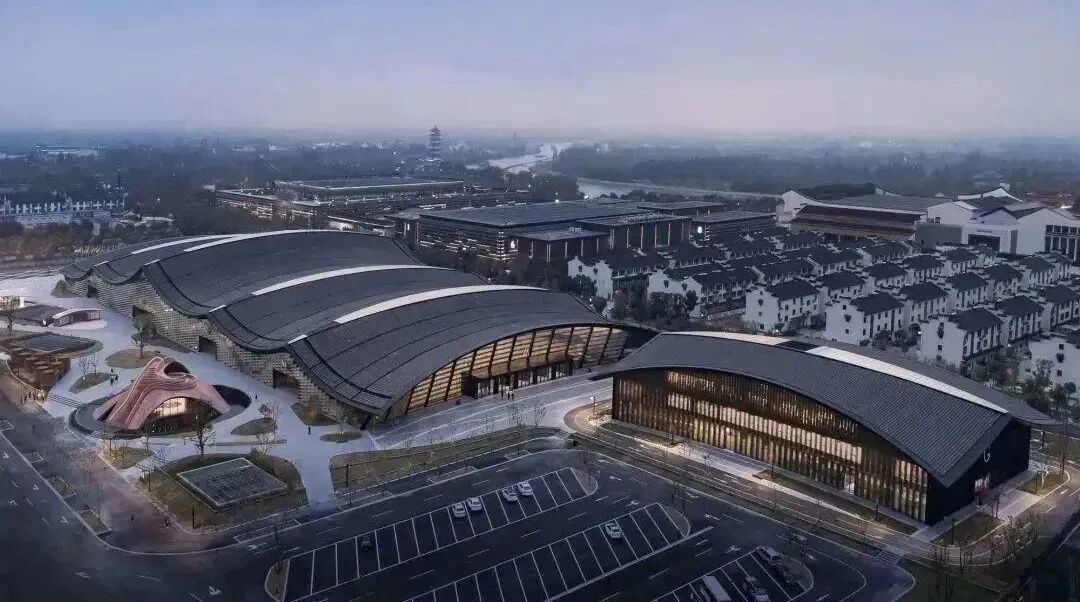
Wuzhen Internet Light Expo Center
"The Other Side of Entrepreneurship": What new changes does this novel delivery model bring to urban sustainable development?
Li Han: "Carbon reduction" is a new challenge facing the entire construction industry. For our rural metaverse-themed exhibition hall project in Xinjing, Chengdu, we used fully low-carbon timber robot construction technology, with the entire roof executed through recyclable 3D printing. The project's comprehensive carbon emissions essentially calculate out to a negative-carbon building — not only producing no carbon during construction but actually capturing carbon. The project itself has become an important scene for architectural technology deployment.
Along the way, this opened up additional business opportunities in Chongqing, Kunming, Guiyang, and surrounding Chengdu municipalities. We believe that through good application scenarios and good technology deployment, you can indeed unlock significant market opportunities.

Design the Beautiful, Build with Your Hands
"The Other Side of Entrepreneurship": What's been the biggest change since starting up? If you could do it again, would you still choose entrepreneurship?
Li Han: Yes. I think the biggest change has been a shift in thinking mode and a deeper reflection on the essence of technology. Earlier, I'd look at industry direction from a technology angle, but now I also project the full picture through the market lens. The projection that emerges is completely different — and seeing different projections helps you spot new application opportunities.
"The Other Side of Entrepreneurship": What kind of people are your entrepreneurial partners?
Li Han: Yizao's team is design-driven — core members all have design backgrounds. Designers are people who envision a better world; we hope to create better spatial environments through better resource allocation.
Our team strongly emphasizes "actually getting hands-on" rather than just doing R&D. Located near Tongji University, we have a strong lab culture: space isn't divided by department, and everyone has the chance to understand what each team is working on. What often happens is that a problem in one line gets solved by another line. This integrated development and cross-boundary innovation opens everyone's perspective. It's like mountain climbing — when the team together discovers a new route, we all go see the new scenery together; side paths have good views too.
Beyond our internal team, clients and customers have continuously helped us, and this positive feedback keeps getting woven into Yizao's culture, reinforcing our belief that we're doing the right thing. Yunqi Capital has also supported us in many ways. Our day-to-day exchanges are always pragmatic — every conversation yields concrete takeaways, and this gives us more confidence in grasping macro trends.