Beyond the Code: Do Liberal Arts Majors Still Have a Seat at the Table in the AI Era? | Yunqi Capital Tech Notes

Every way of thinking could connect to the future.
In the AI era, do liberal arts graduates still have a competitive edge? Will non-technical people be left behind? Every college application season, these questions resurface. Recently, we spoke with three AI professionals from liberal arts backgrounds, hoping their stories might offer some fresh answers to this old debate.
The conversation was sparked by a short video released during graduation season. A new graduate with a degree in theater, film, and television studies chose to join MiniMax, a Yunqi Capital portfolio company, to work on Hailuo's AI content ecosystem. She said: "I never imagined I'd enter the AI industry, using what I learned to train AI models and create alongside AI."
These few sentences reflect an important truth beyond academic anxiety: in an age of technological democratization, the so-called "AI ticket" isn't reserved for coders alone. Every way of thinking can become an entry point to the future.
As a frontier, open-minded technology investment firm, this is a philosophy we deeply share. In this edition of "Yunqi Tech Notes," we bring you stories from beyond the code.
@Chen Kunkun:
I Don't Understand Algorithms, But I Use AI to Tell Stories
AI Video Creator
Dapperly dressed small animals shuttle through scenes reminiscent of The Grand Budapest Hotel... At the end of 2023, an AI short film titled "Animal Hotel" went viral on Xiaohongshu. The video featured anthropomorphic animal characters switching between AI-generated scenes, racking up thousands of likes and saves.
At the time, AI video generation was still a technological "novelty." The creator behind the short, "Chen Kunkun," was simply an early adopter who stayed sensitive to new tools and liked to "play around." But just a year and a half later, this post-90s woman — neither a designer nor a programmer by training — has transformed from a video director into an AIGC video entrepreneur, running her own independent studio and consistently producing AI-powered creative videos.
It's hard to imagine that this transformation began with a study-abroad decision made to "escape a bottleneck," and a hands-on experiment she tried at the dawn of the AI era.
Hong Kong Master's, "Life Reset"
Back in 2022, Chen Kunkun stood at a career crossroads. After seven years of grinding in Beijing, she had worked as a TV director, documentary filmmaker, short video producer, and at a well-known internet company. While she had accumulated professional experience, she increasingly felt the paralysis of depleted creative drive.
Stuck in this stagnation, she decided to hit pause and enroll in a one-year master's program at Hong Kong Polytechnic University to start fresh. "At first I just wanted to change environments and rebuild myself. AI wasn't even on my radar." But this "life reset" happened to coincide with the rapid acceleration of generative AI.
At the end of 2022, ChatGPT ignited the generative AI wave. Thanks to her school's open technical atmosphere and diverse curriculum, Chen Kunkun was among the first to "play" with these new tools. "While others were still watching from the sidelines, we were already running images on Discord."
She used Midjourney to generate images for coursework, used GPT to teach herself coding, and explored fields like Web XR, VR, and AR. Though she didn't understand the technical underpinnings, she was willing to experiment hands-on and continuously learn across disciplines.
Pika Breakthrough, Unexpected "Landing"
In 2023, her PhD applications fell through, leaving her in a career gap. This period of "free time" became her window for deep engagement with AI.
At the end of 2023, the AI video tool Pika broke out. On a whim, Chen Kunkun threw some Midjourney images she had made for school assignments into Pika to test video generation. Unexpectedly, the video gained significant traction on Xiaohongshu, attracting a large following. "That positive feedback was really strong — lots of comments and likes, so I kept making more."
In 2024, AI video generation technology hit the accelerator, with tools emerging constantly at home and abroad. She tested new products as soon as they launched: Runway, Dreamina, Keling AI, Hailuo, Veo... As her "toolbox" grew, she no longer settled for simple experimentation and began exploring deeper creative expression.
But磨合 with AI wasn't always smooth. The "consistency" problem plagued her for a long time: how to keep characters and scenes coherent across AI-generated shots? This required not only relentless prompt refinement, but also extensive reading of official documentation, blogger reviews, and even studying the unique parameters of different AI models. "To go deeper, I later built a computer with a 4090 GPU to run local models." Through continuous trial and self-directed problem-solving, she became an AI creator who was "not just early, but deep."
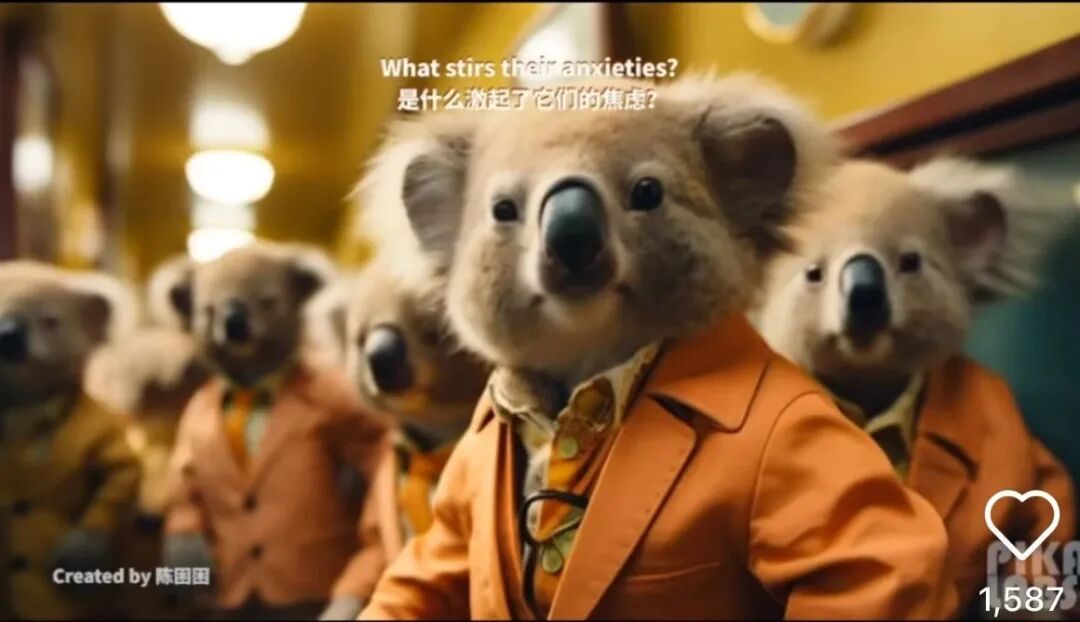
AI video work posted by Chen Kunkun on Xiaohongshu at the end of 2022 (Source: @Chen Kunkun Xiaohongshu page)
"An AI Creator's Moat Is Aesthetic and Expression"
From initial tool experimentation to focused creative work, over the past year-plus Chen Kunkun has produced representative works including Stay With Me and Endless Dreams, collaborating with platforms as prominent as CCTV.com. But about her relationship with AI, she's unequivocal: AI is a collaborator, not the protagonist.
In her daily workflow, Chen Kunkun uses custom-built bot tools to help write prompts and analyze scripts, but the final creative decisions, themes, and storyboards remain hers alone. "I don't rely on AI for ideas. It's just a collaborator. The person who ultimately decides the work is me."
In her view, AI has lowered technical barriers, but aesthetic judgment, expressive ability, and content depth are a creator's true moat. "In this regard, a liberal arts background isn't a disadvantage — it actually makes me better at storytelling and more attuned to humanistic feeling."
For example, her current favorite work, Stay With Me, explores whether virtual reality can replace the emotional companionship of a lost loved one. The inspiration came directly from her research on VR therapy projects during her studies abroad.
Tips on Transformation: Do and Accumulate
"Don't wait until you have it all figured out. AI tools are meant to be learned by doing." She picked up much of her technical knowledge through tutorials, communities, and real-world practice. "Learning by doing matters more than watching."
And accumulation — every film a liberal arts student has watched, every novel read, every piece of music heard, even history, philosophy, or art studied — "that knowledge you thought was useless will someday become a wellspring of inspiration."
@Yudan: From Writing Copy to Writing Code
AI Is My New Language
Enterprise AI Solutions Architect at a Major Internet Company
Eight years after graduating with a degree in a less commonly taught language, and now leading a 20-person team building enterprise AI solutions at a top internet company, the post-95s woman Yudan's career story demonstrates the new possibilities for liberal arts graduates to expand their capabilities amid technological waves.
Yudan's day-to-day work involves designing solutions that integrate products, data, and AI technology based on complex needs from major enterprise clients. Before this, her career path took several turns — from brand planning to brand placement data analysis, to recommendation algorithm business implementation...
Behind these considerable pivots lies the acuity and decisiveness she showed at career crossroads, as well as the natural progression of continuously expanding her "professional toolbox."
"Whatever My Toolbox Was Missing, I'd Add"
When Yudan started working in 2016, she caught the tail end of the internet's golden age. She began in brand planning, but soon the growth hacking trend swept through. "By 2017–2018, ad placement and data analysis became the focus of brand work." Sensing the shift, she moved to another major internet company and began handling ad placements with budgets in the tens of millions.
But a bottleneck soon followed. She found that relying entirely on data analysis teams to extract data made work inefficient. "The business team didn't know how to analyze, and the data team couldn't fully grasp what you meant... it felt limiting." Unwilling to accept these constraints, Yudan chose the most direct approach — doing it herself.
"At first I mainly used Excel. Later, the data team gave me database access, and I taught myself SQL. SQL is actually pretty easy to write." With SQL under her belt, she could conduct independent data analysis and optimize channel budgets more efficiently. This experience changed the perception of someone without a STEM background: "Data didn't seem so hard after all."
First Algorithm Experience: A Business-Driven Experiment
After joining her current company, Yudan's role blended brand, placement, and data analysis functions. An unexpected assignment deepened her technical understanding — her manager asked her to optimize the e-commerce platform's intelligent product recommendation system. Though she readily admits, "at the time, I didn't understand algorithms."
This was a classic case of business driving technology. Her manager valued her product understanding and data literacy. Yudan paired with a colleague from risk control algorithms and learned on the job.
A month later, the significantly optimized recommendation logic tripled core metrics. "I found AI pretty interesting — it felt similar to when I first started data analysis." This success delivered business value, but more importantly, Yudan realized that understanding algorithms and AI could become another tool in her kit. She recognized that algorithms could self-iterate at speeds far exceeding traditional data analysis dependent on human labor.
"Stumbling Upon" GPT: A Technical Awakening During Confusion
In 2021, the internet industry chill brought an existential crisis to Yudan's e-commerce business. At this crossroads, she chose to explore physical retail — a long-standing interest — at another company. But the reality fell short of expectations, and her career entered a period of confusion. Yet the turning point quietly arrived during this phase.
On an overseas trip, she happened to obtain a foreign phone number. A friend she had met while learning algorithms recommended GPT — then still niche. With casual curiosity, she registered an account.
"At first I bought GPT Plus. It was pretty interesting at executing tasks." She even built a daily recipe and calorie tracking app with her partner using the GPT API. GPT's capabilities once again shifted her perspective: "It made me realize that the boundaries of algorithms far exceeded my imagination." This accidental experiment planted seeds for her later deep dive into AI and its formal application in her work.
Return and Focus:
A Composite "Problem-Solver" on the ToB Battlefield
In 2022, her former employer extended another offer — this time in ToB solutions. Armed with her new understanding of AI, Yudan returned to the ToB domain.
"ToB business has more uncertainty." In Yudan's view, the key to ToB lies in aligning three sets of expectations: client perception and budget, the industry team's proposal, and her own team's capability ceiling. "What the client sees, what you actually do, and what the team can grasp may all differ — my role is to align these three."
In this process, her composite background spanning brand and data became invaluable. "I don't believe any path was wasted." Yudan gave an example: when designing digital transformation solutions for clients, the brand strategy and placement perspective that business teams lacked happened to be her strength. This cross-domain understanding became key to defining problems and bridging cognitive gaps.
In Yudan's view, her liberal arts background is not a disadvantage in her current role — it forms a distinctive advantage in ToB solutions. She believes the core of STEM thinking lies in efficiently and reliably solving problems, while the strength of liberal arts thinking lies in acutely defining problems. Especially in complex ToB scenarios, precisely identifying the real problems clients need solved and translating them into clear, executable technical solutions is precisely the competitive edge her liberal arts background gives Yudan.
Transformation Advice: Goals, Interest, Pragmatism —
None Can Be Missing
The motivation to learn should stem from solving real problems, not chasing trends. At the same time, don't ignore your inner interests.
"When you're interested in something, that's often a signal that you'll naturally have passion for it. That passion will slowly pull you into a positive cycle." Interest is the internal drive for sustained investment and overcoming challenges.
Facing career challenges, Yudan uses the metaphor of climbing hills — "The climb is painful, but once you're up, it's nothing. But then you realize there's another hill..." The key is maintaining an open mindset and believing that no path was wasted.
@Chen Lei: Conducting a "Field Study"
in the AI Industry
MA Student in Excavated Texts and Chinese History, Tsinghua University
The final interviewee is a post-00s master's student at Tsinghua University's "Excavated Texts and Chinese History" program. He is also a brand marketing intern at an AI startup, with previous internships at a major state-owned telecom company and a top domestic internet company's AI projects.
On the surface, this looks like a liberal arts student pivoting to AI — an interdisciplinary major plus multiple AI industry internships. But in conversation, we received many unexpected "high-dimensional answers." This student doesn't plan to pursue AI as a career after graduation; he's more interested in understanding, applying, and influencing it in a liberal arts student's way.
Thus, this is more a case of "using AI as a method." Just as AI is to our present moment — it opens not just one or several new industries, but numerous new angles and possibilities for the world we thought we knew. Here is Chen Lei's story.
From Ancient Text Reconstruction to Model Training
"Classical philology is actually a lot like training AI models. You face a mass of unpunctuated, relatively unstructured text, adding annotations and translations to make it readable. Like AI today, turning raw corpora into usable knowledge." In Chen Lei's view, this seemingly obscure major shares a fascinating similarity with large models. If summarized in one word: "assemblage."
In his academic training, Chen Lei learned how to restore authentic structures and establish meaning from fuzzy, diverse fragments — while the underlying logic of AI models is a similar puzzle process, helping humanity reconstruct knowledge fragments that cannot be clearly displayed.
"In the past we pieced together excavated texts; now we piece data into algorithmic models." This commonality sparked Chen Lei's natural interest in AI and gradually drew him into AI industry practice.
Treating the AI Industry as Another Kind of "Field"
"Field" is a word Chen Lei has known since undergraduate studies. Back then, he conducted oral history surveys in a Nanjing village, collecting nearly forgotten stories from elderly residents in a small settlement without written records. But incomprehensible dialects and limited memory capacity made the work difficult. "Even then I was looking for a brain that could help me organize, transcribe, complete, and understand. ChatGPT just hadn't arrived yet."
Near the end of his undergraduate studies, GPT and the generative AI wave it triggered arrived. Chen Lei thus embarked on another form of AI "fieldwork."
At Zhonghua Book Company's Gulian subsidiary, he worked with ancient text digitization systems. At a state-owned telecom research institute, he participated in large model evaluation. At a top internet company, Chen Lei worked with a group of outstanding liberal arts students to design training standards for "what counts as good content" for algorithm teams. In his current internship, he focuses more on brand, communications, and strategy — on how organizations position themselves amid the AI wave.
"Internships are more about observation for me. Observing how a model grows, how a company defines its past and future development, and how every individual inside positions themselves within technology." Each internship is a "field site."
Interpreting AI Through Liberal Arts Methods
"The AI industry moves so fast, sometimes what you're doing is a black-box experiment," Chen Lei says.
Faced with rapidly evolving technology, he chooses slowness and reflection. Years of accumulated reading and critical thinking have accustomed Chen Lei to understanding the AI ecosystem from a humanistic perspective. "Li Bai's poetry is unique because he lived. Large models have seen more text, but they have never truly lived." Chen Lei believes: what truly gives AI meaning is human ways of thinking, that training from the "field," from real interaction and society.
He doesn't see liberal arts students as merely reluctant "replaced parties" in AI. On the contrary, the liberal arts student's capability lies in seeing the essence of problems amid chaotic times, maintaining clarity amid various uncertainties, and finding certainty.
Finding Certainty in an Uncertain World
"I've always remembered this saying: when actions fail, seek the cause within oneself."
Facing AI-era transformations, Chen Lei doesn't believe the future will necessarily be better, but he also hasn't chosen to "lie flat" in self-anesthesia. He genuinely believes: "This is an uncertain era. The only certainty is that you must try with your own hands." Thus, courageously embracing uncertainty is his most sincere advice to young people entering the AI industry. After all, in an uncertain world, the most certain thing is to keep learning and adapting.
Chen Lei also has plans for the future. He wants to go to Africa, to Latin America, to those habitually overlooked places where treasures remain undeveloped. He wants to bring the perspective honed in the AI industry to observe new societies, conduct new fieldwork, and find new possibilities.
"What I'm doing now isn't fundamentally different from what I studied in classical philology or the fieldwork I did as an undergraduate. I'm always doing fieldwork — just in a different location."