Manycore Tech CEO Hang Chen: When Chinese AI Meets the Global Market — Manycore Tech's Overseas Expansion | Yunqi Capital Doers Series

At a time when "going global" has become a core growth strategy for tech companies, challenges like **"overseas launch," "localization,"** and **"sustainable growth"** strike directly at the pain points of business expansion.
At a time when "going global" has become a critical growth strategy for tech companies, questions around "overseas market entry," "localization," and "sustainable growth" strike at the heart of what keeps founders up at night.
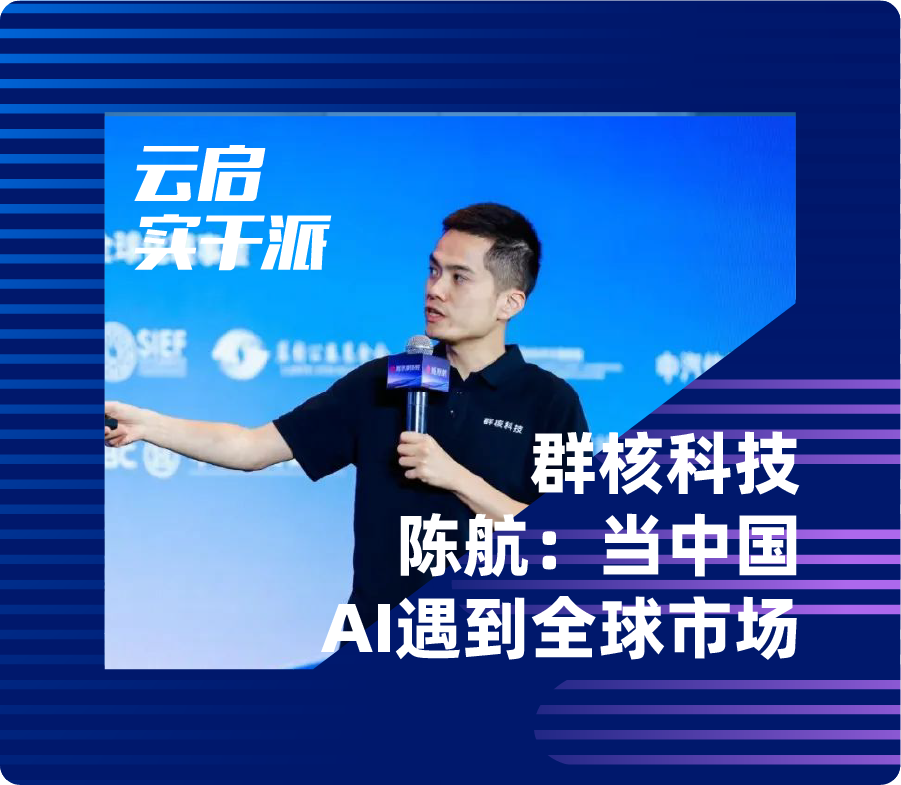
Yunqi Capital portfolio company and spatial intelligence innovator Manycore Tech has in recent years advanced through the stages of "software-service-technology" globalization. Recently, Hang Chen, co-founder and CEO of Manycore Tech, shared the company's overseas expansion experience at the 2025 China Enterprise Globalization Summit. This edition of "Yunqi Doers" walks you through that journey.

*This article is republished from "Manycore Tech"
I. Domestic Replacement: Solving the "Chokepoint" Problem
Hello everyone, I'm Hang Chen from Manycore Tech. I'm delighted to share with you here in Shenzhen, a city brimming with global expansion energy.
First, let me introduce Manycore Tech. Our core mission is building a "simulator for the physical world." Fourteen years ago, when we started out, what was the first thing we tackled?
At the beginning, we discovered that China's 3D CAD software was heavily dependent on foreign products. Whether in architectural design or home renovation, everyone was using imported software. This made us realize that if we got squeezed on this front, even ordinary families' spatial design could be affected. So we seized a major opportunity: the cloud transformation of 3D software. Leveraging cloud computing and GPU power, we achieved a "lane change to overtake."
Cloudification brought revolutionary user experience. What used to take days to produce a single 3D rendering, at high cost, Kujiale could now do at "second-level" speed.
With these technological innovations, we successfully broke the monopoly of foreign spatial design software in China. In home design specifically, we captured over 60% market share.
II. Software Globalization: From Globalization to Localization
During this period, Kujiale's backend started seeing many overseas IP addresses. Chinese users from different countries, finding the product useful, went out of their way to access it. We discovered that designers worldwide need lower-barrier, higher-efficiency tools.
- A product validated in China's already complex market — how does it take its first step toward the world?
As a product- and technology-driven company, Manycore first pursued product globalization, launching our global product — Coohom.
Coohom is the spatial design software Manycore developed for global users, providing 3D cloud design and rendering services. To take it global, here's what we did:
We selected our core product and technical capabilities already thoroughly validated in China, upgraded them to global standards, and deployed them in overseas markets for rapid validation.
The first was the 3D cloud design tool. At the time, this tool was Chinese-only. To make it usable for overseas users, we needed to support English and other languages simultaneously, while accommodating differences in usage habits between overseas and Chinese users. We rearchitected the tool for globalization, enabling a single frontend to support both Kujiale and Coohom, and built a multilingual middleware platform.
The second was the whole-home customization design tool. We took the whole-home customization tool that had proven highly successful with domestic B2B customers and adapted it for global use, offering kitchen, bath, whole-home, and door/window customization design capabilities — plus design-to-production integration — to overseas custom furniture manufacturers and retailers.
In the period that followed, Coohom's overseas registered users grew quickly, but retention and conversion rates remained stuck. As spatial design software, particularly for home scenarios, a critical factor affecting user experience is culture and aesthetics. Simply retrofitting the existing product with language-level "adaptations" couldn't make overseas users truly fall in love with it. We realized —
- The hardest part of going global isn't "getting out" — it's "landing."
How does AI truly land overseas? This requires differentiated treatment for different regions worldwide — in other words, localization.
Let me share three stories about Coohom's localization.
The first story comes from South Korea. For our first localization stop, we anchored here. Korea shares East Asian geography with China, with apartment-dominant living spaces and relatively similar lifestyles. The Korean market is also open — people will use whichever software is best.
In 2019, we connected with Hanssem, Korea's largest home furnishing company. Hanssem integrated Coohom, a cloud design software, into its complete system spanning marketing, sales, quoting, ordering, production, delivery, and installation, achieving full-chain data connectivity. Coohom helped Hanssem realize information management, production automation, and business growth.
- The first step in AI globalization is choosing the right "landing point."
The second story comes from North America. Starting in 2018, we exhibited at North American trade shows, signing many customers. But later we found usage rates and retention weren't high. What to do?
Through in-depth research, we recognized that North America's industry structure and user habits differ enormously from China's.
For North America, here's our approach —
Deep adaptation to local needs: Simplified interfaces aligned with user preferences; expanded brand model libraries and adapted product coding rules (like "B12") based on industry characteristics; strict adherence to local output standards including imperial units, drawing annotations, and list formats. Through dedicated research and retrofitting, we ensured product compliance.
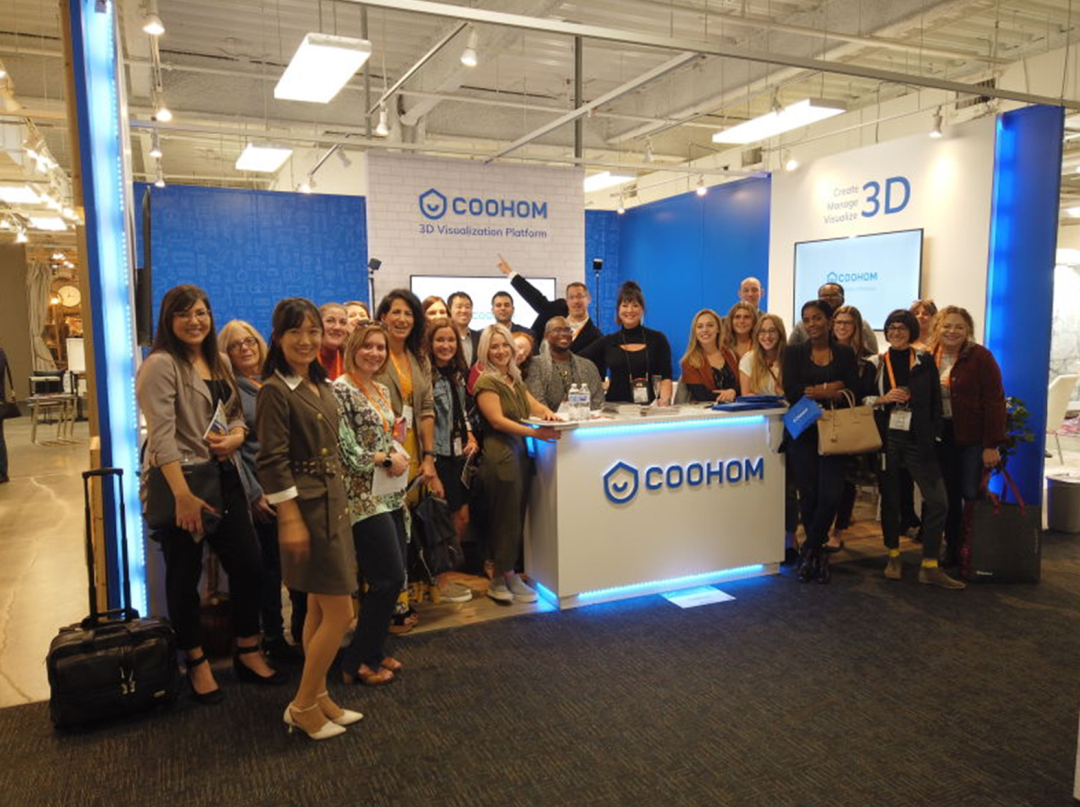
Coohom at a 2018 North American trade show
At the product layer, we retained core technical capabilities. At the application layer, we launched entirely new kitchen, bath, and closet design tools tailored to North American industry characteristics and user habits. This ultimately broke through in the US market.
- The second step in AI globalization is anchoring the ship properly. Step onto local soil, integrate into local life, and understand their needs.
The third story comes from India. Through PLG (product-led growth) online promotion, we found India's online revenue growing fast. Proximity to China meant Indian enterprise clients were also more accessible.
Coohom firmly chose India for localization. On one hand, we increased online channel investment; on the other, we went deep on localization to serve Indian B2B customers. Under this localized operation, our China and India teams worked closely together on traffic, conversion, and operations — gradually building up users and reputation in this market.
- The third step in AI globalization is, after casting a wide net, selecting suitable markets for focused cultivation.
Currently, Coohom has established professional teams in countries including the US, South Korea, Singapore, Vietnam, Malaysia, Thailand, Indonesia, and India for business development. By end of 2024, Coohom's registered users surpassed 10 million.
- So-called globalization is localization in every country. Manycore's AI globalization is localization in every country.
III. Service Enablement: Powering Cross-Border E-Commerce Companies
Today, Manycore has achieved strong results in its own product globalization. What many don't know is that as domestic software, we're also helping cross-border e-commerce companies set sail.
Comparing past and present, the industry has undergone earth-shaking changes from traditional foreign trade to cross-border e-commerce. Zooming in on the past two years, the biggest change has been the proliferation and application of AI tools.
Let me share an interesting company story: among our clients is a factory with its own production and sales, previously focused mainly on OEM manufacturing, specializing in children's products and pet enclosures. Later the company wanted to transform into a branded export business.
A factory of nearly 100 people completed this OEM-to-branded transition in just two months. The company leader told me they needed to produce about 20 pieces of marketing material for e-commerce platforms daily, with materials needing to adapt to completely different cultural aesthetics. With just two designers, they produced 1,200 key product marketing materials in 60 short days, establishing their path onto domestic and international e-commerce platforms.
Behind this remarkable transformation was AI. Visual bottlenecks manifest in many ways: whether SKU updates can generate images quickly, whether products can be presented realistically and accurately, and importantly, whether materials match local culture and atmosphere.
For cross-border e-commerce companies wanting to go global, a very practical question is: can you match diverse, precise images to consumer preferences across different cultural backgrounds?
Kujiale E-Commerce Studio Shooting is helping cross-border e-commerce solve this matching-to-cultural-scenes challenge. Today, we've launched over 5,000 curated studios in different styles and 300,000+ accessory models for cross-border e-commerce companies to freely use.
At this stage, we did one thing: moving from selling our own software overseas to abstracting our core capabilities to serve the thriving cross-border e-commerce ecosystem.
- From software globalization to enabling Chinese companies' globalization, Manycore's AI globalization has evolved from "landing" overseas to "ferrying" more companies toward global markets.
IV. Technology Globalization: Embracing the New Era of Open Source and Openness
Today we've entered a new cycle: technology globalization.
For Manycore, having achieved domestic replacement in China and helped Chinese companies go global, and having opened products to the world, we've now moved toward opening our technical capabilities to power global technological exploration.
A few days ago I heard a discussion. Many were shocked that Kuaishou could produce Keling AI, a globally leading video generation foundation model.
In my view, this was inevitable. China's digital economy has developed explosively over the past decade. Platforms like Kuaishou carry the most complex scenarios and most diverse needs, thereby accumulating the richest content. These are the foundations for Chinese companies to become global technology leaders in the second half.
Manycore is the same. Over the past decade, based on Kujiale serving massive scenarios, we've accumulated the world's largest indoor spatial dataset and developed our own spatial models. These technical advantages make it possible for Manycore today to open up, open-source, and go global with technology.
In the technology globalization stage, we're mainly doing two things: 3D interactive datasets and spatial open-source models.
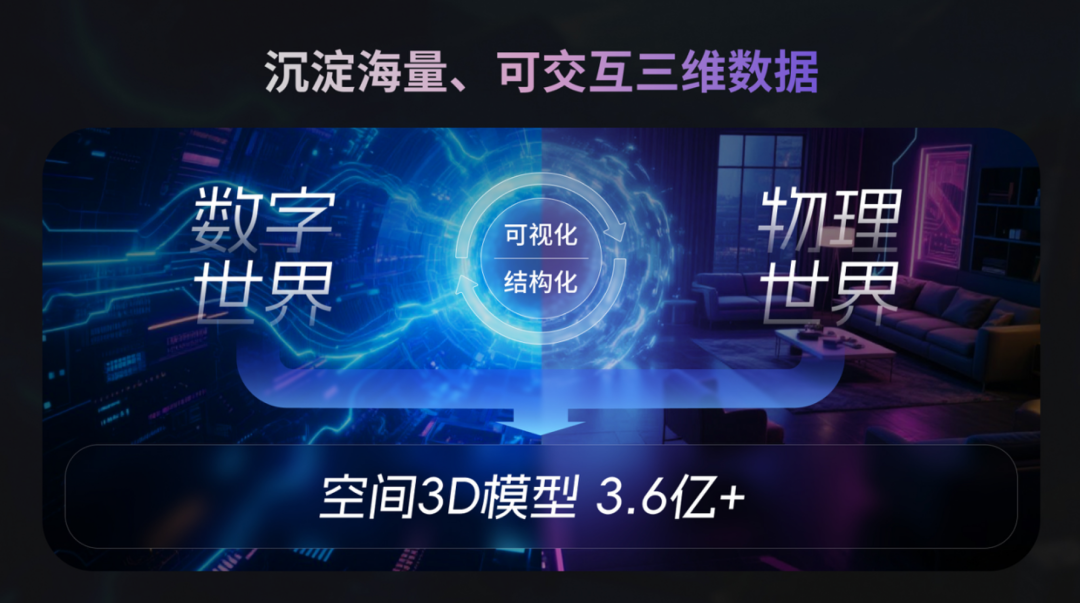
First, datasets. Stemming from the massive demand scenarios Kujiale accumulated in the China market, Manycore has built a rich 3D interactive dataset. Physically correct training data is key for AI to enter the physical world, and it's also a scarce resource globally.
As early as 2018, we partnered with several overseas universities to open-source a dataset called InteriorNet. This was then the world's largest indoor scene deep learning dataset. Shortly after release, a major Silicon Valley company emailed us to collaborate. This email formally launched our exploration in technology globalization, and was our first step in commercial exploration of spatial intelligence.
Since then, we rapidly established the Manycore Spatial Intelligence Platform, opening datasets to global embodied intelligence and AIGC partners for mutual value creation.
After data comes models. Based on our accumulation in spatial data and spatial intelligence technology, we trained our own spatial generation model and spatial understanding model, enabling physical world scenarios to be easily translated into the digital world and understood by AI.
This March, we open-sourced a spatial understanding model, SpatialLM, which helps machines master human spatial understanding and parsing capabilities. Upon release, it hit number two on HuggingFace's global trending list — right behind DeepSeek V3.
Today, China holds pivotal position in global technological innovation. Open source is a distinctive path for China AI to lead global tech innovation, and a new proposition for Chinese companies going global. We hope to become infrastructure in the global spatial intelligence field based on a closed loop of "data-model-software tool" capabilities.
In technology globalization, we're looking at the next 10, 20 years. Only by laying the infrastructure first can true capabilities be unleashed.
- For this generation of Chinese entrepreneurs, embracing open source and achieving technology globalization can unlock greater value.
Manycore Tech initially built its foundation in China, using the domestic market to incubate a new generation of cloud-era spatial intelligence software, then took this best product out to compete globally. So let me share a few thoughts:
First, Chinese companies still need to bravely go out. You can see different markets. As I mentioned, we found India to be a promising market, and that gradually drove growth.
Second, have confidence. Especially in the AI era, I believe the user scenarios China has accumulated, including talent, are extremely strong and will unleash tremendous energy going forward. Combined with our excellent manufacturing companies and strong cross-border ecosystem — with all these links connected, everyone should have ample confidence.
Finally, stay true to your original aspiration. The further you go, the more you'll realize its importance. Manycore's original aspiration is technology. DeepSeek is a great example — I believe such companies are worth our serious study.
I'm very glad to be in Shenzhen, and hope to enjoy this era of globalization together with all of you. Thank you.