Can the "ChatGPT" That Writes Songs and Codes Replace Humans? | Yunqi Science Chat

"ChatGPT Is Coming for Our Jobs Tomorrow"?

ChatGPT is a general-purpose chatbot developed by AI research lab OpenAI. It can answer follow-up questions, admit its mistakes, challenge incorrect premises, and even refuse inappropriate requests. It can compose poetry, write code, draft screenplays, and solve advanced math problems. Netizens have dubbed it "the omnipotent AI." Since its launch on November 30, 2022, it has whipped up a "ChatGPT" frenzy across the internet. Topics like "ChatGPT will steal human jobs tomorrow" and "AI will rule humanity" have once again sparked public debate.
So how exactly was ChatGPT forged? Does it pose a threat to humanity? And how should we view ChatGPT's future development?
In this edition of "Yunqi Kepu", we share information and insights on ChatGPT. Enjoy~
Source | This article is republished with permission from the WeChat account "Electronic Technology Applications ChinaAET" Authors | Keyang, Dong Xingsheng
➤➤➤ Recently, a ChatGPT craze has swept across the internet. The cause: OpenAI released a brand-new chatbot model — ChatGPT, which is also one of the flagship models in the GPT-3.5 series and is currently still in the testing phase.

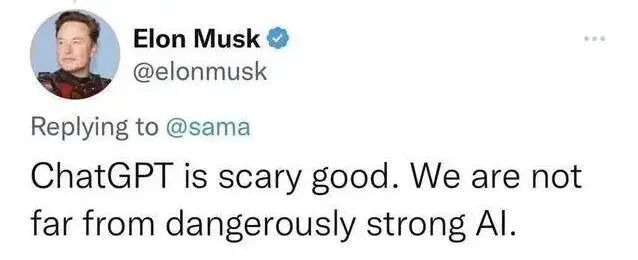
Even Elon Musk has marveled that "so many people are insanely addicted to the ChatGPT loop," and that "ChatGPT is scary good. We are not far from dangerously strong AI."
From composing poetry to writing code, to drafting screenplays and solving advanced math, the free conversational AI model ChatGPT released by OpenAI has demonstrated remarkably powerful capabilities in handling questions across multiple domains, drawing global attention.
Although the model is still in the testing phase, it attracted over one million users within just one week of release, with numbers continuing to grow. Jokes like "ChatGPT will steal human jobs tomorrow" have been endless.
What Is ChatGPT
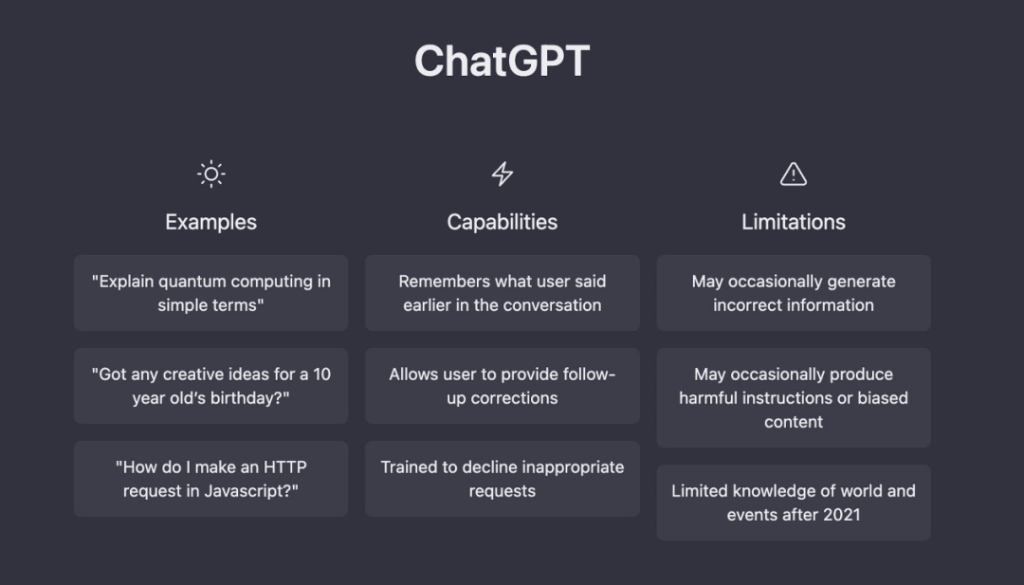
With the boost from GPT-3.5, ChatGPT's training has enhanced its ability to respond fluently. While GPT-3 simply predicts text following any given string of words, ChatGPT attempts to interact with users in a more human-like manner. ChatGPT's interactions are typically very smooth, and it has the capacity to engage on a wide range of topics — showing dramatic improvement compared to chatbots that emerged just a few years ago.
OpenAI officially states that ChatGPT was created and trained with human assistance. Human trainers ranked and rated the ways earlier versions of the AI responded to queries. This information was then fed back into the system, which adjusted its answers based on the trainers' preferences — a standard method of training AI known as reinforcement learning.
How Powerful Is ChatGPT
A coder tested it with programming problems, and the results were satisfying:
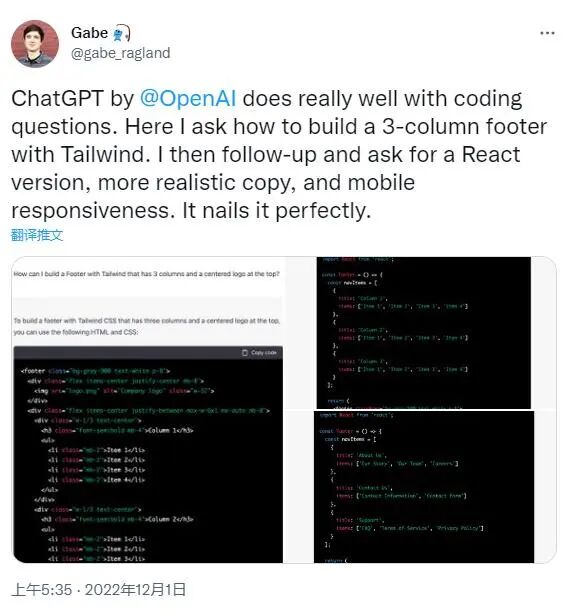
Someone had it write soap opera dialogue using comedians from Friends as characters, and the result was remarkably lifelike:

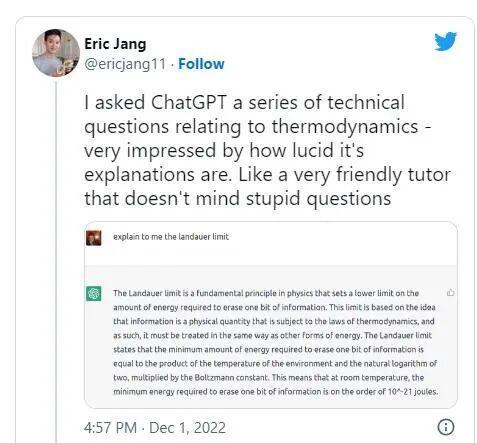
Explaining highly specialized scientific concepts is no problem either. Below, its answer to a thermodynamics question is accessible yet thorough, delivered with a notably patient and encouraging tone:
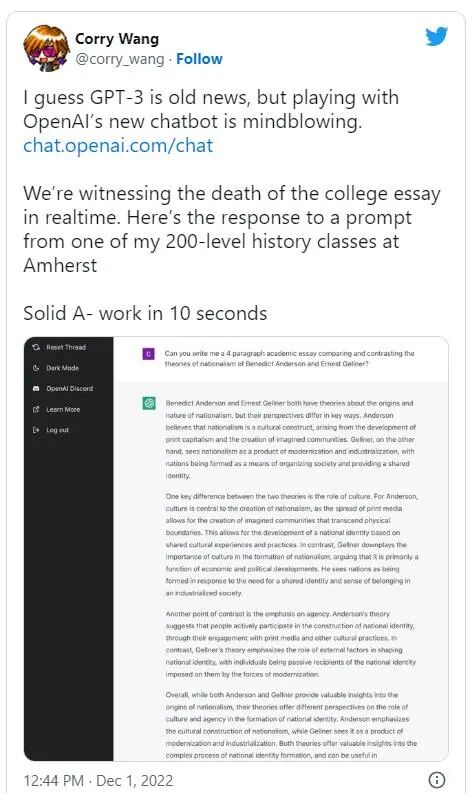
It can even write basic academic essays, such as this university history paper comparing the nationalist theories of two scholars:
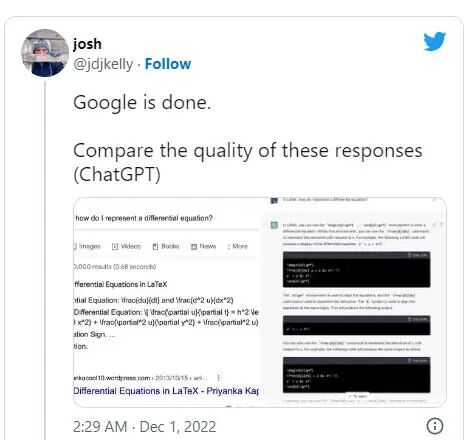
ChatGPT also has a curious ability: answering basic, even somewhat trivial questions. This has led many to believe that AI systems like this could one day replace search engines. Chatbots are trained on information collected from the web. So if they can accurately present this information and deliver it in a more fluid, conversational tone, it would represent a massive leap beyond traditional search. Accordingly, after comparing Google search results with ChatGPT conversations, some have confidently declared that Google is "finished":
How Should We View ChatGPT?
By learning from vast collections of existing texts and conversations, ChatGPT can engage in real-time dialogue like a human, answering all kinds of questions fluently. Amid this wave of ChatGPT euphoria, some view it as representing a viable path toward future artificial general intelligence — that AI may shift from handling specialized, single-domain problems to simultaneously tackling multi-domain challenges.
But to some industry insiders, the concept of AGI itself is fuzzy. Some believe general-purpose AI means the AI must be conscious, aware of what it's saying. But ChatGPT has no logic whatsoever. It doesn't think through logic and deduction — it's a massive probability-mapping machine. For now, ChatGPT remains an efficiency tool that assists productive work, and its business model is still in early exploratory stages.
Although experts still have some disagreements about ChatGPT's commercial prospects, there is no doubt that following the AI wave represented by AlphaGo, ChatGPT and a new wave of AI generative models have further ignited public enthusiasm.
The defining feature of this new wave of AI is: unlike the previous wave, which primarily targeted enterprise markets, this one is close to ordinary users and more easily perceived by the general public. So it's no surprise that ChatGPT has garnered mass response in a relatively short time.
Many netizens joke that ChatGPT's impressive performance has made writers, programmers, and other professionals feel threatened, and claims that it will replace search engines have been endless.
So in this wave of AI for everyone, will AI "steal human jobs"? Perhaps from a technical standpoint, AI may cause short-term unemployment for some groups, but in the long run it will create more job opportunities.
But before a crisis of subjectivity arrives, humanity should understand this: in the future, human思辨性 and creativity — what makes us human — will be elevated to an unprecedented position.