Former Cainiao CTO Bets on Physical AI: Yunqi Capital Leads KunTeng Dynamics' 100-Million-Yuan Seed Round | Yunqi Partners

Building Physical AI's Data Flywheel Through Real-World Business Scenarios

From large language models to Physical AI, artificial intelligence is entering a new phase that demands deep interaction with the real world.
Recently, Yunqi Capital portfolio company Quantum Power (昆腾动力) raised over 100 million yuan in a seed round. Founder and CEO Sam Li spent 17 years at Alibaba, where he previously served as CTO of Cainiao. Drawing on the team's logistics industry experience and AI technical expertise, the company is pursuing a "scene-first, then back to foundation" approach — building a Physical AI data flywheel grounded in real business scenarios. Learn more in this edition of Yunqi Partners.
Yunqi Capital's Perspective:
We see long-term opportunity in Physical AI and world models moving from technical exploration into real industrial scenarios. This track is no longer merely a competition of concepts, models, and demos — the battleground is shifting toward high-value scenario deployment, scalable implementation, and whether players can form a closed loop where data, models, and products reinforce each other. Logistics offers high task frequency, clear feedback signals, and well-defined commercial value, making it a critical entry point for validating robotic capabilities, accumulating real-world data, and improving model generalization.
The Quantum Dynamics team combines logistics industry expertise, AI technical depth, and global business experience. They can start from genuine customer needs and deeply integrate world models, robotic systems, and scenario delivery. We endorse the team's chosen incremental path: beginning with logistics, continuously abstracting the general capabilities underlying different scenarios and tasks, gradually expanding into more industries, and ultimately building a general-purpose foundation model with cross-scenario generalization capabilities for the physical world.
The following is adapted from 36Kr Hard Tech.
36Kr Hard Tech has learned that Physical AI platform company Quantum Dynamics recently completed a seed round exceeding RMB 100 million, jointly led by Yunqi Capital and SenseTime Guoxiang. The funds will primarily support core Physical AI R&D, talent development, and global market expansion — accelerating the full-stack construction of its intelligent systems for the physical world, from underlying models to scenario deployment. Multi-Dimensional Capital participated in project incubation and team formation.
Founded in the first half of 2026, Quantum Dynamics focuses on the deep integration of AI with the real physical world. It develops general-purpose intelligent system technology reusable across multiple scenarios, building a Physical AI underlying platform for all industries.
Founders in the embodied intelligence space currently fall into several categories. One group comes from autonomous driving backgrounds, with strengths in system integration and engineering deployment. Another originates from Neo Lab, bringing cutting-edge embodied intelligence technical perspectives. Quantum Dynamics founder Sam Li represents a third category — he previously worked deep in logistics commercialization scenarios, combining AI technical understanding with global business operations experience.
Company founder and CEO Sam Li spent 17 years at Alibaba Group, building and operating systems from 0 to 1 across Taobao and Tmall, Cainiao, international business, and autonomous delivery vehicles. He served as CTO of Cainiao Group and CTO of Alibaba International Digital Commerce, managing thousands of R&D staff distributed globally. He also concurrently served as General Manager of Cainiao Autonomous Vehicles, overseeing R&D and commercialization of autonomous driving technology. His team conducted deep business integration with postal systems in 200 countries worldwide, accumulating firsthand experience in global logistics fulfillment.

The core team covers all critical links from frontier research, model development, and hardware engineering to global commercial deployment — possessing complete closed-loop capability from technical breakthrough to value delivery. This hybrid team DNA led Quantum Dynamics to choose a differentiated path from its founding.
"We don't need to wait for a perfect general model before finding scenarios. Instead, we identify entry points where existing technology can be converted into customer value, and get commercialization running first," said Sam Li, founder and CEO of Quantum Dynamics.
In fact, this year the embodied intelligence track is undergoing a collective shift from "showcasing tricks" to "getting things done." At the recently concluded WAIC 2026, demo booths with backflipping and dancing robots remained popular, but what also drew crowds were live demonstrations bringing automotive factories and logistics sorting lines directly to the exhibition floor.
Industry consensus is forming: Physical AI has become the next major battlefield after large language models, and the competitive decisive factor is shifting from model parameter size to the depth of real-world data.
IDC report data shows that in 2025, China's embodied intelligent robot user spending is expected to exceed $1.4 billion, surging to $77 billion by 2030 — a compound annual growth rate of 94%. The faster money flows in, the more a structural problem becomes prominent: physical world data cannot be batch-acquired through web crawling like text and images.
This means whoever first achieves scaled real-machine deployment gains priority in data collection. This is Quantum Dynamics's underlying logic for entering the industry: first embed in logistics warehouses, accumulate exclusive real-world data through real-machine deployment, then use that to refine the underlying world action model.
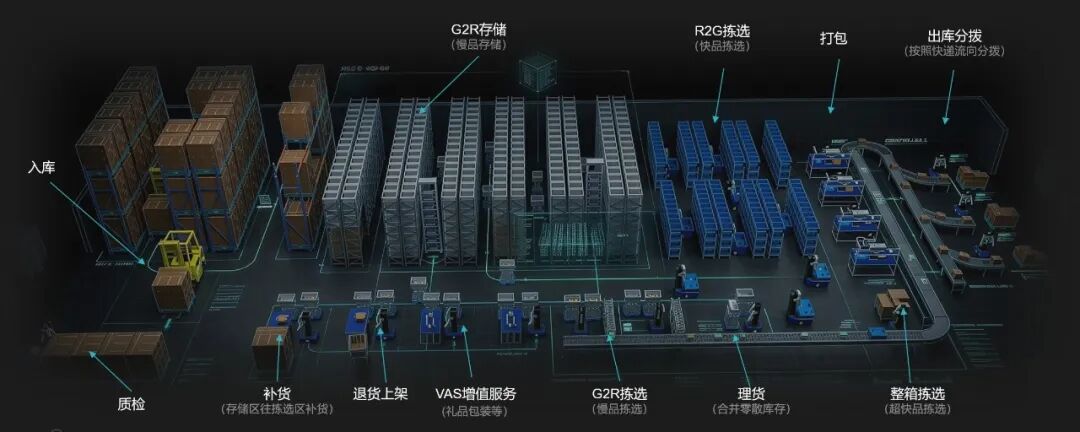
In a medium-sized warehouse, one picking robot completes tens of thousands of grasp, place, scan, and label applications daily — covering nearly all physical operation types from rigid boxes to flexible packages, from standard sizes to irregular SKUs. Every success or failure is a clear signal requiring no human annotation. These are the links with the largest labor gaps and highest human cost ratios in logistics networks, and the hard problems that traditional automation has long failed to crack — precisely where model-driven solutions can achieve breakthrough scale.
On data collection and utilization efficiency, Quantum Dynamics has built a closed-loop data system. Lightweight algorithms running on edge robot bodies can identify high-value data segments in real time — including scenarios requiring human intervention, "near-failure" states with low model prediction confidence, and difficult cases where repeated attempts remain unsuccessful. This data is automatically labeled, transmitted back, and fed into training pipelines.
Meanwhile, for portions requiring human intervention, the algorithm platform extracts only the most learning-valuable segments from intervention operations, filtering out redundant portions to ensure every frame entering the training set contributes effective information.
This mechanism gives Quantum Dynamics's data pipeline two distinctive characteristics. First, scale effects: each additional deployed warehouse adds a new data source. Second, exclusive data production — as data depth increases, model generalization and success rates improve, reducing the cost and cycle for onboarding new customers and scenarios.
When real-scenario data reaches sufficient density, it provides realistic conditions for Quantum Dynamics's self-developed foundation model. The goal is not a single-capability model, but a complete embodied intelligence system that continuously evolves from real deployment. This system platform consists of six technical modules working in coordination, covering the full Physical AI system from data collection, model updating, to swarm collaborative evolution — to be validated and refined through offline real industrial scenarios.
First is the embodied-native World-Action Model. Unlike common video prediction models, it jointly models vision, action, body state, and tactile signals — enabling the model to learn "how one operation changes the physical world" while meeting engineering requirements for real-time robot control.
Simultaneously, based on Quantum Dynamics's established data closed-loop system, using real-machine operations and human manipulation data as primary inputs, raw logistics scenario logs can be automatically processed into high-value training samples carrying task phases, failure causes, recovery actions, and business outcomes — supporting second-level retrieval, automatic cleaning and labeling, and daily model iteration. Combined with Human-in-the-Loop (HITL) mechanisms, it can determine optimal human intervention timing for robots and convert every intervention into training data, continuously increasing the number of robots one person can manage.
At the execution level, the system deploys a lightweight World Model Corrector for real-time monitoring of action execution deviation, triggering correction, replanning, and retry before operation failure — improving task success rates in real scenarios. Facing new customers and warehouses, the system needs no full model weight retraining; through Test-Time Training, few-shot demonstration, and historical experience reuse, robots quickly adapt to different goods, shelving, lighting, and workflow changes.
Ultimately, all embodied robots form a continuously learning, self-evolving swarm. Each device's success, failure, intervention, and recovery experiences undergo multiple processes of offline reinforcement learning, preference optimization, simulation training, and real-machine validation — continuously updating across the entire fleet.
Quantum Dynamics divides its deployment roadmap into two phases. In 2026, it will focus on B2C and small-to-medium B e-commerce warehouses, targeting three labor-intensive processes: replenishment and shelving, item picking, and parcel packing. It will prioritize deployment in warehousing environments with regular SKUs such as beauty and pharmaceutical products, using human-machine collaborative mixed-production models for scaled pilots. By 2027, business boundaries will extend toward complex express delivery outlets, following an expansion path from "logistics warehousing to industrial production lines, retail shelves, pharmaceutical sorting, to commercial services, and ultimately into home and livelihood services" — broadening Physical AI's scenario boundaries.
The Physical AI competition has never been about the impressiveness of technical demos alone, but whether robots can stably complete tasks in the real world. Quantum Dynamics has chosen an unglamorous path: first getting thousands of robots running in warehouses. What it aims to prove is not merely one company's commercial viability, but the route viability of Physical AI's "vertical scenario entry, gradual progression toward generality."
The following is an edited excerpt from 36Kr Hard Tech's interview with Sam Li, founder and CEO of Quantum Dynamics:
36Kr Hard Tech: Quantum Dynamics chose logistics warehouses as natural training grounds, building a data flywheel through real-machine deployment — landing scenarios first, then refining underlying models. Can you break down the timeline and trade-off logic of this "scene-first, then foundation" step-by-step strategy? What differentiated moats can this path form in the long term?
Sam Li: Our team has worked in logistics for many years. We understand both the current technical boundaries of embodied intelligence and the vast, complex real operating environments of logistics. Based on present technical capabilities, we've found a more pragmatic deployment path: relying on post-training solutions, we can first achieve scaled commercial deployment in certain warehousing scenarios.
The most direct benefit is generating revenue while continuously accumulating exclusive real-machine data. This data fully conforms to real physical world distributions — not just standard successful grasp trajectories, but also extensive negative samples of grasp deviations and operation failures. Its richness and authenticity far exceed simulation and motion capture datasets. With the same model architecture, higher-quality real operating data naturally creates generalization capability gaps.
In the long run, competition in this track will ultimately center on data collection efficiency and per-unit data cost. Whoever can continuously produce massive real-machine data at lower cost will establish solid advantage. This logic parallels Claude and Tesla FSD: larger deployed endpoint scale means more accumulated interaction and driving data, and stronger overall performance after the entire fleet iterates and optimizes through reinforcement learning. Our large-scale warehouse robot deployment is precisely aimed at opening the complete closed loop of real-machine RL post-training and fleet-wide continuous evolution.
36Kr Hard Tech: Quantum Dynamics plans to gradually expand from e-commerce warehouses to diverse scenarios, but different environments have vastly different physical interaction logics and operational constraints. What general atomic capabilities will the team distill from logistics data to support cross-scenario transfer? For non-standard, commercially weaker scenarios like home and elder care, what core difficulties remain for current models and few-shot adaptation frameworks?
Sam Li: We've built three layered evolution paths, all relying on warehousing scenarios for capability accumulation, then directly reusing and expanding to various new scenarios.
At the mobile manipulation level, we follow a gradual refinement rhythm: first deploying desktop fixed robotic arm solutions, then achieving humanoid robot static operations, next conquering whole-body coordinated mobile manipulation, and finally reaching stable dynamic operations in open human-flow environments.
For manipulation precision, we continuously iterate control standards in layers, starting from basic grasp precision and progressively refining to millimeter-level, ultimately advancing toward sub-millimeter fine manipulation.
Simultaneously we continuously expand standardized atomic action reserves, thoroughly mastering various practical actions in warehousing scenarios including pick-and-place, waybill application, wrapping and packing — completely precipitating mature interaction capabilities. Logistics itself is an ideal testing ground for refining these underlying capabilities; when expanding outward to new scenarios, all this accumulation can be directly reused.
Entering home and elder care scenarios, we adopt a from-simple-to-complex deployment approach, first landing low-risk basic tasks like item delivery and organization, then progressively iterating close-proximity human-machine fine interaction functions.
At this stage, several key challenges remain for this system to enter the home and elder care track.
First, insufficient few-shot learning capability. Home environments feature highly personalized items and usage needs, urgently requiring stronger in-context learning abilities so robots can master entirely new tasks from minimal demonstration.
Second, the comprehensive safety system needs improvement — optimizing hardware material protections for body structure and batteries, and building multiple protective mechanisms at the model and control system levels to avoid collision and injury risks during human-machine interaction.
Additionally, adaptive force-tactile control still has room for improvement. Elder care scenarios demand extremely high standards for gentle manipulation; dexterous hands need to achieve precisely controllable soft force application, and current dynamic force perception and adjustment capabilities require continued refinement.