Digital Intelligence Weaving, Large Model Production: How Textile Factories Are Upgrading Through Digital Transformation | The B-Side of Entrepreneurship

First, immerse yourself in the factory — "grind every day, ask questions every day."
"The Other Side of Entrepreneurship" spotlights tech-to-B founders. In this series, we zoom in on Yunqi Capital's portfolio companies on the front lines of industry —
to see how they're building the extraordinary behind the scenes of everyday convenience and efficient production.
China is the world's largest textile producer, with the most complete industrial chain and the broadest range of categories. Thousands of years of textile history make up one of the most brilliant chapters of Chinese civilization. "A thousand people spin yarn, ten thousand weave cloth" — the textile industry was once the quintessential labor-intensive sector. Now, this ancient and massive industry is moving toward refined, intelligent operations through digital transformation.
In 2017, we invested in Zhijing Technology (Baibu), a textile industry internet company. Starting with helping factories "find fabric," Zhijing Technology gradually embedded itself deeper into factory operations, using big data, AI, IoT, robotics, and other next-generation technologies to fully connect the information, logistics, and capital flows across the textile and apparel industry — helping the sector achieve collaborative, flexible, and intelligent operations, and building an integrated digital-intelligent service platform.
In this episode of "The Other Side of Entrepreneurship," we invited Zhao Zhenhong, founder and CEO of Zhijing Technology, to share how his team spent every day "grinding away and asking questions" on factory floors to build an intelligent "industrial infrastructure" that customers actually want to use and that delivers real results.

The Answer Is on the Ground
The Other Side of Entrepreneurship: Do you still visit factories often?
Zhao Zhenhong: Kazuo Inamori once said — "The answer is on the ground; the ground has gods." The closer you are to your customers, the clearer you see how to create more value for them. When we were working on the upstream production segment, we spent roughly 200 out of 365 days a year with our clients. We can't just think "our tech is amazing" — we need to see their needs, brainstorm with them, solve their problems. Only then does the product feel grounded, and only then are customers willing to use it.
China is the world's largest producer of textile and apparel fabrics. No other country has such a rich, systematic, and complete textile industrial chain, with every imaginable sub-sector — it's a massive market. But in the past, the entire industry had zero information infrastructure; factories were run on paper and pen. Now, across the full textile chain — from raw material trading of chemical fibers and cotton, to spinning, weaving, dyeing and finishing, and garment factories — we're helping factories at every link undergo digital-intelligent transformation, unifying "capacity" and "demand" on the cloud to enable the most precise matching possible and improve transaction fulfillment quality.
The Other Side of Entrepreneurship: What does digital-intelligent transformation look like inside a textile factory? What problems does it solve?
Zhao Zhenhong: The textile industry has two major pain points — one, from a supply chain perspective, capacity mismatch; two, from an enterprise perspective, excessive reliance on labor and experience.
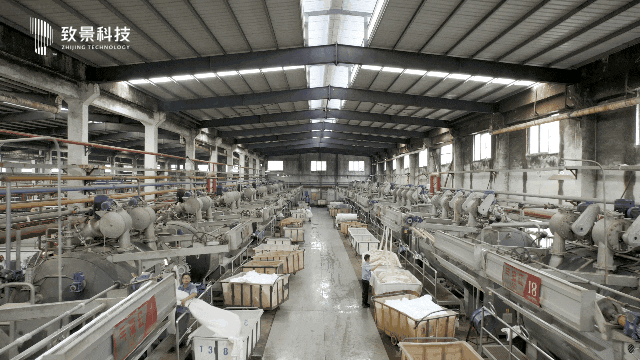
In the past, due to concerns about insufficient customer sources, the average machine utilization rate in the textile industry was below 60%, with idle capacity kept open to wait for additional external orders to match. "Feishuo Zhifang" installs AIoT devices on machines in spinning, weaving, and dyeing-finishing plants to monitor operational status, then uses a textile large model to enable intelligent recommended production scheduling — giving factories full visibility and control over their entire production process and order progress, and improving equipment utilization.
Now, as more and more factories go digital-intelligent, we connect them through our industrial internet platform. Factories on the platform can match their capacity with order demand on the platform, improving supply chain coordination efficiency and solving the underutilization problem. Factory utilization rates have now risen above 70%.
To address the industry's past over-reliance on manual labor, we use online monitoring, anomaly alerts, and big data analytics to rapidly convert production line data into decision feedback, reducing the impact of human misjudgment. One of our clients in Dezhou, Shandong, reduced abnormal downtime by 35% after implementing digital transformation.
For quality control in the weaving process, we've developed intelligent equipment such as an intelligent doubling-and-twisting inspection robot for doubling machines, and an "inspect-while-weaving" intelligent detection system robot for looms — replacing manual inspection with intelligent inspection, pushing full-process quality management and intelligent manufacturing in weaving even further.
We've also made major breakthroughs in the dyeing and finishing segment. Our developed intelligent dyeing brain can recommend dyeing processes intelligently; workers simply scan a code to execute system-issued instructions in the most standardized way. The intelligent color-matching system improves color accuracy and efficiency. Sample production time has been reduced from the previous 3-5 days to just 24 hours for rush orders.
"Feishuo Zhifang" officially launched in 2020. Currently, over 9,000 factories nationwide with more than 700,000 looms are using it, along with numerous dyeing-finishing and spinning plants.

How to Build an Industrial Internet Platform?
The Other Side of Entrepreneurship: From transforming a single factory to extending upstream and downstream across the industrial chain, what other digital-intelligent transformations happen in between?
Zhao Zhenhong: In the past, our entire industrial chain was fragmented across many small factories at every link, each with limited competitiveness; only by connecting everything can we maximize efficiency across the entire industry's chain.
Factory management covers many aspects — from receiving orders to shipping, there are production management, inventory management, employee dispatch, payroll calculation, and more. With a digital and intelligent system in place, we can connect the entire supply chain centralized procurement, intelligent dispatch, and smart warehousing and logistics service chain: First, knowing when each machine has available capacity allows us to dispatch orders more effectively; second, we can provide better raw materials to help improve product quality, and with our logistics centers and industrial parks, help traditional factories create higher value at lower cost.
As consumer incomes rise and people increasingly seek personalization, we need to help these companies quickly find fabric, obtain fabric, and even provide full pattern-making support services — so they can focus on production while we handle everything else.
The Other Side of Entrepreneurship: Zhijing helps improve efficiency across multiple links in the textile supply chain, which requires touching many points across the entire industrial ecosystem. How did Zhijing gradually build its industrial internet platform?
Zhao Zhenhong: When we first started, Zhijing Technology mainly focused on fabric circulation. Now we also cover raw materials upstream like cotton, yarn, and woven fabric, and downstream garment factory capacity integration, apparel brands, and industrial parks. Our industry actually changes very rapidly, so we believe that in the next 3 to 5 years, the entire industry will trend toward faster and more fragmented downstream, and more concentrated upstream — we're doing corresponding work following these two trends.
In the downstream garment manufacturing segment, the time from design to shelf has been drastically shortened, and the industry increasingly adopts a "small-batch, quick-response" model where small quantities hit shelves first, with reorders added later. So we built the "Tiangong Selection Platform," a one-stop apparel manufacturing supply chain. Through our digital-intelligent advantages and supply chain resources, we enable interconnected full production scenarios for apparel — from trend analysis, design, procurement, pattern-making, production to logistics — promoting flexible apparel production to respond to small-batch, quick-response demands.
Our self-developed Fashion 3D software uses digital technology to achieve high-fidelity 3D digital sample modeling. Without needing to produce physical samples, it helps brands and garment factories collaborate online on pattern review and style selection, with faster efficiency — reducing the time and space costs of previous offline sample production.
On clustering, we're now building industrial parks because factories in China's coastal cities have a trend of migrating to the central and western regions. We help these factories relocate holistically, providing them with digital-intelligent services to substantially improve their overall efficiency and reduce their transition costs.
For example, in warehousing, wholesale markets previously had wholesalers storing inventory in small civilian houses around the market — no fire protection, no information systems, poor traffic access. Now in Foshan, we've built a warehousing center covering approximately 150,000 square meters. This is the world's first large-scale intelligent warehousing center to deploy massive automation equipment and platform-based operating models in the fabric segment, helping the entire market improve warehousing and logistics fulfillment efficiency through intelligent warehousing integration.
As our business path becomes clearer, the company is now also investing more resources and capital in talent — not just external recruitment, but also internal talent development, with particular focus on product and technical capabilities. I've personally stayed involved in frontline recruiting, especially for technical leads — I basically go out myself, making repeated visits to bring them on board. Yunqi Capital has also provided substantial help with recruiting, and helped us refine our business model, saving us from many detours.

Searching for the Industry's New Boundaries
The Other Side of Entrepreneurship: Helping traditional industries upgrade is a complex undertaking. What drives the team to keep pushing forward?
Zhao Zhenhong: I can share a small story. The product lead for our Feishuo Zhifang is from Shanghai. Once during National Day, he took his son to the Shanghai Textile Museum to see the history of textiles — looms, spindles, and so on. After the holiday, we went to discuss business with Shanghai government officials, and their staff mentioned they wanted to include digital tools in the textile museum going forward. At that moment, our product lead thought that when he takes his son to the museum again, he'll be able to say this industry has undergone tremendous change because of our efforts.
From 2016 to now, our core team's senior leadership has been very stable. Everyone feels this is something worth doing in their lives. We're helping China's largest traditional industry build digital and intelligent capabilities — the more we do, the more accomplished we feel. In the past, the textile powerhouse was built on massive amounts of inefficient, fragmented small capacity. We hope to help the entire industry substantially improve efficiency and reduce costs in the future, supporting China's upgrade from a textile powerhouse to a textile stronghold.
The Other Side of Entrepreneurship: Zhijing represents Chinese industrial chain upgrading. In your view, what new development opportunities lie ahead for China's industrial chain upgrading?
Zhao Zhenhong: China currently has massive trillion-scale traditional industries. These industries have grown rapidly and extensively over past decades. But the vast majority of enterprises lack digital and intelligent capabilities. To compete going forward, they need to improve their efficiency through digitalization and intelligentization. So I believe industrial internet represents enormous opportunity in this space. Looking at our industry and other traditional sectors, I think industrial internet is a boundless, ceiling-less, ten-trillion-scale market. There's so much we can do within it — helping various factories with digital and intelligent transformation, rebuilding truly intelligent warehousing and intelligent logistics, introducing new financial services, providing new services like AI, IoT, and large models. I believe all industrial internet companies have the opportunity to become infrastructure for their industries. This is a massive opportunity, and also the best opportunity of the next decade.