Making Robots More Human: Stardust Intelligence Unveils DuoCore Fast-Slow Coordination System | Yunqi Capital

Thinking and Cognition Like the Human Brain
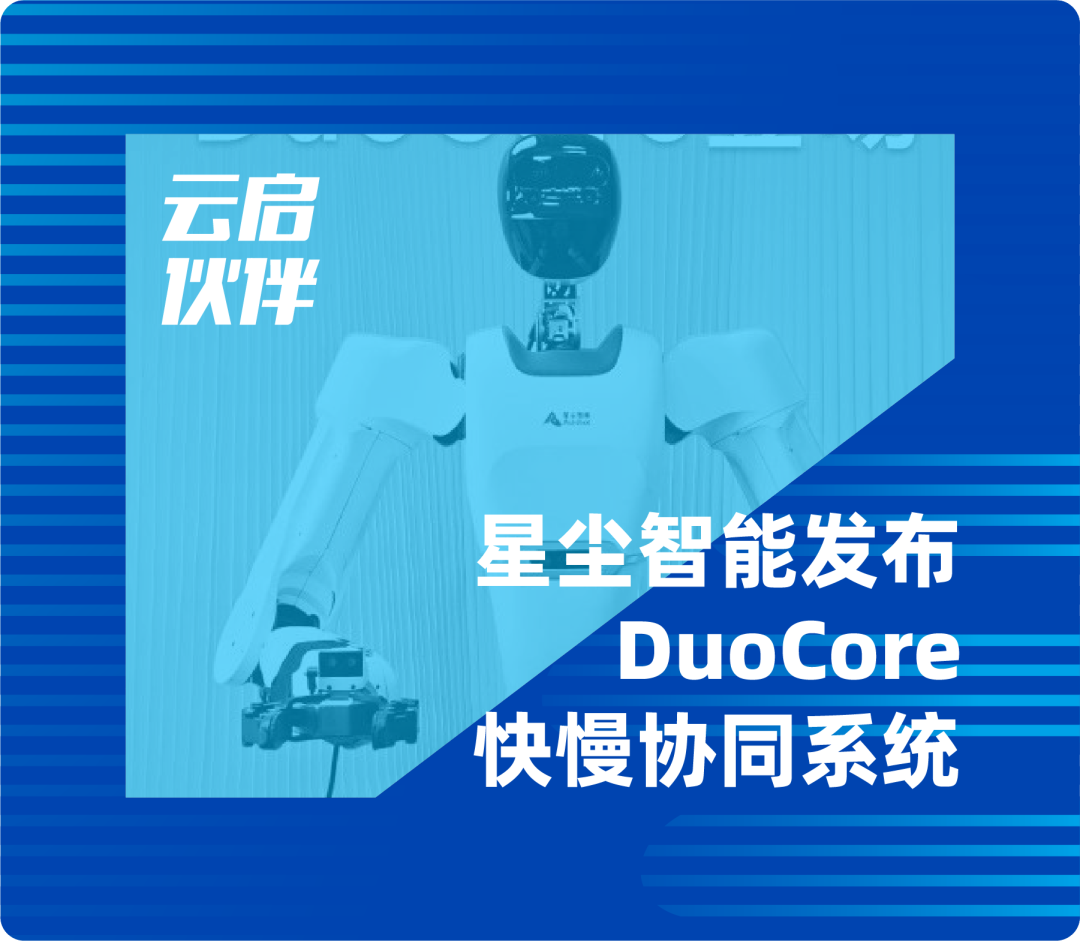
Recently, Yunqi Capital portfolio company in the embodied intelligence space, Astribot, unveiled its R&D breakthrough — the DuoCore Fast-Slow Coordination System. Built on Nobel laureate Daniel Kahneman's "dual-system theory," this system marks the first time robots have been endowed with both instinctive reflexes and deep reasoning capabilities.
Moving beyond traditional AI's "data-feeding" approach to learning, the DuoCore system introduces a human-like skill transfer mechanism. By constructing a modular library of "meta-skills," it enables cross-task, cross-scenario rapid generalization and few-shot learning. In this edition of "Yunqi Capital", we explore how Astribot is using the DuoCore system to "recode the DNA of human-machine coexistence."
The following content is republished from Astribot.
Consider these two problems:
A bat and a ball cost $1.10 total. The bat costs $1 more than the ball. How much does the ball cost?
All roses are flowers. Some flowers fade. Therefore, some roses fade. Is this logic sound?
Take five seconds to think. Scroll down for answers ⬇️
Correct answers:
Problem 1: The ball costs $0.05 (not $0.10). The bat costs $1.05. Total: $1.10.
Problem 2: There's a logical flaw. "Some flowers" may not include roses. The inference is invalid.
Chances are, most people got these wrong in their gut response. Nobel laureate Daniel Kahneman revealed the secret in his book Thinking, Fast and Slow: the human brain is perpetually governed by two systems — System 1 (fast intuition) and System 2 (slow reasoning). The former leverages millions of years of evolved instinct for rapid decisions — like catching a falling plate. The latter reconstructs cognition through trial and error — like iteratively refining how you wash dishes.
Thinker
A Human-Like Brain: Decoding Cognition Through the Fast-Slow System
Can a robot have the muscle memory to snatch a plate mid-fall?
Answer: Yes.
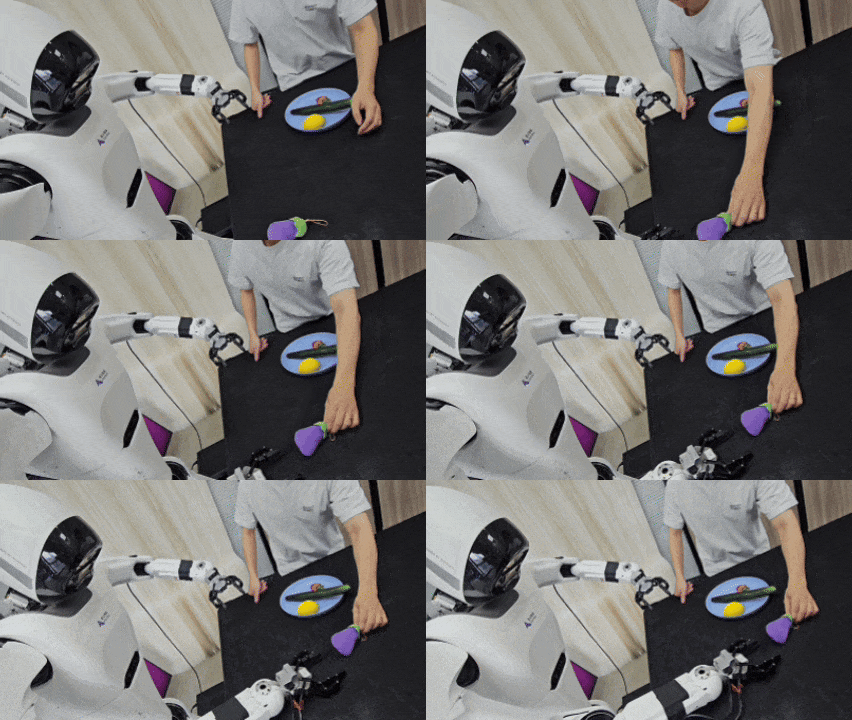
Astribot's DuoCore system gives robots this "gut reaction" — instinctively tracking a moved toy with highly human-like behavior. The fast system — the robot's instinct engine — provides millisecond-level physical intuition, enabling reflexive action feedback. A real-time perception-to-action loop gives the robot action-memory-like instincts.
When humans continuously upgrade their dishwashing technique, can machines similarly "learn from their mistakes"? Answer: Yes!
Astribot's robot pauses to "think" when a drawer interferes, reconstructing the object-placement task into multiple sub-steps. This deliberation closes the loop from cognition to action. The slow system — the robot's reflective brain — grants it cognitive restructuring ability. When task flows are disrupted, the robot can decompose goals, plan paths, and validate strategies just like humans.
Drawing on Nobel laureate Daniel Kahneman's "dual-system theory," Astribot has breakthrough-developed the DuoCore fast-slow coordination system. For the first time, robots possess dual intelligence dimensions rivaling human "instinctive reflex + deep reasoning." Moreover, diverging from traditional AI's "data-feeding" learning, the DuoCore system simulates human skill transfer mechanisms to achieve cross-scenario "meta-skill" migration.
"Meta-skills" are like millions of different LEGO bricks that can be combined into a 1:1 scale Bugatti Chiron. Meta-skills can be "LEGO-ized" into a library and combined on demand. This lets robots, like humans, transfer learned experience to new scenarios without starting from scratch — few-shot transfer that solves the prohibitive data costs of learning new skills and tasks.
Doer
Human-Like Manipulation: The Optimal Vessel for Unified Knowledge and Action
Muscle-Level Force Control: Innovative cable-driven transmission and biomimetic joint structures directly mimic human muscles and force application. Millisecond latency and millimeter trajectory precision enable expert-level force control.
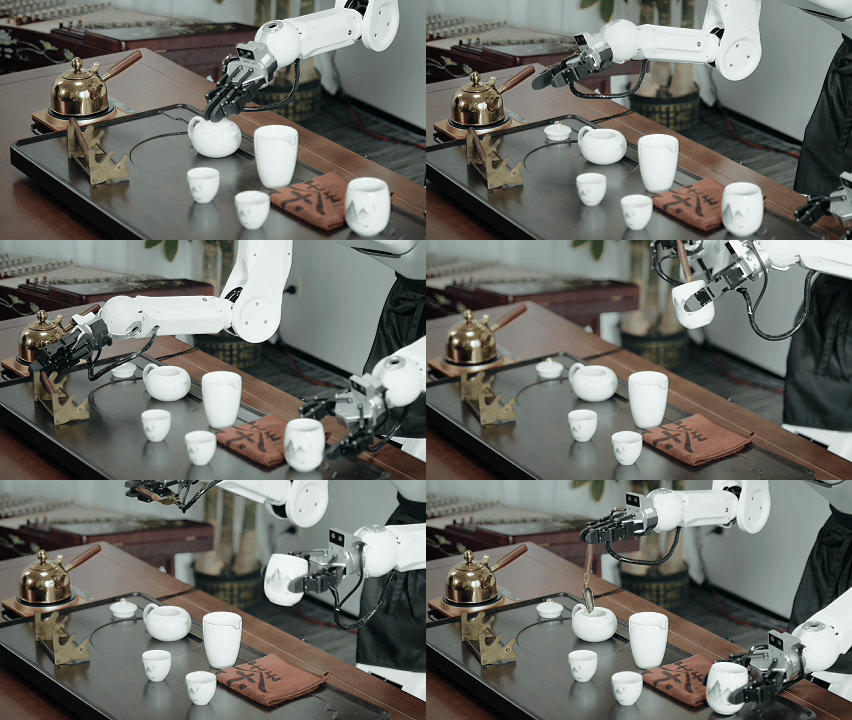
Highly Human-Like Performance: 7-DOF arms, 10 m/s end-effector acceleration, ±0.3 mm repeatability — with human-like flexibility, agility, and precision, it completes complex delicate tasks from making flatbread and brewing tea to folding clothes and cleaning, while also replicating expert-level performance in dancing, playing music, and shooting hoops.
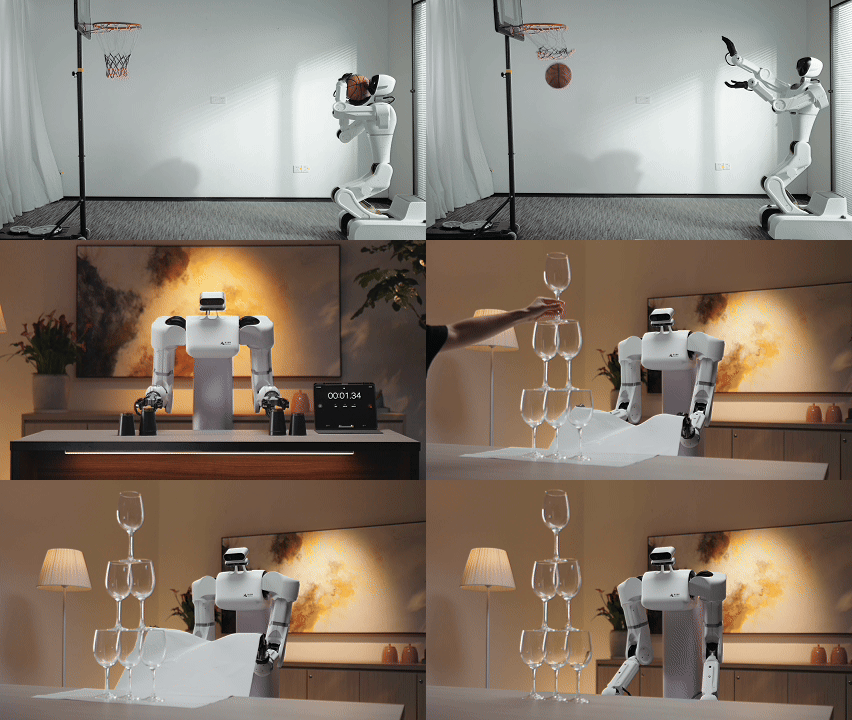
Safe Coexistence Design: S1's self-developed rigid-soft hybrid dynamics model configures comprehensive safety mechanisms for every action system, ensuring the robot "does no harm to itself, others, or the environment" during task execution, data collection, and novel behavior attempts.
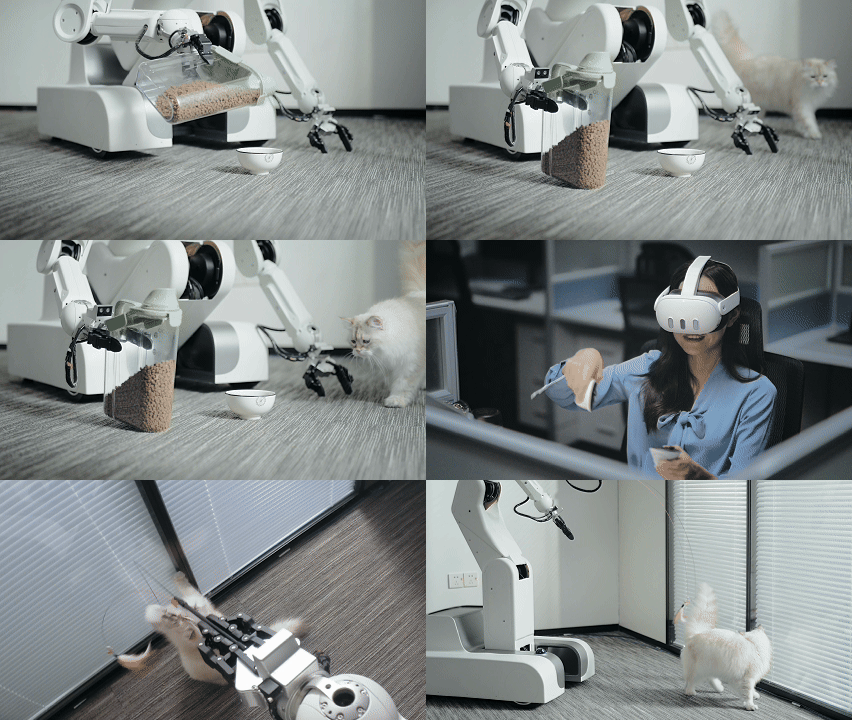
This is the original intent behind Astribot's "Design for AI" integrated software-hardware architecture.
In exploring the ultimate proposition of human-machine collaboration, using human cognition and action logic as blueprint, "actors who can think" and "thinkers who can act" — this is Astribot's positioning of the dual nature of Thinker and Doer.
As the philosophical wisdom goes: "Knowledge is the beginning of action, and action is the completion of knowledge." When cognition and execution are symbiotic — like the resonance of thought and action in the S1 robot — this full-loop closure from "data → model → embodiment" truly transforms "the unity of knowledge and action" from philosophical concept into quantifiable productivity gains.

We look forward to more iterative innovations from Astribot — robots that inherit the evolutionary dividends of human instinctive reflexes while achieving continuous intelligent evolution through data-driven closed loops.