Two FDA INDs Approved in Two Years: Triastek's Third 3D-Printed Drug Enters Clinical Trials | Yunqi Capital

Enhanced Safety Through Precision Drug Targeting and Delivery

"Yunqi Capital" shares tech news from Yunqi's portfolio companies, exploring how frontier technology expands the boundaries of real-world applications and tracking the present and future of tech industrialization. In this edition, "Yunqi Capital" brings you the latest from Triastek.
➤➤➤ On November 18, Triastek (full name: "Nanjing Triastek Pharmaceutical Technology Co., Ltd."), a company Yunqi Capital led in its Series A+ round, announced that its self-developed third 3D-printed drug product, T21, has received Investigational New Drug (IND) approval from the U.S. FDA — the third IND clearance Triastek has secured from the FDA within two years. T21 leverages 3D printing technology to achieve precise colon-targeted drug delivery, demonstrating the versatility of Triastek's drug delivery capabilities and validating the rich application scenarios that emerging technologies can unlock in product development.
Triastek filed T21 under the FDA's 505(b)(2) pathway. The reference drug is a treatment for ulcerative colitis, a non-specific inflammatory disease of unclear etiology whose lesions are typically found in the sigmoid colon and rectum but can extend to the descending colon or even the entire colon. Through colon-targeted delivery technology, T21 precisely transports the drug to the lesion site, enabling localized administration and localized therapeutic effect.
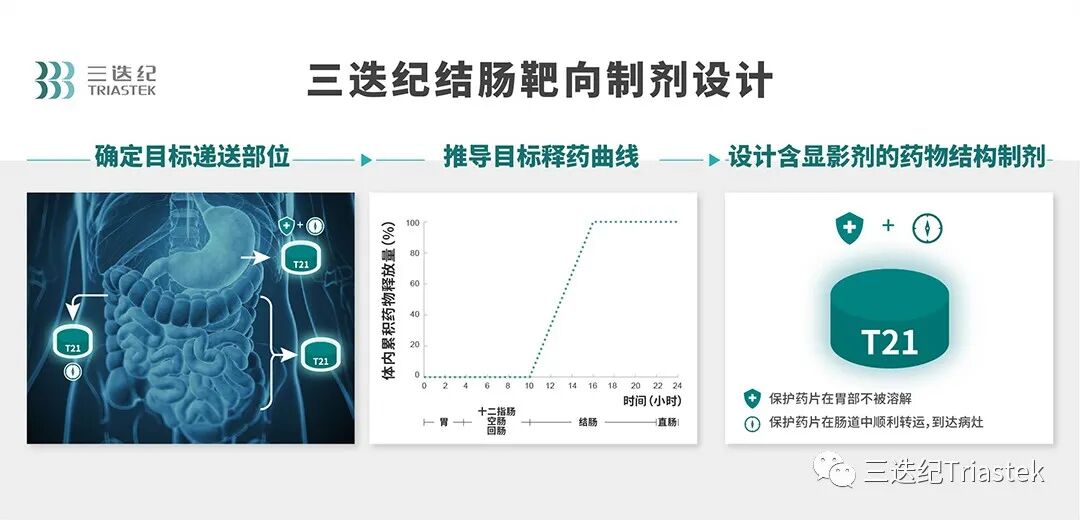
Precise colon-targeted delivery for oral drugs has long been a formulation challenge; the industry has lacked technology capable of accurately releasing drugs at the ileocecal junction through the ascending colon. Traditional formulation approaches typically rely solely on pH-dependent enteric coatings, but because gastrointestinal pH varies significantly between individuals and drops sharply from the ileum to the cecum, depending solely on rising pH to dissolve the coating makes precise colonic release extremely difficult. Triastek's T21 employs an innovative dosage form design to achieve colon-targeted delivery. Using a lower drug dose than the reference product, it reduces systemic drug exposure through precise colonic release, thereby minimizing side effects and improving safety.
T21 utilizes Triastek's proprietary MED (Melt Extrusion Deposition) 3D printing technology. Through sophisticated three-dimensional structural design of the formulation, it can not only control site-specific drug release in the gastrointestinal tract but also incorporate imaging agents during early product development to help verify release location — improving both development efficiency and success rates. This colon-targeted delivery technology is applicable not only to small-molecule drugs but also to peptide therapeutics.
Based on MED 3D printing, Triastek has developed multiple drug delivery technologies, including: time-programmed delayed release, rate-programmed zero-order release, and combination technologies such as solubilization, permeation enhancement, pulsatile release, and gastric retention designed for optimal GI absorption, as well as fixed-dose combinations with precisely controlled release profiles for each component. These delivery technologies can be realized through pre-designed dosage forms, computational simulation of drug release, and rapid prototyping via 3D printing — solving challenges that traditional formulation technology cannot address and providing rich formulation solutions and proprietary products to meet diverse clinical needs. For example, Triastek's first product, T19, uses chronotherapy to improve drug efficacy, while its second product, T20, achieves once-daily dosing for poorly soluble drugs through solubilization and programmed release. Within two years, all three products including T21 have entered clinical studies, reflecting both the diverse applications of Triastek's pharmaceutical 3D printing technology and the company's ability to rapidly develop complex formulations.
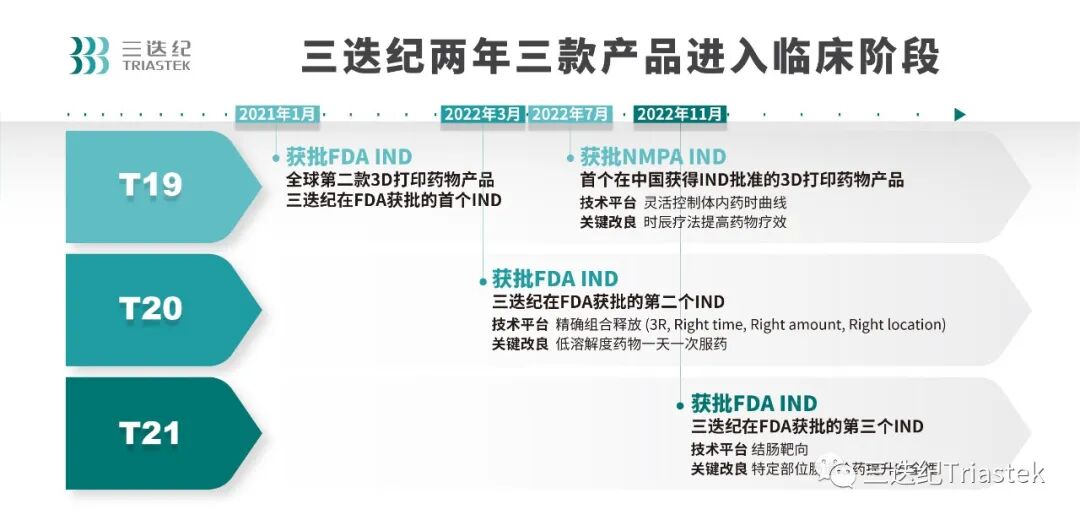
Triastek positions itself as a platform company for 3D-printed drug technology, with a dual business model encompassing both self-developed and partnered products, and has built proprietary end-to-end capabilities spanning drug dosage form design, digital development, and continuous manufacturing. Leveraging the advantages of MED pharmaceutical 3D printing, Triastek collaborates with domestic and international pharmaceutical companies to develop new molecular entities requiring high-difficulty formulation technology and highly differentiated lifecycle management products. Currently, Triastek has three self-owned products approved for clinical trials in the U.S., with T19 also receiving clinical approval in China. On the partnership front, Triastek has established collaborations with global pharmaceutical companies including Merck KGaA and Eli Lilly, as well as several Chinese pharma companies.
Dr. Senping Cheng, Triastek's founder and CEO, stated: "By reducing the dose and minimizing drug side effects, T21 will offer ulcerative colitis patients a safer treatment option. Moreover, T21's precise colon-targeted delivery technology has the potential to become the optimal drug delivery system for colon-localized therapeutics. Triastek will continue to innovate in dosage form design, helping global partners solve drug design and delivery challenges while developing more clinically valuable products for patients."
Yunqi Capital remains focused on "technology innovation, industrial enablement," with intelligent manufacturing being one of its sustained areas of focus. Beyond Triastek, Yunqi has also invested in outstanding companies including PLSI Intelligent, Keenon Robotics, Sintai Optoelectronics, Innosilicon, Xingji, XinKong Microelectronics, and Weichong Semiconductor. Going forward, Yunqi will continue to walk alongside Triastek, helping the company further realize its potential and advance the modernization and digital intelligent transformation of pharmaceutical manufacturing.