Fifteen Years Building a Startup, He's Now Deploying Robots Worldwide | Yunqi Capital Doers

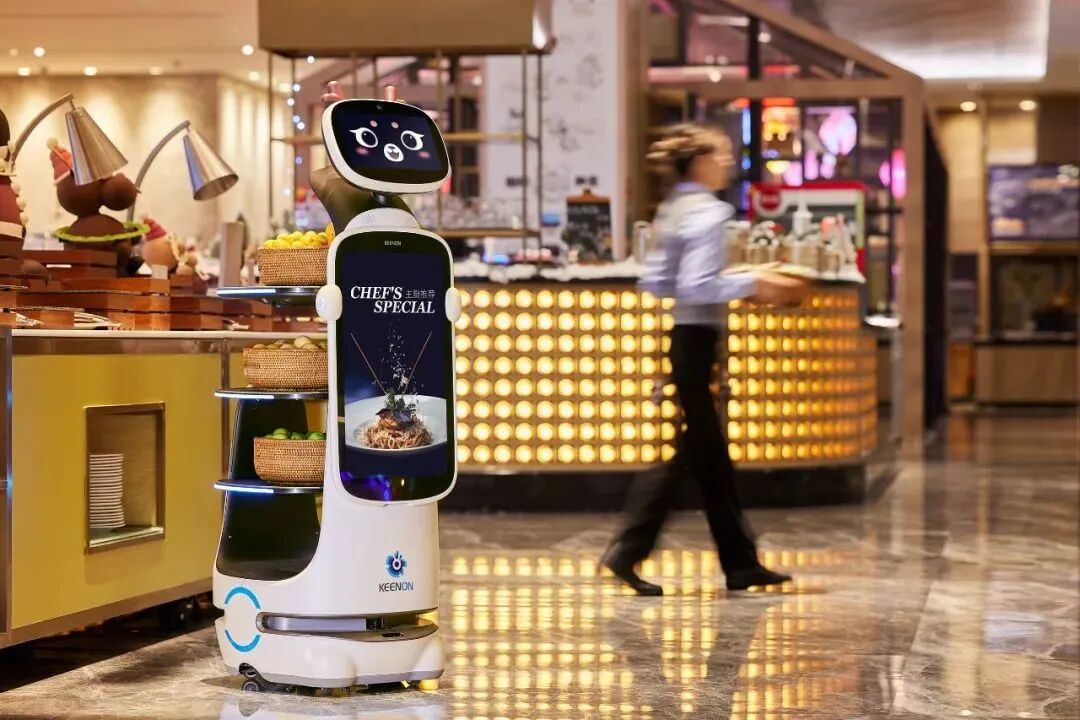
From "robot waiters" in restaurants to "robot cleaners" in hotels, service robots have become increasingly common in our daily lives. Yunqi Capital portfolio company *Keenon Robotics* is a leading enterprise in embodied AI service robots. While deeply penetrating the Chinese market, Keenon has been actively expanding overseas since 2020, with its global operations now covering 600+ cities and regions worldwide.
From "robot waiters" in restaurants to "robot cleaners" in hotels, service robots are becoming an increasingly common sight in our daily lives. Yunqi Capital portfolio company Keenon Robotics is a leading enterprise in the embodied AI service robot sector. While its products have penetrated deeply into the Chinese market, Keenon has been actively expanding overseas since 2020, with global operations now covering 600+ cities and regions worldwide.
Yet deploying robots for work across the globe is no easy feat. How do you overcome "culture shock" and refine products to meet the specific demands of different markets? How do you identify and seize opportunities amid constant change? This edition of "Yunqi Doers" brings you the globalization story of Keenon Robotics founder Li Tong and his team.

This article is republished from CEIBS (ID: CEIBS6688). Original title: "In an Aging World, This Company Is Sending Robots to Work Globally." Author: Tian Jiawei.
Before Dreams Come True, They're "Delusions"
"There's code I wrote running on this robot!" A female engineer at Keenon Robotics once exclaimed to her companion while traveling abroad. Dining at a restaurant, she discovered that the food-delivery robot serving them was her company's product.
Li Tong's excitement about his robots rivals that of his engineer. Asked to pick a favorite, he's genuinely stumped. "I personally participated in the design of every single model. I love them all." Yet little more than a decade ago, all of this was wild fantasy.
Rewind to 2010. Li Tong, an engineering graduate who had been tinkering with robots since his student days, founded Keenon Robotics with passion and ambition. He was determined to build robots, though precisely what kind remained unclear — the robot market was essentially a blank slate. "When we went to register the company, officials couldn't even figure out what exactly we did," Li Tong recalls candidly.
At the time, robots globally were primarily used for research. A single mobile robot in a lab cost as much as 400,000 yuan. The entire industry was in a trough of the robotics development cycle; nobody believed service robots could succeed. But Li Tong let his imagination run wild: Could robots enter everyday life, starting with helping humans with high-frequency, heavy labor?
"Delivery workers run up and down stairs all day — repetitive, exhausting work. That made me think of starting with the dining scene." Analysis showed the food service market was massive with rigid demand. Though then regarded as a low-end scenario, it was a complex application environment that could generate technical data — worth a shot. So Li Tong decided to build service robots, simplifying sophisticated high-tech equipment to bring robots into millions of households and daily life.
Keenon Robotics began manufacturing service robots in 2013. In 2015, the AI industry exploded. Deep learning started scaling into real-world deployment, and the era of AI-driven intelligence officially arrived. This technological progress provided foundational support for Keenon's work. "A former Microsoft colleague called to tell me the industry was about to blow up. The scaled deployment of deep learning frameworks made many previously impossible functions achievable, bringing theory into real life."
The robots we see today operating efficiently in complex, crowded environments would have been unimaginable in the past. Traditional robots mostly worked in unmanned factories because they couldn't handle human interference — especially children, who might hug robots or try to climb on them, essentially robots' "natural enemies." But new technologies dramatically improved robots' ability to navigate complex scenarios. For example, robots can observe surrounding foot traffic through panoramic cameras and predict different agents' behavior. If it's ordinary staff or guests, the robot judges they're unlikely to interfere; but if a child suddenly charges over unpredictably, the robot slows down and yields in advance. Through this trajectory prediction and judgment, Keenon's service robots achieve both high-speed and safe operation.
In 2016, Keenon Robotics produced its first truly operational unmanned delivery robot, the T1, creating the world's first food delivery robot industry from scratch. In 2018, the T1 achieved mass production with the establishment of the world's first food service robot mass production line. With service robots officially on sale and the restaurant scene targeted, Keenon quickly landed a major order from Haidilao — its first major client. Keenon helped Haidilao build the world's first smart restaurant, which still operates eight Keenon robots upgraded to the latest models. "During peak dining hours, one robot can replace three to four food runners, while a robot's average monthly cost is 2,000–3,000 yuan, roughly half that of human labor."
Li Tong has always seen himself as a dream-driven, passionate R&D person. Becoming an entrepreneur selling robots worldwide, he says, was riding the wave of the times. As AI technology exploded at scale, R&D talent gained broad recognition, getting their chance to step from behind the curtain into the spotlight. "We build robots not because the industry is hot, but out of genuine passion. Seeing my love and interest truly materialize is incredibly surreal."
Sending Robots Out to Work
After becoming China's fastest-growing, highest market-share service robot company, Li Tong turned his gaze overseas.
Initially, Keenon adopted a "blanket coverage" strategy. In the globalization process, the company discovered that in markets with low local labor costs, demand for robot substitution was weak and market acceptance of service robots remained low.
At one point, a colleague who had lived in India for ten years recommended Li Tong tap the Indian market. After a year of effort, only a few units sold. "In the end, one of his Indian friends couldn't bear to watch anymore and bought a robot as a birthday gift for his son, placing it in his villa."
Bruised by these early forays, Li Tong adjusted strategy, focusing on countries and regions with high labor costs: Los Angeles, Düsseldorf, Tokyo, Seoul, and Hong Kong, where Keenon established wholly-owned subsidiaries, laying out data nodes, operations, service, and supply chains.
Developed countries have high labor costs, robot end-product prices are relatively high, and returns are more attractive. But entering these countries means higher technical barriers and stricter standards. Consumers demand greater safety and privacy protection from robots, and market education is harder — which, in Li Tong's view, is precisely the biggest challenge for Chinese tech companies going global.
In his view, the core of going global is localization. Hence Keenon's overseas strategy is "one country, one policy." "Many countries and regions aren't like China's unified single market — they don't interconnect. Each country needs its own strategy, independent market plans and transaction systems, to address non-interconnecting market demands."
For example, consumers in Japan and Korea grew up with Doraemon and similar works, giving them a natural affinity for robots. Yet in Europe and America, science fiction commonly portrays robots as alien species that destroy humanity. In France, French words tend to be longer and can't fully display on robot screens, requiring screen modifications. The Middle East has unique preferences: Arabs prefer green robots, demand Arabic-language interaction, and have even asked whether robots could join their daily prayers... This means every new region requires fresh market education and product adjustments — undeniably the biggest challenge.
Keenon once had a food delivery robot that sold extremely well in China but flopped in Japan. After on-the-ground investigation, Li Tong discovered that Japanese restaurants are generally small, so the relatively large robots built for China couldn't navigate smoothly inside. Based on this, Keenon redesigned the robot into a more compact, elegant model wearing a bow tie — the T8 — which quickly became a hit in Japan, won the Japan Good Design Award, was invited to appear on popular variety shows, and has made multiple cameos in local TV dramas.
General-Purpose Robots Will Definitely Happen
"Intelligent" manufacturing of service robots — what advantages does China have? What is the future global market potential for service robots? These are questions Li Tong constantly ponders.
The core of robot operation is algorithms; algorithms stem from data accumulation. Massive application scenarios continuously accumulate data, optimize algorithms, and drive product improvements, forming a growth flywheel. Li Tong analyzes that the first phase of service robots requires solving movement in complex environments; the second phase expands application scenarios to achieve smarter, more general-purpose services. Data and algorithms, plus deep practical experience with scenarios, are key factors beyond cost. The Chinese market has natural advantages here. Additionally, China has a powerful industrial supply chain, especially the electromechanical supply chain in the Pearl River Delta, capable of supporting service robot development and production. Finally, talent advantage. Chinese engineers excel in mathematics and AI, able to rapidly respond to customer needs and provide high-quality technical support.
"Many films and animations have depicted robot companions like Doraemon, but turning this vision into reality still has a long technical road ahead." Li Tong hopes robots can become not just human companions, but like Doraemon helping Nobita, assist in human growth and development.
Currently, most robots in use worldwide are specialized robots — designed for specific scenarios or tasks, unable to perform multiple functions simultaneously. For example, a delivery robot can serve food but can't mop floors. The advantage of such specialized robots is excellent performance on specific tasks, but they're limited to those tasks. This means robot companies must constantly design new products to meet different customer needs.
With the continuous development of large models, Keenon Robotics is also developing smarter, more intelligent embodied service robots. In the future, robots will find balance between generality and specialization, becoming more widespread across scenarios. Technical iteration demands high requirements for scenarios and data — a major current challenge. Take embodied intelligence: its core goal is achieving broad multi-scenario, multi-task application.
Keenon's strategy is to first test and promote in commercial scenarios, then gradually expand to broader applications, similar to how personal computers spread from commercial to civilian use. Product iteration directions include deepening AI technology application, and rapidly replicating and promoting service products to more application scenarios.
Looking ahead, Li Tong believes general-purpose robots will definitely be realized, but it takes time and patience. "In an optimistic scenario, perhaps our generation will usher in a new world — a world where natural humans and artificial humans coexist, a world where carbon-based and silicon-based life coexist."