The Only Chinese Company Named a "Strong Performer" by Forrester, PingCAP Leads HTAP Frontier Trends | Yunqi Capital

Leading the "Invisible Technology" Era

➤➤➤ Recently, Forrester — widely regarded as one of the industry's most rigorous vendor capability assessment frameworks — evaluated 15 major global Translytical platforms across 26 criteria, including established players like IBM, Microsoft, Oracle, and SAP, as well as emerging vendors such as SingleStore and PingCAP. PingCAP earned a spot in the Forrester Wave™: Translytical Data Platforms, Q4 2022 report, landing in the "Strong Performers" quadrant based on its leading HTAP capabilities, making it the only Chinese database vendor to make the list.
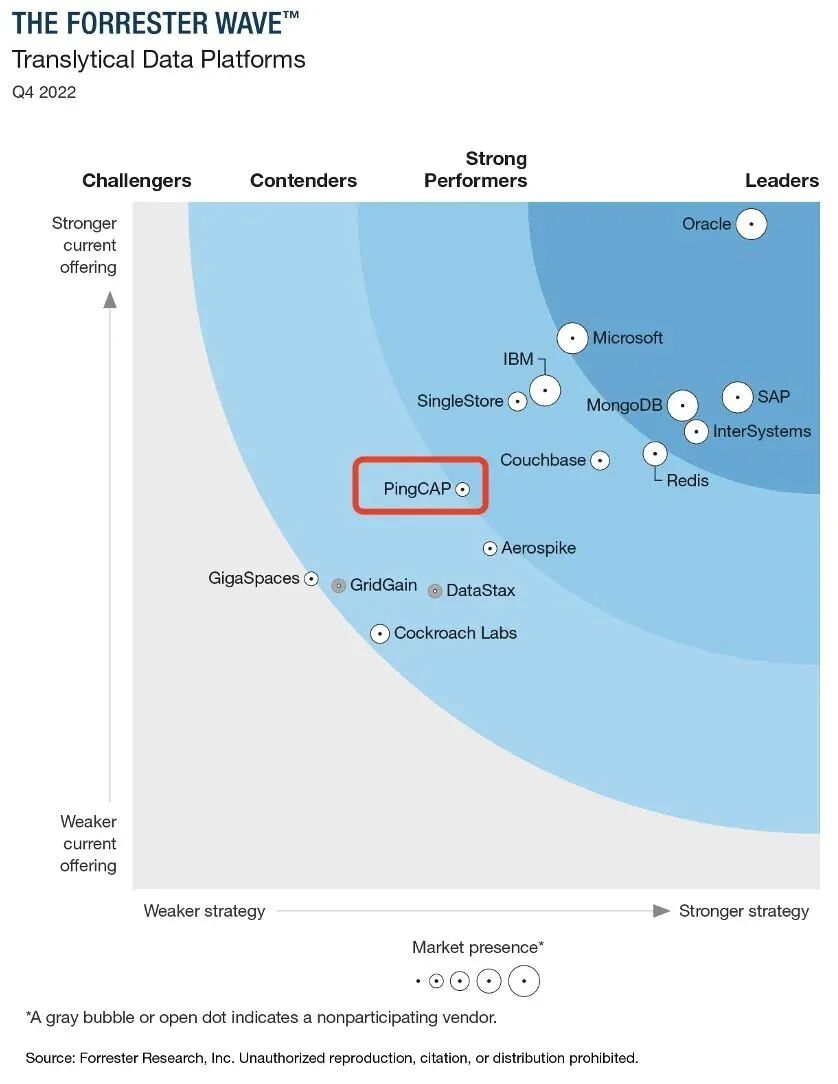
Forrester Principal Analyst Danny Mu offered his take on the report: "It's impressive to see PingCAP, founded just seven years ago, break into the Strong Performers tier. TiDB's cloud-native architecture and MySQL compatibility reduce migration overhead, and its strength lies in combining transactional and analytical processing. Its multimodal scalability and performance are on par with other vendors." He also noted that PingCAP's customer footprint beyond China — with use cases across North America, Europe, Japan, and the broader Asia-Pacific region — was an important factor in its inclusion.
Event Recap: PingCAP DevCon 2022
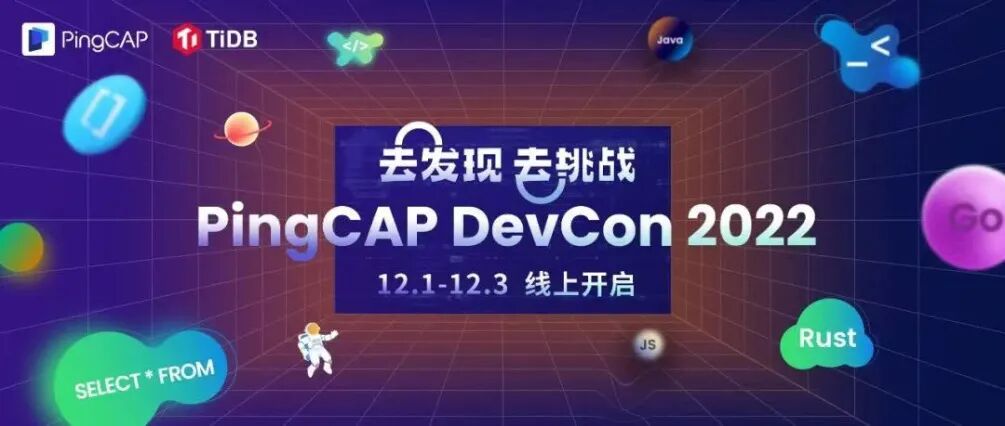
With HTAP, Serverless, cloud-native, and intelligent data technologies trending globally, PingCAP hosted its annual data technology conference, PingCAP DevCon 2022, as a virtual event. Under the theme "Go Discover, Go Challenge," the conference brought together industry thought leaders, academic experts, and more than 80 technical speakers from around the world to explore cutting-edge trends in cloud-native architectures, HTAP, Serverless, and database microservices — sharing best practices and discussing diverse solutions for cloud-based and international expansion strategies.
Targeting Serverless HTAP
Redefining the "Invisible Tech" Experience for Developers
Now in its fifth year, PingCAP DevCon has become a bellwether for tracking open-source industry developments and database technology trends.
PingCAP Co-founder and CTO Dongxu Huang delivered a keynote titled "The Future of Database," sharing his perspectives on cloud-native computing and developer productivity. He discussed the value of Serverless HTAP and the future direction of "invisible technology" — where infrastructure complexity fades into the background.
"The real users of databases should be developers in the broadest sense — architects, application developers, and DBAs alike. But historically, they've spent enormous amounts of time on infrastructure deployment and maintenance. Traditional data stacks have been a major drag on developer productivity. The emergence of public cloud, cloud-native architectures, and HTAP has abstracted away underlying infrastructure complexity and unlocked developer productivity. With the beta launch of TiDB Cloud Serverless Tier in November, you can spin up an HTAP database cluster in 20 seconds and get a smooth development experience. Serverless HTAP databases truly usher in the era of 'invisible technology,' freeing developers from heavy operational burdens and enabling more innovation and possibility in their businesses."
During a panel discussion, Huang was joined by Kai Wei, Deputy Director of the Cloud Computing and Big Data Research Institute at the China Academy of Information and Communications Technology (CAICT); Guoqiang Gai, Founder & CTO of Enmotech; Yang Shen, VP at Linklogis; and Yu Chen, Partner at Yunqi Capital. Drawing from industry, investment, technology, and media perspectives, they discussed the most important technology trends for developers and enterprise users to watch in 2023. Open source, cloud architecture, and platformization emerged as their three points of consensus on the future of Chinese databases. Going forward, making technology "invisible" will be the ultimate goal of infrastructure software, raising the happiness quotient for application developers.
TiDB Accelerates: A First Look at 6.5 LTS
PingCAP also previewed the new features coming in TiDB 6.5 LTS. In the product and technology breakout session, VP of Technology Liu Tang and the PingCAP R&D team shared updates on enterprise-grade capabilities, performance tuning, stability engineering, and application scenarios in the TiDB 6.x series, outlining TiDB's development roadmap for cloud-native, Serverless, and technology ecosystem expansion.
A Rich and Diverse Data Ecosystem
PingCAP has always believed that real-world scenarios are the best architects. Across breakout forums including "Global Expansion — Fintech & Social," "Cloud-Native and Future Data Ecosystem," "Enterprise Users," "Global Expansion — E-commerce, Smart Manufacturing & Social Entertainment," and "Open Source Community Users," nearly 70 industry leaders from customers and partners such as CCB Fintech, WeBank, Galaxy Securities, Essence Securities, Inspur Software, Yingzhicheng, Yunshunghaihong, Tiger Brokers, Shoplazza, Trip.com, vivo, MOKA, NetEase, WPS, Zuoyebang, and Boss Zhipin gathered to share firsthand digital transformation experiences, the capabilities next-generation databases need to meet emerging challenges, how TiDB has evolved in enterprise production environments, and innovative data technology solutions.
Advancing infrastructure software also depends on education. As Renmin University professor Xiaoyong Du noted, "Database education in China still focuses primarily on training application developers, while abroad it has evolved to cultivating database kernel engineering talent. Over the past two years, VLDB Summer School and PingCAP have pioneered a new teaching model combining theory with practice, using open-source code to build student capabilities and deepen understanding of database fundamentals. Inspired by the open-source community, Renmin University also launched a virtual database teaching and research lab — run in the style of an open-source community, embracing the volunteer spirit of 'all for one, one for all.' It has attracted 245 members from 135 participating institutions, representing 29.5% of Chinese universities across 28 provinces and municipalities."
Open source has been PingCAP's foundation since day one. From its founding, the company made open source its core strategy, building a thriving community that now spans 45 countries and regions with over 1,900 developers contributing to TiDB. At the TiDB Community Carnival, PingCAP's community and technical teams engaged directly with developers through workshops on "TiDB Native Performance Tuning — Principles, Tools, and Discussion," hands-on labs for experiencing HTAP capabilities via TiDB Cloud Playground, and a debate on "Future Data Applications and Architecture: Will Databases and Big Data Converge or Diverge?" Together, they explored the future direction of database technology and community evolution, channeling an open and diverse data technology ecosystem into boundless creativity.
For years, Yunqi Capital has focused on "technology innovation, industry enablement," with open source and infrastructure software as one of its sustained investment themes. Yunqi made early-stage lead investments in PingCAP, Zilliz, Jina AI, RisingWave, and other industry leaders, and has been invited to share commercialization perspectives at major global industry summits including the Amazon Web Services Summit, China Open Source Conference, VMware Edge & Cloud Intelligence Open Source Summit, and Huawei Partner & Developer Conference.
As a specialized investor in China's open-source sector, Yunqi has repeatedly earned industry recognition including the "Sci-Tech China" Open Source Innovation award, and its investors have been the only ones in the industry named as domestic open-source pioneers.
Yunqi actively promoted open-source development throughout the past year. In early 2022, Yunqi partnered with China's most influential open-source community, Kaiyuanshe, to release the "2021 China Open Source Annual Report," presenting a multi-dimensional picture of domestic open-source development.
Additionally, Yunqi joined the OpenCloudOS operating system open-source community as a founding member, working alongside community partners to build a fully neutral, comprehensively open, secure, stable, and high-performance operating system and ecosystem, jointly advancing open-source ecosystem development.
Follow the Yunqi Capital WeChat account and reply with "open source report" to read the full Chinese version;
Reply with "open source report international" to access the English and Japanese versions~