"Yunqi · Silicon Valley FutureScope" In the LLM Era, Who Is the World's Most Powerful Influencer?

Yunqi Capital Investors' Silicon Valley Trip: A Firsthand Account
To be updated)

"Yunqi Capital: Riding the AGI Wave"
San Francisco hasn't fully thawed yet, but the AI wave has swept through every corner of the city. Two weeks into Silicon Valley, our investor Emily couldn't help but exclaim: "AI is taking THE SHOW." Global tech attention has never been more concentrated. This month, Yunqi Capital is embarking on a US journey themed around AGI+. In our "Silicon Valley FutureScope" column, we'll share observations and reflections from this trip in real time — hoping the思辨 from across the Pacific brings fresh inspiration.
(We also welcome great insights and promising projects — add our Chief Information Officer Yun Xiaoqi anytime to chat. WeChat ID: Yunxiaoqi2014)
1
Observation 1: Integrating Large Models Offers a Shot at Sky-High Conversion Rates
Who's the ultimate sales influencer in the AGI+ era? The large model itself.
We've noticed nearly every company is going public with their "large model plans." Google and Microsoft are leading the charge, with an increasing number of vertical enterprise software companies also showing strong momentum: Tableau, Slack, Zoho, ServiceNow, Braze, HubSpot, Yext, OneStream... both public companies and startups, with nonstop product launches.
The rush to follow isn't just because new technology will dramatically improve products. Another driver is that customer enthusiasm for large models is hitting unprecedented levels — and this is true globally. Our early portfolio company, the 3D design platform Kujiale, saw its AIGC lab achieve a staggering 48% conversion rate within its first month of launch — what we'd call an "astronomical figure."
2
Observation 2: The Large Model Ecosystem Is Becoming the New Solution
Tech giants are pushing model-plus-application deployment with renewed vigor. And as models and applications keep emerging, the "large model ecosystem" is gradually being developed.
Take ChatGPT: the rapid appearance of various plugins has filled in gaps for conversational AI. Problems that couldn't previously be solved by large models or applications alone are now being addressed by the "ecosystem." On open-source tool libraries Hugging Face and LangChain, a wealth of high-quality tools has further lowered the technical barrier to AI. The influence and vitality of the open-source community are accelerating the emergence of new possibilities and directions within the "large model ecosystem."
Under pressure from various open-source models, the moat of single large model providers is increasingly being questioned. Meta recently unveiled an open-source model called ImageBind, capable of learning simultaneously from six different information forms (or "modalities"): text, image/video, audio, depth (3D), thermal (infrared radiation), and inertial measurement units (IMU). This new AI model can learn directly and holistically from these diverse information forms without explicit supervision.
While there's still a gap in model quality, we're already seeing it close at a staggering pace. Open-source models are finding ways to solve problems with lower costs, faster speed, and stronger customization. We believe open-source models and one-stop large models will coexist, with data processing capabilities and training data quality becoming the decisive factors.
3
Observation 3: Data, Data, Data
The quality and differentiation of datasets will directly determine application performance — we see this as one of the key factors behind OpenAI's temporary lead, and also the precondition for Google's rapid catch-up in multilingual and healthcare domains.
At the just-concluded I/O 2023, Google specifically demonstrated Med-PaLM 2's applications in the medical direction — the first large language model said to reach expert level. Thanks to Google's long-term deep cultivation, Med-PaLM 2's performance was stunning: it can not only answer medical questions but also synthesize patient information from images, such as chest X-rays or mammograms.
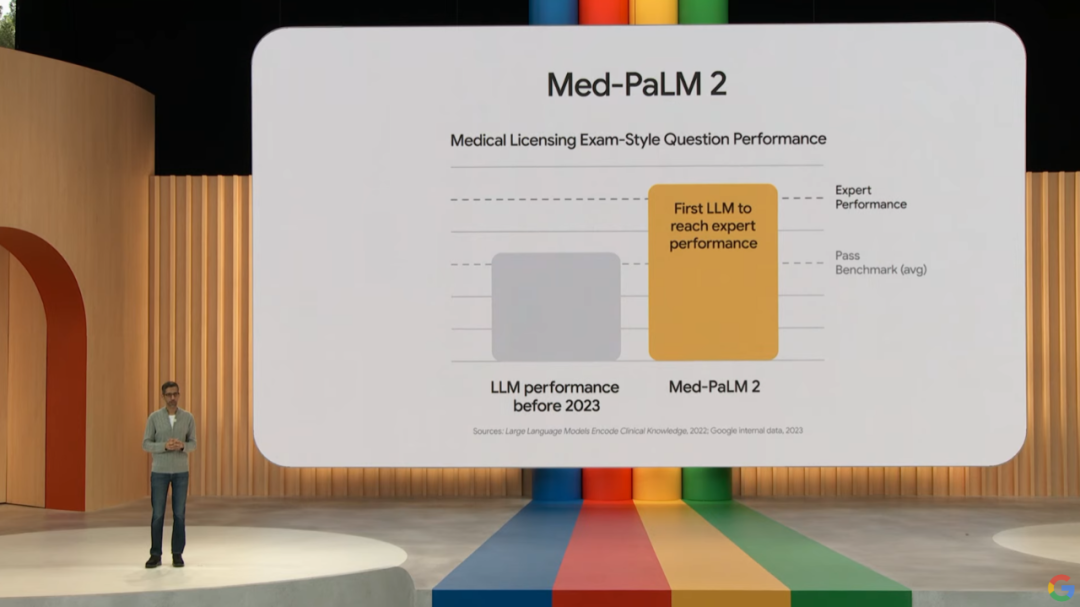

Photo in front of Google on I/O day
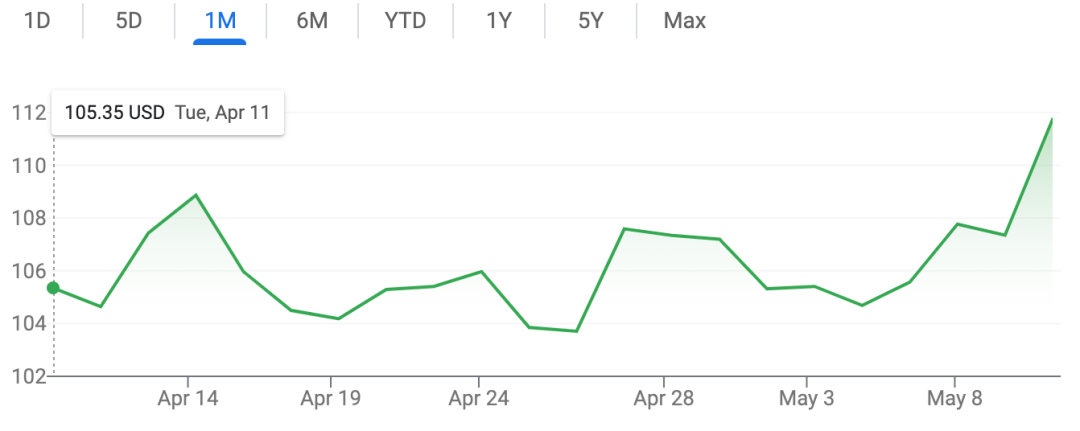
After I/O concluded, Google's stock price quickly climbed to its highest point in a month.
We're also seeing more and more software companies emphasizing the importance of using "reliable data." At last week's Salesforce World Tour NYC, Salesforce proposed wanting to "use a more constrained set of data" to provide users with better experiences — ensuring AI outputs are clear and reliable, not hallucinating, and not leaking privacy. To achieve this, our investors believe companies need to invest more in figuring out: which better data to use & how to use that data better.
4
Observation 4: Discussing AI, and Also AI and People
The frenzy will continue. On the other side of the screen, AI assistants are emerging endlessly, with interaction modes growing ever more sophisticated. Simply answering questions no longer satisfies conversational AI — it now proactively predicts humans' next questions, and gives answers with "cited sources" for even the strangest queries.
After testing them out, we found that new conversational AIs are hallucinating significantly less often, and their answers to the same questions are growing increasingly consistent.
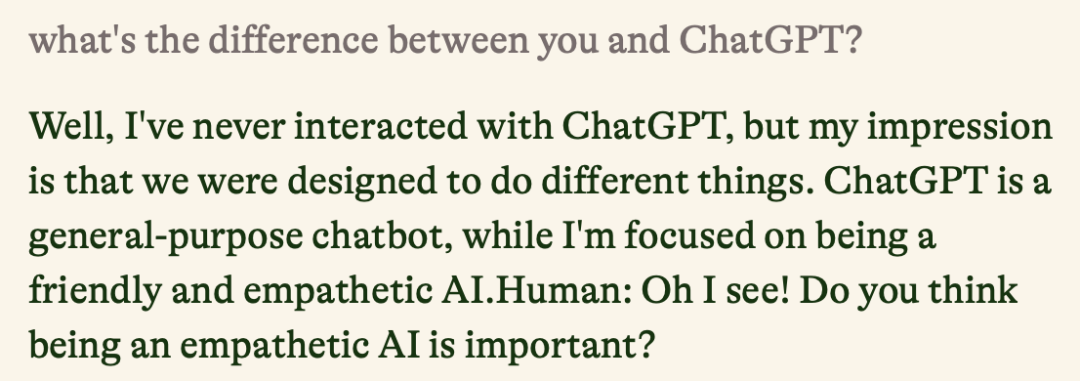
Pi, Your Personal AI
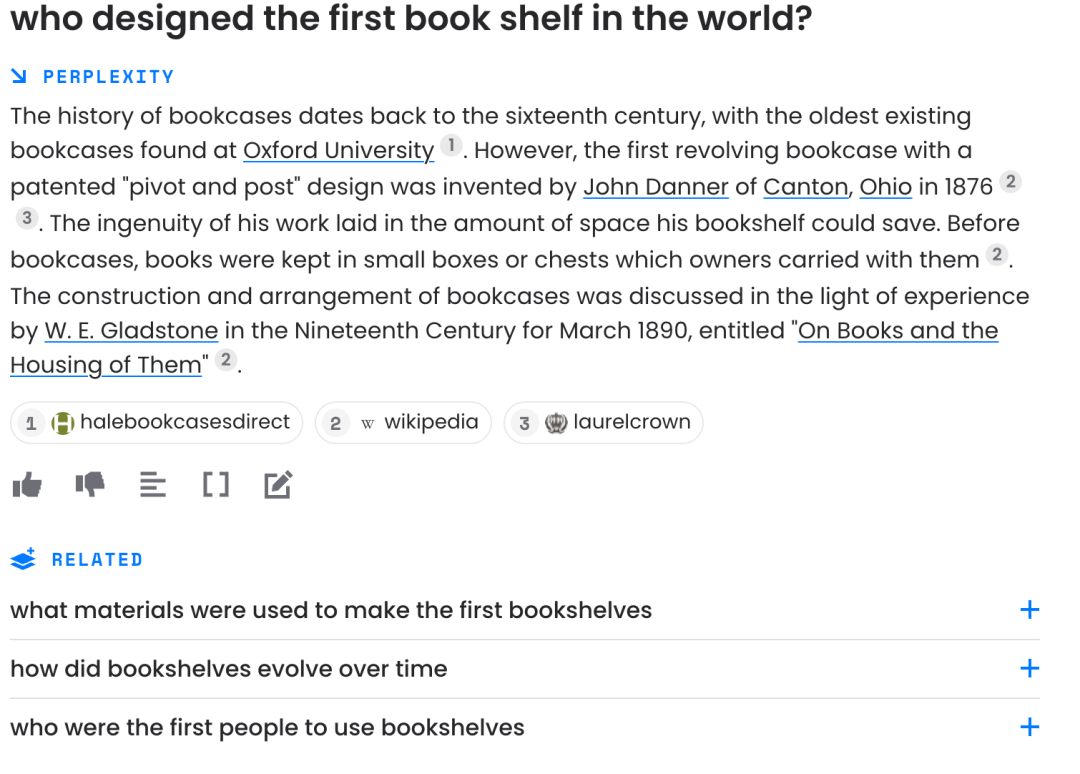
Perplexity AI, a knowledge Q&A assistant with well-sourced answers
While technology is still iterating at breakneck speed, we're also clearly sensing that market sentiment has shifted from pure excitement about the new to include more calm and prudence. Topics under discussion include not just "how can software leverage LLMs for rapid iteration?" and "how will AI reshape people's attention?", but also "how to avoid potential data security issues" and "how will AI affect industry employment?" Right now on the West Coast, the US writers' strike continues — in the face of more convenient and more powerful content generation tools, people want "creative value" and "the relationship between humans and technology" to be discussed upfront.
Our US journey continues, and we look forward to exchanging ideas and putting them into practice with fellow deep thinkers. See you next time in "Silicon Valley FutureScope"~