How Many Steps to Build the *Wandering Earth 2* Space Elevator? | Yunqi Capital Science Popularization

What do you know about space elevators?

"Ladies and gentlemen, the space elevator is approaching the weightless space station. Please prepare to disembark through the door on your right."
"Ladies and gentlmen, we are approaching space station. Please prepare to get off the elevator. The door will be open at the right side."
If I told you that one day you'll hear this announcement with your own ears, would you believe it?
In this edition of "Yunqi Science Chat," we'll share some news about the "space elevator." Enjoy~
Source | WeChat account "IOPCAS Physics" (中科院物理所) Author | Muller's Nanny
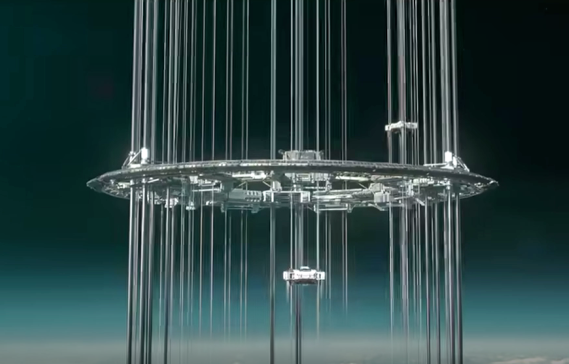 The space elevator in the film The Wandering Earth II
Where Did the Space Elevator Come From?
In the early 20th century, Russian scientist Konstantin Tsiolkovsky, known as the "Father of Spaceflight," proposed several groundbreaking ideas:
- Using liquid fuel for rockets;
- Reaction force as the only means of propulsion in space;
- Stacking two or more rocket stages into a multistage rocket to increase velocity.
Over a century later, these concepts have all become essential applications in aerospace.
 Konstantin Tsiolkovsky
Yet one idea he proposed in 1895 remains unrealized to this day.
The concept was actually quite simple:
He proposed building a suuuuper tall tower on the ground, extending all the way to geostationary orbit, with an elevator inside. This way, we could simply take an elevator into outer space.
 Early concept art for a space elevator
This was the prototype of the space elevator.
Does this tower structure feel familiar?
In fact, Tsiolkovsky was inspired by his visit to the Eiffel Tower in France!
This concept also aligns most closely with our conventional understanding of elevators, but...
Geostationary orbit is 35,786,000 meters away. The tallest building in the world right now, the Burj Khalifa in Dubai, stands at only 828 meters...
At first glance, it seems like the space elevator is a lost cause?
Not so fast!
Right now, you are a mid-20th-century cosmologist — quick, figure out how to solve this problem!
If you need a moment, try answering this question first:
Suppose I ask you to get a kite to 250 meters in the sky. Besides running on the ground and letting out more string, what else could you do?
You could take a helicopter higher up, toss the kite out, and slowly let out string until it reaches 250 meters.
The key here is reverse thinking!
Similarly, if we want to build an elevator straight to outer space, the most important thing is providing a cable track. Since building from the ground up isn't realistic, then...
Could we "toss" a cable down from space, like flying a kite in reverse?
In other words, we could first launch a geostationary satellite, then extend a cable from the satellite "down" to the ground, fixing it at one end to form the track for the space elevator.
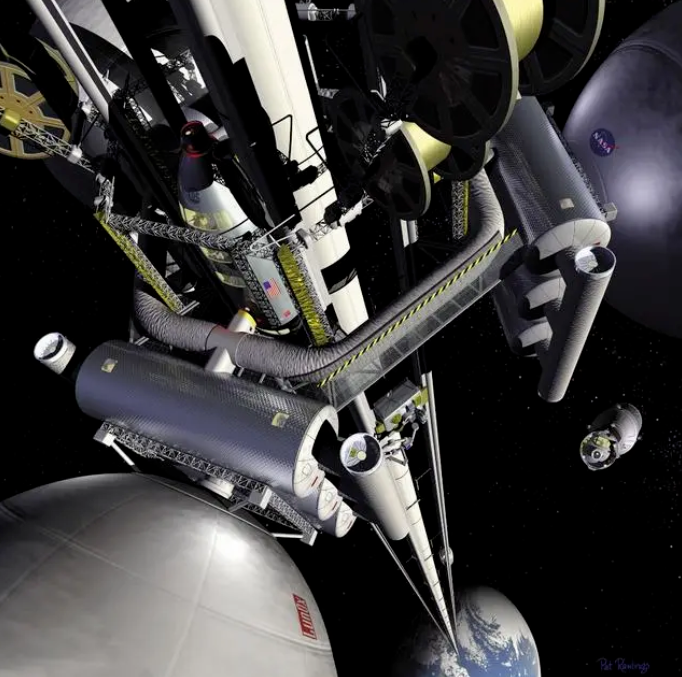 Space elevator concept diagram (Image source: NASA)
Ha! No need to build a tower anymore — just "a few cables" will do!
This reverse thinking is what makes the space elevator seem less like a pipe dream. All modern space elevator plans are based on this model.
The Obayashi Space Elevator Project
Among the many space elevator proposals, one that has drawn particular attention is the project announced by Obayashi Corporation in 2012.
In February 2012, Obayashi — a renowned Japanese construction company especially skilled at building tall towers — announced it would invest $10 billion to build a space elevator. The planned elevator would travel at 200 km/h, with a one-way trip taking 7 days. Construction was slated to begin around 2025 at a sea-based site near the equator, with operations expected to begin around 2050.
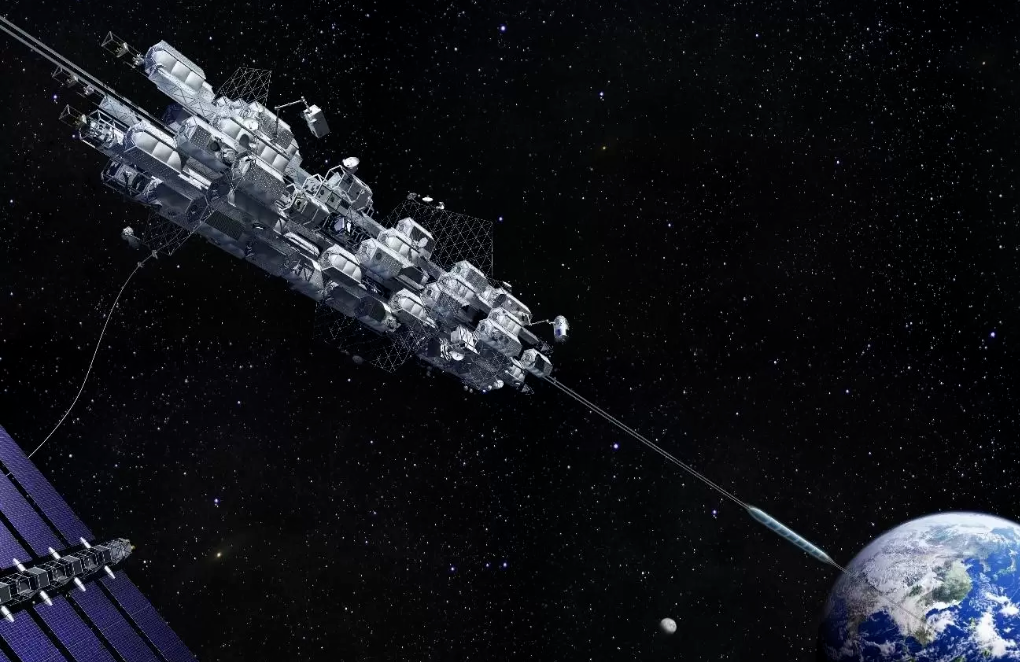 Concept art from Obayashi Corporation's official website
However, more than ten years have passed since the project's launch, and the outlook seems increasingly uncertain. Even Yoji Ishikawa, a senior engineer at Obayashi who has been involved in space elevator R&D, admits: the more they try, the more difficult it becomes.
First, setting aside all external factors, a space elevator mainly consists of four components:
The elevator car, the cable track needed for the car to move up and down, a sea-based platform to anchor the cable on the Earth's end, and a counterweight.
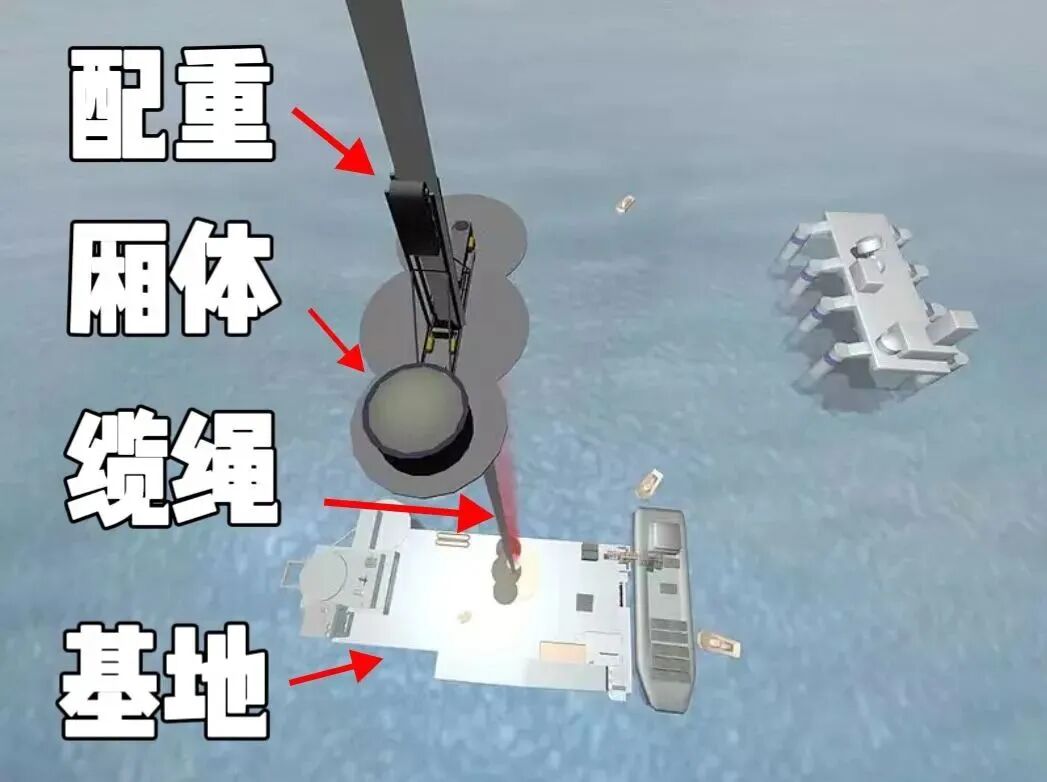 Space elevator structure
The first three seem straightforward enough, but why do we need a counterweight?
In the space elevator concept I just described, we're "tossing" a cable down from a geostationary satellite all the way to Earth. But as the cable is lowered, gravitational force exceeds centrifugal force, so the cable pulls inward on the satellite. Wouldn't that mean the cable, as it's deployed, drags the originally stable satellite down?
To solve this, as we lower the cable downward, we must simultaneously "toss" something upward, creating an outward pull to counteract the cable's inward pull on the satellite. Whatever we toss upward must be heavy enough to stabilize the satellite — we call this the counterweight.
But now, a new problem arises!
The cable isn't actually stationary; it's rotating at high speed along with the geostationary satellite. The enormous centripetal force required could exceed the material's tensile limit, causing the cable to snap itself apart.
Let's really grasp just how demanding the material requirements for a space elevator are.
In a geocentric reference frame, we simplify the cable as a cylinder with density ρ and cross-sectional area S, fixed at one end to a geostationary satellite and at the other to an equatorial sea-based platform. Considering a small segment of cable near geostationary orbit, ignoring any additional loads, the tension it experiences can be calculated as follows:
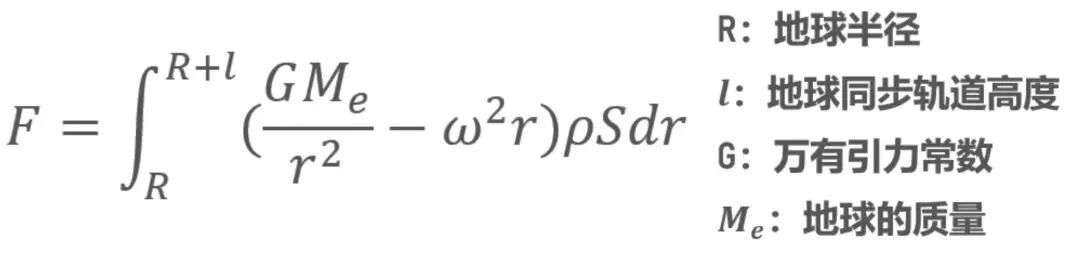
If we use steel for the space elevator cable, simplifying and rearranging the above formula and substituting steel's density value, we can estimate that steel would need to withstand a maximum stress of at least 400 GPa. But in reality, steel's tensile strength is only 400 MPa!
In other words, even using steel for the cable, it would deform directly under the immense gravitational forces.
At this point, we face an exceptionally thorny problem: how do we find a material with low density but high tensile strength?
The Cable Problem for Space Elevators
Currently, the material most likely to meet these requirements is the carbon nanotube: a tubular nanomaterial made of carbon atoms, theoretically the strongest and toughest material known.
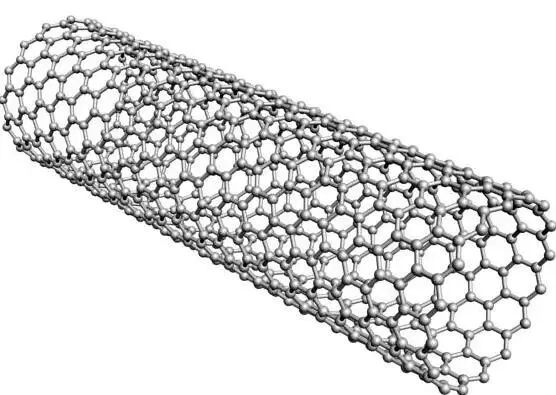 Carbon nanotube structure
The density of carbon nanotubes is roughly 1,700 kg/m³. Substituting this into the formula above, we find that if carbon nanotubes were used for the space elevator cable, they would need a tensile strength of at least 90 GPa.
Currently, carbon nanotubes synthesized in labs can achieve tensile strengths of 200 GPa; moreover, for single-walled carbon nanotubes with ideal structures, tensile strength can reach 800 GPa.
So it seems — we just need to produce carbon nanotubes tens of thousands of kilometers long, dangle them from a geostationary satellite, and anchor them to a sea-based platform near the equator. Problem solved!
However, the road to exploring the space elevator is destined to be rugged.
In 1991, Japanese scientist Sumio Iijima discovered and named carbon nanotubes, injecting fresh blood into the stalled space elevator concept. Many research teams revived their space elevator plans.
But soon, everyone realized that due to manufacturing limitations, the carbon nanotubes that could actually be produced were only a few millimeters long and contained numerous structural defects.
Sigh, another dead end...
But as they say, a thousand sails pass by the sunken ship, and ten thousand trees spring to life before the withered tree.
In 2013, a team led by Professor Fei Wei at Tsinghua University succeeded in producing single carbon nanotubes over half a meter long with perfect structures, after increasing the catalyst activity probability for growing each millimeter of nanotube length to over 99.5%.
Currently, they are working on developing carbon nanotubes over a kilometer long.
Our space ladder seems to have glimpsed a ray of hope!

The Practical Dilemmas of Space Elevators
You may have already realized that everything discussed so far is based on the simplest physical models. Once we actually consider building the project, many practical problems must be solved.
For example, given that all kinds of high-voltage power lines in daily life wear out over time, we naturally wonder:
How durable would cables made of carbon nanotubes be?
After all, if the cable breaks easily, then even a completed elevator would be useless.
To test the durability of carbon nanotubes, Obayashi Corporation sent carbon nanotube samples to the Japanese Experiment Module, located about 400 kilometers above Earth's surface, in 2015.
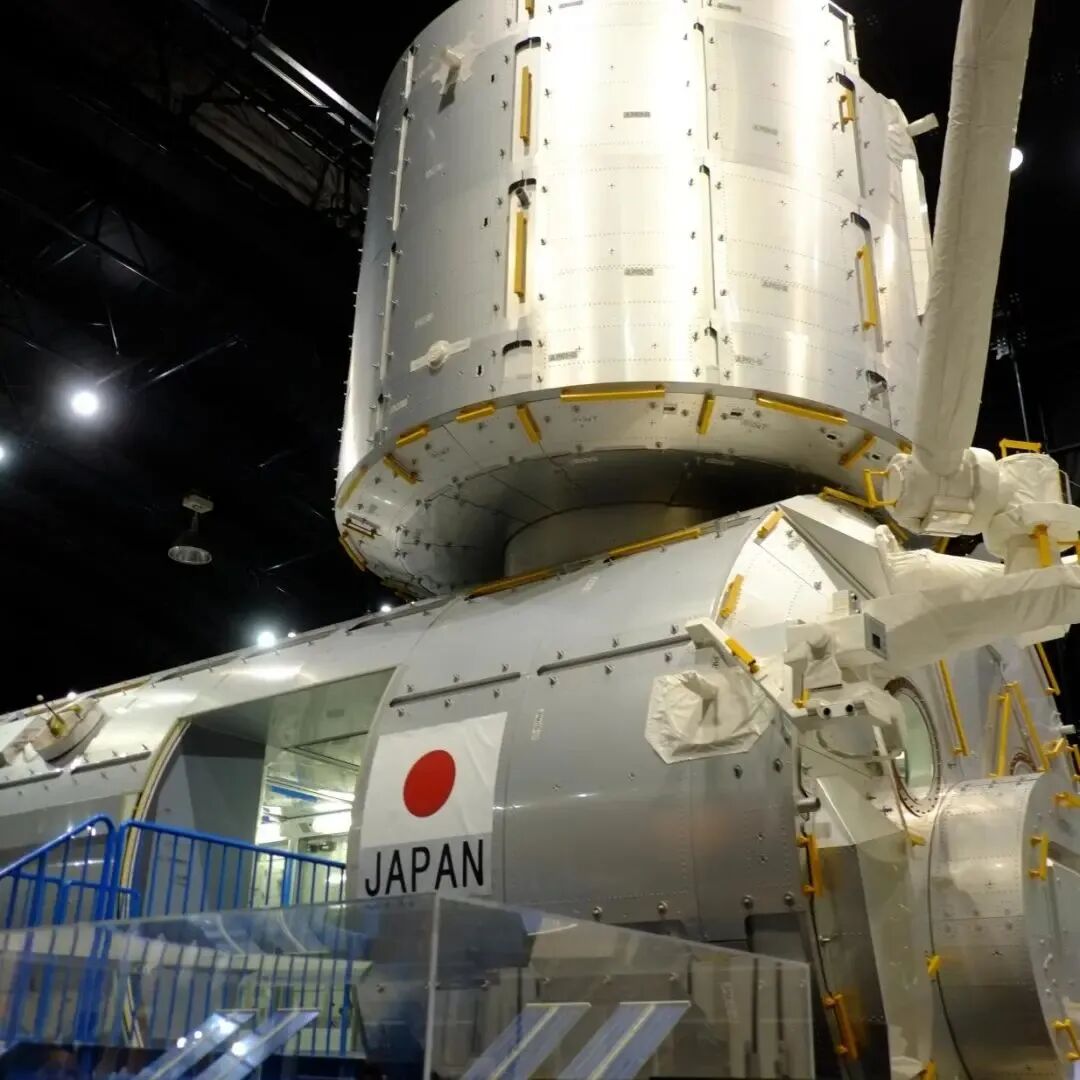
Japan's "Kibo" Experiment Module After being exposed to space for 2 years, the samples were brought back to Earth. Researchers found that the surfaces of the carbon nanotubes had been damaged by atomic oxygen.
Keep in mind that 400 kilometers is in the thermosphere, where the atmosphere is already extremely thin. Even so, two years was enough to damage carbon nanotubes.
One can imagine that cables directly exposed to the lowest troposphere would face even more severe challenges.
Beyond damage from atomic oxygen, they would also need to withstand various weather conditions — wind, sun, rain — and potentially encounter lightning, hurricanes, and other extreme weather events...
Research on improving cable durability is clearly fraught with difficulties, but as long as the path isn't completely blocked, we won't stop exploring.
Of course, beyond durability, there are a host of other challenges waiting to be solved...
For instance, how do we ensure the elevator car has sufficient power to ascend all the way from the ground to the space station?
If the space elevator's power system suddenly fails halfway up, it would be a live-action high-altitude survival horror film — just thinking about it sends chills down your spine.
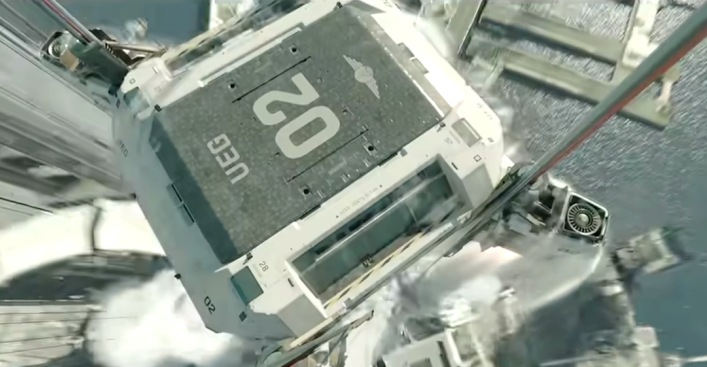
Imagine if the elevator stopped at this moment... (Image source: The Wandering Earth II trailer) Or, how would a space elevator automatically dodge space debris and satellites that might crash into it?
If evasion isn't timely enough, the consequences are unimaginable.
It truly validates that saying:
The space elevator: the more you try, the harder it gets.

Why We Remain Obsessed with the Space Elevator
At this point, you might well ask: if building a space elevator is so difficult, why do we remain fixated on this seemingly impossible vision?
Because we yearn for the stars and the sea.
Ahem, enough of that — let's talk practical:
In current international commercial satellite launches, transportation costs range from $2,000 to $20,000 per kilogram of payload. If this writer wanted to take a trip to space, it would cost at least $100,000.
If a space elevator could be built, ignoring initial construction costs, Obayashi Corporation's estimates put the transportation cost at roughly $200 per kilogram of payload!
That means this writer would only need to spend about 70,000 RMB to travel to space!
Once a space elevator is built, beyond making space tourism accessible, we could also transport materials between Earth and space at low cost.
This could become the most breathtaking turning point in human space exploration history!

In Our Lifetime
Now, look up at the sky and imagine.
Every seemingly ordinary second is personally witnessing history in the making.
In our lifetime, you will see a grand celestial ladder pierce through distant clouds, surging upward with unstoppable force, endlessly charging toward the heavens, ultimately spanning heaven and earth, a marvel for the ages.
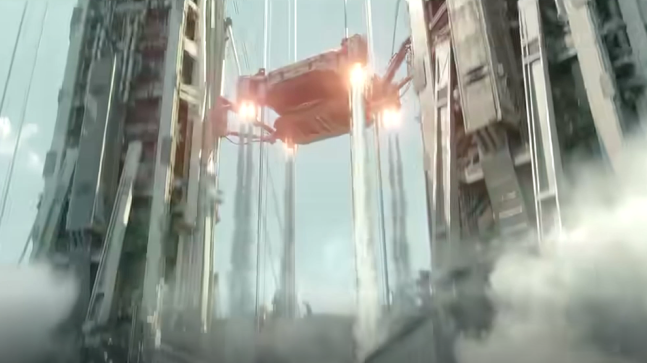
Image source: The Wandering Earth II trailer Thinking of this, I truly have tears in my eyes.