The Life of Goodenough, A History of the Lithium Battery Industry | Yunqi Capital Science Talks

He didn't start researching lithium batteries until he was 54, and kept working until he was 100.
In the 1980s, John Goodenough, the "father of lithium-ion batteries," developed three cathode materials that would change the world. The safe, lightweight, high-performance lithium batteries that followed ushered humanity into a rechargeable world. Goodenough won the Nobel Prize in Chemistry in 2019, at age 97.
For Goodenough, age was always just a number of little significance. Professionally, he started every phase of his career well past the "appropriate" age. In his nineties, he was still full of energy, declaring: "I want to eliminate all carbon emissions from roads around the world. I still have time."
On June 25, 2023, local time in the United States, Goodenough passed away at age 100. He posed new questions to the world, found promising leads, and left behind a model of resilience and long-term commitment for anyone who finds their calling a little late. In a post-Nobel interview, Goodenough emphasized, "Remember that we are competing with problems, not with people. Dialogue, dialogue, dialogue is always very important."
In this episode of "Yunqi Kepu," we share Goodenough's life and the history of the lithium battery industry. Enjoy~
This article is republished with permission from LatePost (ID: postlate) Authors: Qianming He, Zinan Li; Editor: Junjie Huang
Lithium batteries are already the physical infrastructure of modern civilization. Nearly every electronic device within reach today, and the growing number of new energy vehicles on our roads, rely on them for power.
Like many other world-changing technological breakthroughs, the普及 of lithium batteries was the result of decades of basic scientific research, engineering breakthroughs, and commercial drivers coming together. But without one key person's extraordinary resilience, it all would have arrived much later.
The story begins in 1946, in the spring less than half a year after World War II ended. Captain John Goodenough, freshly discharged from military service, reported to the physics department at the University of Chicago to pursue a master's degree. He had just turned 24, after spending the war predicting weather patterns on the European front.

Goodenough during WWII. Image from the Nobel Committee
At an age brimming with possibility, he was mercilessly relegated to the "unwanted" category in the physics world: Newton discovered the law of universal gravitation at 24; Einstein developed special relativity at 26; Schrödinger formulated wave mechanics at 26.
"I don't understand you veterans." His instructor, University of Chicago star nuclear physicist John Simpson, poured cold water on him from the start: "Don't you know that top physicists have already made major contributions by your age, and you're just getting started?"
Simpson had joined the Manhattan Project at 27 and quickly become a research group leader building the atomic bomb. Goodenough, meanwhile, had studied at Yale before the war, but his coursework was in ethics, aesthetics, psychology, and mathematics — he had never touched physics.
Goodenough was accustomed to that feeling of being "shut out." He was born into a family where his parents' relationship was terrible — and they treated him even worse. When his professor father learned he had been admitted to Yale, he gave him $35. "That's all, son." — at a time when Yale's annual tuition was $900. His mother hadn't wanted him to be born at all, and sent him to boarding school at age 12, after which they rarely interacted. In his autobiography, when recalling his childhood, Goodenough warmly remembered his siblings, the family maid, and a dog named Mack. No parents.
Goodenough wasn't deterred by Simpson. And since Goodenough had been assigned to the University of Chicago through a government program, Simpson had no authority to reject him.
Simpson wasn't exaggerating the difficulty of physics research. After earning his Ph.D. in physics at the University of Chicago, Goodenough spent 24 years doing materials research at MIT. At 54, his lab was shut down due to a government restructuring, ending his physics career. During this period, he hadn't made any breakthroughs comparable to Simpson's. His most notable research laid groundwork for computer memory (RAM). But more than two decades of physics research made him intimately familiar with the properties of various materials, which would prove valuable in his later career.
After losing his job, he found work at Oxford University, beginning chemical research into lithium battery materials. He later described this turn to the American Chemical Society as a fresh start: "I officially became a scholar, and I also became a chemist."
His research career started late, but lasted long — 47 years. His research findings proved even more enduring: any product using lithium batteries directly benefits from Goodenough's work.

Three Breakthroughs That Turned a Concept Into Infrastructure
Goodenough wasn't among the first scholars to study batteries. The world's first battery was born in 1800, when Italian physicist Alessandro Volta created a device that could produce steady current for a fixed period using copper plates, zinc plates, and paper disks soaked in salt water.
This is the battery design principle still in use today: batteries generate electric current by moving charged atoms (ions) from one point (the cathode) to another (the anode), powering devices.
For the next 100-plus years, aside from French inventor Gaston Plante's lead-acid battery solving the reusability problem, and the addition of carbon-zinc and nickel-cadmium as cathode and anode materials, battery technology didn't advance much.
Until the 1970s, when Western countries hit by the oil crisis began investing resources to find petroleum alternatives, and research into more efficient batteries became a key funded priority. Lithium became the hottest research subject — on the entire periodic table, it is the lightest metal with the highest charge capacity, making it the most suitable element for battery manufacturing.
With massive resources poured in, scientists developed all the key lithium battery technologies in just fifteen years:
1976: British scientist Stanley Whittingham created the first lithium battery using lithium disulfide and pure lithium metal as cathode and anode, but it had safety problems and was prone to explosion.
1980: Goodenough invented the lithium cobalt oxide cathode, a critical step in improving lithium battery safety and performance.
1985: Japanese scientist Akira Yoshino invented the graphite anode, completing the final piece of the lithium battery architecture.
1991: Sony produced the first commercial lithium battery based on Goodenough and others' research.
2019: Whittingham, Goodenough, and Yoshino shared the Nobel Prize in Chemistry. Goodenough's cathode research was the most critical component of a battery, directly determining its performance. Thus batteries are typically named after their cathode material.
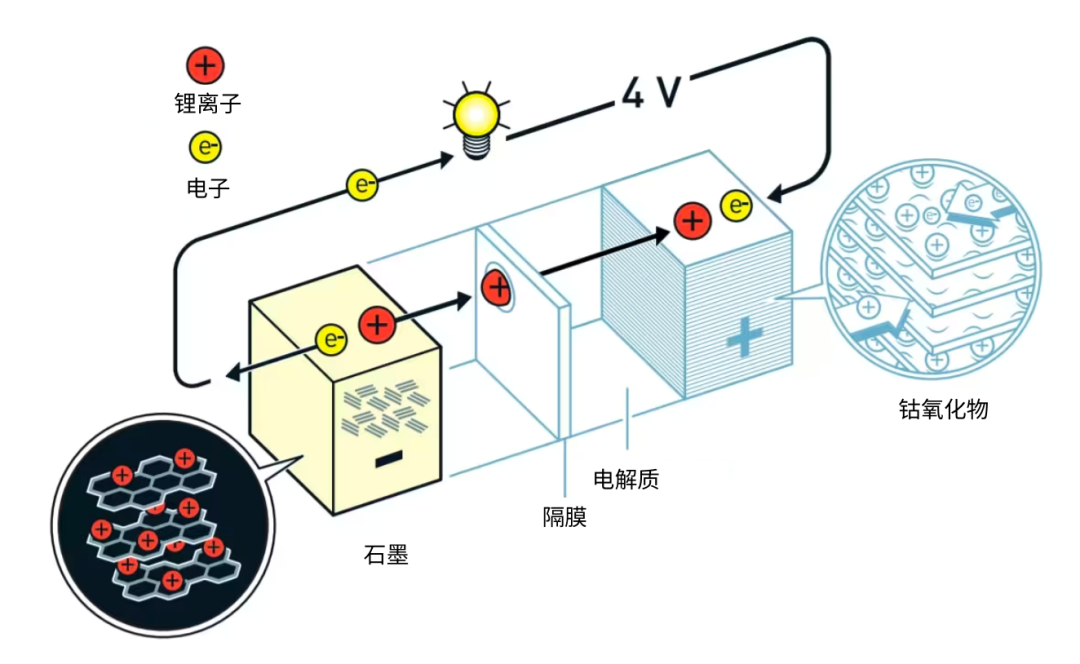
Diagram of a commercial lithium cobalt oxide battery. Image from the Nobel Committee
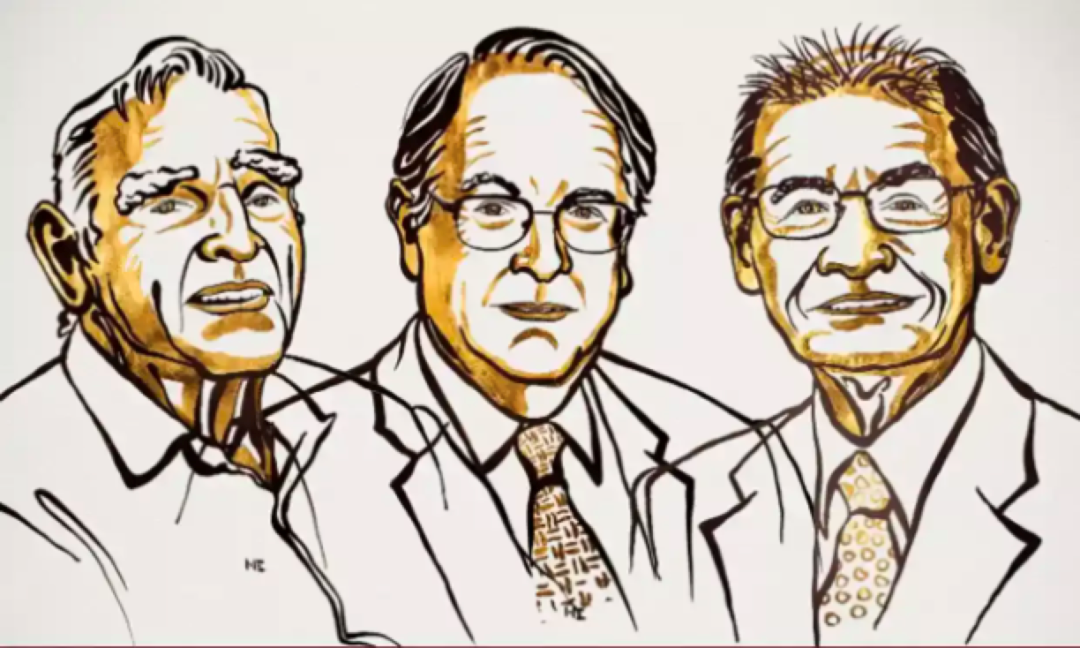
From left: Goodenough, Whittingham, Yoshino. Image from the Nobel Committee
The biggest challenge in developing lithium batteries was lithium itself — it reacts violently with water and air, and is highly flammable and explosive. For a long time, it was only used in nuclear weapons and engine lubricants. Whittingham used titanium disulfide, then priced at $1,000 per kilogram (equivalent to about 37,400 RMB today), to minimize fire and explosion risks, but with limited success.
Goodenough believed he could develop batteries with higher energy density and greater safety. His confidence came from his MIT research on metal oxide materials. He believed that using oxides as battery cathodes would allow batteries to discharge stably at higher voltages, meaning higher energy density per unit weight.
Battery research is a test of extraordinary resilience. Researchers in the lithium battery industry compare the process to "alchemy" — constantly adjusting temperature, humidity, and other factors to test various materials' performance, with no one knowing the results beforehand.
When Goodenough conducted his research, computers were just beginning to spread, so he relied mainly on human trial and error. Goodenough, with more than 20 years of relevant research experience, led his team through four years of work before finding lithium cobalt oxide. Meanwhile, ExxonMobil's lab gave up after a few explosions.
Although cobalt was similarly expensive, at over 300,000 RMB per ton, with half of global reserves located in politically unstable Democratic Republic of Congo, the energy density of Goodenough's battery was 2.5–3 times higher than contemporary nickel-cadmium batteries, and safe enough that costs had fallen to levels acceptable to smartphone and computer companies.
Motorola's 1983 DynaTAC, the world's first commercial mobile phone, weighed 790 grams — equivalent to four and a half iPhones — and required 10 hours of charging for 30 minutes of talk time. Battery limitations made this unavoidable. Motorola used the most advanced nickel-cadmium battery of the time; storing 1,000 milliampere-hours required a battery weighing over 90 grams.
Thirteen years later, Motorola's new Startac model weighed just 85 grams, with double the talk time. The change came mainly from its adoption of lithium batteries.
As lithium batteries rapidly spread through consumer electronics, they also awakened automotive industry ambitions. In 2008, Tesla built an electric sports car using 6,381 laptop lithium cobalt oxide batteries, with 393 kilometers of range and 0–100 km/h acceleration in 3.7 seconds — already competitive with typical gasoline vehicles.
Powering a car requires 1,300 times as many batteries as a phone. Making electric vehicles widespread was impossible if they were built like luxury cars using only lithium cobalt oxide batteries. Reducing battery costs became a key research direction for Goodenough after developing lithium cobalt oxide.
Today, 99.9% of electric vehicles use either ternary lithium batteries or lithium iron phosphate batteries. Both technological paths originated in Goodenough's team:
-
In 1982, Goodenough and his Oxford postdoc Mike Thackeray invented ternary lithium (lithium manganese oxide) material, cheaper and safer than lithium cobalt oxide.
-
In 1991, Goodenough's University of Texas postdoc Akshaya Padhi created lithium iron phosphate material using phosphorus and iron compounds.
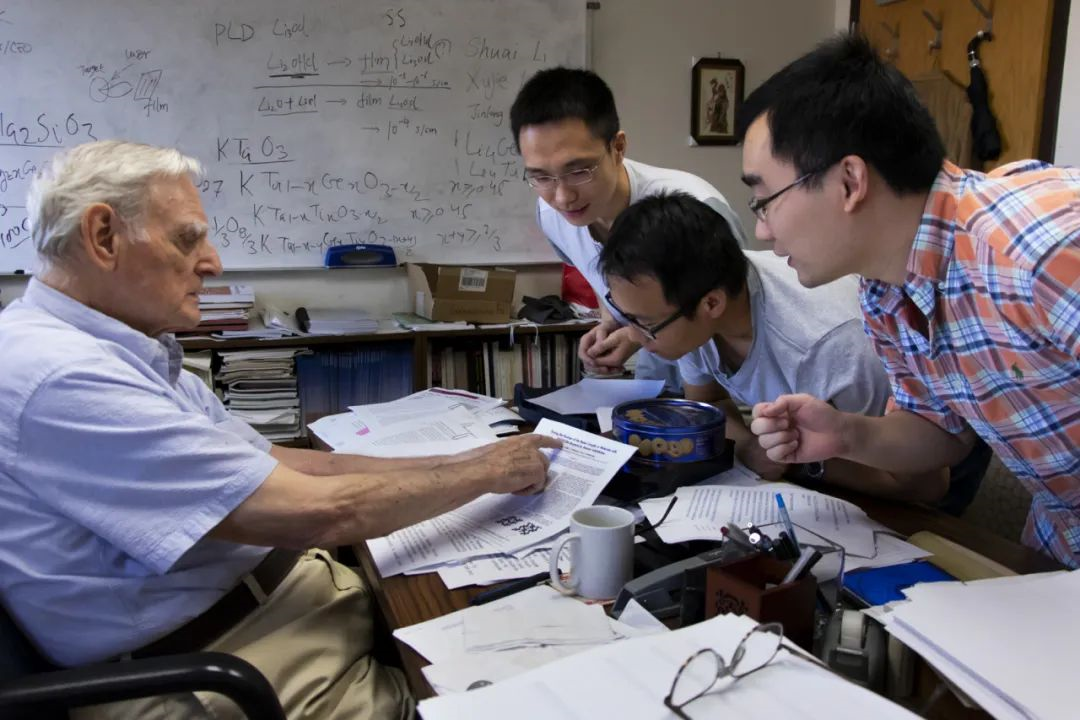
Goodenough still advising students at age 97. Image from University of Texas
"Remember that we are competing with problems, not with people," Goodenough said in a post-Nobel interview about how to do research. "Dialogue, dialogue, dialogue is always very important."
Conflict is common in research, and some Nobel laureates who shared the prize even refused to appear together due to competition. But Whittingham and Yoshino, who shared the prize with Goodenough, both considered him a friend of decades. After retiring, Whittingham was still frequently pulled into discussions by Goodenough. "I tell my colleagues that as long as John is still around, I'm still an active scientist," Whittingham said in a 2019 interview.
Developing three world-changing battery cathode materials in just over a decade cemented Goodenough's unmatched position in lithium batteries, earning him the title "father of lithium-ion batteries." In 2022, for his 100th birthday, researchers around the world joined online to celebrate, and the American Chemical Society's Chemistry of Materials journal published a special issue commemorating his achievements.
In his 100th year, global lithium battery production reached 957.7 GWh, used in nearly all consumer electronics, almost every electric vehicle, and energy storage equipment for solar and wind power generation. China's Ministry of Industry and Information Technology estimated that these batteries alone were worth over 1.2 trillion RMB.

Changed the World, but Didn't Profit from Patents
Over 47 years of battery research, Goodenough won every award a chemist could receive: the Nobel Prize in Chemistry, the Enrico Fermi Award, the National Medal of Science, the Franklin Medal, the Welch Award in Chemistry, the Copley Medal, the Charles Stark Draper Prize, the Japan Prize, and others.
But he didn't make much money from lithium battery patents. His income came mainly from salaries at several universities. Prize money from various awards was donated to research or used to establish scholarships.
When he developed the lithium cobalt oxide cathode at Oxford University, no one yet recognized its potential, and Oxford refused to apply for a patent on his behalf. He eventually applied through the UK Atomic Energy Research Establishment, at the cost of forfeiting any financial benefits.
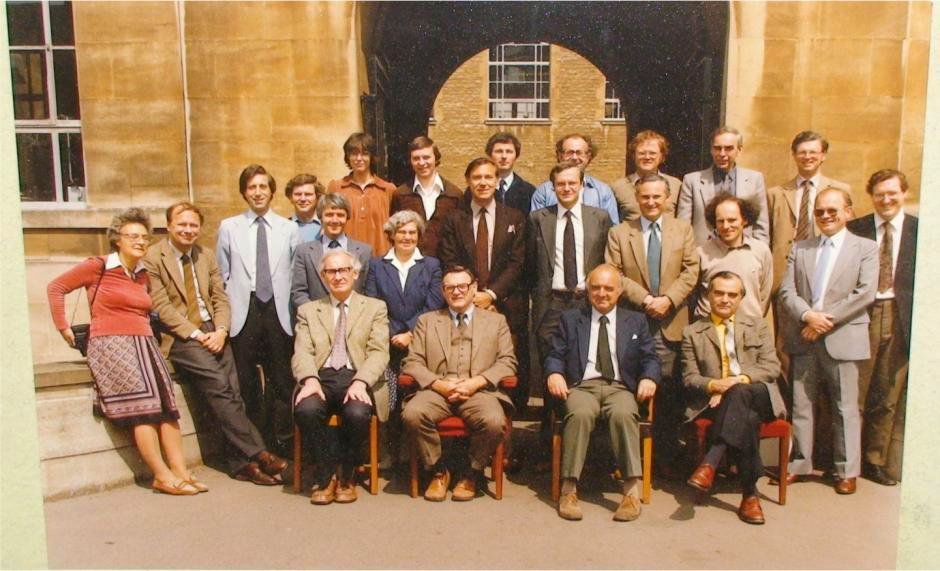
Goodenough (front row, second from left) at Oxford University, 1982. Image from University of Texas
Goodenough was often asked afterward: "When you gave up the patent, did you anticipate what would happen?" His answer was honest: "Of course not," "I didn't know it would be worth billions of dollars." But he never showed any regret. "The joy of helping bring about technology that makes many people's lives better is enough," he wrote in his Nobel autobiography.
His loss of patents on subsequent key research illustrated the darker side of commerce. In 1993, 71-year-old Goodenough had moved from Oxford to the University of Texas at Austin, mainly because Oxford required retirement at a certain age, while he wanted to continue researching.
That year, as a lithium battery authority, Goodenough received an application from NTT (Nippon Telegraph and Telephone) materials scientist Shigeto Okada, asking to self-fund his research under Goodenough's guidance. Goodenough agreed, arranging for him to work with Indian postdoc Akshaya Padhi to find lithium batteries with higher energy density and greater safety.
After several years of research, they discovered lithium iron phosphate under Goodenough's guidance. During this period, Okada had been secretly passing Goodenough's team research results to NTT. NTT built on this for further research, and in 1995 applied for a lithium iron phosphate patent, sparking a patent dispute between the two sides.
While the University of Texas was fighting NTT in court, MIT researcher Yet-Ming Chiang developed his own version of lithium iron phosphate based on Goodenough's research, also applied for a patent, and also ended up in court with the University of Texas.
"After this, the industry impression was that inventions from the Goodenough lab could appear anywhere," said Steve LeVine, a writer who has long covered batteries. By 2008, when BYD released an electric vehicle with self-developed lithium iron phosphate batteries, no one cared anymore where its battery technology had come from.

An Unfulfilled Wish
"I want to solve the automobile problem. I want to eliminate all carbon emissions from roads around the world." In 2018, 96-year-old Goodenough said in an interview, "I hope to see it before I die."
He didn't wait — he went to work on it himself. The year before saying this, he and team members published a paper introducing a "glass battery." This falls into the "solid-state battery" direction that is currently the hottest area of lithium battery research.
Today's lithium batteries are still not perfect energy storage devices. If charged too quickly, "dendrites" form on the cathode, piercing the battery's separator and causing short circuits and fires — the main cause of electric vehicle fires today. And current lithium battery energy density still can't match gasoline, with limited range and charging speed being the main reasons electric vehicles struggle to replace gasoline cars.
Solid-state batteries use solid electrolytes in place of liquid electrolytes. They represent humanity's ultimate known battery solution, potentially fully resolving lithium battery safety issues while dramatically improving charging speed and energy density. In recent years, they have been pursued by battery companies and research institutions globally, with CATL, Panasonic, LG, and others all investing resources in research.
Goodenough's team used glass electrolytes in place of liquid electrolytes, paired with alkali metal anodes, claiming energy density three times that of current lithium batteries, full charging in just minutes, 23,000 charge-discharge cycles rather than the current few thousand, and no dendrite formation — meaning no spontaneous combustion.
After their research was published, it drew widespread skepticism due to lack of comprehensive data. Researchers from Princeton University and other institutions even commented that the battery mechanism they proposed "violates the first law of thermodynamics."
Goodenough treated such skepticism as competition, and didn't let age slow his research. Until 2022, at age 100, he still published three papers as first author. And the team he led released six more papers on solid-state batteries this year.
As with all previous battery research, solid-state batteries remain a direction requiring repeated experimentation, a contest of resilience and time. Over the past 30 years, Japan's Toyota, Hitachi Zosen, and other companies have tried tens of thousands of electrolyte formulations, selecting only dozens of materials for battery application.
Unlike earlier research, lithium batteries have already fully demonstrated commercial value. More scholars and more companies are willing to invest. In just the past year, the world's two largest battery companies, CATL and LG Energy Solution, invested 20 billion RMB, racing to find the next promising compound.
But this time, Goodenough could no longer participate. On June 25, he passed away with one month remaining until his 101st birthday.