A Deep Dive into Room-Temperature Superconductivity: The LK-99 Replication Controversy and Practical Applications | Yunqi Capital

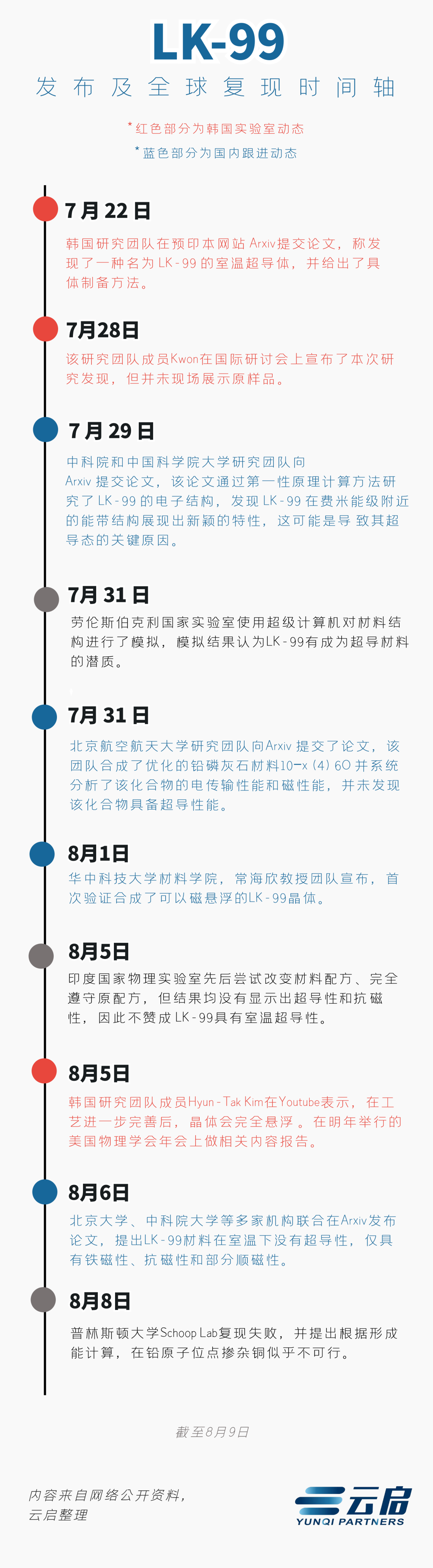
On July 22, 2023, a South Korean research team published a paper on arXiv claiming the discovery of the world's first room-temperature, ambient-pressure superconductor: LK-99. The material reportedly reached its superconducting critical point at 127°C under normal atmospheric pressure, **meaning LK-99 could function as a superconducting material in virtually any environment on Earth**. Multiple laboratories around the world quickly moved to verify LK-99's superconductivity under ambient pressure and room-temperature conditions.

On July 22, 2023, a South Korean research team posted a paper on arXiv claiming the discovery of LK-99, the world's first room-temperature, ambient-pressure superconductor. The material reportedly reaches its superconducting critical point at 127°C under normal pressure, meaning LK-99 could function as a superconducting material in virtually any environment on Earth. Multiple labs worldwide quickly followed up, attempting to verify LK-99's superconductivity under ambient pressure and room-temperature conditions.
- What does "room-temperature superconductivity" actually mean?
- Why did "LK-99" spark such widespread, intense discussion?
- Why have different labs produced different "replication results"?
- Where do high-temperature, low-temperature, and room-temperature superconductors stand in terms of "commercialization progress"?
- How are "superconducting materials" developing currently?
- If room-temperature superconductivity were achieved, what new impacts would it have on "industry and daily life"?
- What superconducting applications already exist "domestically"?
In this Yunqi Capital research feature, we'll sort through these questions factually, offering answers from dual perspectives of technological innovation and industrial development.
01
LK-99 Room-Temperature Superconductivity What "Breakthroughs" What "Doubts"
Yunqi Capital View
- "Room-temperature superconductivity" dramatically raises the ceiling of existing superconducting materials research; new materials may inspire fresh exploration in the field.
- Currently, the LK-99 crystal preparation process disclosed by the Korean team remains incomplete, and the reasoning behind what causes LK-99's superconducting phase transition is still disputed.
A preprint refers to a draft paper that has not yet undergone peer review or been formally published in a recognized scientific journal. The arXiv preprint server allows registration and free article uploads with an email from a university or research institution, or upon invitation from an expert in the same field. Every year, dozens of papers on "novel superconducting materials" are published on arXiv.
So why did this particular paper from the Korean team trigger such broad, intense discussion?
According to the Korean team's paper, LK-99 has a critical temperature of up to 400K (about 127°C) under ambient pressure, far exceeding all currently known material systems, and both the material system and preparation process are remarkably simple.
The new material and viewpoint proposed in this paper represent a comprehensive breakthrough in existing superconducting materials research.
Key words for preparing superconducting materials:
Temperature, pressure, process
1►
Critical Temperature
Because it directly determines a superconductor's practical applications and preparation methods, critical temperature has always been central to superconductor research. Critical temperature refers to the temperature at which a superconductor transitions from its normal state to its superconducting state (zero resistance).
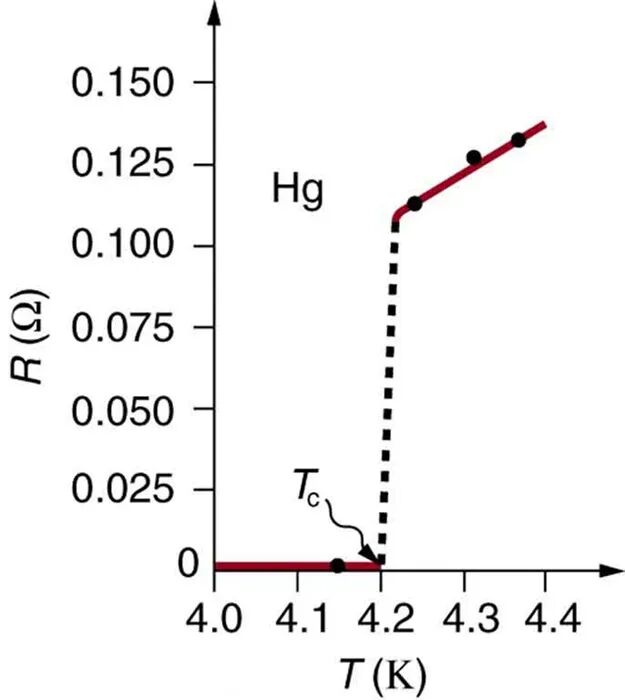
In the spring of 1911, Dutch physicist Heike Kamerlingh Onnes used liquid helium to cool mercury to 4.15 K (-269°C) and discovered that mercury's resistance dropped to zero. He termed this phenomenon "superconductivity." In the more than a century since, the critical temperature of superconducting materials has repeatedly broken theoretical limits and continued to rise.
Mercury's resistance at low temperatures
Some breakthrough superconducting materials discovered:
1986 Ceramic metal oxides were confirmed as superconductors, launching the era of copper-based high-temperature superconductors
1987 Yttrium barium copper oxide (YBCO) superconducting materials raised the critical temperature above 90K, breaking the liquid nitrogen temperature barrier
2008 Iron-based superconductors were discovered, with a critical temperature of 55K
2015 Hydrogen sulfide was found to undergo superconducting phase transition at 203K under extreme high pressure (about 1.5 million standard atmospheres)
······

Discovery dates and critical temperatures of important superconducting materials
Source: Wikipedia
Based on critical temperature, currently scaled-up superconducting materials can be divided into "low-temperature superconducting materials" and "high-temperature superconducting materials." All superconducting materials operate at temperatures far below room temperature:
Critical temperature below the liquid helium range (about 30K/-245°C) belongs to low-temperature superconducting materials, mainly used in medical MRI, particle accelerators, colliders, etc., primarily niobium-titanium and niobium-tin.
Critical temperature below the liquid nitrogen range (about 77K/-196°C) belongs to high-temperature superconducting materials, mainly used in superconducting cables, controlled nuclear fusion, induction heating, etc., primarily bismuth-based and YBCO.
In fact, tens of thousands of superconducting materials have already been discovered, but the vast majority have very low critical temperatures. The other route to achieving superconductivity, "high pressure," also imposes extreme demands on the working environment.
In 2019, lanthanum decahydride was confirmed to undergo superconducting phase transition at 2 million atmospheres, with a critical temperature of 260K (about -13°C) — the highest critical temperature superconductor known to date. Compared to LK-99's critical temperature of 400K under ambient pressure, this is still much lower.
2►
From "External Pressure" to "Internal Pressure"
Applying pressure can increase a material's superconducting critical temperature, which is the ingenious aspect of LK-99's structure.
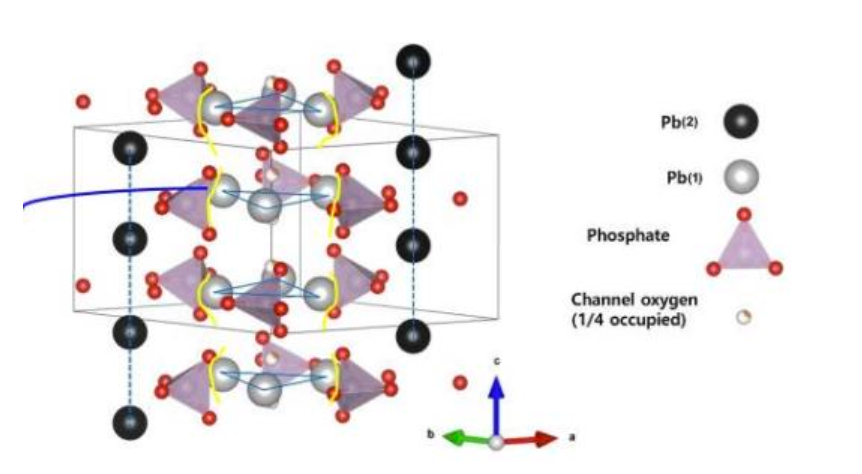
According to the Korean team's paper, LK-99 replaces "external pressure" with "internal pressure" — through copper atoms substituting for lead atoms, creating tiny distortions in the crystal lattice that enable electrons to move with zero resistance, thereby giving LK-99 its superconductivity.
In the paper, LK-99's superconductivity stems from a tiny volume contraction (only 0.48%) caused by Cu2+ replacing Pb2+(2) ions. This internal stress acts on the one-dimensional chain between Pb and O within the phosphate ([PO4]3−), restricting electron perturbations and producing a superconducting quantum well (SQW). This approach originates from the "Inter-Atomic Superconducting Band" (ISB) theory proposed by their mentor, Korean professor Choi Dong-sik, in 1993, and is logically self-consistent.
LK-99 crystal structure
According to simulations by Lawrence Berkeley National Laboratory, LK-99 possesses properties that a room-temperature superconducting material in the real world would have. But the conditions are relatively stringent: when copper atoms substitute for lead atoms, superconductivity only forms when copper atoms penetrate into harder-to-reach positions in the crystal lattice or "higher energy" bonding sites.
This means such a material would be very difficult to synthesize, because only a small fraction of copper in the crystal would happen to be in the correct position.
3►
Preparation Process
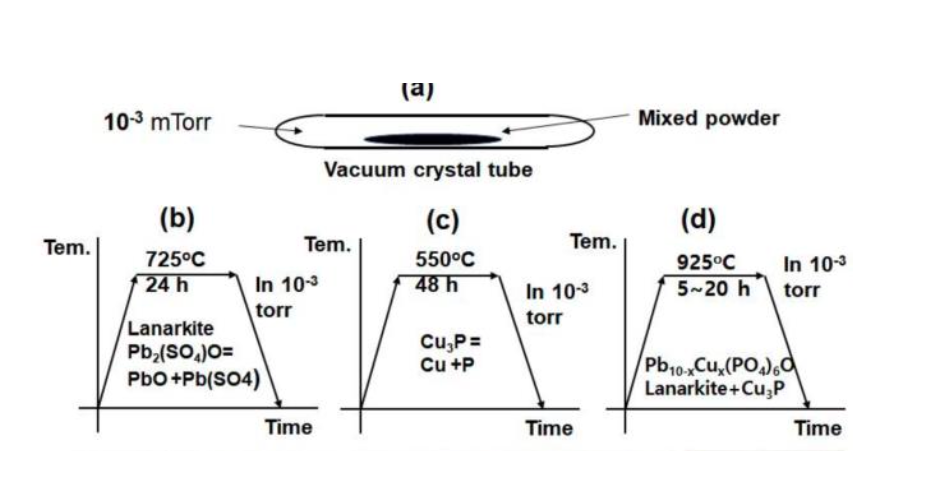
According to the preprint paper, the preparation method published by the Korean team is also quite simple:
Step 1: Synthesize lead apatite Pb2(SO4)O
Mix lead oxide and lead sulfate powders in a 1:1 ratio, place in a crucible, and heat in air at 725°C for 24 hours to obtain lead apatite crystals.
Step 2: Synthesize copper phosphide crystals Cu3P
Place copper and phosphorus powders in a vacuum tube, then heat in a crucible at 550°C for 48 hours to obtain copper phosphide crystals.
Step 3: Generate ambient-pressure, room-temperature superconductor Pb(10-x)Cux(PO4)6O
Grind the two crystals from the previous steps into powder, place in a vacuum tube, and heat in a crucible at 925°C for 5-20 hours to obtain a copper-doped lead apatite — LK-99 crystals with ambient-pressure, room-temperature superconducting properties.
LK-99 preparation process schematic
Netizens jokingly dubbed this seemingly overly simple preparation process "crucible alchemy" and "hand-rolled superconductors." But the paper fails to answer numerous practical detail questions: What purity level is required for precursor materials? What particle size is needed? Are any necessary pretreatment steps required before use? What specific environment does the reaction occur in — air or vacuum? How sensitive is LK-99 to the duration of the final 925°C step? ...
An unclear preparation process may lead to impurities in samples and ultimately affect experimental results.
Experimental results from the Institute of Physics, Chinese Academy of Sciences, suggested that LK-99's diamagnetism originates from copper sulfide — one of the materials required to produce LK-99.
Precedents of solving world-class problems with simple methods do exist. However, "simplicity" is not this paper's biggest point of suspicion; there are still many professional questions urgently awaiting answers.
02 Global
Replication Room-Temperature Superconductivity What "Progress" How to "Understand"
Yunqi Capital View
- To date, among global replication experiments, no single experiment has fully verified that LK-99 possesses room-temperature superconductivity; experimental results regarding zero resistance and diamagnetism also remain disputed.
- For supercomputer simulation results suggesting LK-99 has a "superconducting structure," the academic community generally maintains a cautious attitude. Whether LK-99 is superconducting will primarily depend on laboratory verification results.
Superconductors have two independent fundamental properties: absolute zero resistance and perfect diamagnetism. From an experimental physics perspective, these two basic characteristics are also used to determine whether a material has achieved superconducting phase transition.
Currently, there is no universally accepted theory for the cause of high-temperature superconducting phenomena, which is one reason why no conclusion has been reached on LK-99.
Superconductor verification: Absolute zero resistance, perfect diamagnetism
1►
Absolute Zero Resistance
Zero resistance verification generally uses four-probe measurement technology. Among currently known detection results, Professor Sun Yue from the School of Physics at Southeast University announced in a video that his sample's resistance dropped below 1E–5Ω at 110 K (about -163°C) under ambient pressure.
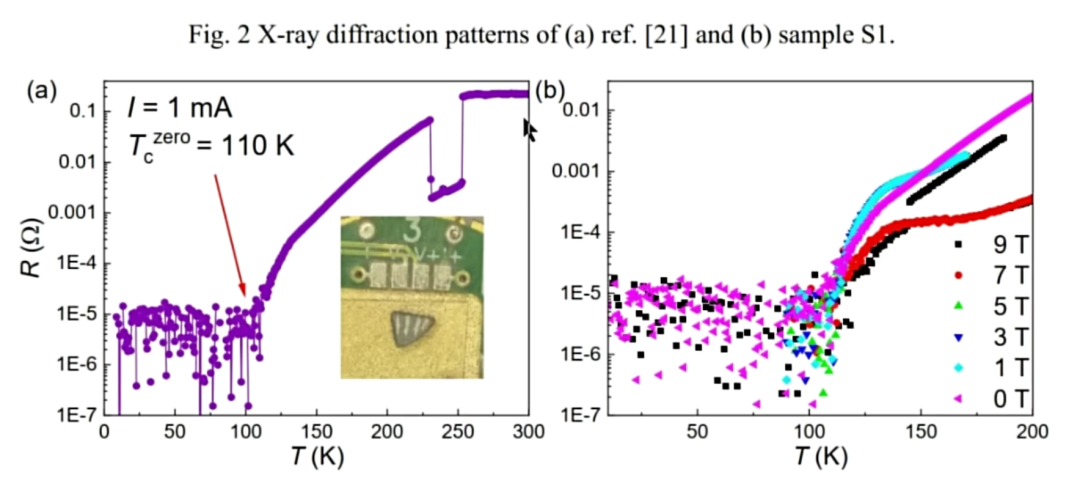
Replicated sample resistance Source: Bilibili, Professor Sun Yue's video
Yunqi Capital View
The left figure uses a logarithmic scale for the y-axis; the resistance drop curve is steeper than it visually appears, somewhat matching the pattern of a superconducting zero-resistance transition, but the transition temperature range is still relatively wide;
Additionally, under normal circumstances, when a magnetic field is applied to a superconductor, vortices pass through the sample; after current is applied, these vortices act on the current and cause dissipation, and the zero-resistance temperature decreases with increasing magnetic field. However, in the upper right figure, the zero-resistance temperature shows no response to magnetic field changes;
In summary, the sample in this experiment was too small, having already dropped below 1E-4 at 120K, making it impossible to rule out the possibility of a zero-resistance measurement artifact. More detailed experimental data is still needed.
To date, no additional verification regarding LK-99's zero resistance has been published. The Korean team stated they will present related reports at next year's American Physical Society meeting.
2►
Perfect Diamagnetism
Magnetic flux lines can pass through ordinary diamagnetic materials, but cannot pass through a superconductor in a perfectly diamagnetic state. This important characteristic distinguishing superconducting materials from ordinary materials is also known as the "Meissner effect."
A superconductor's magnetic susceptibility is -1, reaching the maximum value of diamagnetism. Even if magnetic flux lines can partially penetrate a superconductor under specific temperatures and magnetic fields, a strong flux pinning effect occurs. Therefore, superconductors strongly repel external magnetic fields and can firmly pin flux lines, while ordinary diamagnetic materials only weakly repel external magnetic fields.
Superconductors can not only levitate in magnetic fields but also maintain fixed relative positions with conventional magnets — the phenomenon of "macroscopic quantum locking."
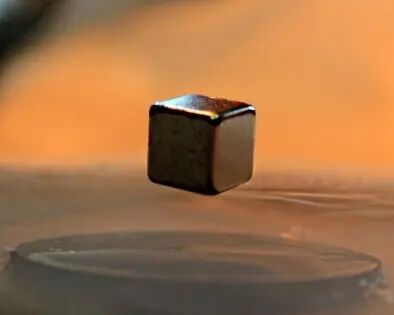
Meissner effect
Postdoctoral researcher Wu Hao and doctoral student Yang Li from the School of Materials Science and Engineering at Huazhong University of Science and Technology, under the guidance of Professor Chang Haixin, synthesized "magnetically levitating" LK-99 crystals.
Yunqi Capital View
From the Bilibili video, the material exhibited diamagnetism, but the sample still required a support point and did not achieve completely contactless levitation, unlike the perfect diamagnetism of common superconductors.
To date, no publicly available replication results have verified LK-99's perfect diamagnetism.
Supercomputer Simulation
Just as global laboratory replications were getting underway, Lawrence Berkeley National Laboratory quickly used the U.S. Department of Energy's supercomputer to simulate LK-99 material calculations, stating it possesses properties that a room-temperature superconducting material in the real world would have.
Researchers used Department of Energy computing power to perform density functional theory calculations on modified lead apatite, discovering a flat band crossing the Fermi level — a structure that exists in many known high-temperature superconductors. Therefore, LK-99 may theoretically possess room-temperature superconductivity.
Yunqi Capital View
Typically, the academic community is relatively cautious about modeling and computational results "based on unverified findings." Theoretical physics simulations often require artificially introduced assumptions, so the results have considerable adjustable degrees of freedom — hence this approach is colloquially called "shooting the arrow first, then drawing the target."
For LK-99 specifically, given extremely limited experimental data, there is substantial flexibility in parameter selection. If LK-99 is ultimately verified by laboratories, related calculations could aid principle research, but they themselves cannot serve as direct evidence verifying LK-99's room-temperature superconducting performance.
Superconducting Materials
Room-Temperature Superconductivity
What "Applications"
How Will It "Develop"
Yunqi Capital View
- YBCO-based second-generation high-temperature superconducting materials can break through the magnetic field strength limits of low-temperature superconductors and significantly reduce cooling costs, offering broader application prospects.
- From laboratory to commercial application, superconducting materials themselves need improved performance customization, ensured stability and reliability, and scaled production. Meanwhile, the superconducting industry needs more talent and industrialization experience to jointly establish complete upstream-downstream industrial chains, achieving technology and industry coordinated development through application-driven traction.
Possible Applications of "Room-Temperature Superconductivity"
Based on superconducting materials' fundamental properties — zero resistance, perfect diamagnetism, and macroscopic quantum effects — superconducting materials can enable large-current transmission, strong magnetic fields, magnetic levitation, and detection of weak magnetic signals, among other applications. They are therefore widely used in electronic communications, power energy, transportation, medical devices, and many other fields.
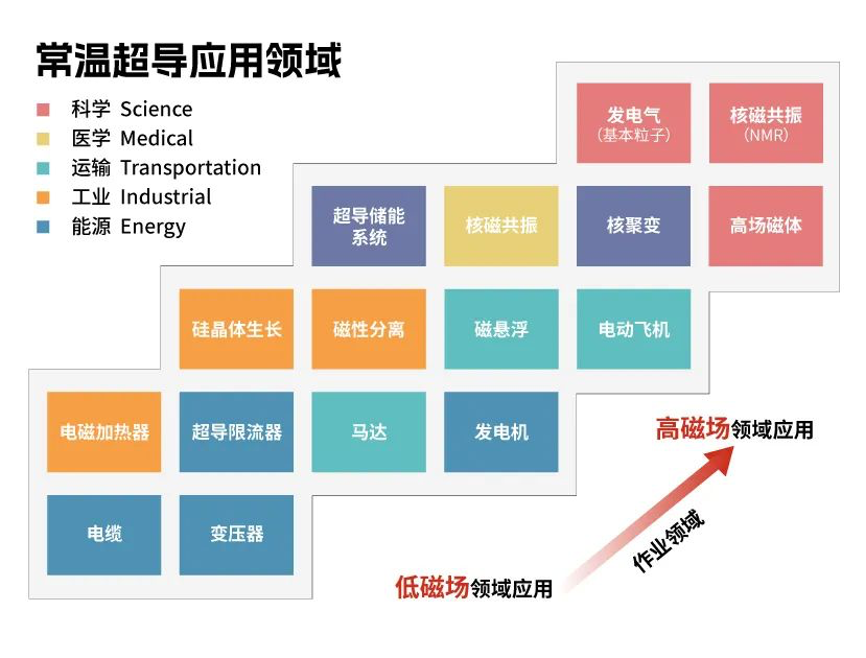
Room-temperature superconductivity means power transmission and application losses would disappear entirely. Moreover, because superconducting coils don't heat up, they can carry large currents, generate strong magnetic fields, and have no energy loss — greatly enhancing humanity's application of electromagnetic effects.
Room-temperature superconductors that are easy to prepare, low-cost, and have good applicability could fundamentally reshape all electricity and magnetism-related industries.
Energy and Industrial Applications: Room-temperature superconductivity could reshape the entire energy system from energy generation (controlled nuclear fusion), energy storage (superconducting coil energy storage or superconducting magnetic levitation flywheel energy storage), energy transmission (superconducting power transmission), to energy utilization (superconducting motors).
Information Industry: Applying room-temperature superconductors to existing computing units could provide higher computing power at lower energy consumption. It could also have unimaginable impacts on quantum computer development.
Transportation: Room-temperature superconductors in electric motors and propulsion systems would make current electric vehicles, ships, and other vehicles more powerful, with longer range and shorter charging times, even making commercial electric aircraft possible. Additionally, room-temperature superconducting materials could enable maglev trains to achieve higher speeds at lower costs, making ultra-high-speed maglev trains for daily commuting a possibility.
Practical Applications of Superconducting Materials
The excellent mechanical processing properties and cost advantages of low-temperature superconducting materials currently give them a dominant position in commercial applications. However, limited by scarce liquid helium resources, their applications are mainly in cost-relatively-insensitive fields such as medical care and large scientific installations. Additionally, low-temperature superconducting magnets typically stop working when internal magnetic induction intensity exceeds 25T, which also limits their magnetic field strength.
High-temperature superconducting materials operate at higher temperatures and can use cheaper, more readily available coolants, thus having broader application prospects. At present, high-temperature superconductivity has achieved preliminary applications in induction heating, power transmission, and other fields; feasibility in controlled nuclear fusion has been confirmed. It is expected to replace low-temperature superconducting materials in more fields in the future.
Among these, YBCO as a second-generation high-temperature superconducting material can break through the magnetic field strength limits of low-temperature superconductors while significantly reducing cooling costs, offering even broader application space.
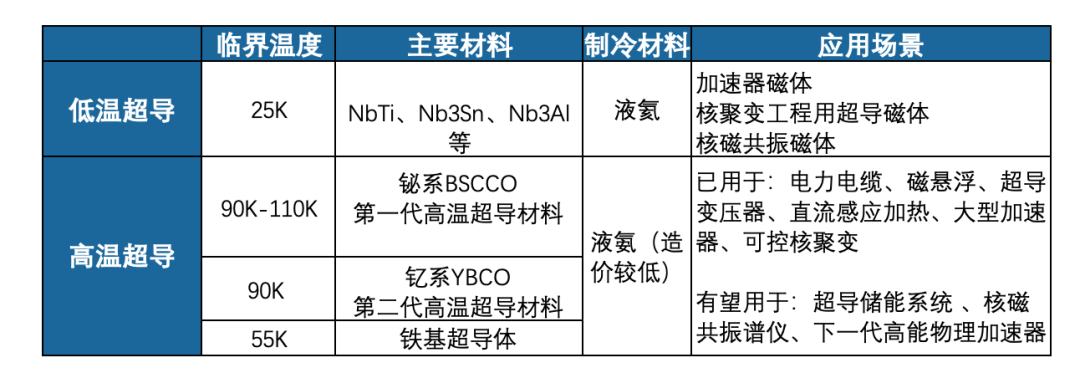
Source: "Superconducting Materials and Their Application Status and Development Prospects," Yunqi Capital compilation
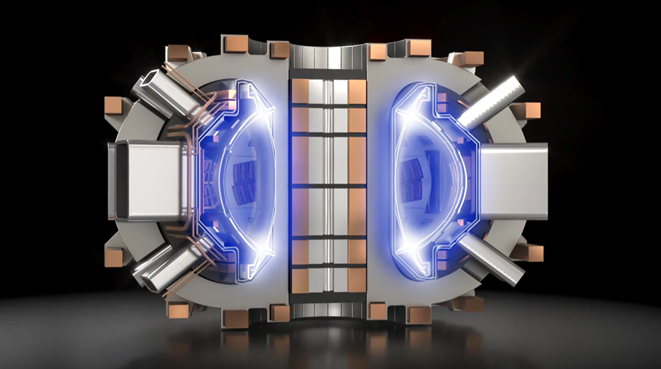
In 2019, MIT-CFS used high-temperature superconducting materials to manufacture a toroidal magnetic field that could encircle a tokamak, reaching a record-breaking 20 Tesla magnetic field strength, making net energy gain possible and igniting an investment boom in the nuclear fusion field. According to Fusion Industry Association (FIA) statistics, more than 30 companies globally, represented by CFS, are working to commercialize nuclear fusion, having raised over $5 billion in total.
Magnetic confinement is one of the necessary conditions for controlled nuclear fusion. The successive launch of commercial controlled nuclear fusion projects using high-temperature superconductivity has created strong demand for upstream high-temperature superconducting magnets and tape suppliers, potentially greatly driving industry expansion and process upgrades, further reducing costs and expanding application scope. In 2022, investment in the nuclear fusion field approached $3 billion.
Development of Superconducting Materials in China
Over the past decade-plus, China has continuously supported the development direction of superconducting materials through industrial policies, with various new materials industry-related policies driving the continuous development and innovation of superconducting materials.
······
2015 Made in China 2025 listed superconducting materials as a frontier disruptive new material requiring key development
2016 The 13th Five-Year National Strategic Emerging Industries Development Plan proposed active participation in the International Thermonuclear Experimental Reactor (ITER) program, continuously improving national major scientific and technological infrastructure such as the all-superconducting tokamak nuclear fusion experimental device.
2021 The 14th Five-Year Raw Materials Industry Development Plan proposed grasping new materials technology development trends, promoting superconducting materials systematic development, and strengthening support and guidance for application fields.
······
China's basic research in superconducting materials is at an internationally advanced level, having created world records for low-temperature superconducting materials' critical current density, first discovered YBCO high-temperature superconducting materials, new iron-based superconducting materials, and other achievements, leading international superconducting materials development directions;
As high-temperature superconducting materials begin entering commercialization, China has also reached internationally advanced levels in some high-temperature superconducting application-layer technologies.
For example, high-temperature superconductivity has already been successfully piloted in power transmission: In September 2021, a 400-meter superconducting cable pilot in Shenzhen successfully supplied power to the landmark Ping An Building;
In December of the same year, State Grid Corporation of China completed China's first 35-kilometer-level high-temperature superconducting cable demonstration project, with a total length of 1.2 kilometers, supplying power to over 40,000 households and core commercial streets in Shanghai's Xujiahui area.
Additionally, China was the first to complete superconducting wire supply tasks for the International Thermonuclear Experimental Reactor (ITER) program, achieve industrialization of high-performance YBCO coated conductors, realize grid connection of high-voltage-grade superconducting fault current limiters, and apply accelerators for cancer treatment, among other achievements.
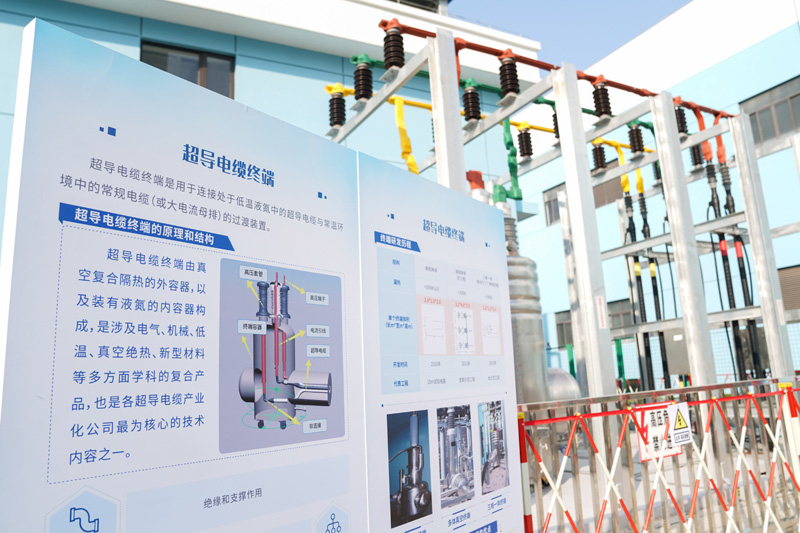
Shanghai High-Temperature Superconducting Cable Demonstration Project
Yunqi Capital View
The main future directions for superconducting materials are directly related to their specific application scenarios.
For substitutive applications (such as cables), superconducting materials need to achieve higher cost-effectiveness through large-scale mass production to compete with existing technologies;
For irreplaceable application scenarios (such as nuclear fusion), as applications expand and commercialize, superconducting materials on one hand need continuous improvement in performance, customization capability, and stability to adapt to scenario requirements; on the other hand, they must also consider cost-effectiveness while ensuring performance.
From laboratory to commercial application, superconducting materials themselves need improved performance customization, ensured stability and reliability, and scaled production. Meanwhile, the superconducting industry needs more talent and industrialization experience to jointly establish complete upstream-downstream industrial chains, achieving technology and industry coordinated development through application-driven traction.
Although achieving "room-temperature superconductivity" remains distant, continuous innovation in "high-temperature superconducting" materials is already gradually meeting industrialization needs. Yunqi Capital continues to pay attention to new energy technologies and believes that high-performance, low-cost high-temperature superconducting materials will provide cost-effective solutions for future clean, sustainable energy structures.
Expert Interviews for This Report:
Yue Zhao, Associate Professor at Shanghai Jiao Tong University, Member of the National Superconducting Standardization Technical Committee, Shanghai Municipal University Distinguished Professor
Jie Sheng, Associate Professor at Shanghai Jiao Tong University
This expert dialogue, participated in by Yunqi Capital Executive Director Zheng Ruiting, has been released on Yunqi Capital's tech podcast "Attention."

"Attention" is now live on Xiaoyuzhou. We'll share more new perspectives and great stories about technological progress and industrial upgrading here — welcome to listen!