Booster Robotics' Portfolio Company MiniMax Kicks Off A-Share IPO: ARR Doubled in Two Months as AI Leader Accelerates Evolution | Yunqi Partners

Advancing Toward an AI-Era Platform Company
Following its Hong Kong listing earlier this year, Yunqi Capital's first-round portfolio company MiniMax has reached another capital markets milestone: the company recently signed a tutoring agreement with CITIC Securities, officially launching its A-share IPO process.
MiniMax is one of China's most representative large model companies. Since listing on the Hong Kong Stock Exchange on January 9, its stock price has risen more than 250% cumulatively. The company currently serves approximately 300 million users globally, with ARR growing over 100% in the past two months.
As MiniMax's first-round institutional investor, Yunqi Capital has accompanied MiniMax throughout its journey, witnessing its continued deep cultivation in general intelligence, AI Native products, and global commercialization. We believe that AI companies with genuine underlying model capabilities, productization capabilities, and globalization capabilities will unlock long-term platform value in the new round of intelligent industry transformation.
The following content is reprinted from IPO Zaozhidao
According to IPO Zaozhidao, the CSRC official website disclosed that MiniMax Group Inc. (hereinafter referred to as "MiniMax") signed a tutoring agreement with CITIC Securities on May 29, 2026, officially launching its A-share IPO process.
Based on MiniMax's latest disclosed business data: to date, MiniMax serves over one million global enterprise and developer customers, a 5x increase from six months ago; global user scale is approximately 300 million. In the past two months, MiniMax's annualized recurring revenue (ARR) achieved growth of over 100%.
On March 2 this year, MiniMax released its first full-year earnings report since listing. The financial report shows that its 2025 total revenue was $79.038 million, a year-on-year increase of 158.9%, with over 70% of revenue coming from international markets. At the same time, MiniMax's profitability improved significantly — in 2025, MiniMax's gross profit was $20.079 million, a substantial year-on-year increase of 437.2%, while gross margin rose 13.2 percentage points to 25.4%; adjusted net loss was $250 million, with the loss ratio narrowing substantially year-on-year, and commercialization efficiency continuing to optimize.
Dr. Junjie Yan, MiniMax's founder and CEO, emphasized at the earnings call at that time that in 2026 MiniMax will advance from a large model company to a platform company in the AI era, continuously defining and driving new intelligence paradigms, constantly improving technological and product innovation capabilities, as well as scalable infrastructure and token throughput capabilities, while deepening commercialization layout and cultivating global market opportunities, providing more powerful intelligence for global users and partners.
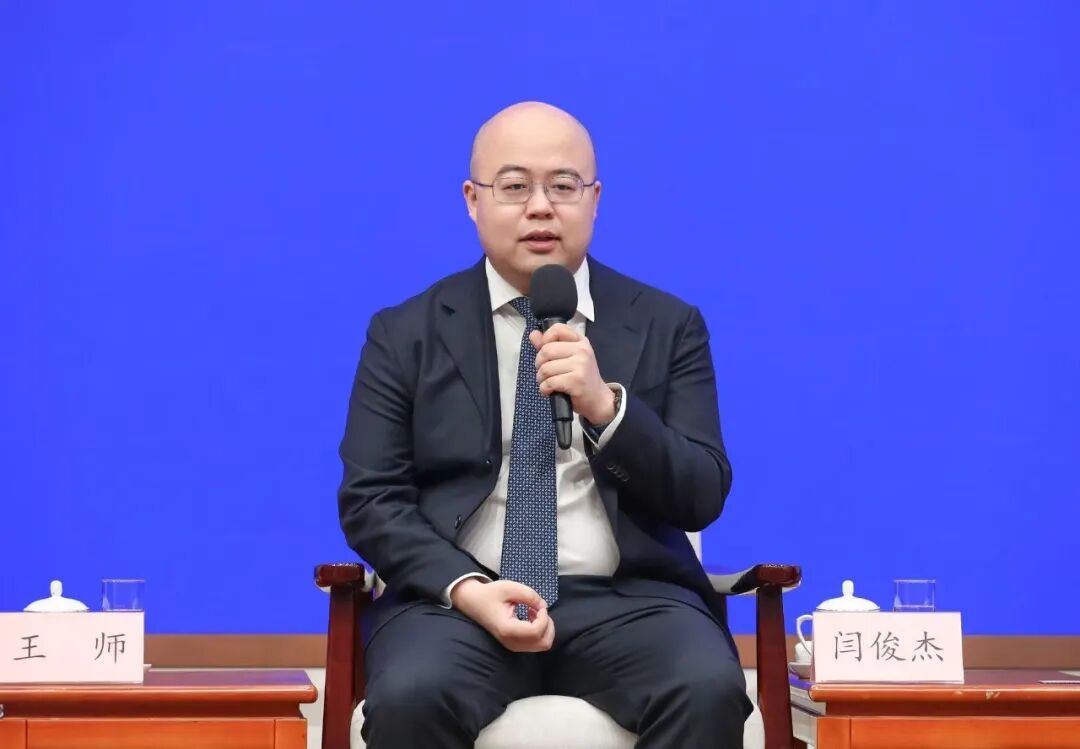
It is worth noting that on May 28, Junjie Yan attended the State Council Information Office's "Private Enterprises Taking on Responsibility in the 15th Five-Year Plan" press conference for Chinese and foreign journalists as an entrepreneur representative.
Junjie Yan pointed out that artificial intelligence will become a massive productive force. On one hand, it needs to be made more accessible, so that costs can be borne by more people; on the other hand, it needs to be as open as possible. "In both these aspects, China's industry has enormous global influence, and we believe it will become even better in the future."
Junjie Yan believes that looking ahead, there are three things worth continuing to strive for.
First, the integration of artificial intelligence with the entire industrial chain. "From semiconductor manufacturing and chips at the top, to software, cloud platforms, and then to artificial intelligence — this is a very large industrial upgrading opportunity, because artificial intelligence has very strong demand for and driving force on this industry."
Second, artificial intelligence is moving from simple applications to deeper integration with industries, capable of accelerating industrial development more rapidly. "In the future, we can see that when AI talent truly cooperates deeply with specialized talent in traditional industries, it will bring more changes. We've already seen rapid development in the programming domain, and these can be extended to more industries."
Third, the ultimate goal of artificial intelligence still needs to be benefiting society and the general public. "We believe that artificial intelligence, including ourselves and the entire industry, can have better planning for a path toward beneficial use."
In Junjie Yan's view, technological progress over the past three years has been very rapid, and the pace of progress in the next three years may be just as fast.
"We will also work in this direction, hoping to extend intelligence levels to more industries in this process," Junjie Yan stated. "As long as there is sufficient accumulation and enough talent that can emerge, I believe China's technological innovation will become increasingly better."