Net Energy Gain of 0.3 kWh: Nuclear Fusion Achieves Historic First Profitability | Yunqi Science --- China's "Artificial Sun" EAST tokamak has set a new world record — sustaining a high-confinement plasma for 1,066 seconds. But there's an even more significant milestone you may have missed: for the first time in history, a nuclear fusion experiment has achieved net energy gain. On February 12, 2025, the U.S. Department of Energy's National Ignition Facility (NIF) announced that during its December 2024 experiment, the facility produced 1.3 megajoules of fusion energy while consuming 1 megajoule of input energy — a net gain of 0.3 megajoules, or roughly 0.08 kilowatt-hours (about 0.3 kWh when converted to the more commonly used "degree" unit in Chinese energy billing). This marks the first time humanity has extracted more energy from a fusion reaction than was put in — crossing the critical "Q=1" threshold where output exceeds input. ## The Long Road to "Burning Plasma" NIF's approach differs

The Ultimate Dream of Future Energy

Recently, big news broke in the US on the nuclear fusion front — Lawrence Livermore National Laboratory's National Ignition Facility (NIF) achieved an unprecedented breakthrough.
In the experiment, the facility fired lasers with a total energy of 2.05 megajoules, triggering a deuterium-tritium fusion reaction that ultimately produced 3.15 megajoules of energy. That output may not sound like much — not even one kilowatt-hour (1 kWh = 3.6 MJ) — but the ratio of output to input energy, known as Q, reached 1.54, meaning the output exceeded the input by more than 50%. For decades prior, countless human fusion experiments had never managed to break even on energy. (Well, except for hydrogen bombs…) This marks the first time in history that humanity has achieved Q > 1 in a controlled fusion experiment — a net energy gain!
In this edition of "Yunqi Science Chat", we'll share some insights on nuclear fusion. Enjoy~
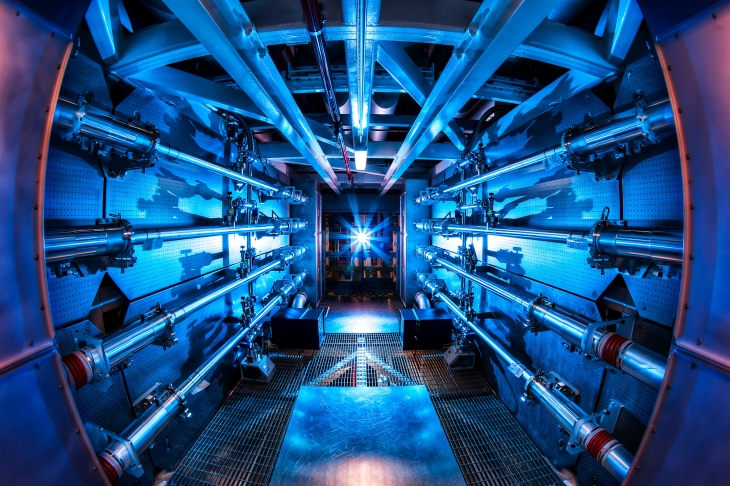
Pre-amplifier support structure at the US National Ignition Facility | Damien Jemison/LLNL
1
Nuclear Fusion: The Ultimate Dream of Future Energy
Nuclear fusion, as the name suggests, is the process where two or more lighter atomic nuclei combine to form a single heavier nucleus.
Inside the sun, this happens constantly: four hydrogen nuclei (protons) fuse into one helium nucleus, converting a portion of mass into energy that's ultimately released as light and heat, nourishing all life on Earth.
Fusion fuel can be extracted from seawater, making it "inexhaustible." If we could harness this reaction on Earth, humanity would solve its future energy problems in one stroke, potentially reducing dependence on fossil fuels and reversing global warming. The prospects are dazzling!
Seventy years ago, humans already achieved nuclear fusion on Earth — in 1952, the first hydrogen bomb test released energy exceeding 10 million tons of TNT. But that energy couldn't be harnessed; it was uncontrolled nuclear explosion. You can't exactly detonate hydrogen bombs casually for power generation…
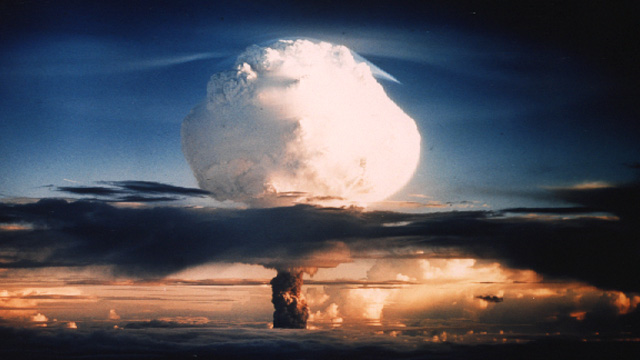
Mushroom cloud from the first hydrogen bomb test in 1952 | US Department of Energy
To realize humanity's ultimate energy dream, simply bringing fusion to Earth isn't enough. The energy must be released in a gentler, continuous manner — what's called controlled nuclear fusion.
For decades, scientists have pursued this goal, developing various experimental devices that create and sustain extreme conditions similar to the sun's core — the prerequisite for fusion reactions.
Unsurprisingly, this requires energy input. In theory, as long as the resulting fusion reaction generates more energy than consumed to initiate it, achieving self-sustaining fusion, the mission is accomplished.
Now you can probably appreciate how remarkable NIF's Q > 1 achievement is. The US Department of Energy took it so seriously that they held a special press briefing before officially announcing the results.
So what exactly is this National Ignition Facility? And with net energy gain achieved, is fusion power now just around the corner?
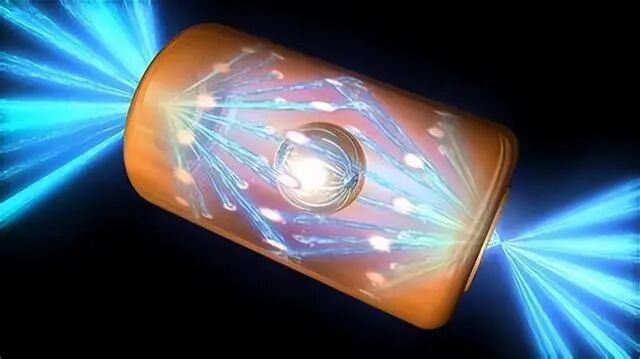
Principle of inertial confinement laser fusion | US Department of Energy
2
NIF: The US National Ignition Facility
The US "National Ignition Facility," full name National Ignition Facility, abbreviated as NIF, broke ground in 1997 and was completed in 2009. It's an inertial confinement laser fusion experimental device.
The fusion reaction it achieves is called deuterium-tritium fusion.
Earth can't easily replicate the extreme temperature, pressure, and density found in the sun's core. The process of four protons fusing into a helium nucleus there is complex and demanding. Deuterium-tritium fusion, by comparison, has somewhat less stringent requirements.
Deuterium and tritium are both isotopes of hydrogen: deuterium has one proton and one neutron, tritium has one proton and two neutrons. When they fuse, they produce a helium nucleus and release a neutron.
The three isotopes of hydrogen: protium, deuterium, and tritium, with protium being the most common.
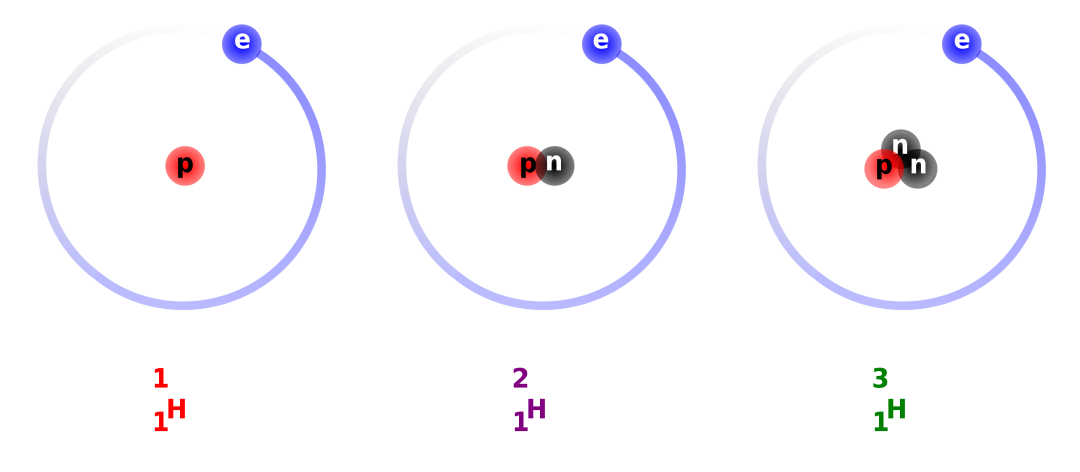
The three isotopes of hydrogen: protium, deuterium, and tritium, with protium being the most common
Achieving deuterium-tritium fusion is still no easy feat. Both nuclei carry positive charge, and the closer they get, the stronger the electrostatic repulsion. For fusion to occur, they must approach within 10^-15 meters — one five-hundred-billionth the width of a human hair — at temperatures exceeding 100 million degrees.
Multiple methods can create such extreme conditions for controlled fusion: magnetic confinement (tokamaks), stellarators, and others. The most straightforward approach is NIF's inertial confinement. The principle is simple: focus many powerful laser beams onto an extremely small point to trigger fusion.
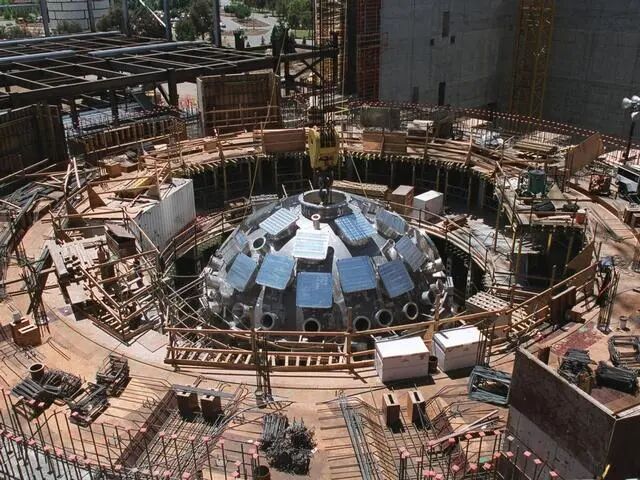
NIF's target chamber | LLNL
NIF uses 192 ultraviolet laser beams, capable of delivering 2.05 megajoules in a single shot — roughly 0.57 kWh. That may not sound like much, but this pulse is delivered in 3 nanoseconds (1 nanosecond = 1×10^-9 seconds), with instantaneous power roughly 1,000 times the output of all US power plants combined.
At the focal point of these lasers sits a gold "hohlraum." At its center is the fuel capsule, just 2–3 mm in diameter.
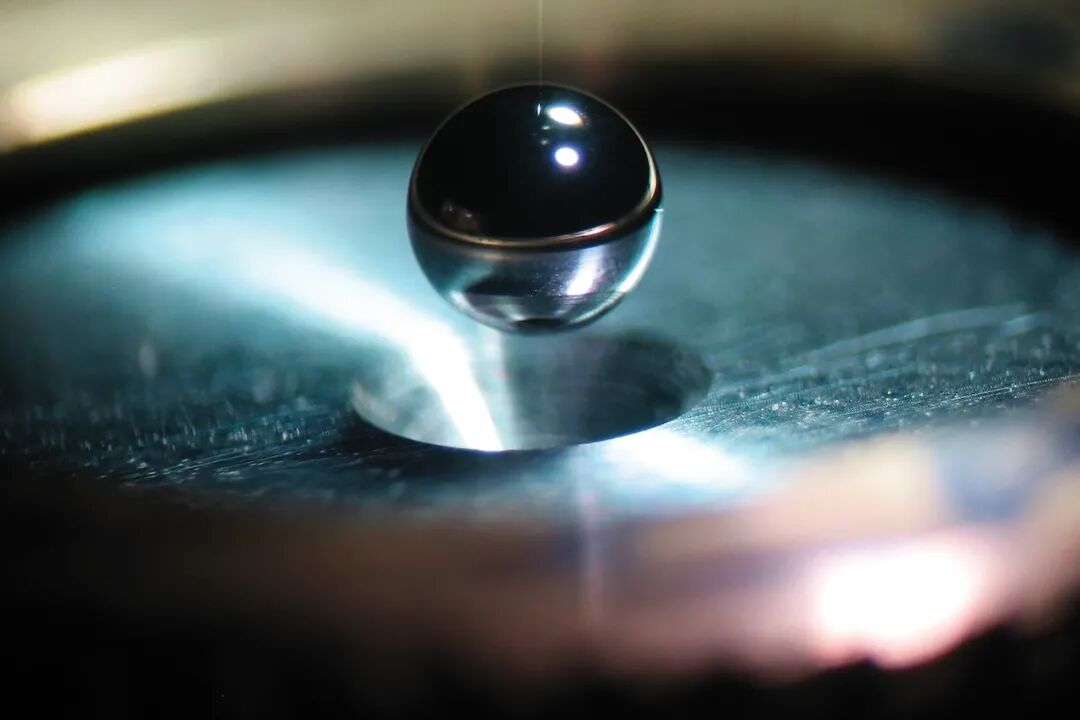
NIF fuel capsule | Damien Jemison/LLNL
The 192 laser beams split into upper and lower clusters entering the hohlraum, generating intense X-rays that instantly vaporize the capsule's outer layer into plasma.
The outward-flying ions create a reaction force, compressing the capsule's deuterium-tritium fuel inner layer inward at 400 km/s, reaching temperatures over 100 million degrees and pressures of hundreds of billions of atmospheres.
Then — bang — fusion ignites at the capsule's core.
"Inertial confinement" refers to how the capsule shell and fuel, during inward compression, maintain their high-density state for a brief period due to inertia.
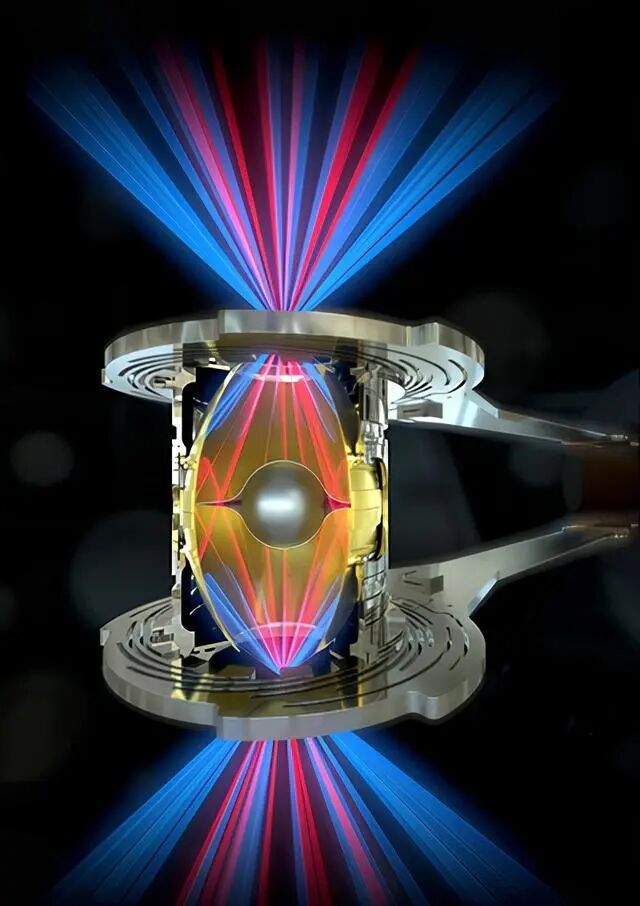
Lasers entering the hohlraum, X-rays irradiating the capsule | Jacob Long/LLNL
This sounds straightforward in description, but execution is extraordinarily difficult.
Generating such high-energy laser beams requires massive, complex machinery. The 192 beams must converge precisely at the hohlraum's openings. The X-rays must compress the capsule uniformly. Once core fusion begins, as much fuel as possible must undergo fusion before the capsule disassembles. And so on.
Every single element here is cutting-edge technology, bought with astronomical spending.
The net energy gain achieved this time means the energy produced by capsule fusion now exceeds the energy consumed to generate the lasers — satisfying a prerequisite for fusion reactions to become "self-sustaining."
This is genuinely a milestone achievement.
So does this mean fusion power is nearly here?
Not even close!
3
Fusion Power? No, That's Naive…
Simply put, NIF was never designed for power generation.
True self-sustaining fusion would require continuously replacing hohlraums and fuel capsules at a rate of 10 times per second, converting the fusion energy into electricity, and using that to power the lasers.
NIF's inertial confinement fusion, by contrast, is a one-shot deal. After each experiment, 4–5 hours pass before the next can begin. And each fusion event produces less than 1 kWh — a far cry from the dream of fusion power.
Additionally, capturing the fusion energy presents a major challenge.
Deuterium-tritium fusion produces a 14.1 mega-electron-volt fast neutron carrying 80% of the fusion energy. Capturing this energy is difficult because fast neutrons easily penetrate metal materials and escape. Neutron shielding and cooling systems are needed outside the chamber, using the generated heat to produce electricity.
These capabilities are beyond NIF's design, making electrical conversion impossible.
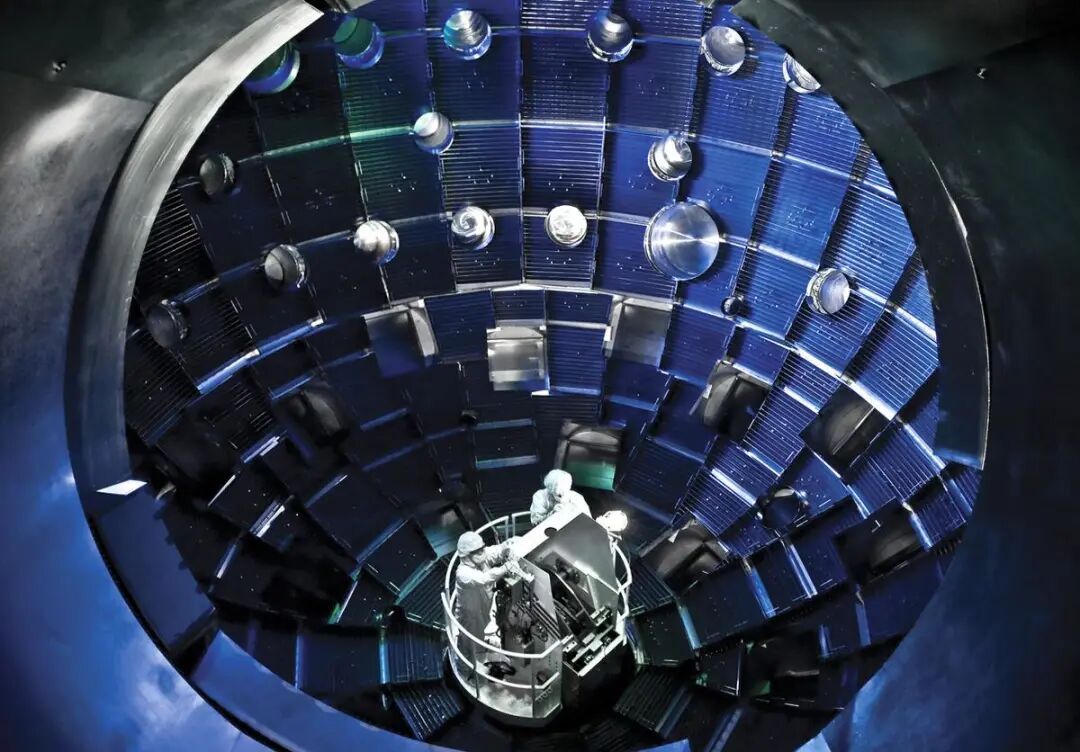
Technicians entering NIF's target chamber for inspection and maintenance | Philip Saltonstall/LLNL
And even assuming NIF could run continuously, even with 100% energy-to-electricity conversion, there's a "fatal flaw":
Producing 2.05 megajoules of laser energy consumes far more than 2.05 megajoules. Equipment cooling, laser losses, and other factors mean the actual electrical consumption vastly exceeds that 0.57 kWh.
So even with NIF's claimed Q = 1.54, this is merely an idealized value. True self-sustaining fusion remains out of reach.
Keep in mind, NIF is a money pit: 12 years of construction cost $3.5 billion, nearly the price of a nuclear-powered aircraft carrier. This raises an obvious question: why did the Americans invest so generously in a fusion device that can't generate power?
The secret lies in NIF's ability to simulate nuclear tests.
NIF's hohlraum and capsule structure actually resembles a miniature hydrogen bomb. With most nations having signed the Comprehensive Nuclear-Test-Ban Treaty, using a "scientific facility" to effectively conduct nuclear tests is NIF's more important mission.
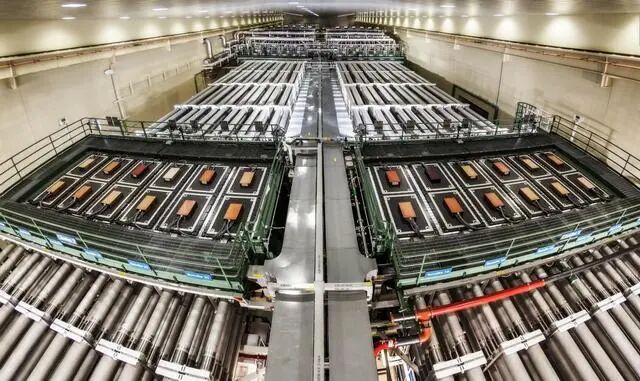
NIF's laser transport system | Jacqueline McBride/LLNL
This net energy gain achievement will bring significant benefits at the weapons level, aiding the design of higher-yield or more miniaturized hydrogen bombs.
As for the fusion power people have been longing for, genuine realization still awaits.
4
Another 50 40 30 Years, Definitely!
NIF achieving Q > 1 is a genuine, major breakthrough. But the inherent characteristics of inertial confinement devices give them natural disadvantages for continuous power generation.
By comparison, another approach — magnetic confinement fusion — holds more promise. The under-construction International Thermonuclear Experimental Reactor (ITER), for instance, targets Q > 10.
ITER is a magnetic confinement device, a "tokamak." Its principle: confine extremely hot plasma within a toroidal chamber using magnetic fields, maintaining it for sufficient duration.
This allows deuterium-tritium fuel to continuously fuse and output energy inside the chamber, while lithium-containing blanket modules outside absorb neutron energy and convert it to heat.
ITER's designed fusion power is 500,000 kilowatts, equivalent to a small coal plant. But ITER still won't generate electricity — it's only for testing fusion energy conversion.
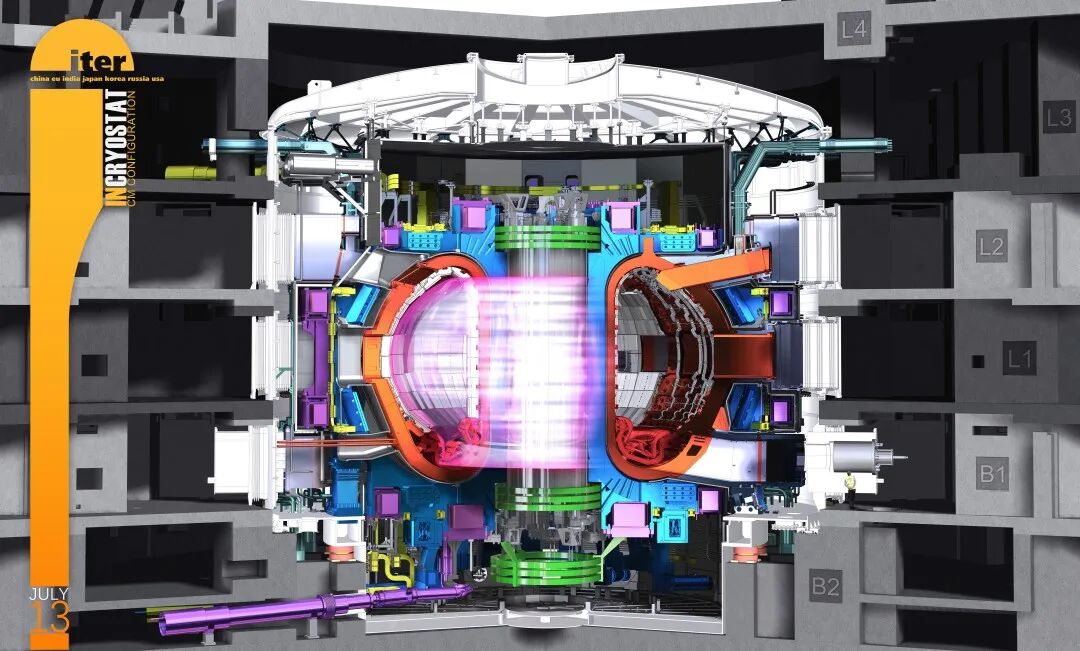
ITER structural schematic | ITER
But as a multinational project (China participates too), ITER's biggest problem is chronic delay. For various reasons, progress has been excruciatingly slow, with completion dates repeatedly pushed back. The current target is 2025, though honestly, I have my doubts.
Even after ITER succeeds, a demonstration fusion reactor must still be built before actual power generation, with commercialization likely taking even longer. So when people say "fusion power is always 50 years away," it's not without reason.
Now, with NIF's inertial confinement achieving Q > 1, this should provide some impetus for ITER's construction. Controlled fusion has long seen rivalry between inertial and magnetic confinement approaches. The US has favored inertial confinement, likely tied to its interest in simulating nuclear tests, while Europe and Japan lean more toward magnetic confinement tokamaks.
Perhaps NIF's breakthrough can pressure ITER to accelerate, shrinking that "50 years" to 40 or even 30. (But certainly no shorter than that…)
For humanity seeking to peacefully harness fusion, that would count as a significant contribution indeed.
Author: Sagittarius A; Editor: Steed; Cover image: John Jett and Jake Long/LLNL
This article is from Guokr (ID: Guokr42). Unauthorized reproduction prohibited. For inquiries, contact sns@guokr.com