Not Here to Disrupt the World Yet, Just Heading to the Office First: Keenon Unveils New Humanoid Robot "K-Zai" | Yunqi Partners

The Pragmatic Romance of Embodied AI
For humanoid robots to truly enter commercial spaces, the first step may not be becoming a "universal employee," but rather finding a specific, deployable, and replicable role.
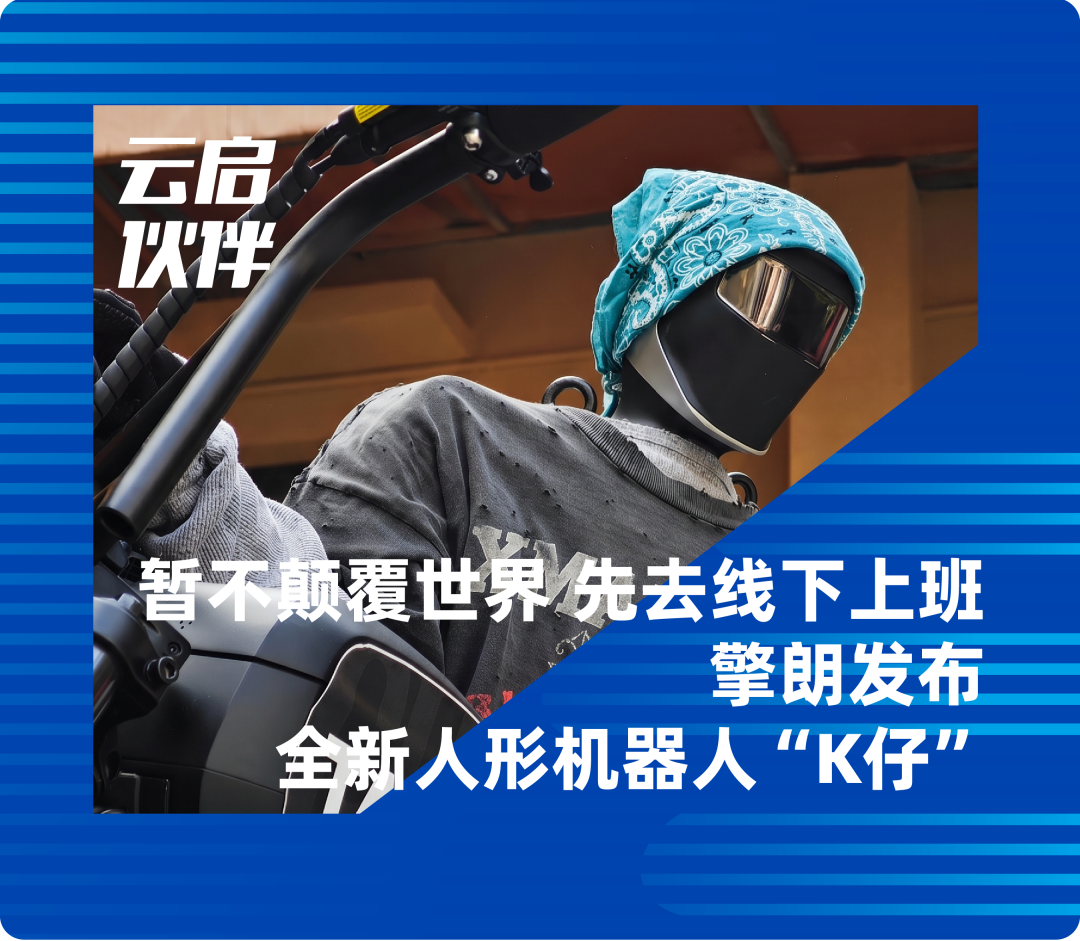
Recently, Yunqi Capital portfolio company Keenon unveiled a new addition to its XMAN family — the compact humanoid robot XMAN-L1, nicknamed "K-Zai." As part of Keenon's "general + specialized" embodied service robot matrix, K-Zai targets lightweight service roles such as supermarket traffic generation, exhibition engagement, and event performances, handling tasks like trendy interactive experiences, customer guidance, and on-site atmosphere creation.
K-Zai's value extends beyond the product itself — it represents a "role-based" deployment approach. Learn more in this edition of Yunqi Partners.
K-Zai on the Job: Targeting Lightweight Service Roles
The XMAN-L1 "K-Zai" is a compact humanoid robot designed for lightweight service roles in commercial spaces.
Standing 136 cm tall with 42 biomimetic degrees of freedom, it features a full-metal high-rigidity body with modular design, combining flexibility, stability, and maintainability.
In terms of mobility, K-Zai delivers high-dynamic performance, supporting walking, running, dancing, and martial arts movements, with continuous improvement in motion stability and expression through reinforcement learning and imitation learning.
On the interaction front, K-Zai carries 100 TOPS of edge computing power and can connect to mainstream large models including Doubao and Tencent's, enabling natural voice dialogue and handling on-site interaction, guidance, and Q&A tasks.
In its debut appearance, K-Zai showed up as a trendy "influencer" at a streetwear pop-up event, performing dance routines and engaging with the audience. For commercial spaces including supermarkets, exhibitions, and event venues, K-Zai can serve as an "atmosphere anchor" that draws foot traffic, while also taking on concrete roles like lightweight interaction, customer guidance, and event performance.
From Specialized to General: Keenon Builds a "General + Specialized" Embodied Service Robot Matrix
K-Zai is not an isolated product launch, but one component of Keenon's "general + specialized" embodied service robot matrix.
Within this matrix, each member has its distinct function: the compact humanoid robot XMAN-L1 primarily handles trendy interaction, customer guidance, and lightweight performance roles; full-size humanoid robots XMAN-F1 and XMAN-R1 tackle more complex manipulation tasks such as making burgers, brewing coffee, and folding clothes; while specialized service robots in the C and T series continue to deepen their presence in standardized service roles like cleaning and delivery.
This means Keenon is not attempting to cover all service scenarios with a single robot form factor, but rather building a multi-form-factor robot system where different models complement each other through tiered capabilities.
In real commercial environments, service demands are rarely single tasks — they typically comprise multiple roles including reception, guidance, delivery, cleaning, preparation, and interaction. Compared to having one robot type handle everything, a "general + specialized" multi-agent collaborative approach stands a better chance of striking a balance between efficiency, cost, and reliability.
The "Role-Based" Path: Getting Robots Running in Concrete Roles First
In the process of embodied intelligence deployment, the industry broadly faces challenges including insufficient real-world data, high scene complexity, and difficulty rapidly validating general capabilities. Keenon's chosen path is to decompose complex service environments — hotels, restaurants, supermarkets — into quantifiable, trainable, and replicable standardized roles.
In September 2025, Keenon formally upgraded and released KOM 2.0 (KEENON Operator Model 2.0), its industry-facing model for the service sector, and built the role-based domain-specific model KEENON ProS on this "role-based" foundation. This model undergoes deep specialization optimization for concrete service roles, enhancing the applicability and execution efficiency of general embodied large models in vertical scenarios such as dining, hospitality, and retail.
In Keenon's practice, robots first go deep in a single role, operating continuously in real commercial environments to accumulate environmental data, task data, interaction data, and scheduling data — which then feeds back into underlying model and system optimization.
Through this, Keenon has gradually developed an embodied intelligence closed loop of "data — model — scenario": extracting data from real-world deployment, using model training to improve understanding, decision-making, and execution capabilities, then returning to concrete roles for validation and iteration.
This "specialized — general — specialized" data flywheel also provides a more pragmatic path for humanoid robots to move from demonstration to actual deployment.