OpenAI Sora2 Drops, and the "AI Version of Douyin" Arrives | Yunqi Tech π

AI Video Generation Hits the Gas
In the early hours of October 1 Beijing time, OpenAI released Sora 2, its new video generation model. The new model delivers significant improvements in character consistency and controllability, with OpenAI officially calling it the "GPT-3.5 moment" for AI video.
The Sora mobile app launched simultaneously. With an interface and operation logic similar to Douyin and TikTok, plus "AI generation" as the sole permitted content format, could an extraordinarily potent AI-native content social media platform be born? This episode of "Yunqi Tech π" takes a closer look.
This article is republished from GeekPark.
Original headline: OpenAI Just Released the "AI-Native" Douyin, Plus Sora 2
Author: Yongyi Zhang
Perhaps you've grown weary of scrolling through Douyin and Xiaohongshu, trying to distinguish real videos from AI-generated ones. This fatigue rarely stems from rejection of the technology itself; it's more a sense of mistimed dissonance: when AI-generated content mingles with real-world footage, our ability to comprehend and consume reality becomes deeply unsettling.
But what about the opposite approach — deliberately building a "Douyin" where only AI content is allowed?
This is precisely OpenAI's latest move. The company released a new iOS app called Sora, with an interface and operation logic remarkably similar to Douyin and TikTok, but governed by a fundamentally different core rule: here, AI generation is the only passport.
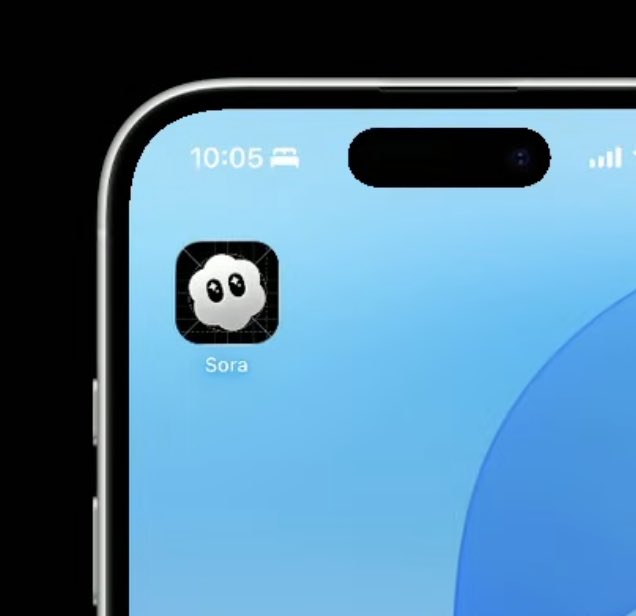
01 Sora App: A New Social Species Born for AI
Like Douyin, opening Sora presents an extremely streamlined and familiar UI: Douyin's signature "swipe up" gesture remains the core operation for switching videos, and sharing functions are fully available.
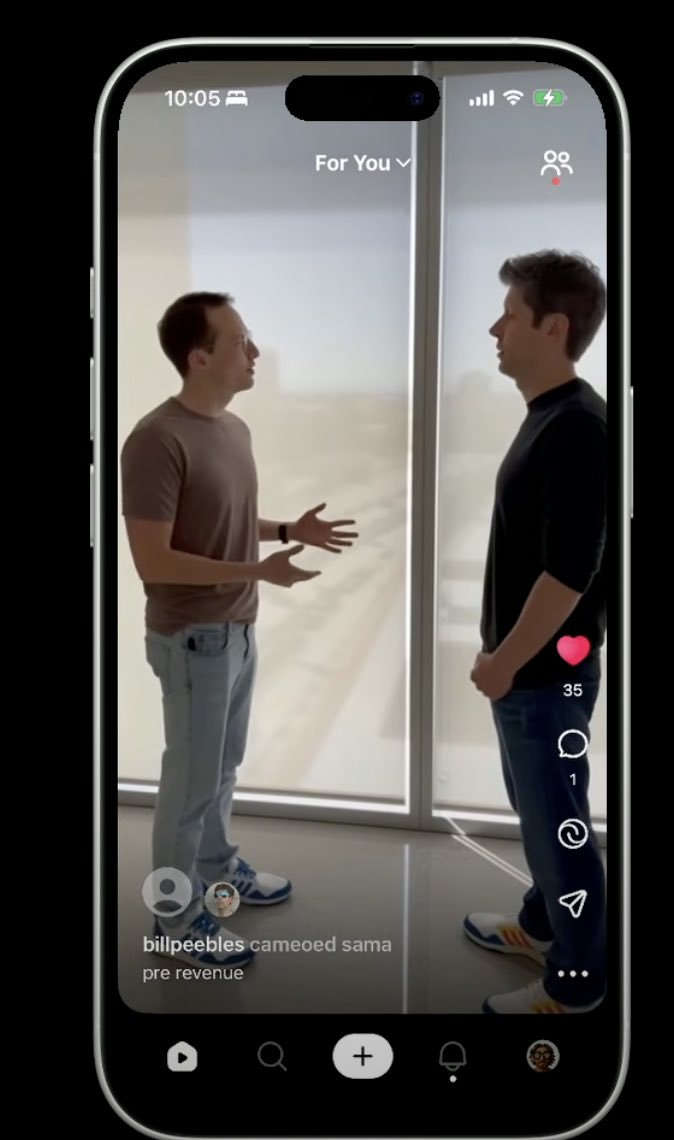
According to OpenAI, the app features two core functionalities: First, the Cameos feature: this is Sora's most revolutionary capability. Users need only complete a one-time brief audio-video recording within the app to verify identity and capture their likeness, and the Sora 2 model can replicate them with astonishing fidelity. Thereafter, you can authorize your friends — or, if you're bold enough, everyone on the platform — to place your virtual likeness into any AI scenario, creating "cameo videos" featuring your personal image.
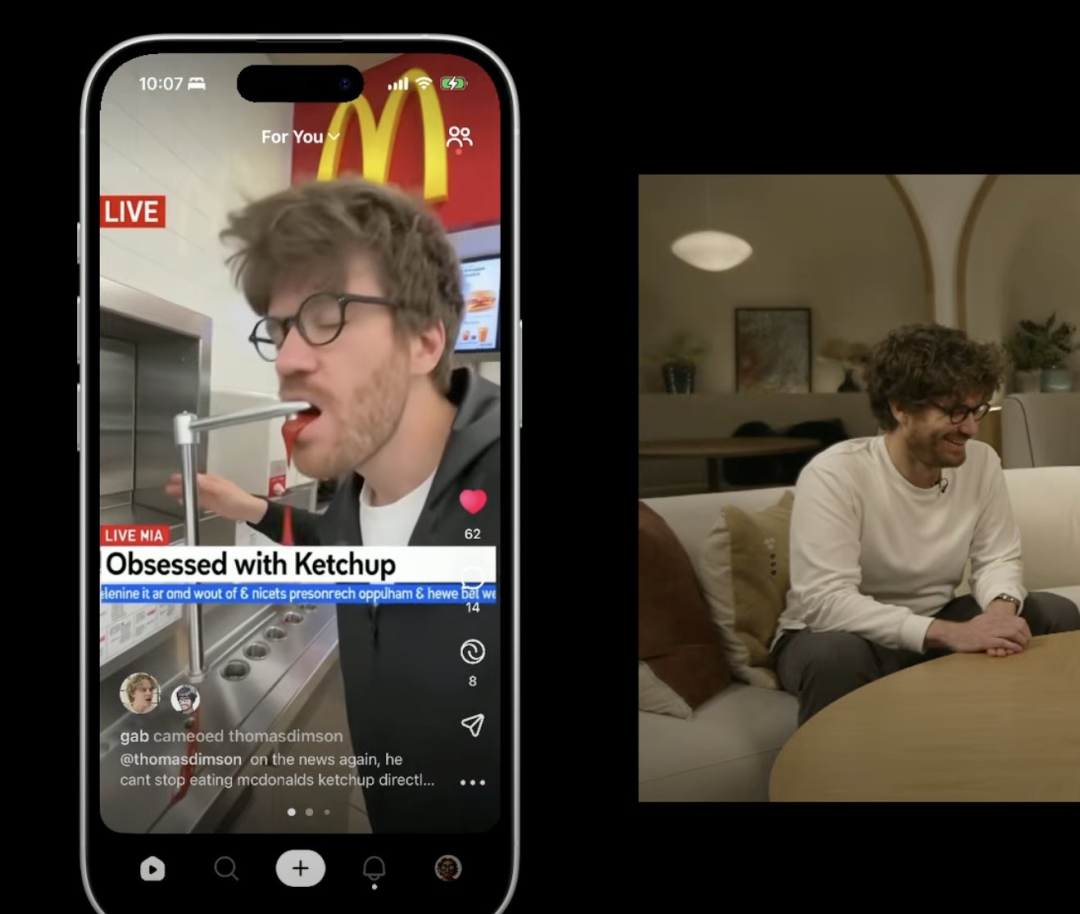
OpenAI emphasizes that users whose likenesses are used are "co-owners" of the final work, with the power to delete videos or revoke others' usage permissions at any time.
Second, Sora also includes editing tools, though these too are more "AI-native": a clipping tool called Remix that only allows users to input prompts, enabling them to "remix" any video or trend on the platform and generate their own version.
To protect personal likenesses from misuse, OpenAI has established clear rules: if you haven't proactively uploaded and authorized your own "cameo" likeness, no one can generate videos featuring you in Sora. This rule applies equally to public figures — unless they themselves upload cameo videos and authorize their use. Meanwhile, the platform currently strictly prohibits and "cannot generate restricted content."
02 Sora 2 Model: A Critical Step Toward the "World Simulator"
Powering the entire Sora App experience is the Sora 2 video model, released simultaneously by OpenAI. Despite the relatively low-key launch, OpenAI didn't hesitate in its official press release to call it the "GPT-3.5 moment for video."
Sora 2's power lies in its deep understanding of the physical world, enabling it to accomplish tasks previously beyond the reach of models.
Whether simulating Olympic gymnastics maneuvers, completing backflips on a surfboard with precise simulation of buoyancy and rigid-body dynamics, or having a cat execute a triple-axel while desperately holding on. The model performs especially well in photorealistic, cinematic, and anime styles. You can even use Sora 2 to generate a convincing anime sequence outright (though anime itself isn't real, of course).
More importantly, Sora 2 achieves a massive leap in controllability, capable of following complex instructions across multiple shots while precisely maintaining world-state consistency, and even possesses the ability to simulate "failure."
Past video models tended to be overly "optimistic," distorting reality to fulfill instructions — a missed basketball might magically fly into the hoop. In Sora 2, a missed shot follows physical laws and bounces off the backboard.
03 The "Responsibility" Behind the Social Experiment
Facing the existing issues of teen addiction on platforms like Douyin and TikTok, OpenAI clearly doesn't want its "Douyin for the AI era" to be mired in controversy from day one.
OpenAI stated in its launch that avoiding "doomscrolling," addiction, and isolation were primary considerations in product design.
According to OpenAI's published Feed Philosophy, Sora's recommendation algorithm leverages large language models, allowing users to guide what they want to see through natural language. The algorithm is not optimized for "time spent," but explicitly designed to "maximize creation, not consumption." By default, content heavily skews toward people you follow or interact with, prioritizing videos that might spark your creative inspiration.
Additionally, the app includes mechanisms that periodically check in on users' mental and physical wellbeing, and proactively offers options to adjust the feed. For teen users, there are default daily limits on generated content viewing, along with stricter Cameo permissions.
Beyond automated safety systems, human moderation teams are being expanded to quickly address bullying behavior. Parents can also enable Sora parental controls through ChatGPT, overriding infinite scroll limits, disabling algorithmic personalization, and managing direct message settings.
Finally, release and pricing information: the Sora app is currently only available to users in the US and Canada, with other countries to follow. Distribution is invite-only to ensure users can join alongside friends. When granted access, users receive four additional invites to share with friends. There is currently no word on when an Android version will be released.
Within the Sora App, Sora 2 will initially be free with generous initial usage limits. ChatGPT Pro users can also access the high-quality Sora 2 Pro model on the Sora website (coming soon to the Sora app as well). OpenAI also plans to release Sora 2 through its API. Sora 1 Turbo will remain available, and all content you've created will continue to be saved in your media library.
If OpenAI in the past was providing a powerful "AI engine" for the world, the release of Sora App sends a clearer signal about its evolving strategy: this organization once dedicated to exploring AI is no longer content to merely serve as a technology supplier, but is diving in directly to build a complete closed loop from underlying models to upper-layer applications to community ecosystems.
While the Sora App has debuted as the "Douyin of the AI era," the questions and controversies surrounding AI content platforms have only intensified: will users accept a virtual world composed entirely of AI? How will traditional content platforms respond?
The board is set. With a deceptively simple app, OpenAI is attempting to blueprint social media for the "post-truth era."
Whether Sora App ultimately becomes the next phenomenon-level hit or merely satisfies a niche community of creators, one thing is certain: the boundaries of content consumption and digital social interaction have become unprecedentedly blurred and fascinating because of this unorthodox move.