Live from OpenAI's Developer Conference: GPT Dead Last? | Yunqi Capital Tech Talk

What's more important is...
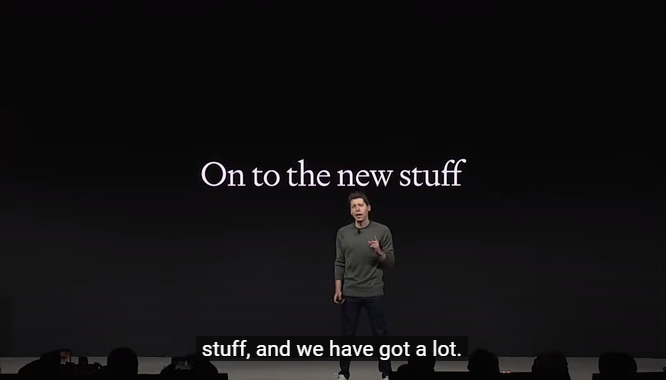
On the morning of November 6, OpenAI held its developer conference in San Francisco. Alongside a more powerful new version of ChatGPT, OpenAI also unveiled the GPT Store, an open platform designed to "empower more creators."
OpenAI is evolving faster on both technical and commercial fronts. In this edition of "Yunqi Kepu", we bring you live highlights from the event, showing how OpenAI is articulating its new vision.
Source | WeChat public account "Gui Tu Sai Pao"
Authors | Amelie, Manman
Some images courtesy of: GPTDAOAI
"There is no royal road to science, and only those who do not dread the fatiguing climb of its steep paths have a chance of gaining its luminous summits."
— Karl Marx, Capital
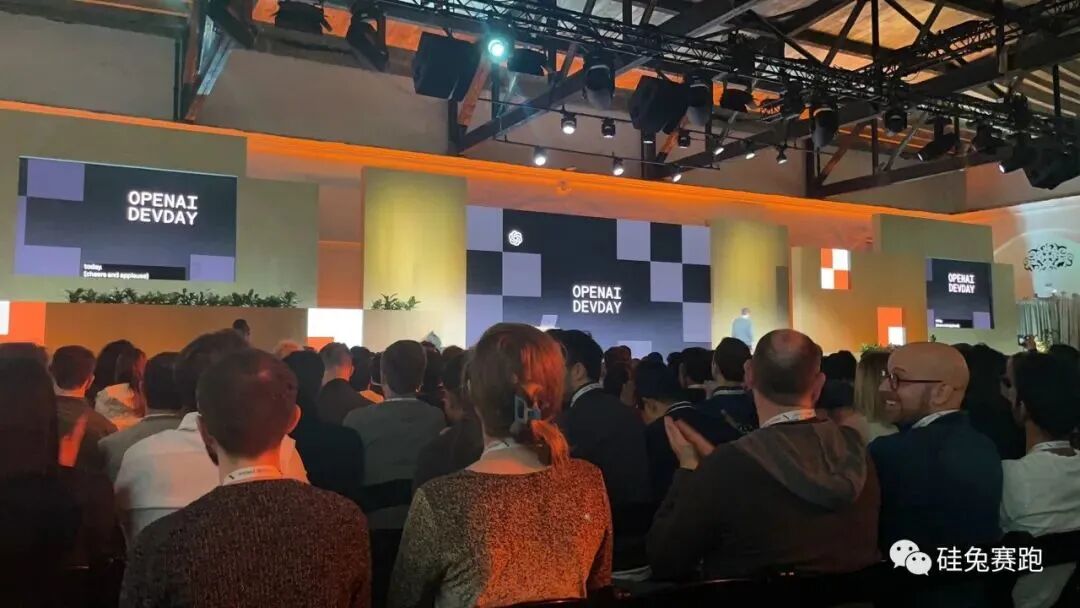
The developer conference aimed to encourage enterprises to use OpenAI's technology to build AI-powered chatbots and autonomous agents capable of executing tasks without human intervention. The OpenAI team also hoped to attract more developers to pay for access to OpenAI models and use them to build a new AI ecosystem. Ahead of the conference, Sam Altman said on X: "We'll be showing off some great new stuff."
01 GPT-4 Turbo Released
A Stronger Version of GPT-4
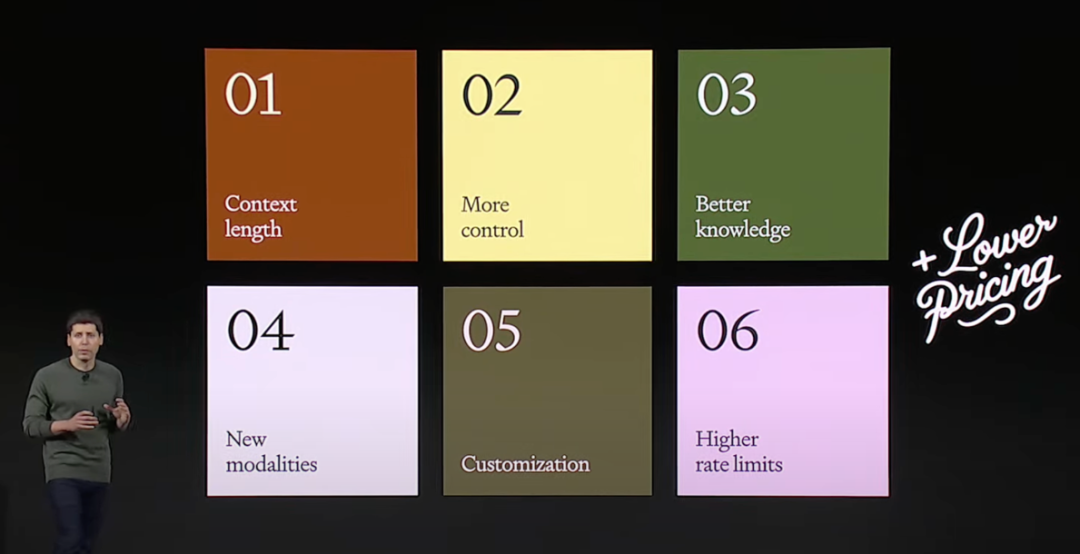
The Turbo version of GPT-4 has finally caught up to the present, as it was trained on internet data through April of this year.
Compared to the original GPT-4, which could only access data through September 2021, the Turbo version is far more current. It not only knows about the pandemic and economic turbulence the world has just experienced, but also understands the vast majority of world events through April of this year.
Moreover, GPT-4 Turbo offers a 128k context window, meaning it can process prompts equivalent to more than 300 pages of text in a single go (hard to imagine handling that many prompts without crashing).
Lower Prices
Compared to the original GPT-4, Turbo pricing has dropped significantly. Input tokens cost $0.01 — three times cheaper — while output tokens are $0.03, twice as cheap.
The Turbo version is available to all paid developers through the gpt-4-1106-preview API. OpenAI plans to release a stable, production-ready model in the coming weeks.
GPT-3.5 Updated in Tandem
OpenAI simultaneously updated GPT-3.5, releasing a Turbo version that supports a 16k context window by default. The new version features improved instruction following, JSON mode, and parallel function calling. Input and output token pricing for the new version are also three times and twice as cheap as the original, at $0.001 and $0.002 respectively.
More Like an App
Based on what was announced at the conference, the new GPT-4 Turbo looks more like a ChatGPT iOS app.
Compared to previous versions, the new interface adopts a minimalist black-and-white design. Users can add avatars, names, bios, and other personal information to their profile pages, and customize their start screen — placing greater emphasis on personalization.
Functionally, the new GPT can browse the web, analyze data, and generate images, with faster access to advanced modes for DALL-E, Data Analyst, and custom GPTs.
02 GPT Store Coming Soon
"Later this month, we're launching the GPT Store, featuring creations by verified builders. Once in the store, GPTs become searchable and may climb the leaderboards. We'll also spotlight the most useful and delightful GPTs we come across in categories like productivity, education, and 'just for fun.' In the coming months, you'll also be able to earn money based on how many people use your GPT."
In this section, Altman explained that custom GPTs can assist users in daily life, specific tasks, work, or at home — helping you learn the rules of any board game, teaching your kids math, training your writing, or designing stickers. These custom GPTs can also be shared with others.
Users can create their own GPT without writing any code. It's as simple as starting a conversation: just give the GPT instructions and new knowledge, then select what it can do — such as searching the web, making images, or analyzing data. Users can design it for private use, for internal company use, or for general public use.
OpenAI is now offering sample GPTs for ChatGPT Plus and ChatGPT Enterprise users to try, including AI image generation app Canva and AI automation integration Zapier AI Actions. OpenAI plans to roll out GPTs to more users soon.
For Enterprise GPT users, starting this Wednesday, you can create your own ChatGPT for specific customers, departments, or proprietary datasets.
Companies can authorize internal users to design code-free, internal-use-only GPTs and publish them securely to their workspace. The admin console lets you choose how these GPTs are shared and whether external GPTs are permitted for internal use.
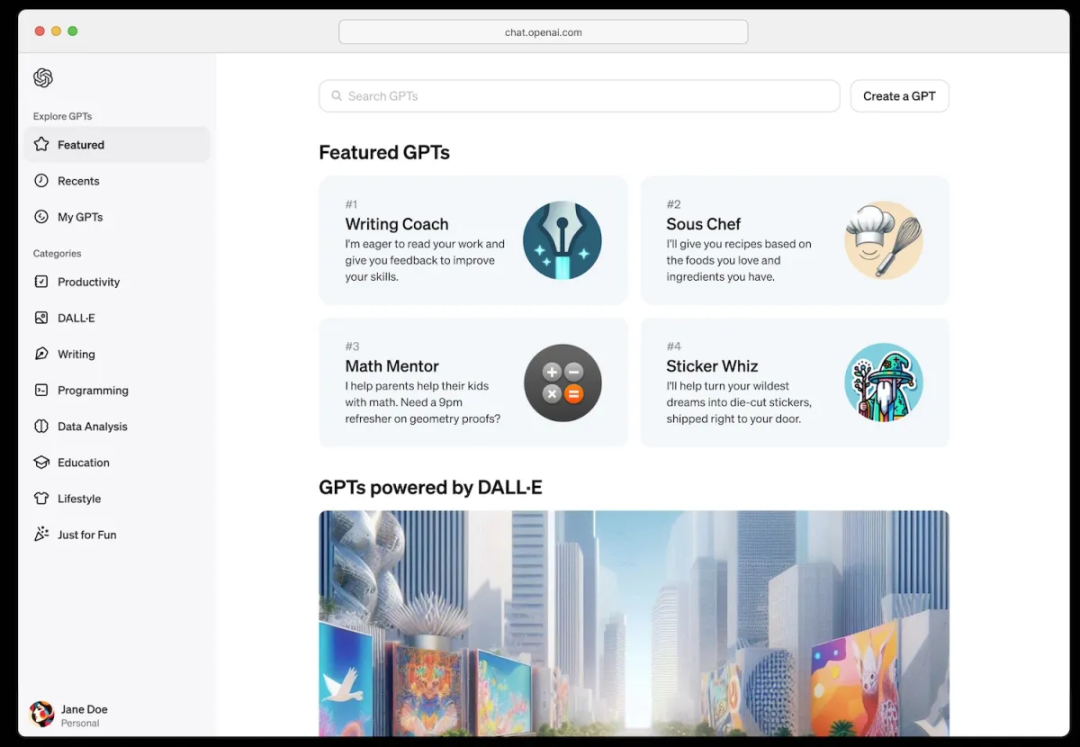
Once the App Store model proved itself as a lucrative revenue pool for Apple, it was hardly surprising that OpenAI would follow suit and attempt to replicate it. Going forward, various GPT models will not only be hosted and developed on the OpenAI platform, but also promoted and evaluated.
"We will pay people who build the most used and most useful GPTs with a portion of our revenue. We believe that if you give people better tools, they will do astonishing things."
This inclusivity and openness clearly align better with the diverse development of AI. Recognizing that "being the preferred platform for others' creativity is at least as valuable as having your own" reflects the magnanimity of a truly great company.
03 New GPT Draft
Can you build a GPT model without knowing how to code?
OpenAI says: no problem, you absolutely can.
Now you can simply chat with ChatGPT and describe what you want to create your desired GPT model.
"You can actually program GPT with language — it's this easy-to-customize behavior that lets them do what you want. That makes them very accessible and gives agency to everyone," Altman said.
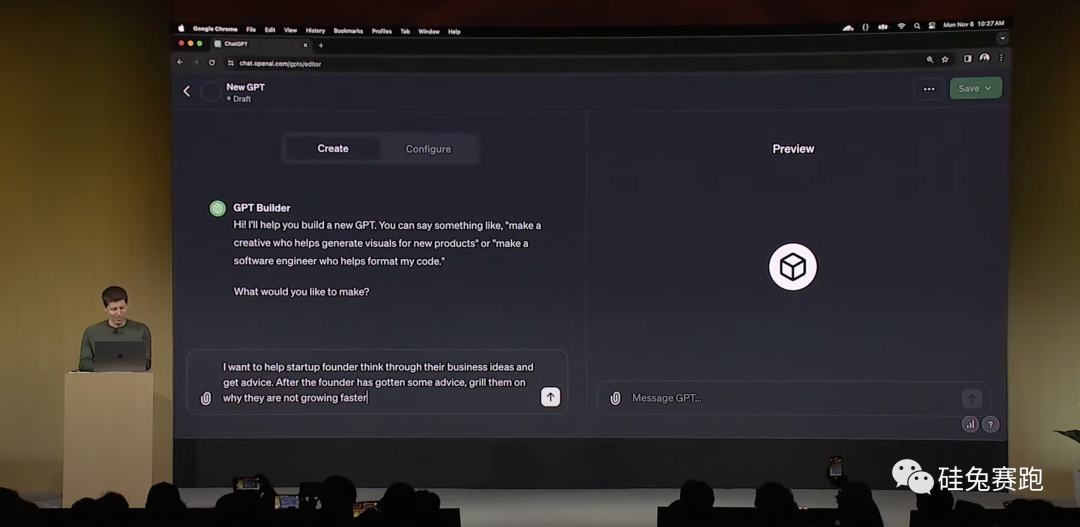
He gave a demo on stage. If you wanted to start a robotics company and asked GPT for a concise, constructive, immediately actionable plan, GPT quickly produced detailed recommendations based on these instructions. If you wanted to use GPT to improve your recipe, it would promptly tell you what ingredients you need to make a soup.
04 Comprehensive API Assistant
Application Programming Interface, abbreviated as API, is a computing interface that defines interactions between multiple software intermediaries, the types of calls or requests that can be made, how to make them, the data formats to use, conventions to follow, and so on.
According to OpenAI's official website, uploading a 750-word document currently costs $0.06 via GPT-4 and $0.003 via GPT-3.5 Turbo (calculated at maximum speed). The "memory-enabled" storage API released at this conference can improve large model computation speed and reduce developers' API calling costs by 95%.
OpenAI also released the purpose-built Assistants API, making it easier for developers to build their own assistive AI applications that can call models and tools to achieve their objectives.
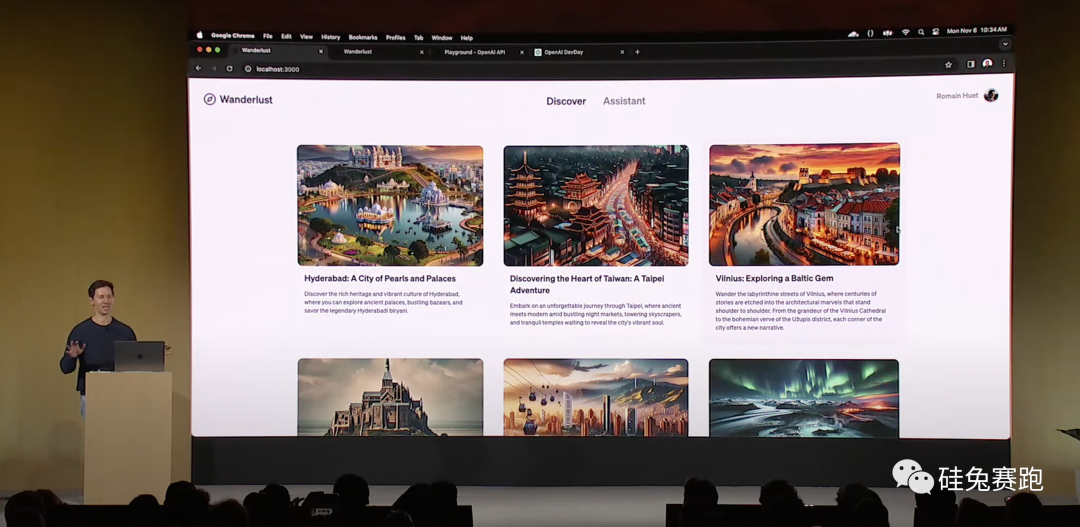
The Assistants API offers new capabilities including Code Interpreter, Retrieval, and Function Calling, handling much of the heavy lifting developers previously had to do themselves, enabling them to build high-quality AI applications.
OpenAI explains that this API is designed for flexibility, with use cases ranging from natural language-based data analysis apps, coding assistants, AI-powered vacation planners, voice-controlled DJs, to smart visual canvases. The features supporting the Assistants API are the same as those in the new GPT product: custom instructions and tools such as Code Interpreter, Retrieval, and Function Calling.
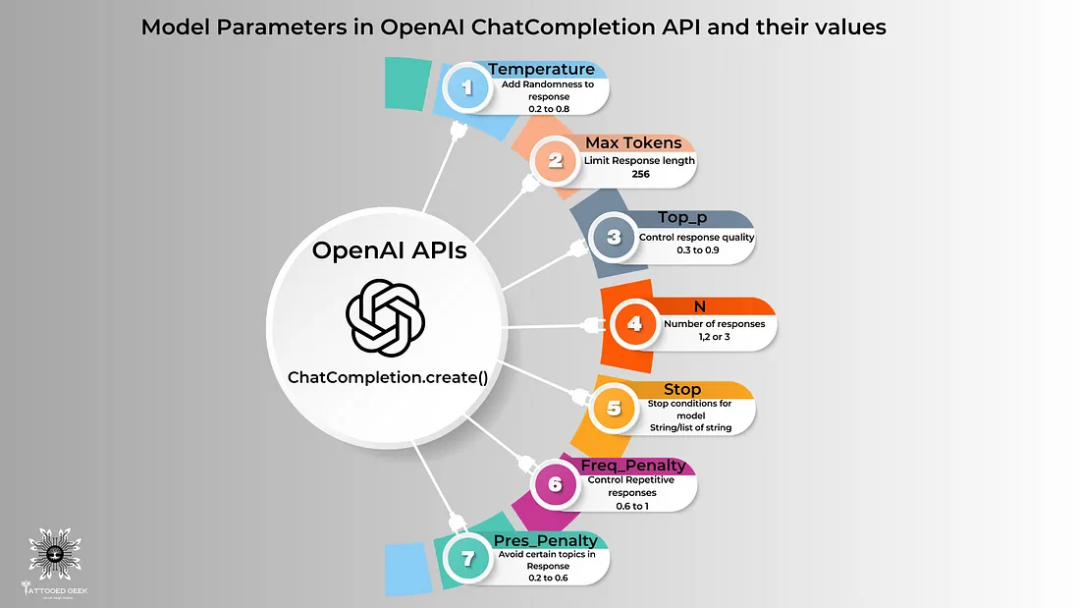
Image source: Medium
OpenAI stated that, as with the rest of its platform, data and files passed to the OpenAI API are never used to train their models, and developers can delete data whenever they see fit. Developers can try the Assistants API beta at the Assistants playground without writing any code: https://platform.openai.com/playground?mode=assistant
Starting today, the Assistants API beta is available to all developers. See pricing at: https://openai.com/pricing
05 Multimodal Interaction
The new version adds new multimodal capabilities, including vision, image creation (DALL·E 3), and text-to-speech (TTS). Turbo GPT-4 can accept images as input in the Chat Completions API, enabling use cases such as generating captions, detailed analysis of real-world images, and reading documents with graphics.
OpenAI plans to offer vision support for the main Turbo GPT-4 model. Vision input pricing depends on the size of the input image. For example, sending a 1080×1080 pixel image to Turbo costs $0.00765. For image creation, OpenAI offers different format and quality options, starting at $0.04 per generated image.
The main feature updates for the new GPT version available to paid users include:
- Multi-format file upload support
In the old version, users needed to use "Advanced Data Analysis" and similar features to upload PDF documents and extract information. In the new version, users can directly upload PDFs, data files, and other formats, with more file types potentially supported in the future.
- One-stop tool integration
GPT-4's different modes each have their own strengths and weaknesses. The multimodal mode can process text, images, audio, and other data types simultaneously, but only supports image uploads. The data analysis mode has strong data processing and analysis capabilities, but cannot access the internet in real time. The real-time internet mode and DALL-E do not support file uploads. In the old version, users had to manually select modes. In the new version, GPT-4 will automatically select and orchestrate multiple tools based on user needs, iterating toward an AI agent role.
For now, OpenAI has opened a potential path from defining the model layer to the product application layer through hardware layout. The AI hardware being developed by the OpenAI team alongside former Apple chief designer Jony Ive is likely to be smart glasses supporting GPT-4 or even GPT-5, though this places higher demands on end-device chips.
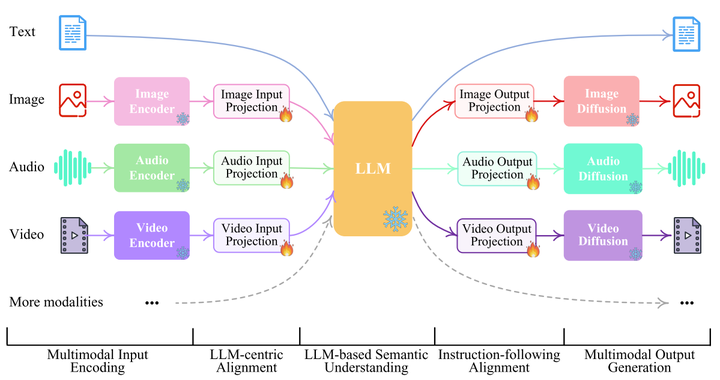
Image source: Zhihu
As is widely known, OpenAI has become a top-tier global AI leader. Its GPT series covers nearly 1.5 billion active users — roughly 20% of the world's population — and user growth continues.
Building on ChatGPT's near-human-level language understanding, it is now ready to iterate toward a more humanized level. The new GPT applications are expected to become the most successful products in artificial intelligence in the past decade.
Based on the outstanding performance of its latest GPT-4 product, OpenAI's valuation has risen steadily, tripling since the beginning of the year to over $90 billion, making it the world's third-highest-valued startup behind only SpaceX and ByteDance.
From its origins as a non-profit AI research organization created to compete with Google, to its transformation into a giant commercial company ranked in the top three by valuation, OpenAI must inevitably confront commercial competition and its own profitability requirements. A report from Analytics India Magazine stated that OpenAI spends approximately $700,000 per day just to run its AI service ChatGPT. From unicorn to super "money-guzzler," commercialization has become OpenAI's primary objective.
Technology liberates productivity; the more powerful the technology model, the more leverage it has to convert into commercial value.
The emergence of the OpenAI developer conference is not only inevitable at its current stage of development, but in the long term, also serves as a vehicle to push large models toward iterative evolution into AI agents and to build a new ecosystem centered on the ChatGPT large model.
The online developer conference lasted only 45 minutes, but its content was enough to send shockwaves through the AI industry. We can also see that OpenAI's ambitions are clearly high. Its decision to position itself as a platform independent of existing app stores and distribution methods did not come overnight. The next step in commercialization means directly challenging industry giants like Apple and even its long-time sponsor Microsoft.
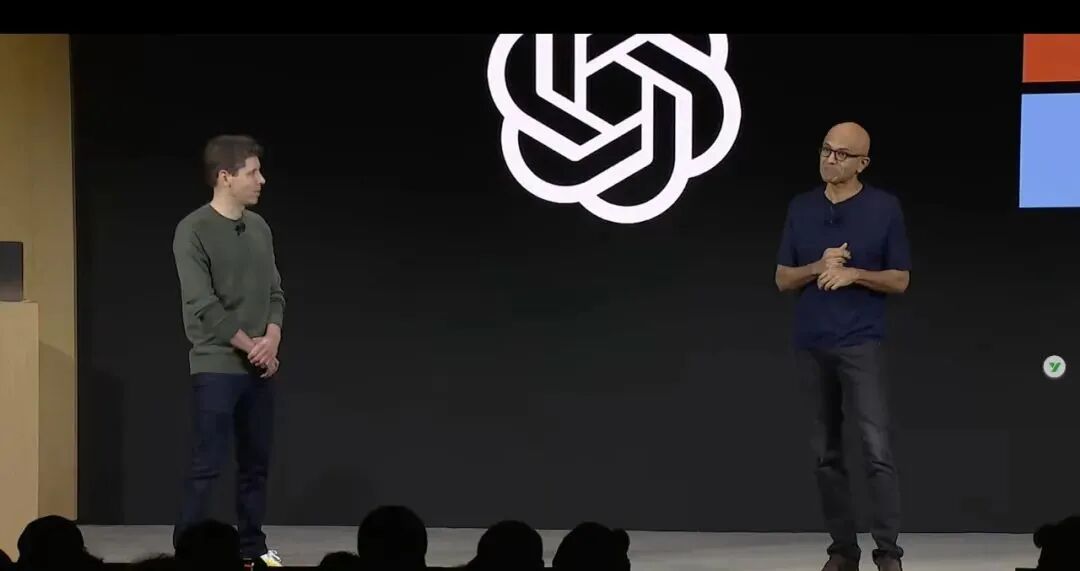
Microsoft CEO Satya Nadella made a brief appearance on stage at this conference. Microsoft is about to launch its own Copilot models, specifically for Office tools and similar tasks, suggesting GPT may be directly applied to these enterprise-level models.
Whether OpenAI remains Microsoft's ally in the future or becomes a potential competitor remains to be seen. But for the era, we need more enterprises with this kind of adventurous spirit.
Reference links:
-
App Store for AI: OpenAI's GPT Store lets you build (and monetize) your own GPT. (TechCrunch)
-
All the news from OpenAI's first developer conference. (The Verge)
-
#OpenAI DevDay, Opening Keynote. (YouTube)
-
#OpenAI