A 10,000-Word Deep Dive into Physical AI: Chinese Companies and the Global Arena at an Inflection Point | Yunqi Capital Pragmatists

Real Speed and Methodology from Entrepreneurs on the Front Lines
In 2025, as embodied intelligence increasingly breaks into the mainstream, discussions around Physical AI timelines, commercialization paths, and the global competitive landscape continue to intensify: How much longer until it truly lands? Is the model the hardest part, or the hardware and scenarios? When Chinese embodied intelligence companies go global, is cost their only advantage?
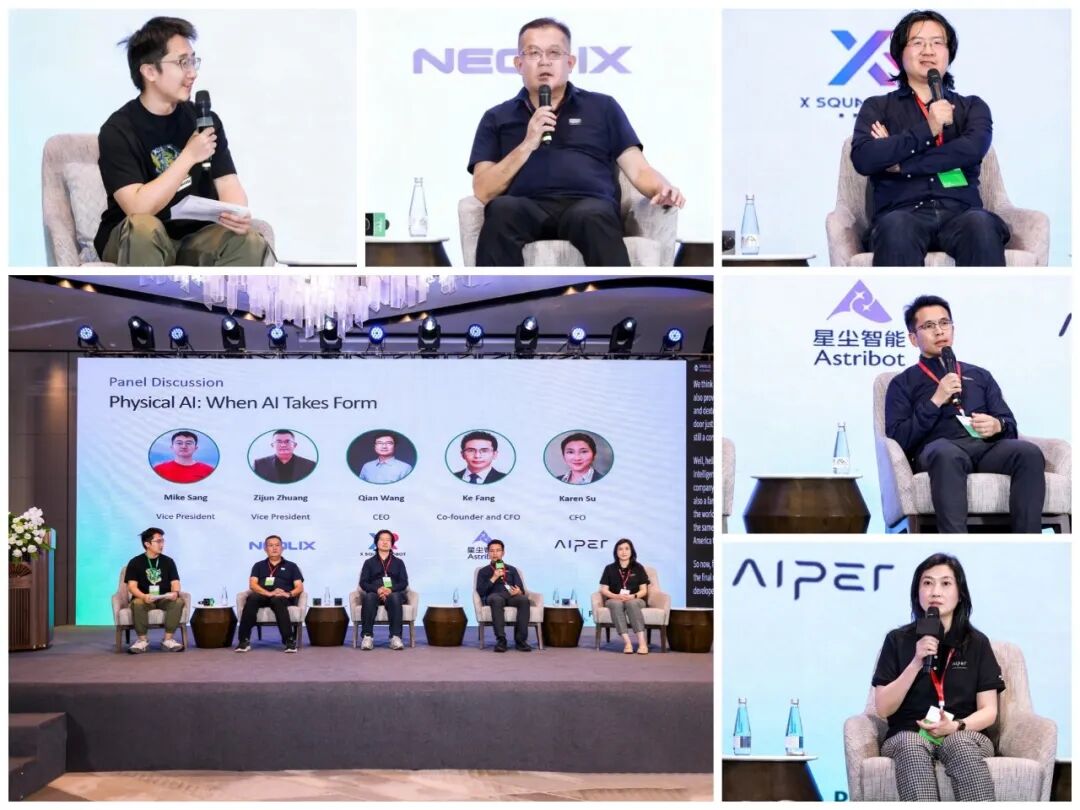
Recently, at Yunqi Capital's 2025 USD Fund Partner Annual Meeting, several portfolio companies at different development stages in the Physical AI space exchanged views on these questions. From Neolix's autonomous delivery vehicles, deployed across 15 countries with over 13,000 RoboVans, to Ziliangliang Robotics, which builds both embodied foundation models and general-purpose hardware; from Astribot, the world's first company to mass-produce cable-driven AI robots, to Aiper, the global leader in wireless pool robot shipments.
Through this collision of perspectives, we aim to address one question: When Physical AI truly arrives before us, is China's innovative force ready?
Before the formal discussion, each guest introduced what they do in one sentence.
Neolix Vice President Zhuang Zijun opened with a set of numbers:
"Neolix is a global leader in L4 autonomous driving vehicles. We've entered 15 countries worldwide and deployed over 13,000 vehicles, and will continue expanding our unmanned logistics services globally."
Ziliangliang Robotics Founder & CEO Wang Qian approached from the angles of "models" and "integrated hardware-software solutions":
"On one hand, Ziliangliang builds embodied intelligence foundation models, including VLA, world models, and more. On the other hand, we provide integrated hardware-software solutions, including complete robot bodies and dexterous hands. Essentially, we're an AI and robotics model company."
Astribot Co-founder & CFO Fang Ke emphasized "cable-driven AI robots":
"We're in the same space as Ziliangliang, also working on embodied intelligence. Our distinction is being the world's first company to mass-produce cable-driven AI robots — from hardware bodies, to middle-layer teleoperation systems, to upper-layer VLA and world models, entirely self-developed."
Aiper CFO Karen Su切入 from "consumer-scale":
"Aiper is the world's leading company in wireless pool robot shipments. We lead in both product price segments and omnichannel coverage, with projected global shipments exceeding 1 million units in 2025. Going forward, we'll deepen applications in pool and yard scenarios."
01 Opportunities Each Track Sees: When Physical AI Arrives

Sang Yu | Yunqi Capital Investor
Today we deliberately selected portfolio companies at different life cycles and stages, hoping to explore key business and strategic questions across technology breakthroughs, scenario selection, and commercial closed loops.
First, I'd like to ask Wang Qian of Ziliangliang. You're one of the few domestic embodied intelligence companies that can open-source foundation models and achieve leading breakthroughs, while also building robot hardware. On the direction of technological breakthroughs, one question everyone focuses on is: how much longer until Physical AI truly lands? I'd also like you to combine this with your company's recent R&D progress to discuss what transformation and breakthroughs you see Physical AI undergoing.

Wang Qian | Ziliangliang Robotics Founder & CEO
Honestly, over the past year, although Physical AI seems to have made limited progress in academic papers and actual deployment, the industry has at least reached some consensus on several important questions — which is a good foundation.
First, there's now a relatively clear view on Physical AI's scaling law. Of course, Ziliangliang had a relatively clear judgment nearly two years ago. Recently, everyone probably knows that Generalist published their exploration results on scaling law, which matches very closely with our own internal estimates. Today, there's general agreement on this view: that building embodied foundation models is the right thing to do.
Going further, beyond scaling law, as I just mentioned, Ziliangliang's model is a foundation model encompassing VLA, world model, and all other capabilities. Our approach today is to put all functions — controlling robot actions, video generation for future prediction, 3D construction, etc. — into a single model. This is the direction for future evolution of embodied foundation models. We've now very clearly obtained some results and answers, and the results are quite good.
Regarding when embodied intelligence can land — Sang Yu just asked this — we now have a basic methodological starting point, with scaling law predictions and inferences, so we can do a linear extrapolation.
Our current judgment is that today's state is probably analogous to where language models were in 2019. Extrapolating linearly, at that time there was GPT-2, followed by GPT-3, 3.5, or what became ChatGPT. Based on current estimates for data and model scale expansion and their capabilities, there's a high probability that in roughly three years, we'll see an embodied foundation model analogous to that intermediate stage between GPT-3 and ChatGPT.
So today, people can at least reach some consensus, which I think is quite good. A year ago, or even six months ago, many people would say "won't embodied intelligence commercialization take seven or eight years, or a decade?" I said definitely not. Of course, at that time no one had published specific scaling law parameters, so it was hard for us to say directly. But today, people are more optimistic about embodied intelligence commercialization.
What I just mentioned is landing at the embodied foundation model level. For single-point commercialization, you don't need to wait nearly that long. In fact, language models started doing single-point commercialization even at the GPT-1, GPT-2 stage. Embodied intelligence and language models differ significantly here, because most language tasks still require the ability to generalize, to have high-level intelligence.
But in the embodied domain, in the scenarios where robots can be applied, many scenarios are actually very simple. From a human perspective, in very single, repetitive labor or tasks, there's a high probability that next year we'll see commercialization scenarios with positive ROI.
I may be speaking somewhat directly here. Because what people see today claiming to be embodied intelligence generally doesn't have positive ROI — it's basically still providing emotional value or brand value to the public. But this inflection point really isn't far away, most likely it's next year.
02 From Hardware, Data to Model Validation: The Realistic Path to Commercialization
From Cable-Driven Hardware to Remote Teleoperation: Getting Customers to "Pay for Data"
Sang Yu | Yunqi Capital Investor
The discussion just now shows us that technological progress is promising, but as technology advances, we also need to consider how products balance with technology iteration. Next, I'd like to ask Fang Ke of Astribot. Astribot was also relatively early in launching differentiated robot hardware products. How do you balance product design with technology iteration? And how do you advance solid commercialization in the embodied intelligence industry?

Fang Ke | Astribot Co-founder & CFO
Actually, I very much agree with one point Wang Qian just made — the arrival of embodied intelligence commercialization is actually much, much faster than imagined. Last year, the industry generally believed that true embodied intelligence landing might still need two to three years, but by this year, we clearly see: the commercialization pace has already far exceeded our original expectations as industry insiders.
I'll add two points. First, the core of embodied intelligence is hardware-software synergy, and hardware is the non-negotiable foundation. This is why we've long invested substantial resources in researching cable-driven technology. The essence of embodied intelligence is a machine that can execute tasks in the physical world; hardware is equivalent to its "body," the ultimate carrier for all software capabilities. Software breakthroughs often occur as exponential leaps at certain points, but hardware maturation is more like autonomous driving之于汽车 — it requires long-term, systematic refinement.
Second, cable-driven is our judgment for the form most suitable for human-robot interaction and most ready to enter homes. Cable-driven has inherent safety at the底层, and in performance simultaneously possesses high flexibility, high dynamic response, and high biomimetic characteristics. Because force transmission efficiency is high, it can generate continuous, rich data for AI, enabling software to better learn about the world. The founding team has been deeply refining this core technology from their time at Tencent until now.
Notably, two weeks ago, 1X — a company backed by OpenAI — launched its new home product to global attention, prompting many in the industry to take fresh notice of us. The reason is simple: cable-driven is currently the robotic form closest to human movement, the safest, and the most promising to enter home environments first. This aligns closely with our long-standing technical conviction.
On the hardware front, we became the first in the industry to achieve cable-driven mass production this June, gradually beginning shipments. We've fully cleared the path from zero to hundreds in production volume. This puts us at least one cycle ahead of 1X, which is scheduled to ship next year. We're currently building a production line with annual capacity of 4,000 units, and by year-end we'll iterate to a new product generation with exponentially lower costs. Let me give a sneak peek: the price will be extremely competitive. Next year, we expect to produce 2,000 robots. With hardware now unblocked, we want robots to reach people faster, moving cable-driven technology from relatively niche to mainstream and better penetrating homes.
From a commercialization standpoint, any product ultimately reaching market is fundamentally driven by the combination of improved hardware performance, reduced costs, and enhanced functional capabilities — together achieving true PMF. For us, current commercialization can reference two stages of autonomous driving: L2 and L4.
The L2 stage corresponds to embodied intelligence's operational viability in real-world scenarios. In relatively standardized applications with lower generalization requirements, we've begun pushing AI model capabilities into deployment, enabling robots to demonstrate functional efficiency value and emotional value in the physical world.
Take our partnership with Jinma Entertainment as an example. Jinma Entertainment is the first listed company in China's amusement equipment sector and has long held exclusive service relationships with international park systems like Disney and Universal Studios, possessing deep industry know-how. We're jointly developing unmanned retail products and have already deployed them in Guangdong amusement park scenes. The robot can autonomously sell Coca-Cola, popcorn, and other goods on-site while interacting with visitors. Going forward, we can combine IP imagery with cultural creative merchandise, IP trendy toys like WAKUKU, and other derivatives to create new consumption experiences. We believe applications like these will let the public more directly feel robots' real efficiency value "beyond emotional value."
Meanwhile, AI deployment depends not only on algorithmic capabilities (such as improvements brought by scaling laws) but is even more constrained by the scarcity of real-world data. Unlike the internet, high-quality data from the physical world is difficult to obtain and costly. This has become a core challenge the industry has broadly faced over the past six months. To address this, we're exploring an entirely new path: in highly generalized scenarios, through remote teleoperation, having robots execute tasks and complete data collection globally.
Significant labor cost differences exist between regions today. For instance, labor costs in some Western countries are relatively high, while many developing countries are markedly lower — perhaps a gap between $5,000 and 3,000 RMB per month. If personnel in low-cost regions can remotely operate robots deployed in high-cost regions, this will create commercial value from labor cost arbitrage while enabling large-scale, high-quality data collection. Once this chain is fully unblocked, robot deployment speed in real scenarios will accelerate markedly, and data growth will become more sustainable.
When discussing robot data, we want to push the path where "customers buy robots and naturally generate the real data AI needs during use," rather than reflexively saying "let's build a thousand-unit or several-thousand-unit data training ground" and relying on large enclosed training facilities for data collection — the latter is extremely costly and not a real environment. Therefore, we insist on driving a data generation system powered by real commercial scenarios, using business to feed back into AI performance.
This technical chain is already running. We've achieved remote operation spanning three to four thousand kilometers, for example from developing countries to Europe and North America, and from domestic cities to Shenzhen for ultra-long-distance operation. The system performs stably in real-time and synchronization, with latency controllable within approximately 40 milliseconds. Robots can undertake high-frequency logistics picking, hotel services, and other tasks.
Going forward, we plan to first achieve scaled deployment in B-end scenarios such as logistics, hotel operations, and commercial services, then gradually enter home scenarios after accumulating data and stabilizing performance. In this process, robots may always serve as a fallback solution. As AI model capabilities continuously improve, we'll move from initially "80% AI + 20% teleoperation" to gradually "90% AI + 10% teleoperation," and ultimately perhaps "99.99% AI + 0.01% teleoperation."
We believe this is a sustainable path that can truly enable robots to land in highly generalized scenarios. POCs in multiple scenarios have already launched, with relevant technical validation completed. As hardware costs further decline, AI capabilities improve, and the remote teleoperation system matures, we're confident we'll see more scaled deployment in real scenarios next year.
Beyond Ten Thousand RoboVans: Redesigning Logistics Operations
Sang Yu | Yunqi Capital
The next question goes to Neolix's Mr. Zhuang. With technology and a well-defined product model in place, the next step is making the business work. Neolix has reached an inflection point of business model validation and explosive growth this past year, also setting a new record for the largest single round of autonomous driving funding. In the past year, what explorations did Neolix go through in validating its business model? What experiences and lessons can you share? And what new thinking do you have about defining future business models?

Zhuang Zijun | VP, Neolix
Business model has been accumulating at Neolix for a long time. From founding in 2018 with unmanned vehicles locked into logistics, through to 2025 achieving the long-awaited breakthrough of ten thousand units, one thing that has remained important throughout the business model is logistics — we emphasize overall cost reduction.
On September 23 this year, Neolix's ten-thousand-unit business model breakthrough was based on existing scheduled logistics. But simultaneously, this year we also partnered with DiDi to launch on-demand logistics in Qingdao. From the initial 100 units to now 1,200 units, this on-demand logistics partnership has become the world's largest in scale.
From a delivery capability perspective, we delivered about 3,000 units last year. This year, so far, we've already delivered over 13,000 vehicles, and may exceed 15,000 by year-end. This is several-fold growth. So we've gone through different changes throughout this process.
Unmanned vehicles solve the problem of moving on roads, of driving — the two ends of unmanned vehicles can't form loading and unloading. In this process, how do you increase delivery station owners' willingness to use the vehicles? What's important is changing the entire operating model. Previously, users needed to find drivers to do station delivery runs; now with unmanned vehicles, they just load goods at the hub and deliver to the station, where station staff unload. In this model, delivery personnel are freed up to explore more business opportunities. So when unmanned vehicles make the original operating model more efficient, users can put them to work.
This model also came from Neolix's continuous discussion with the express delivery industry during operations. Take the SF Express model: to get packages to customers faster, we developed the "back-cage vehicle" (Neolix X3 container vehicle). With the "back-cage vehicle," both ends can be unmanned — it can drop off express at company entrances at night, unload the cage, and go. This business model makes Neolix profitable, with lower production costs and more significant scale effects.
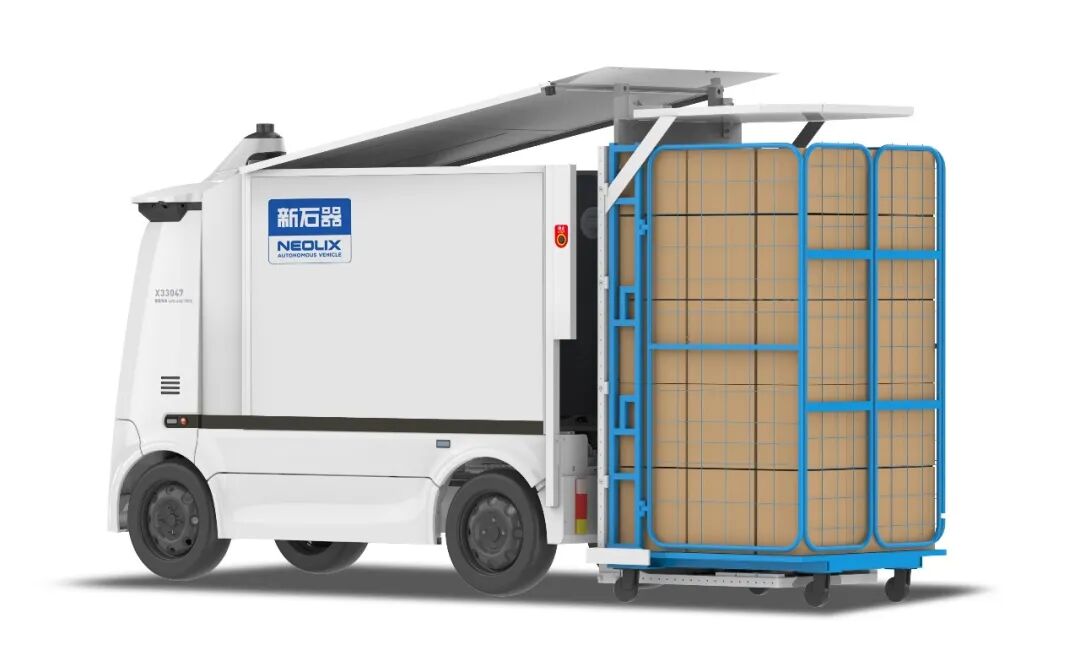
Diagram of the "back-cage vehicle" (Neolix X3 container vehicle)
China's Embodied Intelligence: Structural Advantages and Future Opportunities
Facing Global Markets
From Pool to Backyard: A Consumer Robotics Company's Globalization Exercise
Sang Yu | Yunqi Capital
Next I'll pass the question to Aiper's Karen. After validating a business model in China, the next step for robotics companies is internationalization, going global. On this topic, Aiper is unquestionably a standout. I'd like to ask you to share experiences and explorations in business model and globalization directions.

Karen Su | CFO, Aiper
Our annual market scale and market share are already industry-leading, so from a commercialization perspective, what we focus more on is how to expand market share more broadly on a global scale, replicating Aiper's accumulated capabilities across different scenarios. So internally we now have a "6 + 2" strategy, representing six capability quadrants.
First is product R&D capability. Because over the past four years, we've had product upgrades every year. From a product R&D perspective, based on real customer needs, we land smart technology applications on an annual technology iteration cycle.
Second is global brand power. Pool products' main application scenarios are in North America, Europe, Australia, and some larger markets in South America. In terms of global brand influence, we've already achieved industry-leading levels.
Third is global channel capability. For Chinese companies going overseas, there are several major channels that matter. The first is Amazon and your own direct-to-consumer website — I believe most Chinese companies already have experience with these. Two other channels are particularly important for our industry. One is offline KA (key account) retail, which everyone is familiar with: Walmart, Costco, MediaMarkt in Europe. These channels take time to build. After three to four years of strategic investment, Aiper has made solid progress here. The hardest and highest-barrier channel is the pool professional channel. This year, we actually entered the world's largest, as well as Europe's and North America's two largest professional channels.
Then there's global supply chain capability, which is also a critical condition for partnering with major KAs and professional channels. Beyond China, our supply chain has expanded to Southeast Asia, and will further extend to countries in the Americas.
We also have global service capability — how to deliver and provide service. We've already accumulated more than 3 million users.
Data and AI applications are also important parts of our overall capability matrix. So beyond scaling and commercialization, beyond these six capabilities, we believe there are two additional dimensions where we need to add:
First is global capitalization capability. We spent a year on capital cooperation and strategic integration with a top-tier comprehensive player in the pool industry. Once this is completed, beyond the channel competitive landscape, Aiper will have more certainty and better odds of success on its future capitalization path.
Second is global organizational capability. Aiper's organization isn't just based in China — we also have employees on the ground in Europe, North America, Australia, Hong Kong, and Singapore. So beyond operational capability, global capitalization and global organizational capabilities are also critical supports for the company to further scale and win in global competition.
Chinese Robot Companies' Underlying Advantages: Supply Chain, Talent, and Data
Sang Yu | Yunqi Capital
I'd like to use this to kick off our second round of discussion: What underlying competitive advantages do Chinese robot companies have in their globalization process? What globalization strategies do each of you have?
Zhuang Zijun | VP, Neolix
I think one very important point is the strong new energy supply chain. Additionally, automotive-grade capabilities like radar and cameras are very well established in China, so Neolix has no worries about taking our mass-produced vehicles abroad. At the same time, China has clear scenario advantages. Over the past few years of development — from opening road rights in 2021 to expanding from planned logistics to on-demand logistics this year — Neolix has distilled this entire model. Going forward, we can combine this model with our vehicles and replicate it overseas. This is an important cornerstone for our subsequent international expansion.
Wang Qian | Founder & CEO, Autonomous Variables Robotics
I'll focus more on AI and models. At least this year, nobody is still saying China's talent density is inferior to America's. Last year people were still saying that about large models — that China's talent density couldn't match America's. This year, nobody seems to be saying that anymore.
Looking at the actual models produced, Chinese companies really aren't any worse than American companies, and in many ways actually do better. The bigger issue is probably compute. Embodied intelligence is precisely a field that doesn't require massive amounts of GPUs. In this field, the obstacle to scaling up isn't primarily compute — it's mainly data. This happens to be one of China's advantages.
Hardware is the familiar story. China has strong comparative advantages here. Anyone who has worked on robots today can definitely feel that model progress and iteration depend to a great extent on the support of fast, agile hardware supply chains. So embodied intelligence models are different from pure language models. In terms of comparative advantage, China is definitely the best place in the world.
Jensen Huang himself said that the Shenzhen Bay Area should be where hardware and software are most tightly integrated. That's definitely the right assessment. From day one, our company's goal has been to become the world's leading company. I believe Chinese companies definitely have this kind of advantage in the embodied intelligence field. The core points are the talent density and model level I just mentioned — right now we're at least on the same level as the US, and have even surpassed them in many areas. We're advantaged on scale-up data, and advantaged on hardware. We have no reason not to achieve world-leading status.
From a technical perspective, Autonomous Variables has been a global company from day one, and we're definitely aiming for first place in embodied intelligence.
Fang Ke | Co-founder & CFO, Astribot
We've felt this most acutely in supply chain and data.
First, supply chain. Taking the cable-driven track as an example: when we started the company at the end of 2022, we knew that 1X and a Korean research institute were working on cable-driven technology. In a sense, there were only three players globally in cable-driven at that time. Looking at this year: the Korean research institute didn't commercialize, 1X just released its new product with mass production expected next year, while we've already been in mass production and continuous shipment — a full year ahead of them.
The cost difference is even more stark. Our robot has more than twenty joints, and the cost of the motors alone was driven down to one-tenth of the original by multiple suppliers within a single year. This kind of supply chain efficiency is a uniquely Chinese structural advantage, similar to the new energy vehicle industry path: when overseas markets are just getting started, Chinese companies can already enter at highly competitive costs and rapidly achieve scale.
On international business, we've already entered the North American market. Overall, our product prices are roughly one-third to one-half of local companies', and combined with our more scalable technical solution, this allows us to truly penetrate overseas markets across multiple vertical scenarios. So we believe the embodied intelligence field can completely replicate the globalization path of new energy vehicles, and potentially do so at even greater scale and breadth.
The second underlying advantage comes from data. China not only naturally has rich application scenarios, but also extremely high scenario diversity, covering everything from industrial to commercial to consumer-grade tasks. In the remote teleoperation model we're pushing, robots can run continuously in real business operations, forming a "large-scale distributed data collection system." This system, from B-end to commercial scenarios to future C-end, will continuously accumulate high-quality long-tail data.
More importantly, Chinese supply chain companies, robot OEMs, robotics companies, and end users all have high willingness to participate and high tolerance for trial-and-error speed. This means data is not just large in scale, but also fast to update, diverse in type, and high in density — a uniquely differentiated advantage globally for AI model iteration.
Karen Su | Aiper CFO
I think the answers to this question should have a lot in common. Our own feeling is the same: the ability and speed of product technology iteration, as well as supply chain efficiency, should be very important reasons why our cohort of companies can gain first-mover advantages in competition after going out, and sustain those advantages.
From a technology perspective, we now hope that while technology empowers the product itself, it also empowers internal efficiency improvement and the accuracy and effectiveness of decision-making — applying AI technology to data analysis and decision support. At the same time, on the talent dimension, we also hope to find industry-leading talent in various fields to work alongside us.
04 Opportunities Each Track Sees
When Physical AI Arrives
Sang Yu | Yunqi Capital
Finally, please each use one sentence to look ahead: When physical AI truly arrives, what important opportunities will it bring to each of your respective tracks?
Zhuang Zijun | VP, Neolix
I think the biggest future opportunity is global unmanned logistics capacity for autonomous vehicles. The RoboVan track is definitely a very good niche market.
Wang Qian | Founder & CEO, Autonomous Variables Robotics
My sentence is: "What we face may not be a singularity of intelligence, but a singularity of the physical."
I’ll need a bit more time to unpack this. The old assumption about the singularity was that once a really smart AGI was invented, it would invent an even smarter AGI, leaving humans far behind. What we’re seeing today is that the logic doesn’t quite work that way. Building a really smart AGI or ASI (Artificial Superintelligence) actually requires more physical-world resources — more compute, more power, more data. These aren’t problems that a really smart AGI can solve on its own. They’re problems that embodied intelligence can solve.
From the First Industrial Revolution to today, every major technological transformation has replaced linear productivity growth with exponential productivity growth. The classic example: the very concept of a "machine" started with the steam engine, and the most recent industrial revolution gave us Moore’s Law. The real key to breaking free from linear productivity is to replace human physical labor as extensively as possible in the physical world. Embodied intelligence is the final piece of that puzzle. Once true embodied intelligence is achieved, everything should develop exponentially, just as we went from the early steam engine to today’s chips following Moore’s Law.
So this isn’t just about building an ASI that genuinely surpasses human capability. It’s also the most basic prerequisite for everything to move toward a true realm of freedom, toward the stars and the seas. Yet right now, the potential and applications of embodied intelligence are generally underestimated, while the potential and applications of language models in the virtual world are somewhat overestimated.
Fang Ke | Co-founder & CFO, Astribot
We’ve always believed that the interface between humans and embodied intelligence won’t remain confined to phones or computers in the long run. The most natural and efficient interface will be the robot itself. So from our perspective, robots will become the primary vehicle through which AGI reaches every individual user — this is the inevitable direction of embodied intelligence.
Going back to when we started the company, our vision was to get robots into millions of households, becoming a super-assistant for billions of people. Frankly, at the time this goal felt more like an ideal. But after two years of deep engagement in the industry, we’re increasingly seeing that this might be closer than we imagined.
Of course, "closer" doesn’t mean robots will match human-level intelligence in the near term, or that they’ll be able to handle every task in a home environment. Our read is that this will start from a clear, realistic, and scalable entry point, and robots will gradually make their way into your life.
This entry point comes from two shifts: first, costs are falling fast. When a high-performance robot can enter the home at a five-figure RMB price point, it already delivers real value.
Second, the way humans interact with robots is being redefined. Whether it’s teleoperation technology, or the new platform we’re building that lets people "play with" robots, both are lowering the barrier to engaging with robots. Similar to how 3D printing spread from the geek community to a much broader user base, we estimate that next year we’ll see the emergence of a cohort of "home robot hobbyists" who will actually start using and exploring robots in their own homes.
Once people begin "playing with" robots in their own domestic environments, questions around home data, privacy boundaries, and human-robot interaction patterns will keep getting clarified in real-world scenarios, building user trust and dependence. From early adopter communities to broader user diffusion, this will become the real breakthrough for robots entering the home.
And once that entry point is opened, robots moving into daily life will no longer be a distant vision, but a sustainable, progressively realizable path.
Karen Su | CFO, Aiper
Our vision for Physical AI applications is to evolve from a leading pool company to a leading company in the yard scenario overall.
Sang Yu | Investor, Yunqi Capital
Thank you all for the wonderful sharing. Yunqi Capital hopes to accompany everyone in witnessing these bold visions become reality.