RebyteAI: Lobsters Don't Need to Be Farmed Forever | Yunqi Capital

No need to be a permanent resident, and more than one.
The OpenClaw buzz has reached NVIDIA GTC.
In this year's GTC keynote, Jensen Huang defined the Agent as "a new form of computer." Last week in "Yunqi Capital Portfolio: Catching Shrimp", we also saw more and more portfolio companies starting to explore real-world Agent deployment scenarios built on OpenClaw.
But if every lobster requires a 7×24 online environment — high cost, low utilization — this will never truly scale.
Yunqi Capital early-stage portfolio company Rebyte offers one solution: make Agents run Serverless — wake on call, stop when done, pay only when working.
This means you're no longer "keeping a lobster online all the time," but calling on capability units that exist only when you need them. In this edition of "Yunqi Capital Portfolio," we share Rebyte's work in this direction.
The following content is republished from RebyteAI
Have you ever thought that raising an AI robot is like raising a lobster?
AI Agents are hot right now. Claude, ChatGPT, Gemini... all kinds of AI now have "memory" and can do continuous work for you. So many people start thinking: can I raise an AI that's exclusively mine, always online, ready to help anytime?
Great idea. But you'll quickly run into a practical problem —
To raise a lobster, you first need a fish tank
The traditional approach goes like this: you find a machine (local computer or cloud server), deploy the AI on it, and let it run 7×24.
Sounds reasonable, but in practice:
Local machine? Your laptop can't stay on forever. Close the lid, lose the connection, and your lobster goes offline.
Cloud server? Then you're paying monthly. A decent server runs hundreds to thousands of RMB per month. The problem is, this server runs 24 hours, but you might only chat with it for 10 minutes a day. The other 23 hours and 50 minutes, it's idling — burning electricity, burning compute, burning money.
More critically: one server usually runs only one lobster. Want more? Sorry, spin up more servers, costs double.
It's like buying a massive fish tank with 24-hour water circulation, heating, and aeration — just to raise one lobster that mostly sleeps.
Our lobster is different
Rebyte's lobster is On-demand — start when needed, rest when done.
Here's how it works:
You send a message to your lobster on Telegram (or Lark, Slack, WhatsApp).
The message reaches Rebyte's relay layer. Relay finds the lobster sleeping, so it wakes it up.
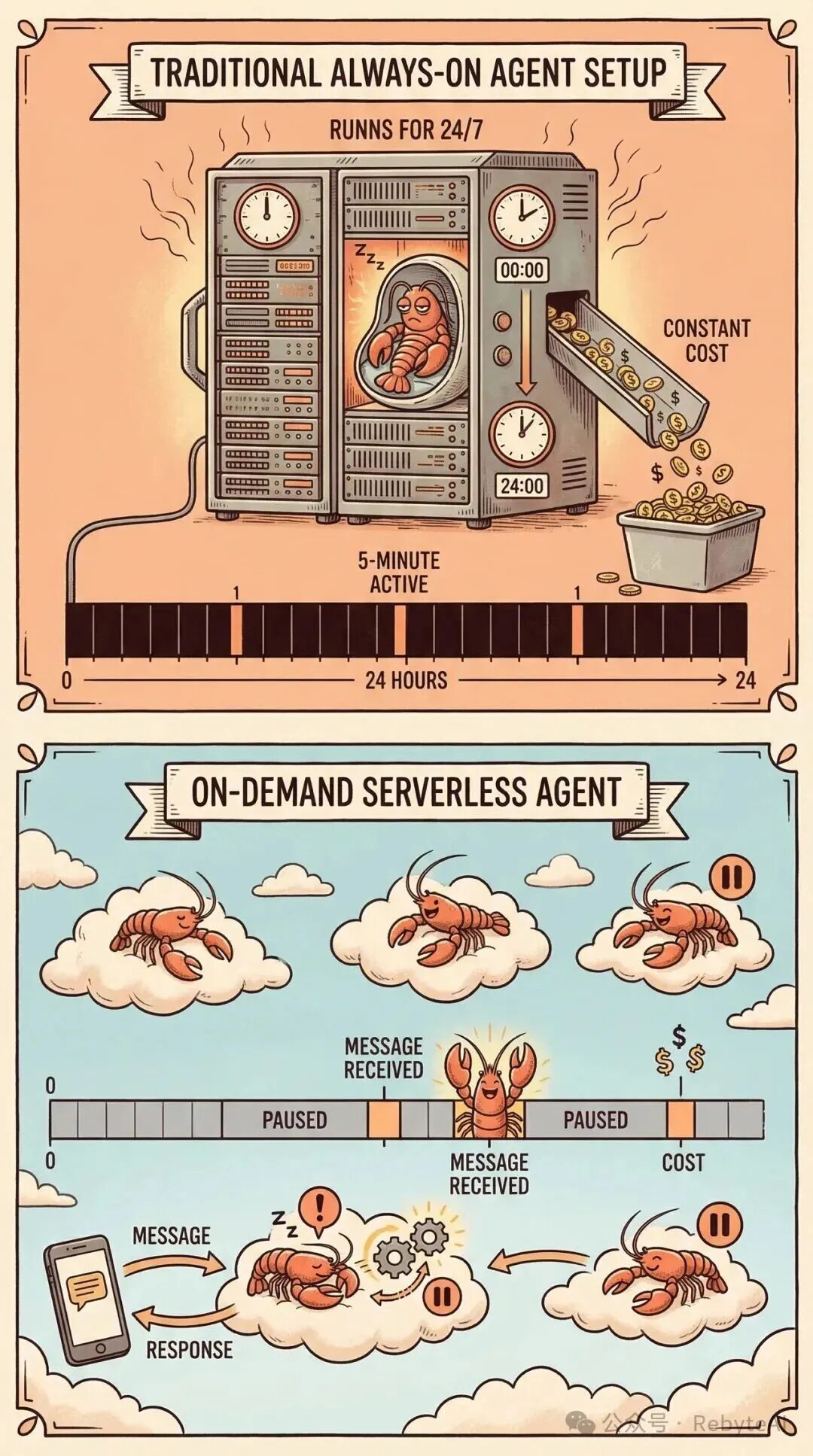
The lobster wakes up, processes your message, replies.
You stop talking. After 10 minutes, the lobster automatically hibernates.
During hibernation, zero compute charges.
No 7×24 server idling. No fixed monthly bill. The lobster only lives when you need it.
Technically, each lobster lives in an independent cloud VM. This VM supports automatic pause and resume — when paused, only disk state is preserved, no CPU or memory consumed. When a new message arrives, the VM resumes in seconds, and the lobster picks up from its previous memory to continue working.
So, you can raise a whole colony
This is where it gets really interesting.
Because each lobster costs almost nothing while hibernating, you can keep many in the cloud simultaneously, each specializing in one task:
🦞 One to organize your reading notes. Throw in your Kindle highlights, reflections, excerpts anytime — it categorizes, summarizes, generates thematic indexes for you.
🦞 One to manage your personal knowledge base. Papers, articles, podcast notes — it digests, summarizes, builds connections.
🦞 One to watch your stocks. Plug in market data, get a daily analysis brief.
🦞 One to write your weekly reports. Tell it what you did this week in fragments; on Friday it generates a properly formatted report.
🦞 One dedicated to making podcasts. Feed it a script, it generates voice and packages it into publishable audio.

These lobsters don't interfere with each other. Each has its own memory, its own skills. Your "lobster farm" can expand infinitely, and costs scale only with actual usage time.
A cloud-native lobster
Rebyte's lobster has another special trait — it's purely cloud-native AI.
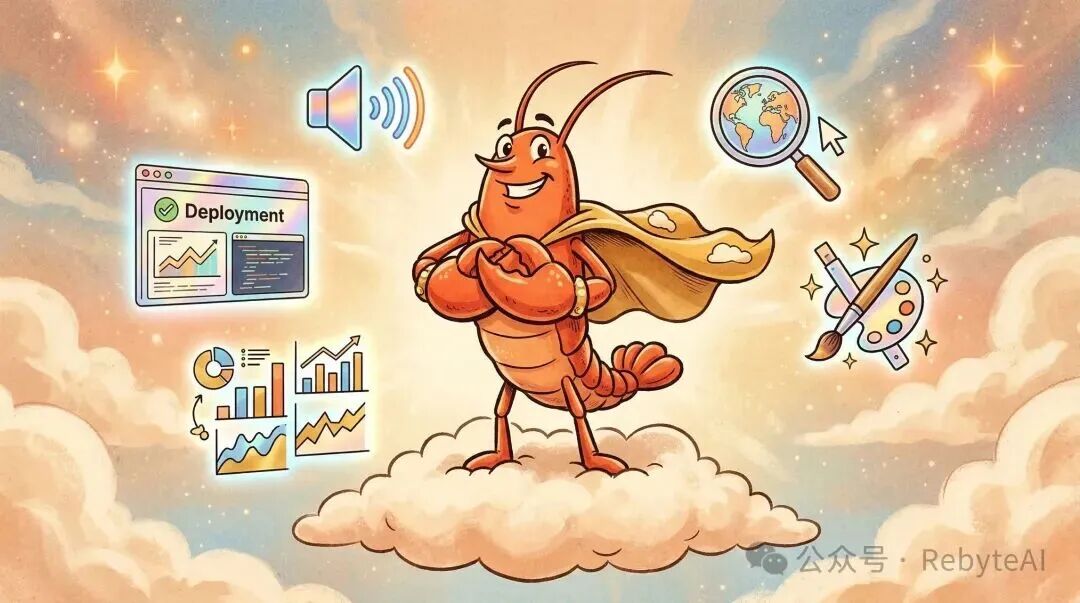
What does this mean? Ordinary AI bots run in a "bare" environment. Want them to do something beyond conversation? You have to wrangle API keys, install dependencies, configure environments yourself. But Rebyte's lobster is born with a full suite of cloud capabilities:
Built-in app deployment (similar to Lovable / Vercel)
You can tell your lobster:
"Build me a website to showcase my portfolio."
It doesn't just write code — it deploys the website to a domain and generates an accessible live URL. Supports Next.js, Nuxt, Astro, Vite, pure HTML — even Python backends (FastAPI, Flask, Django). Built on S3 + CloudFront + Lambda Serverless architecture, auto-scaling, zero infrastructure concerns.
This isn't an extra feature you need to configure. It's a skill the lobster was born with.
Built-in voice capabilities
Normally, adding voice to AI means registering for OpenAI's API key, configuring Whisper, handling audio format conversion... just setting up the environment takes half a day.
On Rebyte's lobster, all of this is built-in:
- Speech-to-Text (STT): Send a voice message directly, the lobster understands. Multi-language support, auto-detection.
- Text-to-Speech (TTS): Have the lobster turn text into natural, fluent speech. 6 voices to choose from, supports speed adjustment, multiple output formats.
No API key needed. No extra dependencies to install. Send a voice message, the lobster understands and replies.
And more
Beyond these, each lobster comes pre-installed with 40+ skill modules:
- Browser automation — operate web pages, scrape data
- Internet search — retrieve latest information in real-time
- Data analysis — process data, generate charts
- Spreadsheet handling — create and edit spreadsheets online
- Deep research — multi-source investigation, generate cited reports
These aren't simple "plugins" — they're deeply integrated into the lobster's runtime. It knows when to use which skill, no manual triggering needed.
The essence of the lobster
At its core, what Rebyte is doing can be summarized in one sentence:
Let you use AI Agents like you use Serverless functions.
Just as AWS Lambda transformed backend development — you no longer manage servers, code only runs when invoked — Rebyte applies the same philosophy to AI Agents:
- No server management
- No paying for idle time
- Run unlimited instances simultaneously
- Each instance has full cloud capabilities
Traditional AI bots are full-time employees you hire at great expense — salary paid regardless of whether there's work.
Rebyte's lobsters are on-call freelancers — billed only when working, back to rest when done, yet remembering everything from last time when you call again.

If you want to raise some lobsters of your own
Come claim yours