RisingWave Founder Yingjun Wu: Building a Global Distributed Open-Source Software Company | COSCon'22 Commercialization Forum × Yunqi

Open source is eating software.

Recently, COSCon'22, the 7th China Open Source Conference and the industry's most influential annual open source gathering, successfully concluded. As an open source supporter from Day 1, Yunqi Capital was deeply involved in this year's conference, curating the Open Source Commercialization sub-forum. With our sights set on the new world, we aimed to share our thinking on how open source software can commercialize as it goes global. To that end, we're launching the "COSCon'22 Open Source Commercialization Insights Series", bringing you practical lessons from industry leaders.
This installment comes from Yingjun Wu, founder and CEO of RisingWave, a Yunqi Capital seed portfolio company, on the topic of building a global, distributed commercial open source software company during the COVID-19 pandemic.

Yingjun Wu, Founder & CEO of RisingWave. He graduated from the National University of Singapore's Department of Computer Science, and previously worked as an engineer at Amazon Redshift and a researcher at IBM Research Almaden. He has long served on the program committees of the three top database conferences: SIGMOD, VLDB, and ICDE.
RisingWave is a cloud-native streaming database that uses SQL as its interface language. It aims to reduce the complexity and cost of building real-time applications. RisingWave ingests streaming data, executes continuous queries, and dynamically updates results. As a database system, RisingWave persists results in its own storage and allows users to access data efficiently.
Yunqi Capital led its seed round and has continued to invest in subsequent rounds.

Cloud-Native Streaming Database
A streaming database can process streaming data within the database itself, including system logs and daily monitoring records. A cloud-native database, meanwhile, is built from the ground up for the cloud to achieve cost reduction and efficiency gains. The core problem it solves is converting traditional batch processing into stream processing.
The difference between the two is that batch processing latency can run to 10 minutes, an hour, two hours, or even a day, two days, ten days. Stream processing, through incremental computation, can dramatically reduce latency to one minute, 10 seconds, one second, or even sub-second.
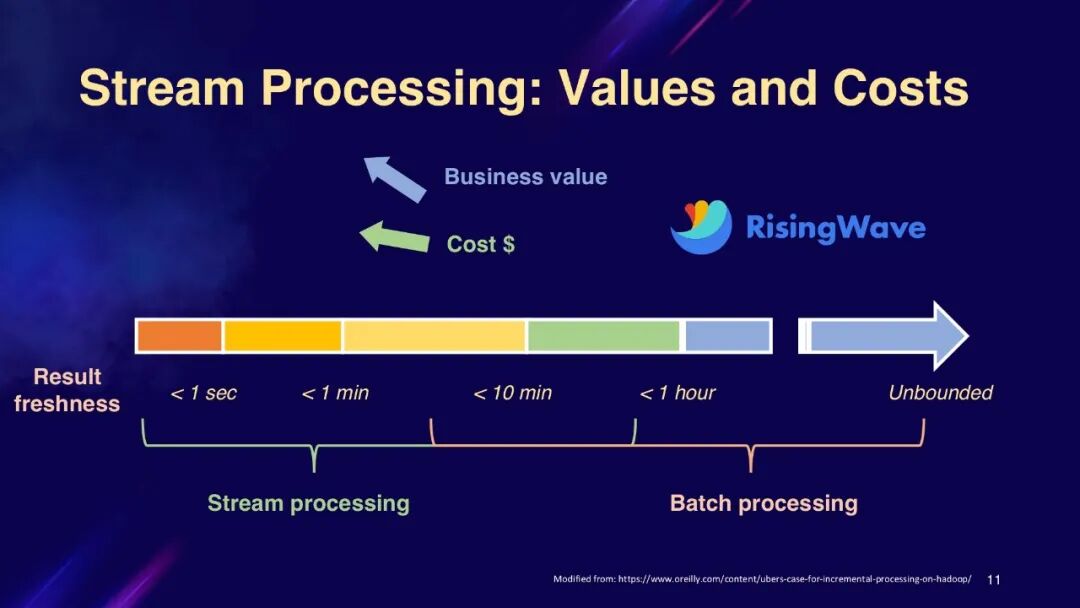
RisingWave is a cloud-native streaming database. The company currently has over 50 full-time employees distributed across seven time zones. The most fundamental difference between RisingWave and traditional stream processing systems is its dramatically lower cost, made possible by fully leveraging cloud capabilities and performance.

Three Characteristics of Engineer Founders
Founders of global commercial open source software companies generally fall into two categories: businesspeople and engineers. Businesspeople spot opportunities and promising application directions in the market, then seek out applicable technologies, building products to better serve market demand. Engineers, by contrast, typically start with the technology and then assess whether there's market demand for it. When there is, that's the ideal case. Compared to businesspeople, engineer founders tend to exhibit three distinct characteristics:
First, engineers expect their teams to be engineering-driven. They may not have deep business acumen, but their technical understanding is profound, and they want to showcase what they've learned to the world.
Second, engineers genuinely enjoy sharing technology. When engineers sit down for a meal, they'll likely talk about tech, code, bugs, and debugging.
Third, engineers generally have little grasp of product marketing and sales. They've spent their careers immersed in frontline technology, not frontline sales or customer-facing roles, so their business understanding inevitably lags behind that of businesspeople or marketing professionals.
Given these traits, one particular company-building model is especially friendly to engineer-background founders: the commercial open source software company. Commercial open source software is, simply put, open source software that is commercialized. Open source software means developers put their source code online (on GitHub, for instance) and share it under certain licenses — Apache licenses, for example — which engineers love.
Developers don't just put code online; they put their engineering projects there too. This signals that the project is engineering-driven rather than business-driven. Making code publicly available also perfectly satisfies engineers' need to share technology. They can open an issue or submit a pull request on GitHub to address specific scenarios, and explain their project's advantages to others who've looked at similar projects.
Open source software is inherently viral. If a project is well-executed, word spreads through programmer circles, and at some point it may break into broader awareness across other fields. This viral quality significantly lowers the commercialization barrier for engineering-background founders. In other words, in the early stages, founders can focus more on building the project, writing code, and optimizing code, rather than worrying about finding customers, building awareness, or buying ads.

Software as a Service
If a piece of software is merely open source but no one is willing to pay for it, it can be a successful open source project at best, not a successful commercial open source project. A crucial part of making money from open source software is recognizing that what you're selling isn't the software — it's the service.
This applies beyond cloud databases. Take Microsoft Office: users aren't interested in Office's source code; they're interested in the service Microsoft provides. For cloud databases, this service-centric model is even more pronounced. Setting up a database in an on-premise data center is extremely costly. Moving everything to the cloud means you're selling a service where deployment, debugging, and operations are already packaged — users simply purchase the service.
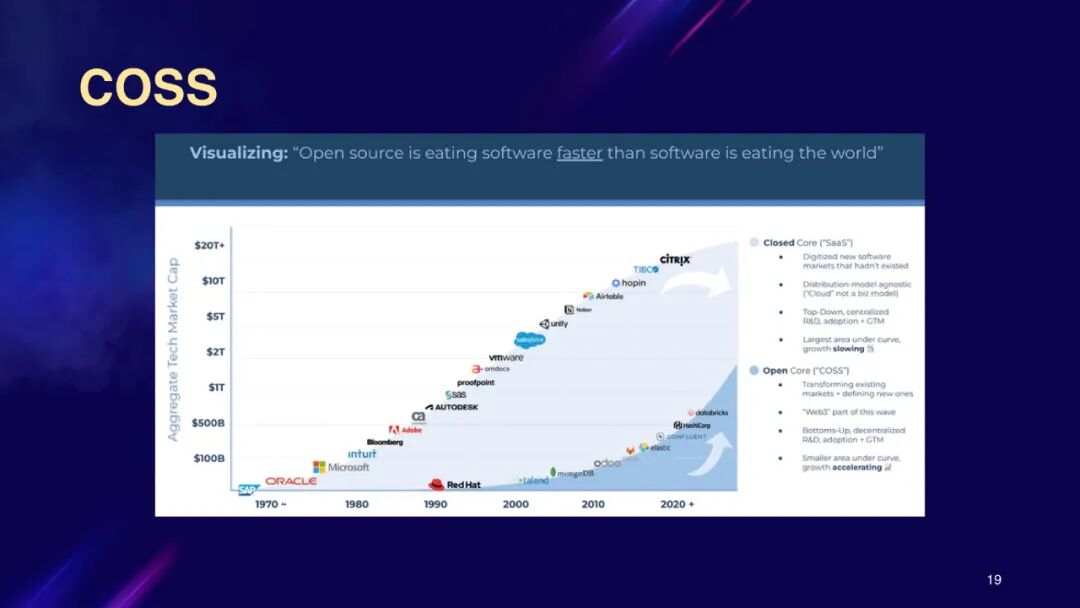
Since Red Hat's founding in 1990, an increasing number of companies have adopted the commercial open source software model. Their growth rates have outpaced those of proprietary products from that era. Open source is eating software faster than software is eating the world.

The Pros and Cons of Remote Work
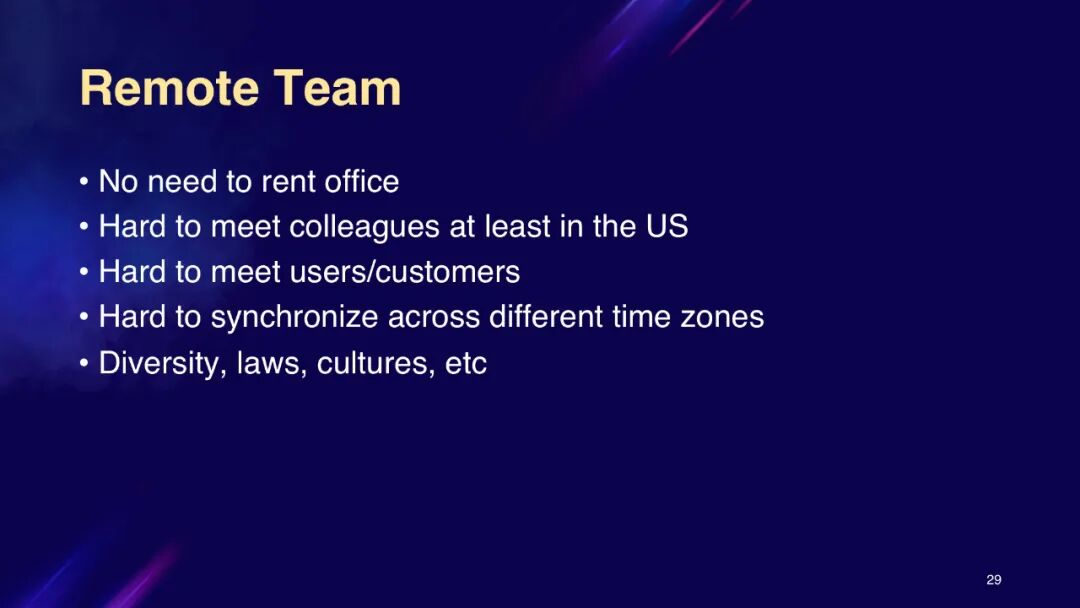
Returning to the topic of building a globally distributed, remote-first commercial open source company. Remote work isn't as great as people imagine. The pain points: First, it's hard to see colleagues. This isn't ideal for younger or recent graduates, who need an environment where they can share and learn from each other.
Second, you can't meet your users or customers, which has real negative impact on a commercial company. Normally, both sides would sit down face-to-face to deploy a project, but due to the pandemic, people couldn't go to other companies to deploy their products.
Additionally, our team has employees from seven time zones. This diversity means differences in local laws, culture, and more. India, China, the US, and Europe all have distinct cultures. We need to respect regional cultures, give employees time off for local holidays, and celebrate those holidays as a company to give everyone a sense of belonging — this is essential.
Remote work also has four advantages.
First, significantly lower costs. From the company's perspective, talent costs can be substantially reduced through savings on office rent and similar expenses.
Second, it gives companies the opportunity to recruit talent globally. Finding suitable talent is difficult; every hire means competing with many other companies. Remote work lets companies tap into global talent pools.
Third, it provides an opening to serve global customers. With globally distributed remote work, as long as you have people in the same European time zone, you can use them to serve European customers; the same applies to Asia — as long as you have people there, you can serve Asian customers without needing to be in a specific city.
Fourth, it aligns with open source culture. Open source is about people from different regions around the world contributing to a shared ideal or technical vision, which dovetails with the philosophy of a globally distributed, remote-first commercial open source company.

Pandemic-Era Trends
First, both global remote work and commercial open source have been accelerated by the pandemic, and the potential of cloud has grown enormously.
Second, SaaS and cloud are very similar. When people work remotely across the globe, they want to avoid installing software in server rooms — they just want to open a browser and use the software. Even Microsoft Office has fully shifted to a SaaS model. So the pandemic has also pushed forward "software as a service."
Third, with uncertain economic prospects, many software companies need to cut costs, leading them to question whether they still need server rooms, whether they need to hire large operations teams, and whether they should adopt more cloud services or "software as a service."
There are certain advantages to building commercial open source in China. The country's population has relatively high overall quality, with a large base of higher-educated people, making it easy to find abundant elite talent. China is thus a very suitable place for building commercial companies.
For years, Yunqi Capital has remained focused on "technology innovation, industrial empowerment." Open source and infrastructure software are among Yunqi's sustained areas of focus, with early investments in multiple industry-leading companies. Additionally, Yunqi has repeatedly received industry recognition including the "Sci-Tech Innovation China" Open Source Innovation award, and has been invited to share commercialization perspectives at multiple world-class industry summits including the Amazon Web Services Summit, China Open Source Conference, VMware Smart Cloud Edge Open Source Summit, and Huawei Partner & Developer Conference.
As a deep partner of Kaiyuanshe (the Open Source Society), Yunqi also co-published the 2021 China Open Source Annual Report, analyzing commercialization paths for domestic and international open source projects from a practical perspective, criteria for identifying promising projects, and trends and directions for the future open source 4.0 era. How to Access the Report
To read the full report,
follow the Yunqi Capital WeChat official account and reply with "open source report".