Why Won't Chinese Database Companies Simply "Copy" the Snowflake Model? | Yunqi Capital Science Chat

Respect the market, seek common ground while reserving differences.

There is a classic paper in software engineering: No Silver Bullet, by Fred Brooks. Using the silver bullet metaphor, Brooks argued that due to the inherent complexity of software, there is no single technology or practice that can increase software engineering productivity tenfold within a decade.
Over the past decade, ToB software in China and the US has followed different starting points, each catching up to the other in various ways, with growth shaped by complex ecosystems. In this article, Dr. Yingjun Wu, Founder & CEO of RisingWave, examines the differences between the Chinese and American database industries across four dimensions — talent, capital, customers, and ecosystem — and offers predictions on where each market is headed.
RisingWave is a distributed cloud-native streaming database designed to reduce the complexity and cost of building real-time applications. Yunqi Capital led RisingWave's seed round and has continued to support the company. Dr. Wu graduated from the National University of Singapore's Department of Computer Science, and previously worked as an engineer at Amazon Redshift and as a researcher at IBM Research Almaden. He has long served on the review committees of SIGMOD, VLDB, and ICDE, the three top conferences in database research.
The following is republished from InfoQ's WeChat account
➤➤➤ The global database industry is experiencing robust growth. Even as we enter a new era of technology driven by generative AI and large models, the database sector remains strong, with niche segments like vector databases attracting considerable attention. After all, databases are where data is managed — an essential product for any enterprise. In the US, the database industry dates back to the 1970s, when Oracle and Db2 dominated. Over the past decade, companies like AWS, Snowflake, and MongoDB have led the cloud database era, opening entirely new frontiers for the field. In China, the concept of cloud databases has gradually gained traction. PingCAP was a pioneer in China's database industry. Since its founding in 2015, it has accumulated a large user base and expanded its commercial operations globally. After Snowflake's IPO, senior executives from major tech companies like BAT left their posts to start their own ventures, raising substantial funding to build "China's version of Snowflake."
In early 2021, I left AWS Redshift — Snowflake's most direct competitor — to found RisingWave (risingwave.dev), an open-source commercial company. Although RisingWave's commercial focus is currently on the North American market, I have kept a close eye on the Chinese market and recognize its enormous potential. Through in-depth conversations with customers on both sides, I have gradually come to understand the differences between the world's two largest unified markets.
In my view, the differences between these markets go far beyond the commonly cited "Chinese customers have weak willingness to pay and are reluctant to move to the cloud." I believe the differences involve the interplay of talent, capital, customers, ecosystem, and more. In this article, I will elaborate on my understanding from each of these angles and offer some predictions for the database industries in China and the US.

Talent
People often say that labor is cheap in China, that there is an abundance of low-cost engineers. I disagree. It is true that compared to the US, where inflation has been severe, hiring engineers in China still offers considerable cost advantages. But Chinese engineer salaries are already on par with or have surpassed those in Europe and Singapore, especially when social insurance and housing fund contributions are factored in. The total cost of hiring an engineer in China is effectively higher than in most countries outside the US.
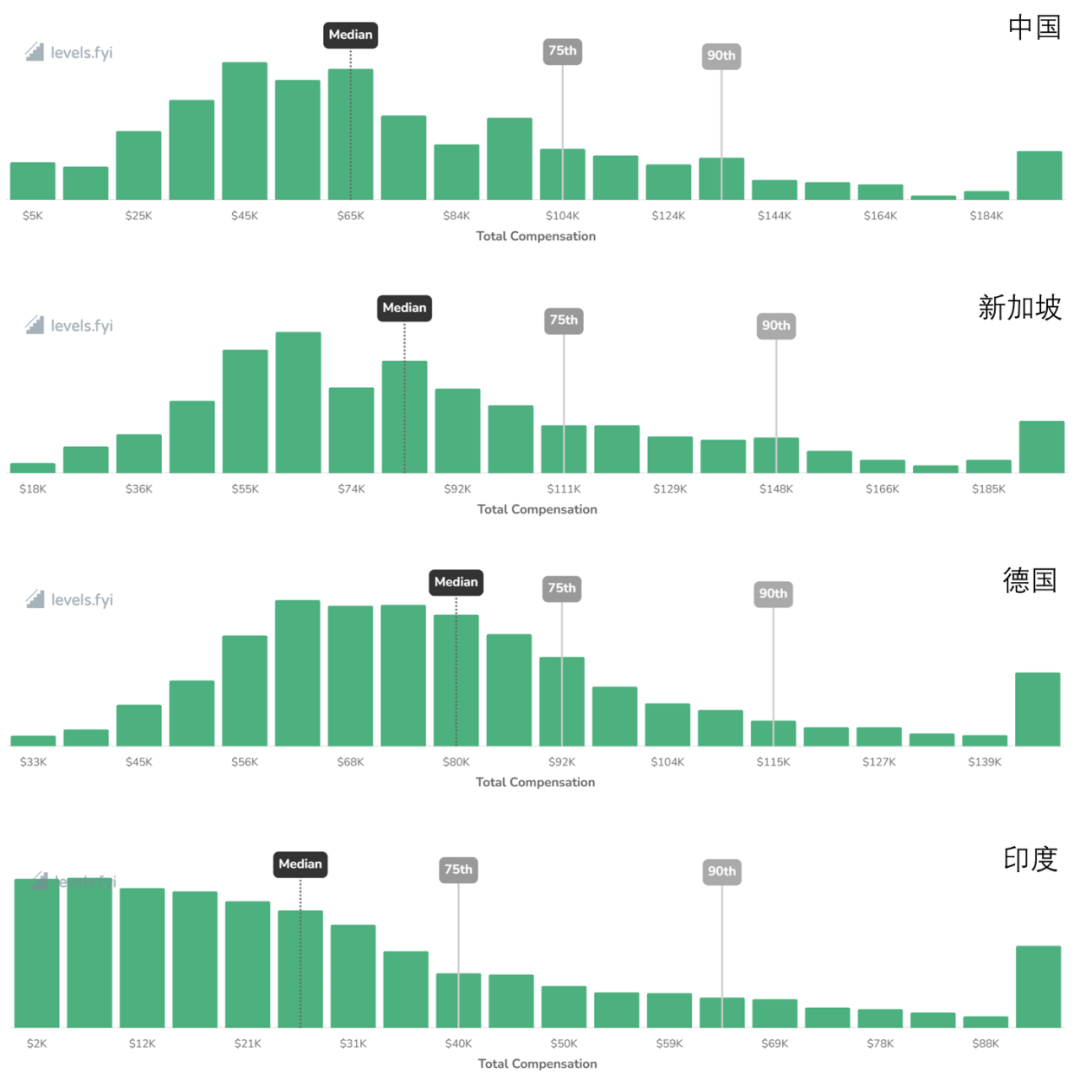
Chinese software engineer salaries are comparable to those in Singapore and Germany, and far exceed those in India. Data source: levels.fyi.
For the database industry specifically, I believe China's advantage lies not in "cheap" engineers, but in highly efficient ones. Thanks to its foundational education system, Chinese engineers possess strong hands-on skills and problem-solving abilities, allowing them to traverse in a very short time roads that American companies take years to walk. Of course, this efficiency may come at the expense of some rigor. This is why American database companies tend to build smaller but reliable products, while Chinese database companies build larger products that users complain about for various issues. After all, many things require slow, careful work to get right; moving fast with broad strokes can cause numerous details to be overlooked.
If Chinese engineers are so efficient, why hasn't China produced a giant like Snowflake in the database space? There are certainly many reasons, but looking solely at the talent dimension, I believe it is because China lacks good product managers. A product manager's job is to communicate with users externally to understand their needs, and to communicate with engineers internally to plan the product roadmap. User needs are wildly diverse, especially in China's complex software market. When faced with a flood of different demands, a product manager should not simply throw every request at the engineering team. Instead, they need to understand engineering complexity themselves, prioritize ruthlessly, and learn to say "no" to users.
This requires product managers to ideally come from a technical background, with deep understanding of the database domain; it also requires strong communication skills, so they can manage user expectations while still solving user problems. However, in China's talent development system, the product manager role has not been given adequate attention, and the art of "communication" is missing from education. This makes it difficult to find engineers who both want to become product managers and possess strong communication skills. When product managers fail to mediate the tension between user demands and engineering development, it can lead to customer churn and internal friction. And when the product manager is not up to par, the shape of the product naturally suffers.

Capital
As the world's leading capitalist power, the US has a modern venture capital industry that has undergone a century of development and refinement. Through the rise and fall of countless investment cases, VC firms have learned to quantify the merits of each investment through various metrics. In China, however, venture capital started much later. The first venture capital institution — China International Trust and Investment Corporation (CITIC) — only appeared in the 1980s. Well-known American investment firms like IDG and Sequoia entered China within the last thirty years. Because the VC industry started later, the overall market is relatively immature. Although investors conduct due diligence, more often than not they approach investments with a lottery mentality: as long as one out of ten investments can exit, they profit. Of course, small gains on individual projects are insufficient; a major win is needed to ensure positive overall returns. This leads investors to favor projects with grand narratives: founding teams should ideally be senior executives from large companies like BAT, and their products should ideally be clones of listed American companies, or address obvious, massive markets.
Moreover, due to past successes in the mobile internet era, people believe that large capital injections can build massive projects, viewing short-term (or medium-term) cash burn as justified, as long as defeating competitors leads to ultimate victory. From the investor's perspective, this model seems sound. But from a societal standpoint, it carries the risk of low capital efficiency. After all, there are only so many listed companies to clone, and major categories like transaction processing, data warehouses, data lakes, and real-time analytics are already crowded with strong players. Once everyone starts chasing similar grand-narrative projects, homogenized competition emerges, leading to price wars and a race to the bottom — "acquire customers in bulk through low pricing, defeat competitors, then raise prices." Of course, we cannot lay this problem entirely at the feet of venture capital firms. In China, exits through acquisition are relatively rare, and the system is not yet mature. So if investors do not pursue these grand-narrative projects, they may well fail to recover their capital.
By contrast, American investors place greater emphasis on milestones. They want to see whether a company's metrics can steadily progress to the expected next stage within a reasonable timeframe (typically 18 months). If milestones are met, they continue investing; if not, they consider adjusting valuation or seeking acquisition opportunities. Achieving stage-by-stage metrics is genuinely challenging, which requires startups to make trade-offs between product direction, engineering development, and customer needs. Regardless of the specific metrics, the overall direction is to find the path with the highest return on investment. With extremely high labor costs in the US, a low-price, high-volume approach rarely yields high ROI, so people steer clear of this strategy and constantly explore ways to maximize profit.
For American VC firms, they place comparatively more emphasis on project success rates. While everyone hopes to find star projects with hundred-fold or thousand-fold returns, I have also seen some firms willing to bet on projects that end up being acquired — after all, in the US, acquisition is already a very mature exit path.
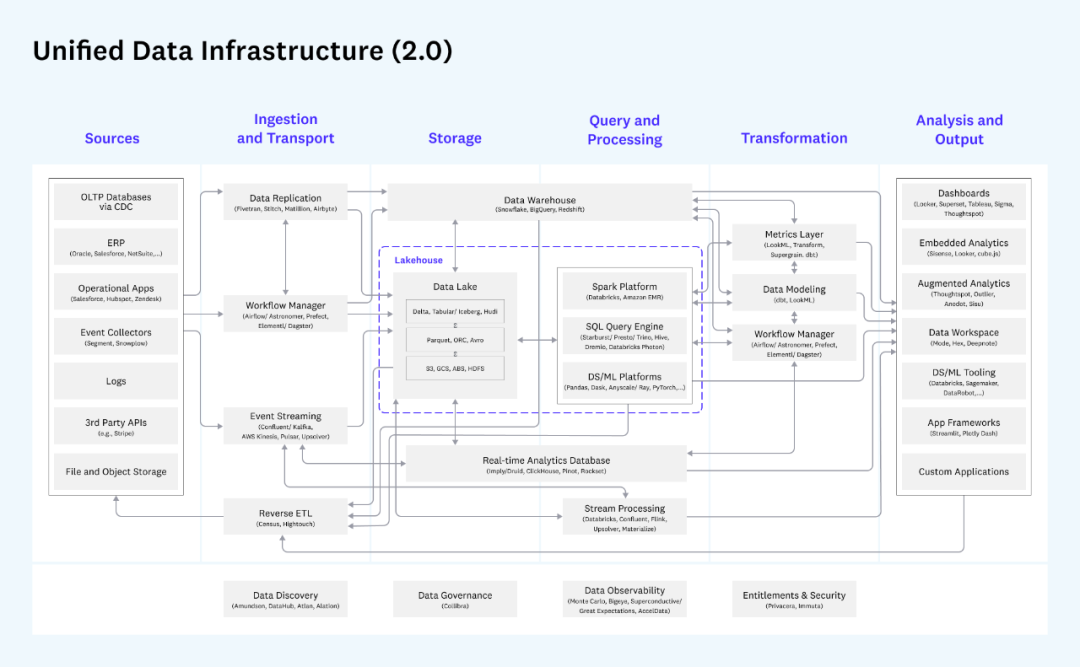
The prominent VC firm Andreessen Horowitz (a16z) has been actively promoting the concept of the modern data stack.
A notable difference between American and Chinese venture capital firms is that the former actively educate the market. VC firms wield enormous influence in society; their evangelism can even sway the judgment of C-suite executives at buyer companies. In the database industry, for example, firms like Andreessen Horowitz have been championing the concept of the "modern data stack." They constantly pitch it everywhere, backing their portfolio companies and building consensus around the modern data stack philosophy. This philosophy explicitly advocates that enterprises break their tech stack into small pieces, with each database company focusing on its own domain and pushing a single赛道 to the extreme. In such a market environment, it is difficult for the "unified database" that Chinese companies often favor to emerge. In China, it is typically industry giants like BAT that lead market education. They have already built unified systems internally through heavy capital investment, and they promote the unified-system philosophy to other companies. While this approach certainly maximizes the interests of these large companies, a unified system is not necessarily optimal for small and medium-sized enterprises. After all, a user who simply wants a kitchen knife to cook is essentially wasting money by buying a fully-featured Swiss Army knife.

Customers
In the ideal case, the optimal market structure should be olive-shaped. Such a structure includes some large enterprises at the top — small in number but dominant in position — a substantial middle segment that forms the core of the market, and at the other end, numerous long-tail small businesses. Why? Because small businesses typically have limited payment capacity, while large enterprises demand heavy customization. When there is a large population of mid-sized companies with strong payment capacity, this is highly favorable for startups. After all, startups can standardize their products and reach mid-sized companies through distribution channels. As a highly standardized product, databases are well-suited to develop in an olive-shaped market. The US market is such an olive-shaped market. By contrast, China's overall market started later, and people's willingness to pay for services remains underdeveloped. It does not yet have a large middle segment; long-tail small businesses may account for half the market. This is one reason behind the common saying that "Chinese customers have weak willingness to pay." Cloud databases, as a service, essentially charge service fees. When small businesses hear that cloud service providers charge high "service fees," they naturally hesitate. This explains why people say "Chinese customers are reluctant to move to the cloud."
Of course, I do not believe the Chinese cloud database market is as pessimistic as many imagine. In fact, in my conversations with customers, the proportion of companies purchasing cloud services from Alibaba Cloud, Tencent Cloud, and others far exceeded my expectations. On the contrary, in the US, which is perceived as "all enterprises are on the cloud," selling cloud databases is not that simple. Although many large companies, even banks and insurers, use cloud services, most enterprises have extremely high requirements for data security and privacy, and remain cautious about accepting independent third-party cloud services outside of cloud vendors themselves. For any company of even moderate scale, their legal department will likely conduct extensive reviews of data compliance. For many such companies, placing data with a third-party company is difficult to accept. Fortunately, the industry broadly recognizes the credentials of the three major cloud providers — AWS, GCP, and Azure. This allows database companies to adopt an entirely new deployment model: BYOC (Bring Your Own Cloud), where the database vendor provides services within the user's AWS account, while the control plane can be deployed at the database vendor. This compromise is essentially privatized deployment for the cloud era.
Although enterprises in both countries purchase cloud databases, their priorities often differ. Based on my experience engaging with customers on both sides, Chinese users care more about performance, while American users care more about experience. Because performance improvements typically mean lower unit prices, which aligns with Chinese user needs. For American users, because engineer quality is relatively lower, they prefer simpler products. I still remember when I was at AWS Redshift, a user left simply because a competitor's documentation was easier to understand. While this may be an isolated case, it illustrates how much American users value product experience.
From the customer perspective, I believe there is one area where China and the US differ markedly: communication style. Chinese customers tend toward synchronous communication, typically through WeChat groups or direct phone calls, and if in the same city, in-person visits. American customers tend toward asynchronous communication. Initially, customers typically communicate only through seemingly inefficient channels like email. After preliminary communication, a dedicated Slack channel may be established. Video calls almost certainly require booking several days in advance, and in-person visits are relatively rare in the post-pandemic era. These synchronous and asynchronous communication styles lead to huge differences in customer service between the two countries: Chinese service is almost entirely white-glove, with database vendors accompanying customers through testing, deployment, go-live, and sometimes even helping write code. This communication style effectively provides service beyond the product itself, but if vendors cannot control it properly, they may effectively become outsourcing companies. American service is typically self-service: database vendors provide only cloud products, and when customers encounter issues, they submit tickets through the system with no guaranteed response time unless explicitly stipulated in the contract. This communication style creates more equality between vendor and customer, giving vendors greater comfort.

Ecosystem
In China, because most companies focus on major domains, vendors often find themselves in competitive relationships. In the US, because companies tend to focus on niche areas, vendors frequently maintain close cooperative relationships. For example, as a stream processing company, RisingWave does not operate in OLAP, data warehouses, or data lakes, so we have maintained good cooperative relationships with companies in these domains and refer customers to each other. This actually builds a healthy ecosystem: everyone collaborates, integrates engineering efforts, conducts joint marketing, and can even negotiate with customers together. In such an ecosystem, each company knows its position and does not actively enter others' markets when its own scale is still small.
Let us also discuss the relationship between database vendors and cloud vendors. In the US, database vendors and cloud vendors are more mutually reinforcing — the prosperity of database vendors promotes the prosperity of cloud vendors, with both sides benefiting. Take Snowflake and AWS as an example. Snowflake's product competes directly with AWS Redshift, yet AWS did not delist Snowflake. In fact, Snowflake's rise has been a massive success for AWS's infrastructure business (EC2, S3, etc.), with gains far exceeding the losses from Snowflake capturing Redshift's market share.
In China, the relationship between database vendors and cloud vendors like Alibaba Cloud and Tencent Cloud is sometimes more complex. When database vendors launch products that compete with cloud vendors' offerings, they often remain wary, because the cloud vendors' platform position puts database vendors at a competitive disadvantage. What I mention here is not unfounded. Setting aside specific cases, if we look purely from an engineering perspective at the interface designs that domestic cloud vendors provide externally, these designs create significant integration difficulties, making it less than smooth for database vendors to use.

Trends
Overall, due to factors spanning talent, capital, customers, ecosystem, and more, there is a considerable gap between China and the US in the database domain. As for whether Chinese cloud database companies can reach the scale of their American counterparts, I hesitate to predict, though many estimate 3–5 years. I believe the cloud database industries in both countries are converging. Two trends are worth noting: the rise of converged databases, and open source.
Regarding converged databases, China and the US have different understandings. Chinese database companies tend toward "doing everything, and doing everything well" — an understanding often driven by large enterprise customers. After all, large customers have strong bargaining power and pay well; when such demands arise, database companies are likely to choose to satisfy them. American database companies tend toward "taking one area as core, with other areas as supplements." Take Snowflake as an example. As a listed cloud data warehouse company, Snowflake has been expanding into transaction processing, stream processing, and other directions. However, their pace of development in these areas is relatively slow; the features they deliver can be described as "usable" but far from "great to use." After all, they surely understand that users fundamentally choose Snowflake for its data warehouse capabilities; everything else serves a supplementary role.
On open source, I believe there is also a divergence in understanding between China and the US. Chinese database companies tend to view open source as a means to build and grow the community, then gradually convert community users into paying customers. While many American database companies also hope to use similar approaches for market expansion, a significant portion place greater value on the "trustworthiness" that open source brings. After all, American customers are highly sensitive about data security; when the database product they use is a black box, they inevitably have some concerns.
The database market will certainly continue to thrive over the next 5–10 years, and I firmly believe the market structures in China and the US will grow increasingly similar. For those looking to serve both the Chinese and American markets — or the global market — my advice is: respect the market, seek common ground while reserving differences, stay true to yourself, and take the leap.