The Rise of SpaceX: Everything, for Mars | Yunqi Technology
The "Test Flight" of Commercial Space Has Just Begun
Over the past ten days or so, SpaceX's IPO has been the unavoidable headline across global tech and capital markets.
The company, whose mission is to "go to Mars," completed the largest IPO in human history, with its market cap briefly touching $2 trillion on its first trading day. The subsequent stock volatility, meanwhile, illustrates from another angle that the market has yet to reach any consensus on how to price this sector. And that ambiguity is precisely what makes this moment in the industry so fascinating.
As an investment firm with a long-term focus on frontier technology, commercial aerospace is one of Yunqi Capital's strategic areas of deployment. To date, we have invested in projects including ASTRONSTONE, Dongsheng Aerospace, Zhongke Yixin, and Beichen Aerospace, covering critical segments of the industrial chain including launch services, satellite manufacturing, core components, and space infrastructure.
This installment of Yunqi Technology features an article from Silicon Valley 101. Based on field visits to SpaceX's Starbase and headquarters, the piece offers a complete retrospective of the company's 24-year roller-coaster journey. The path SpaceX has walked is, in many ways, a microcosm of the commercial aerospace odyssey itself: protracted, iterative, yet continuously opening new frontiers of human imagination through repeated test flights and engineering evolution. We hope you enjoy it.
The following content is republished with permission from Silicon Valley 101. Original title: The Rise of SpaceX: Everything for Mars | Field Visits to Starbase and Headquarters Produced by: The Silicon Valley 101 team (credits at end)
This is a company that makes history, and its mission is simple: go to Mars.
On June 12, U.S. time, SpaceX officially listed on the NASDAQ. Intraday, its stock surged more than 30% at one point, ultimately closing at $160.95 — up roughly 19% from its $135 IPO price, corresponding to a market cap of $2.1 trillion. SpaceX's IPO raised $75 billion, setting a new record for the largest IPO in global capital markets history.
Just before the IPO, Silicon Valley 101 traced SpaceX's development trajectory across a journey spanning the United States: we traveled to the Boca Chica rocket launch center at the southernmost tip of Texas, stepping into the scene as Starship lifted off; and we visited SpaceX's Los Angeles headquarters, searching for the earliest footprints of the company's founding.
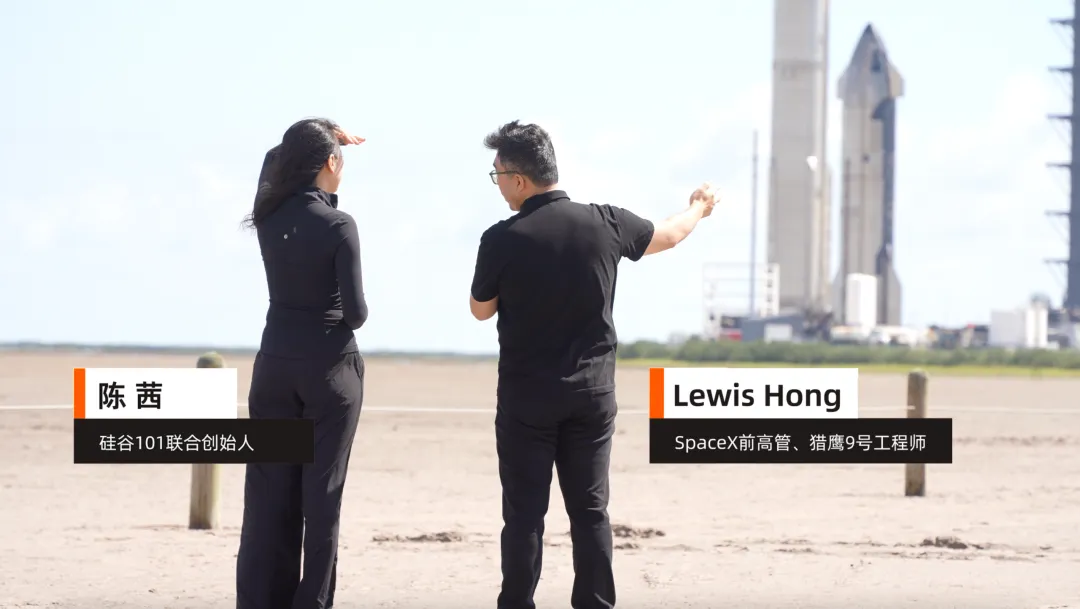
On this journey, we also invited Lewis Hong, a former SpaceX executive and Falcon 9 engineer, to join us in reviewing SpaceX's 24-year rise and exploring where this company might be headed next.
SpaceX's history is one of being mocked, dismissed, yet repeatedly vindicating and redeeming itself: reusable rockets, low-Earth-orbit satellite internet, Starship... one after another, what were once pipe dreams have become reality. Now, few would doubt SpaceX's ultimate mission: colonizing Mars.
So how did a company that from day one set out to send humans to Mars navigate failure and skepticism, high-stakes gambles and desperate struggles, to ultimately rewrite the history of the entire aerospace industry?
(This article is adapted from video; we welcome you to watch the video below)


The Beginning
Elon Musk Decides to Build His Own Rocket
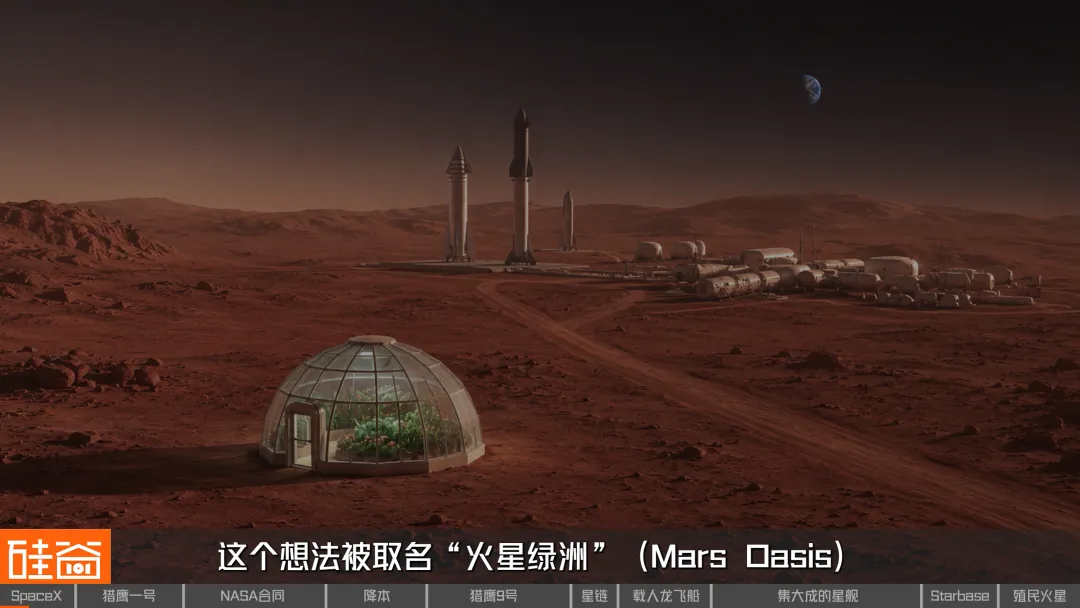
SpaceX's origins were, at first, essentially a piece of performance art. In 2001, while browsing NASA's website, Musk was stunned to discover that more than 30 years after humans had walked on the moon, NASA didn't even have a plan to return — let alone go to Mars. So Musk proposed what was then a wildly "performative" idea: buy a decommissioned Soviet missile, retrofit it, and send a small greenhouse to Mars to snap a photo, stirring public enthusiasm for space exploration and pressuring the government to increase NASA's budget. The concept was dubbed "Mars Oasis."
To this end, Musk traveled to Russia three times, planning to purchase an intercontinental ballistic missile. But in Russia, Musk was humiliated. Not only did the Russian side quote an absurdly high price with no genuine intent to sell, one rocket designer even spat on Musk's leather shoes, convinced this American "nouveau riche" knew nothing about rockets.
On the flight back to the United States, Musk made an Excel spreadsheet listing the market prices of raw materials for rockets: aluminum alloys, titanium, carbon fiber, propellants. After crunching the numbers, he discovered that the combined cost of these materials accounted for only about 3% of a rocket's total price. Musk saw that the exorbitant cost of rockets stemmed partly from scientific and engineering challenges, but far more from the inefficiency of the traditional model. Bloated, inefficient bureaucracies; convoluted, drawn-out supply chains; and the cost-plus pricing model favored by legacy giants like Boeing and Lockheed Martin — these were the real culprits making rockets so expensive.
So Musk decided to build his own rockets. In 2002, eBay acquired PayPal for $1.5 billion in cash, and Musk used his proceeds to found SpaceX. Yes, SpaceX is not a young company — it was established even before Facebook, and eight years before Steve Jobs unveiled the iPhone 4.
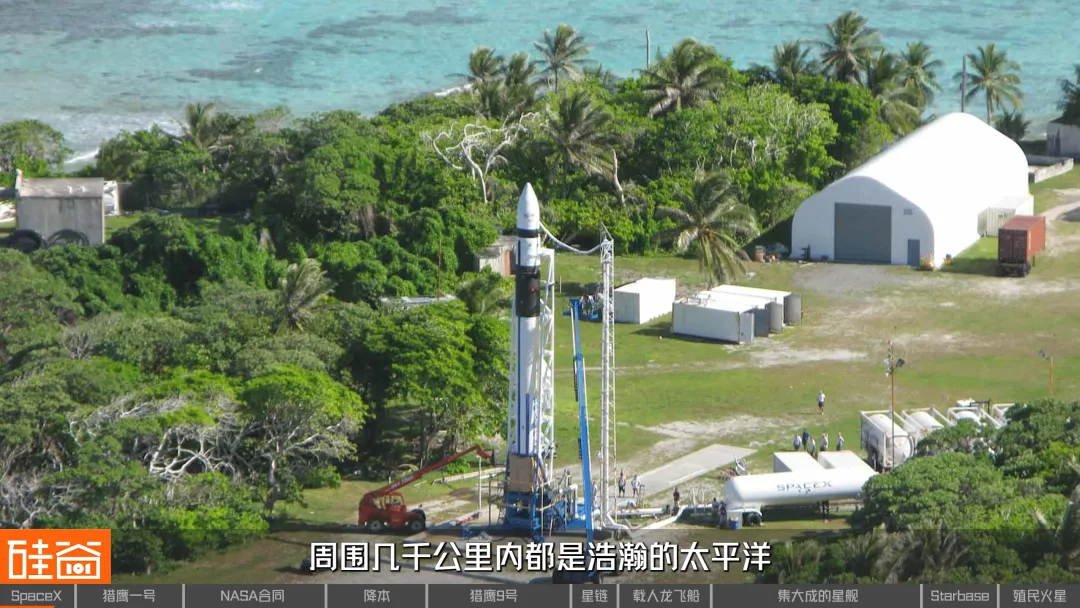
In its first few years, SpaceX was essentially conducting a desert-island survival experiment on a tiny speck of land in the middle of the Pacific Ocean.
This island, covering only about 0.03 square kilometers in the Marshall Islands, served as SpaceX's early rocket launch test site. For thousands of kilometers in every direction stretched the vast Pacific. There was no fresh water, no proper dormitories. The salt spray from the ocean was brutally corrosive to metal rockets, forcing engineers to repeatedly inspect and clean components. What they were attempting here was to launch the first rocket ever built by a private company: the Falcon 1.
But the true birthplace of SpaceX was actually a small warehouse near Los Angeles International Airport in California. After SpaceX moved out, the warehouse was leased by a seafood trading company.
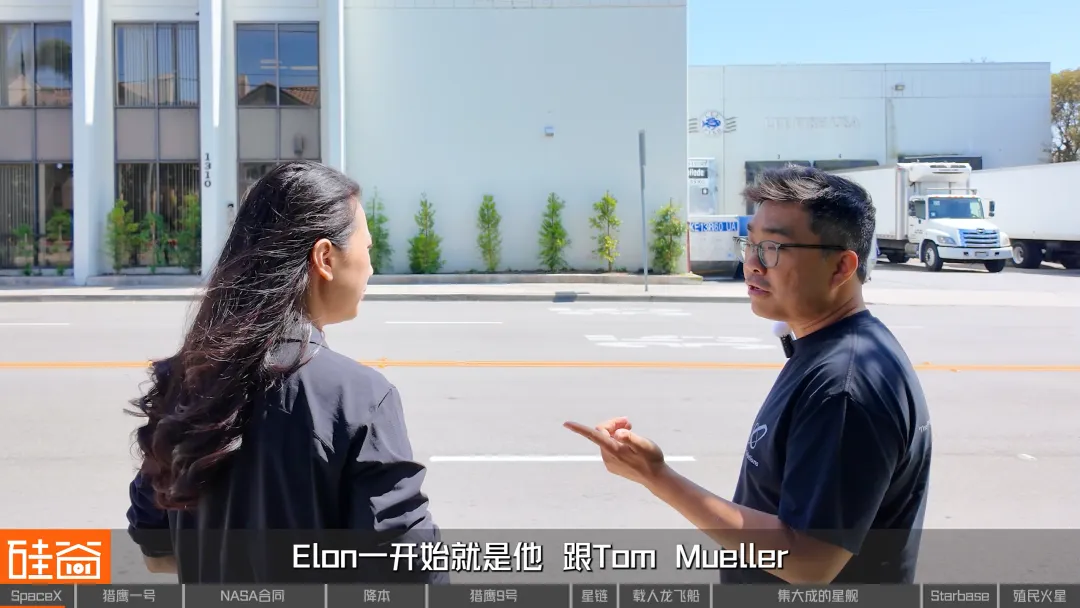
Lewis Hong: Day one started right here, and it stayed here all the way through 2007.
Chen Qian: There weren't many people in the office back then.
Lewis Hong: Of course not. Everything started with two people. At the very beginning, it was just Elon and Tom Mueller. Tom Mueller later became the most famous rocket engine expert in America — he was SpaceX's employee number one.
Chen Qian: Were rocket parts actually designed here?
Lewis Hong: Yes, the Falcon 1 was developed right here. This was a real factory floor at the time. The Falcon 1 wasn't that big — it was a small rocket.
Chen Qian: You can see there are lots of crates here now. Back then they shipped rocket parts; now they ship frozen fish.
Lewis Hong: So, everything about people is ultimately limited by imagination.
Falcon 1's Three Failures: A Desperate Turn After Hitting Rock Bottom
Accustomed to the visual spectacle of Starship today, the Falcon 1 back then looked like a toy rocket. Musk's plan was to start by launching small satellites on small rockets, then iterate upward. But getting even this "toy rocket" built and successfully launched kept SpaceX's early team busy on that desert island for years.
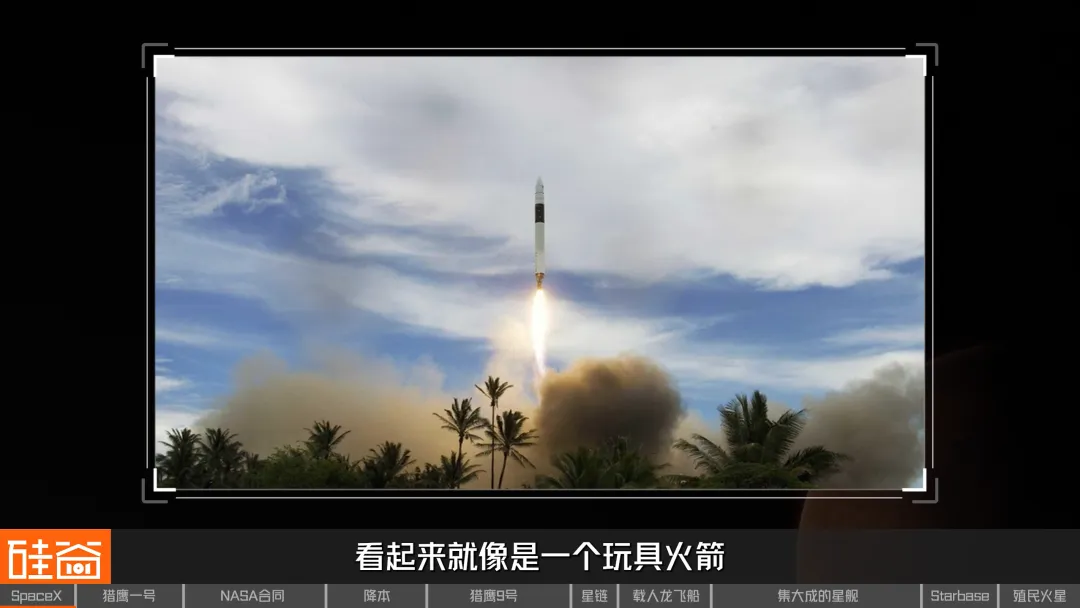
The initial planned launch date was November 2005, but was scrubbed due to a valve issue.
In March 2006, Falcon 1 launched for the first time. Dozens of seconds after liftoff, the rocket crashed. The post-mortem revealed that because the launch site was on a tropical island with extremely high salinity in the air, a nut in the fuel line had corroded, developing a tiny crack that caused a fuel leak and subsequent engine shutdown.
In March 2007, Falcon 1 failed again. While the first stage performed normally, the second stage's attitude control system malfunctioned, causing the engine to cut off prematurely and fail to reach orbital velocity.
In August 2008, Falcon 1 failed for the third time. During first-stage separation, the first stage didn't drop away quickly enough — it surged forward and "rear-ended" the second stage. The rocket shook violently and spun completely out of control. Plunging into the Pacific along with it were not only two small NASA satellites, but also the ashes of 208 people scheduled for "space burial," including Apollo 7 astronaut Gordon Cooper and Star Trek actor James Doohan.
Then came the history everyone knows: SpaceX hit rock bottom.
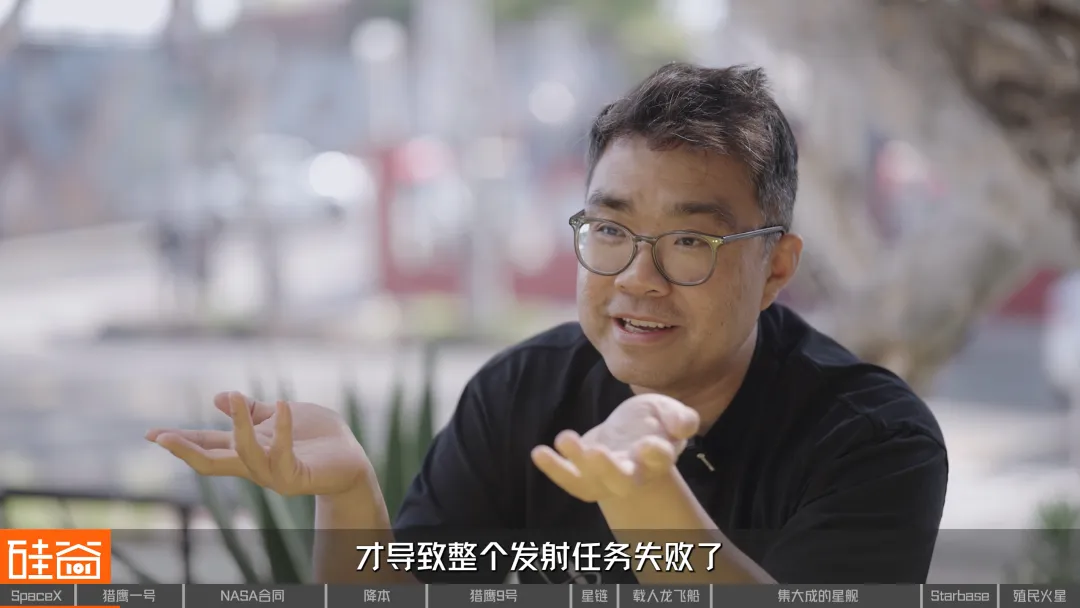
Lewis Hong:
Back then, Falcon 1 was the product of everything we had. The first launch simply exposed one thing: the team genuinely hadn't yet figured out how to build rockets. But SpaceX learned fast. After the first failure, the team immediately redesigned the entire first-stage propulsion plumbing system.
So by the second launch, the first stage performed almost perfectly. The second failure happened at the first-stage/second-stage separation phase — when the payload was supposed to continue into orbit. Some details went wrong during separation, another problem the team hadn't fully grasped: too much vibration was generated. The first stage performed well, but the second-stage engine couldn't keep burning normally because of the violent shaking, so the second launch failed too.
The third launch was probably the most heartbreaking. Because that third rocket had incorporated all the lessons from the first two failures — those problems were basically solved. But in the end, the issue came down to an incredibly tiny detail. During first-stage separation, the second stage's movement was delayed by one second. In that single second, the first stage still had residual thrust, so it collided with the second stage, and the entire mission failed.
So that third rocket was basically a 99% finished product. But this shows that in space, 99% isn't enough — you need a 100% solution. After the third failure, everyone was devastated. Many people thought the company might fold tomorrow, because there was no more money left.
After three failed launches, the cash Elon Musk had cashed out from PayPal was nearly gone, and post-financial-crisis, no one wanted to invest in tech companies. Meanwhile, Tesla had entered its own bankruptcy countdown, and Musk was even going through a divorce.
Before we get to how SpaceX came back from the dead, let's return to SpaceX headquarters. After the third launch failure, the control room fell into dead silence. Some people started crying. Musk gave the staff an impromptu speech. Since it was off-the-cuff, there's no verified complete transcript, but Silicon Valley journalist Ashlee Vance interviewed and cross-checked multiple witnesses' recollections to roughly reconstruct what was said.
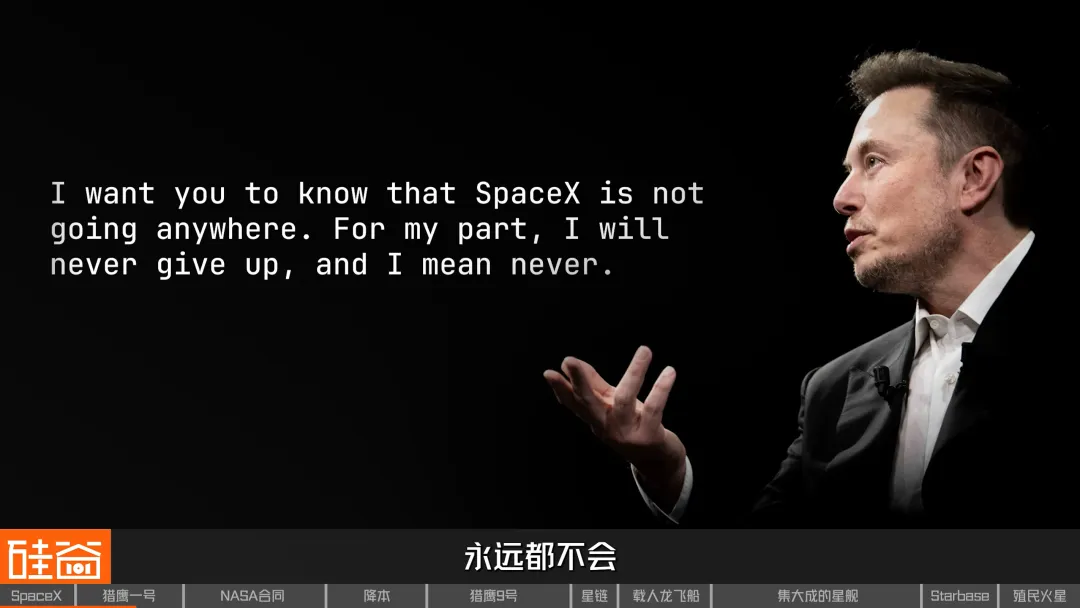
Elon Musk:
I want each of you to know that SpaceX will not fall. As for me, I will never give up, ever. We already have funding for a fourth launch, and I'm ready.
We need to pull ourselves together, get back to our desks, find the problems, fix them, and prepare for the next launch. Now, back to work.
The funding for that fourth launch Musk mentioned came from his old rival and old friend: Peter Thiel. In August 2008, the same month as the third launch failure, SpaceX closed its Series B round of $20 million, with Founders Fund as the sole outside institutional investor.
In 2008, the world was still in a social networking era. Facebook's user base surpassed 100 million, overtaking MySpace; Twitter saw its billionth tweet, with user growth of 700% that year, and the Obama campaign used Twitter for political mobilization during the election; WhatsApp's founding was still months away, and Instagram wouldn't launch for another two years.
Silicon Valley VCs at the time championed asset-light social or entertainment companies. Hard tech companies couldn't get anyone's attention — which led to Peter Thiel's later famous line: "We wanted flying cars, instead we got 140 characters."
So Founders Fund made this contrarian bet at the exact moment when all of Silicon Valley was bearish and SpaceX had just suffered three consecutive launch failures. After SpaceX went public, this investment might become the most impactful and highest-returning bet in the history of venture capital.**
Just over a month after this investment closed, on September 28, 2008, SpaceX made history: Falcon 1's fourth launch succeeded. This was the first orbital-class rocket successfully launched by a private company in human history. From this day forward, space was no longer a state monopoly.
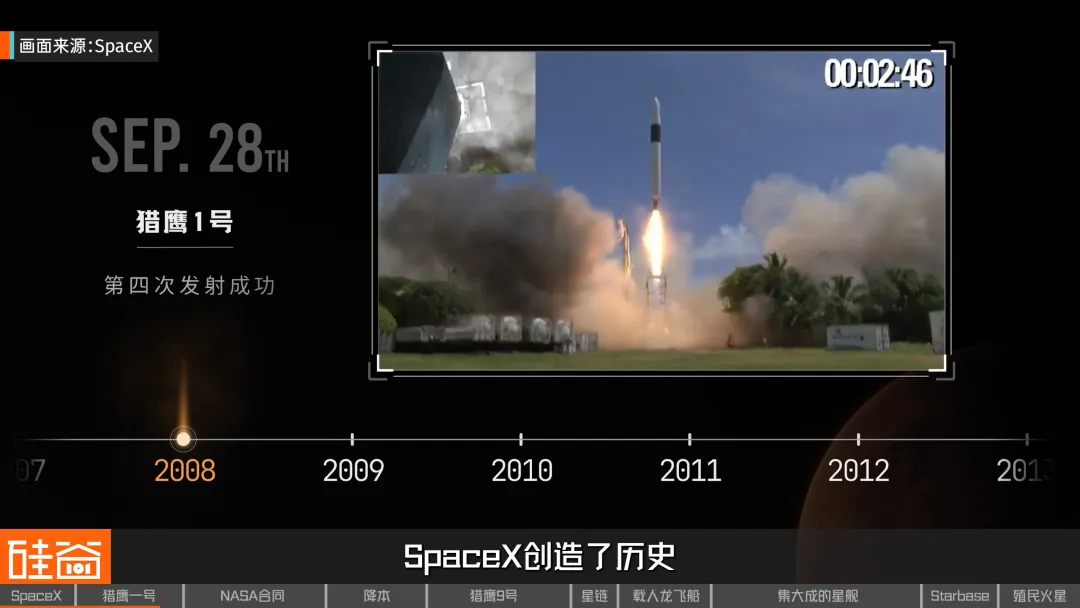
The launch carried no actual payload. What reached orbit was a 165-kilogram metal mass, which orbited for nearly 15 years until finally burning up in the atmosphere in early 2023.
Though Falcon 1 had finally succeeded, SpaceX was far from out of the woods. Two weeks before the successful launch, Lehman Brothers filed for bankruptcy protection. The ensuing financial tsunami swept across the globe, liquidity dried up, and no one could raise money from the markets. Musk sold his houses and sports cars, and had to borrow money from friends just to pay rent.
Scraping together funds from here and there, SpaceX limped along for another two months. By Christmas Eve 2008, the company had barely enough cash left for one more payroll. Bankruptcy had entered its final countdown. Then, another miracle happened.
**On December 23, 2008, a NASA official called Musk to tell him SpaceX had won a NASA supply contract worth $1.6 billion. Musk later recalled in interviews that he said into the phone: "I love you guys!" At that moment, he was so overwhelmed he could barely hold the phone. And so, NASA yanked SpaceX back from the cliff's edge with a blockbuster order.
Did NASA Play Favorites with Its "Lifeline"?
NASA's lifesaving money came from a program called CRS-1. Looking back from today's perspective, CRS-1 and its predecessor COTS didn't just save SpaceX — they effectively announced the birth of commercial spaceflight.
Let's first introduce CRS-1, then explore the biggest controversy in SpaceX's early history: Did NASA play favorites? CRS-1, short for Commercial Resupply Services, had one goal: deliver cargo to the International Space Station. In 2005, after determining that the Space Shuttle would retire in 2010, then-NASA administrator Mike Griffin decided to launch COTS, the precursor to CRS.
The old way the space industry worked: say NASA wanted to move a batch of cargo to the ISS. Traditional contractors like Boeing and Lockheed Martin would calculate the manufacturing and launch costs of the rocket and spacecraft, add a percentage for profit, and NASA would pay accordingly.
Under the new model, same cargo, same deal: NASA puts out an open tender with a fixed price. Whoever delivers the cargo to the ISS gets the money.
Bureaucracies are said to resist change. So why was NASA willing to change? And why then? The big picture was that NASA's budget hadn't grown in years, and facing ever-higher bids from traditional contractors, NASA was increasingly overmatched. After the Space Shuttle retired, the US would be forced to rely on Russian spacecraft. For geopolitical reasons, NASA also wanted to nurture an American domestic company.
Lewis Hong:
NASA's culture is almost completely opposite to SpaceX's. SpaceX is "move fast, iterate fast, fail fast." NASA is "failure is not an option" — success is mandatory. That's NASA's starting point for thinking about everything. Their shift from building rockets themselves to handing missions over to commercial companies was a huge transformation.
NASA's logic was simple: first, the mission must be completed. They never give the order to just one contractor — at least two, sometimes three, as long as funding allows, so these companies can all develop healthily. Second, from a reputational standpoint, NASA gives opportunities to experienced, lower-risk companies, while also giving some new companies chances to grow. In other words, in any competition, there are always one or two companies NASA is confident can get the job done even if they're inefficient; plus one or two new companies to promote commercial space development. That's how NASA thinks.
In November 2005, NASA officially released the request for proposals. By February 2006, 21 companies had submitted proposals. That August, NASA announced SpaceX and Rocketplane Kistler as the winners. Only two selected from 21 companies, and one was SpaceX — favoritism? Obviously not.
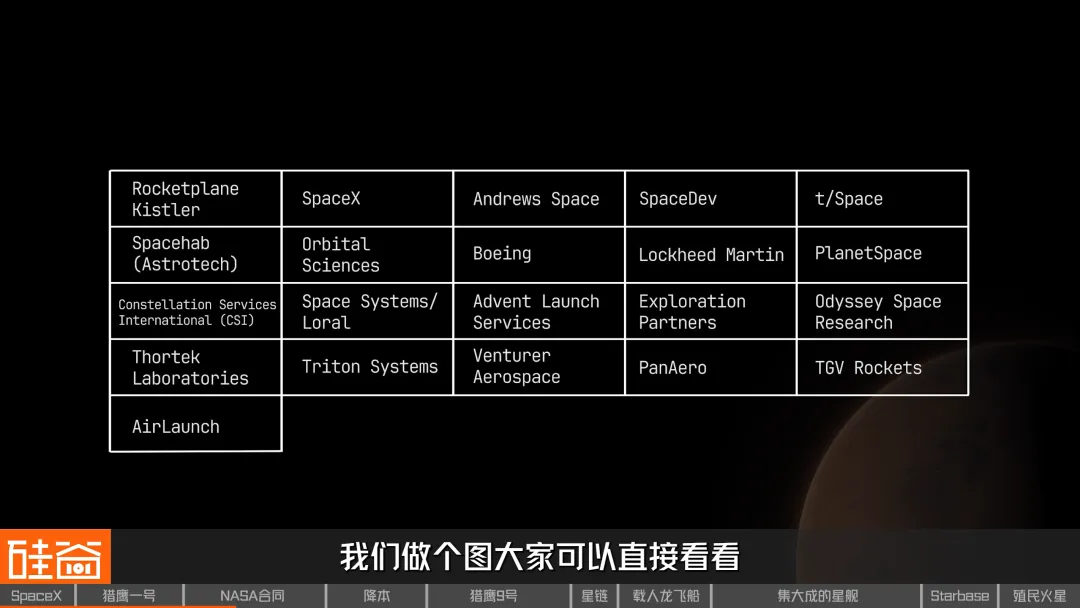
The non-winning companies fell roughly into four categories:
First, old wine in new bottles: Traditional contractors like Boeing and Lockheed Martin, whose proposals were basically modified versions of existing Delta and Atlas rockets.
Second, excessive dependence on Russia: Such as CSI, whose proposal directly involved importing Russian Progress spacecraft and Soyuz rockets, and leasing Russian launch sites.
Third, excessive technical risk: For example, t/Space proposed carrying rockets to high altitude aboard a specialized aircraft before ignition, while PanAero put forward a "space van" concept.
Fourth, pure PowerPoint companies with no prototype whatsoever.
NASA ultimately selected SpaceX and Rocketplane Kistler, both of which proposed independently developed reusable rockets. The Rocketplane Kistler team was composed almost entirely of former NASA personnel. Their K-1 rocket initially progressed even faster than SpaceX, and in NASA's technical scoring, it actually ranked higher than the Falcon 1. But the financial crisis made fundraising difficult for Rocketplane Kistler, and unlike SpaceX, their team had no wealthy backer like Elon Musk willing to foot the bill himself.
In October 2007, Rocketplane Kistler failed its financial review due to funding difficulties, and NASA withdrew its contract. In 2008, NASA reopened bidding, and Orbital Sciences filled the vacancy. After that, the story picks up where we left off above.
On September 28, 2008, the Falcon rocket's fourth launch finally succeeded. That same year, on Christmas Eve, NASA officially announced the $3.5 billion CRS-1 contract, awarding it to SpaceX and Orbital Sciences. Of this, Orbital Sciences received $1.9 billion and SpaceX received $1.6 billion. So even by dollar amount, there's no basis for concluding that NASA favored SpaceX.
Over the lifetime of the CRS-1 program, SpaceX was contracted for 12 missions and ultimately executed 20. According to SpaceX's original plan, after the Falcon 1's success, they would develop the slightly larger Falcon 5. But after securing the NASA contract, Elon Musk decided to abandon the Falcon 5 and jump straight to developing the Falcon 9. (The Falcon rocket naming convention is based on engine count: the Falcon 1 had one engine, while the Falcon 9 has nine.)
On October 8, 2012, CRS-1 saw its maiden flight. The Falcon 9 v1.0 lifted off from Cape Canaveral, Florida. Seventy-nine seconds after launch, the first stage's Engine 1 suddenly exploded. The onboard computer responded instantly, shutting down Engine 1, and the launch succeeded.
Two days later, the Dragon spacecraft arrived at the International Space Station. The mission delivered approximately 400 kilograms of supplies to the ISS, including chocolate-vanilla ice cream for the astronauts. On October 28, the Dragon splashed down in the Pacific carrying roughly 700 kilograms of experimental samples — mission accomplished.
Through the CRS-1 program, SpaceX secured the cash flow to survive, broke into NASA's core supplier circle, and — perhaps most importantly — before Starlink's rise, NASA's orders sustained the Falcon 9's launches and iterative improvements. From then on, SpaceX was no longer a small company struggling to stay alive.
In 2007, SpaceX moved to a larger factory. This had originally been Boeing's facility, later gradually taken over by SpaceX. Until Elon Musk relocated the headquarters to Texas in 2024, this remained SpaceX's global headquarters, responsible for rocket design, production, and assembly.
Lewis Hong: The SpaceX headquarters is on the right. On the left is a parking garage built specifically for employees. The circular building above is a facility for receiving Starlink ground stations. One day at noon, everyone received an email telling employees who parked there to move their cars, because the boss was about to start digging — the starting point for what would become the Boring Company.
Chen Qian: So this whole area has SpaceX, Tesla, and the Boring Company — all three companies together?
Lewis Hong: Yes, it's all the center of Elon's activity.
Chen Qian: This arrangement actually makes it convenient for him to shuttle between different companies. Is it to save time?
Lewis Hong: Yes, at the time Elon's weekly schedule was very fixed: Mondays were all-day meetings at SpaceX, then he'd go to Tesla's global design headquarters to review design plans, then take a private jet to the Tesla office. Tuesdays and Wednesdays he worked at Tesla. Thursdays he returned to SpaceX for all-day meetings. Weekends he might go to Australia to meet with the prime minister or handle other matters — he barely stopped all seven days of the week.
After the Falcon 1 succeeded and SpaceX secured the NASA contract, they leased this factory. It looks massive from the outside, and the building is very deep — the entire campus is roughly a mile deep. Behind the main factory are many machining workshops that Boeing previously used to make 747 parts. After that program ended, Boeing no longer needed them. SpaceX was growing rapidly, so they took over the entire campus and gradually expanded.
"Cut Them"
The Extreme Compression of R&D Costs
With the guarantee of NASA's massive contract, SpaceX could finally throw itself into R&D without restraint. To get to Mars, Elon Musk did what he'd always wanted to do: make launches cheaper.
In Musk's view, what was the biggest obstacle to reaching Mars? Technical challenges, funding pressure, government regulation — all of these were obstacles. But the biggest one was cost. If launching a kilogram of payload to space still cost tens of thousands of dollars like before, humanity would be trapped on Earth forever. To make launches cheaper, SpaceX pursued two tracks simultaneously: cutting costs and developing reusable rockets.
Let's start with cost-cutting. Inside SpaceX, Musk popularized a concept called the "idiot index" — the ratio of a part's total cost to its raw material cost. If the idiot index is very high — say, a part costs $1,000 but the aluminum to make it costs only $100 — then the design is likely too complex or manufacturing too inefficient.
Musk's exact words were: "If the thing you're making has a high idiot index, you're an idiot." He demanded that everyone reduce the cost of the parts they were responsible for by 80%. Those who couldn't deliver likely faced dismissal.
To lower the idiot index of its rockets, SpaceX put in enormous effort. Some of these details are extensively described in Walter Isaacson's Elon Musk.
For example, SpaceX needed an actuator that could rotate a rocket engine's nozzle. A supplier quoted $120,000, but Musk believed the device was no more complicated than a garage door opener. He demanded that one of his engineers build it for $5,000 each. In the end, a young SpaceX engineer discovered that valves used in car wash systems to mix cleaning solution could be adapted for use on the rocket.
A latch used by NASA on the space station cost $1,500. SpaceX engineers adapted a bathroom stall door latch that worked just as well for $30.
Another example: the air cooling system for the rocket's payload fairing cost $3 million. SpaceX engineers used a $6,000 residential air conditioning system, modified the pump, and achieved the same result.
On another occasion, Musk asked his engineers why a crane cost $2 million. The engineers produced Air Force safety regulations. Musk then successfully persuaded the Air Force to update its outdated regulations, and the final crane cost only $300,000.
Lewis Hong:
Before SpaceX, the rocket industry was extremely inefficient, riddled with corruption and waste. Musk would measure everything using something like an "idiot index," comparing it to Tesla: if a car could be made that efficiently, so could a spacecraft.
Take the Merlin engine. It's an extraordinarily precise machine, one of the largest engines in the world, and it cost several million dollars. Elon would ask: how much does it cost me to build a Model S? Why does a Merlin engine cost this much? It doesn't look that much more complex than a car — why this price?
Musk once said that the first step in any task should be to question the requirements you've been given, because all requirements contain, to some degree, stupidity and error — so you have to cut them out. Whether at Tesla or SpaceX, in every production meeting, Musk would seize every opportunity to chant his so-called "Five-Step Work Process" like a mantra.
What is the Five-Step Work Process?
First, question every requirement. You must know the name of the person who made the requirement, and then you must question them, no matter how smart they are.
Second, delete every part and process you can delete. You may have to add some back later. In fact, if you end up adding back less than 10% of what you deleted, you haven't deleted enough.
Third, simplify and optimize. This comes after step two, because the common mistake people make is simplifying and optimizing a part or process that shouldn't exist in the first place.
Fourth, accelerate cycle time. Every process can be sped up, but only after following the first three steps. Musk said that at the Tesla factory, he mistakenly spent a lot of energy accelerating production processes before realizing some of them should have been eliminated entirely.
Fifth, automate. You should first question all requirements, delete unnecessary parts and processes, screen out and fix problems, and only then push forward with automation.
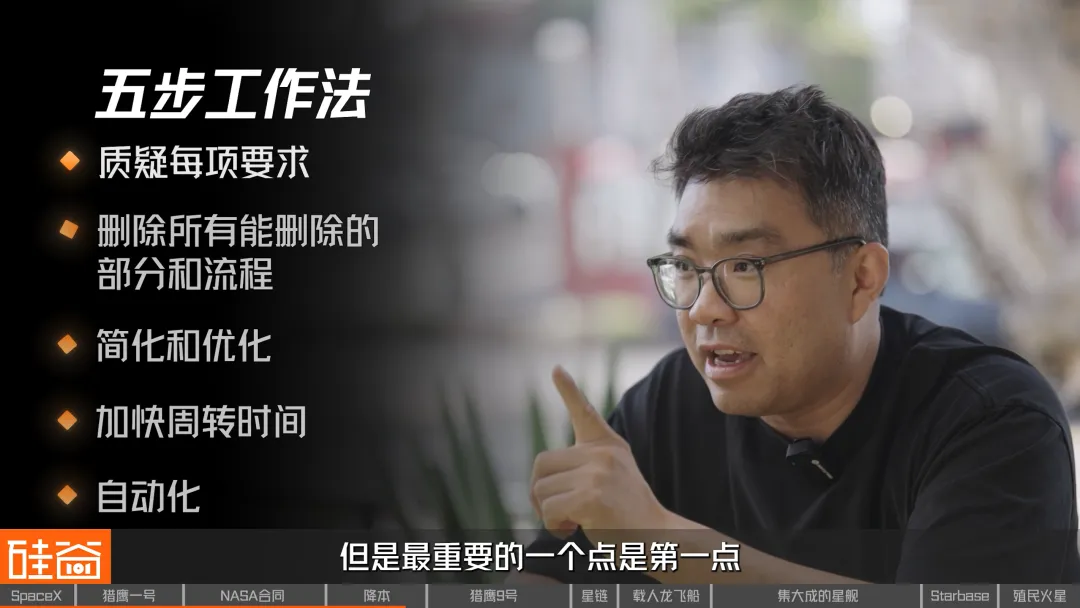
Chen Qian: How do employees view the "Five-Step Work Process"?
Lewis Hong: His starting point is actually quite simple. Musk believes the most common mistake engineers make is imagining problems that don't exist. Very good engineers often think: I've designed this thing to account for situations A, B, C, D, E — it's perfect under any condition. This is a trap engineers easily set for themselves.
Musk constantly challenges this: much of what we're doing now is in territory humanity hasn't fully explored, so what makes you think you already know what all these specs and requirements should be? So while the Five-Step Work Process has many details, the most important point is actually the first one: question the requirements.
Chen Qian: Were there people inside SpaceX who didn't buy into Musk? Who challenged him?
Lewis Hong: Outside media might give the impression that Musk is like a king — he has a powerful vision, he's extremely determined — but Musk is not an unreasonable person. This is something I feel many in the media haven't given him credit for. He's a good leader. He knows what he wants, and he knows how to push the whole company forward.
At the same time, Musk listens to reason. If you disagree with him, that's fine — you just have to prove to him why something doesn't work, or why he's wrong. He can accept that. What Musk won't accept is saying "this is too hard" or "this is impossible" without any basis. Inside SpaceX, or across all of Musk's organizations, this is a fatal proposition. Many people have probably been fired on the spot for making this mistake, even if they were outstanding.
With these measures, a brand new Falcon 9 rocket could have its cost brought down to roughly $50 million, about 30-50% lower than comparable products on the market. But even with cheaper rockets, if they were still thrown away after a single use like before, costs would remain too high to ever reach Mars.
Musk's original words were: if you had to throw away a Boeing 747 after every flight, how much would a plane ticket cost? So the next step was rocket recovery.
Developing Rocket Recovery: "All-In" After Repeated Explosions
In 2012, a bizarre-looking device named Grasshopper appeared at a Texas test site. It consisted of a Falcon 9 first-stage rocket tank, one Merlin engine, and four massive fixed steel landing legs. This four-legged metal can was built to validate the technical feasibility of a recoverable rocket.
On its first test, it merely hopped, lifting just 1.8 meters off the ground. The second test added hover time, reaching 5.4 meters. By the seventh test, Grasshopper had reached its target altitude of 250 meters, but instead of hovering as usual, it began translating sideways mid-air. After shifting 100 meters horizontally, it readjusted its attitude, re-aligned with the "X" mark at the center of the launch pad, and landed precisely at the center.
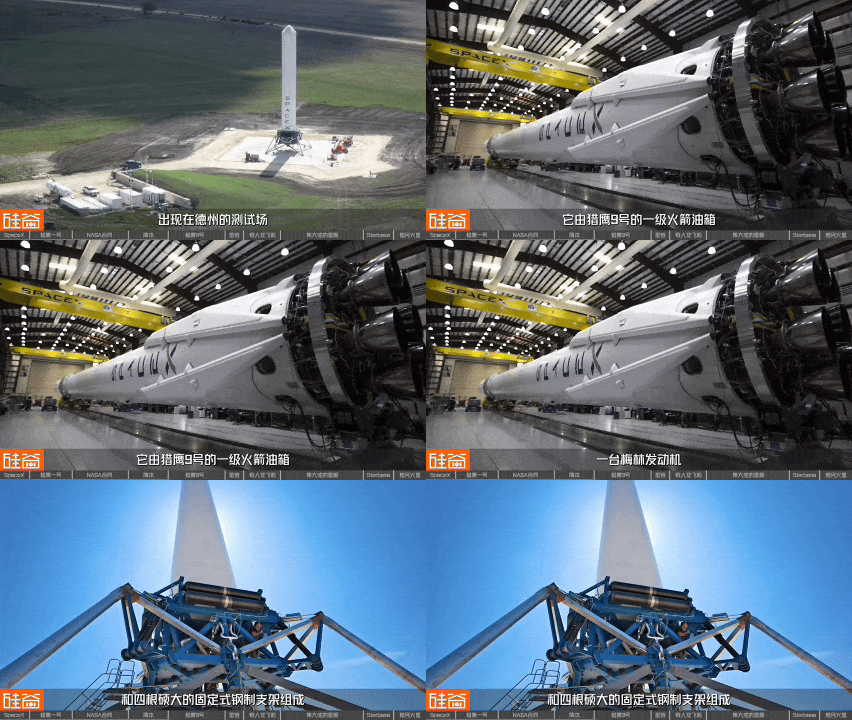
After Grasshopper completed its technical validation, 2014 brought the beginning of real rocket recovery tests — and it was during this period that SpaceX contributed countless "rocket explosion" videos to the world.
April 2014: first attempt to land on the ocean surface. The rocket successfully decelerated, but then tipped over and capsized.
January 2015: first attempt to land on an autonomous drone ship. The rocket crashed into the vessel and was destroyed. Musk self-deprecatingly called it a "rapid unscheduled disassembly."
April 2015: another ocean recovery attempt. The rocket hit the ship too hard and exploded into a fireball.
June 2015: the darkest moment of SpaceX's previous decade. The rocket disintegrated mid-air after launch. This was the Falcon 9's first major accident, and recovery experiments were forced to halt for six months.
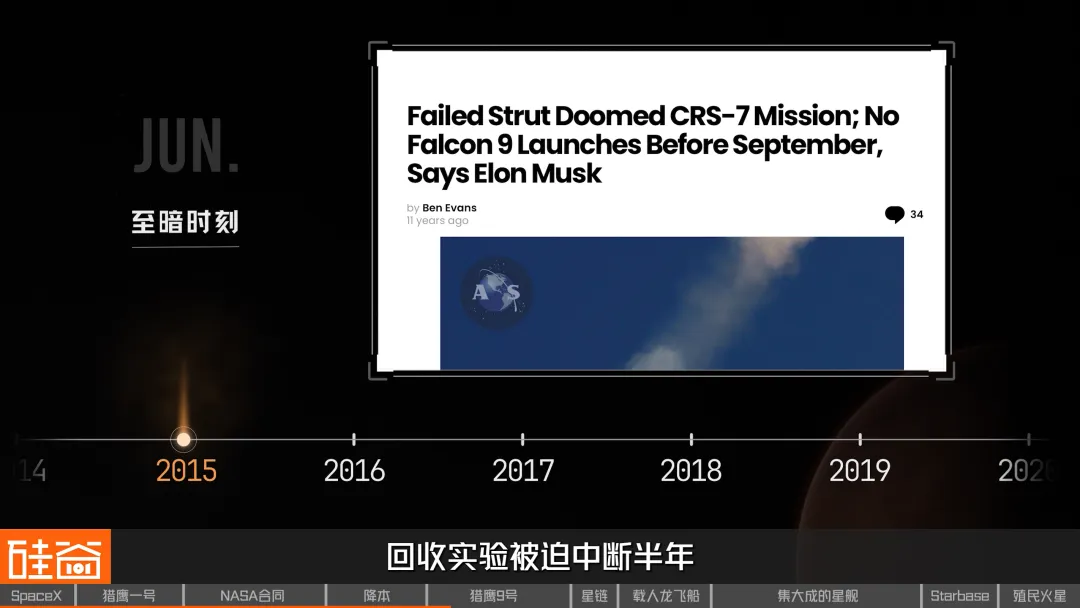
Chen Qian: From 2014 to 2015, you were the lead engineer on the Falcon 9. That was also when the Falcon 9 kept exploding. What was the atmosphere inside the company? Was everyone under enormous pressure?
Lewis Hong: Immense pressure. I think SpaceX at that time was closer to bankruptcy than even after the third failed launch of Falcon 1.
During the Falcon 1 phase, Elon could still figure out ways to ask his best friends for help, or sell his house, scrape together some more money, and get through one last launch. But by 2015-2016, SpaceX's scale and burn rate were completely different. This funding gap couldn't be filled by someone pitching in a bit more money. Unless you solved the problem yourself, there was no other way out. So the pressure then was company-wide. Honestly, if you ask many people at SpaceX, they'd probably say that was the company's lowest point.
What made it harder was that you didn't know where the problem actually was. You had to find an "unknown unknown." And at the same time, there was nobody in the industry who could help you.
Before, you could reference experience from NASA and other agencies. But when you're running ahead of NASA, ahead of the entire world, you can only rely on yourself. Worst of all, other companies were taking the opportunity to poach SpaceX talent in large numbers. So it was intense pressure from both inside and outside.
I was at the very center of that project because the problem originated in our department. Every day was high-pressure. Looking back now, we'd call it a very low period. But in the moment, you don't have the luxury of wondering if you're sad, if you want to cry, if you want to give up. You just stay busy. Like everyone around you, the only thing you can do is try every possible way to find the problem. We had no way back, only forward. If we couldn't make it work this time, the company would stop right there.
Chen Qian: During that period, what signals was Elon giving you inside the company?
Lewis Hong: At the peak of the pressure, you could actually see the team's cohesion. When the company faced such serious problems, nobody was pointing fingers: whose fault is this? Who should take full responsibility? Which department screwed up? Everyone was genuinely, wholeheartedly trying to solve the problem. Elon was the same way.
Elon himself is incredibly smart, and he knew he had to give the team enough room to execute — after all, nobody understood the technical details better than the people on the ground. So he gave us a lot of space. As a leader, he was genuinely supportive during that time.
One Sunday evening, we urgently needed to transport a critical rocket component from Florida back to California for testing. We wanted to verify whether the component's condition matched our theoretical assessment at the time. I reported this to Elon, and he said without hesitation: "My plane is in Florida. Just use my private jet." So that day, we literally turned Elon's brand-new private jet into a SpaceX cargo plane. The interior was pristine white, but we loaded that rocket component on board and flew back to California on Elon's plane.
Why do so many people want to follow Elon? I think in many people's eyes, he comes close to the perfect leader because he has always been someone who puts the company first. During the company's lowest point, Elon also spoke to the entire company. He wasn't particularly skilled at public speaking back then, but he said something very simple. He said, this company means everything to me — so much so that I would sell all my assets, even borrow money. I would put my last dollar into this company. You might say a lot of bosses say things like this during tough times, but when Elon said this to the entire company, not a single person questioned whether he was just grandstanding. Everyone deeply believed that he was exactly that kind of person, and that he would actually do it. So everyone also felt that we had to give it our all — we had to solve this problem.
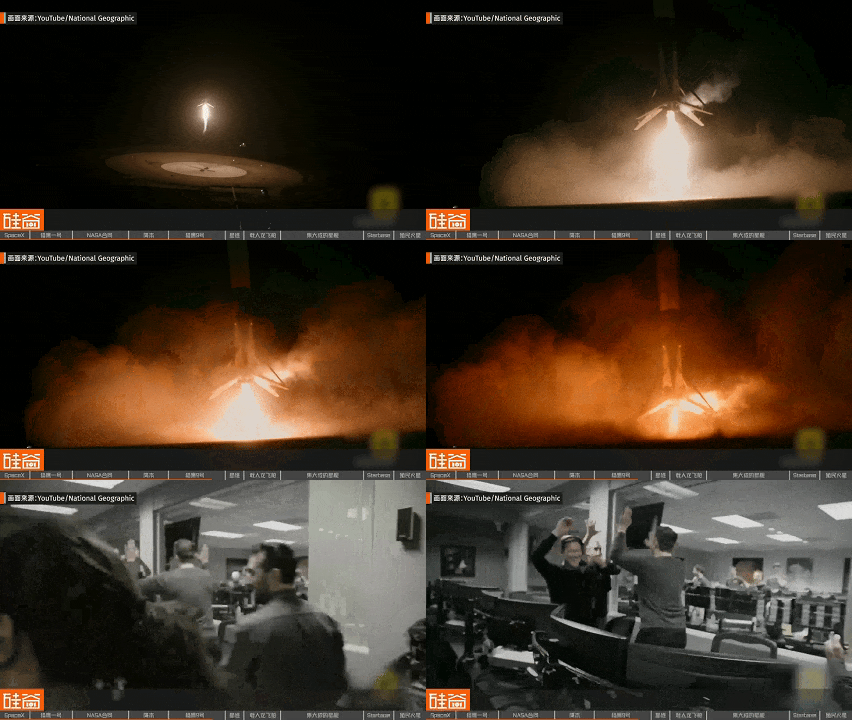
Six months later, a miracle happened. On December 21, 2015, Falcon 9 completed its first land-based recovery — the first orbital-class rocket in human history to be successfully recovered.**
The next iconic moment came on April 8, 2016, when Falcon 9 completed its first sea-based recovery. From then on, recovery sites were no longer limited to high-risk land areas. The drone ship that Falcon 9 landed on was the famous "Of Course I Still Love You" — a name that brought a touch of romance to rocket testing.
In February 2018, Falcon Heavy made its maiden flight. The image of two boosters simultaneously landing vertically on land stunned the world once again.
Lewis Hong:
What we're looking at right here is the first successfully recovered orbital-class rocket in the world. On December 21, 2015, this was the very one that landed successfully for the first time. This is the actual rocket that flew a mission, was recovered, and preserved — everything is original, nothing is a mockup. Its height doesn't look that dramatic, especially compared to Starship, which is much taller. But many people actually can't imagine how tall a rocket really is. You only get that feeling when you're actually standing next to it.
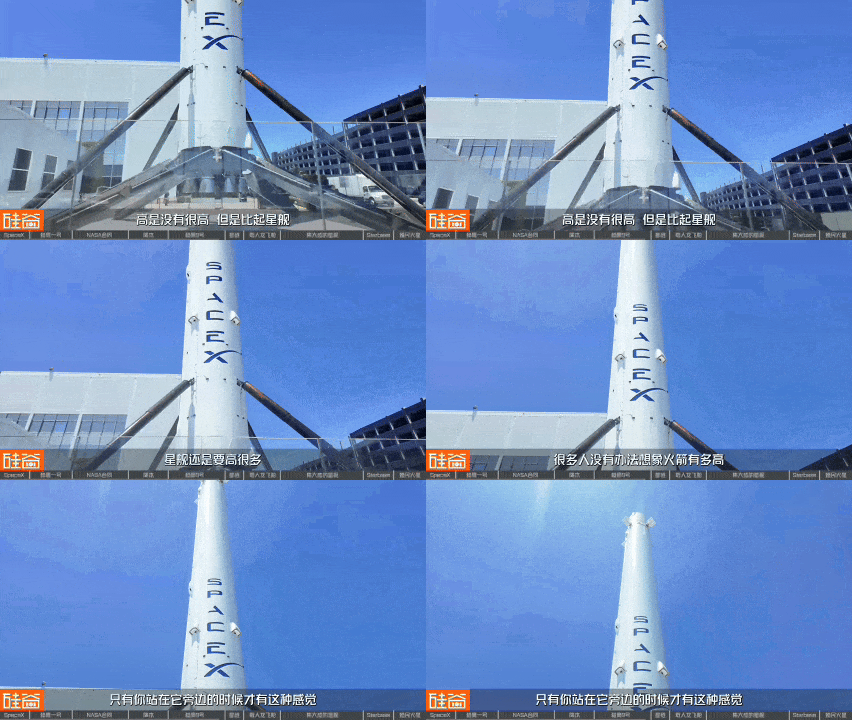
Currently, Falcon 9 recovery has reached a very mature stage, with success rates approaching 100%. Multiple rockets have completed more than 20 recovery missions. At the same time, turnaround speed is extremely fast. The shortest interval between two launches for the same rocket has been shortened to under 20 days. Just recently, on February 21, 2026, a Falcon 9 first-stage rocket successfully completed its 33rd launch and recovery mission — a number that once again broke the world record it itself had set.
Keep in mind that the aerospace industry had previously believed recovery around 10 times was essentially the physical limit. But with continuous optimization of rocket thermal protection and engine materials, this threshold has been pushed higher and higher. Elon Musk once predicted that Falcon 9's ultimate lifespan could reach over 100 flights. At this point, SpaceX has completed its disruption of the entire industry's cost structure.
Starlink
SpaceX's Cash Flow Engine
After all these stories about rocket manufacturing and launches, we still need to return to Elon Musk's original vision for founding SpaceX: going to Mars.
The global space launch market is only a few hundred billion dollars a year. Even if SpaceX captured all of it, that wouldn't be enough to cover the enormous cost of going to Mars. So satellite internet entered Musk's sights.
According to Musk's initial calculations, the global internet communications business is roughly a $1 trillion market. If Starlink could capture 3% market share, that would be $30 billion in revenue — more than NASA's annual budget. So in 2015, Musk announced he would launch a space-based high-speed internet program: Starlink.
The Starlink proposal had very clear commercial use cases. According to a 2015 survey by the International Telecommunication Union, more than half the world's population — about 4 billion people — remained unconnected to the internet. Even in developed countries, communications in sparsely populated remote areas were similarly poor. A U.S. Federal Communications Commission report stated that over 24 million Americans lacked access to fixed broadband. In rural America, approximately 28% of the population had no high-speed internet access.
Starlink's goal is to build a globally covered, high-capacity, low-latency space-based communications system, using 42,000 satellites to replace traditional ground-based communications infrastructure and provide satellite broadband services worldwide.
In February 2018, SpaceX successfully launched a Falcon 9 rocket from California, sending two small experimental communications satellites into orbit. The Starlink program had begun. To date, more than 10,000 Starlink satellites are in orbit, representing approximately 65% of all active satellites in orbit globally. Starlink's global subscriber base has surpassed 10 million, providing service in over 155 countries and regions.
Beyond individual users, commercial customers are also scaling up. Major airlines including Hawaiian Airlines, Qatar Airways, and Air New Zealand have introduced Starlink service, allowing passengers to stream video smoothly in flight. Cruise lines including Royal Caribbean, Norwegian, MSC, Carnival, Costa, and Silversea have successively begun partnering with Starlink to provide internet service for passengers in the middle of the ocean. According to SpaceX's latest prospectus, Starlink's full-year 2025 revenue was $11.4 billion, accounting for 61% of total 2025 revenue.**
**Starlink's significance goes far beyond simply generating revenue. Of SpaceX's 165 launches in 2025, 123 were Starlink deployments — approximately 74.5%. In other words, even if competitors emerge in the future, nearly three-quarters of SpaceX's launch missions are ones that no one else can take away.
With Starlink's total planned constellation of 42,000 satellites, and annual replacement needs of 10% to 15%, future Starlink launch missions will only increase. Such a massive number of launch missions not only allows SpaceX to amortize the unit costs of rocket R&D and production, but also enables SpaceX's various rocket models to continuously test, improve, and iterate — further reducing costs and improving performance.
From the moment Starlink began operating, SpaceX stood at the intersection of business and technology, and the dual growth flywheel started spinning.
Victory Over Boeing
Redefining the Crewed Spacecraft
Once Falcon 9 reached maturity, SpaceX had become the backbone of American spaceflight and NASA's most relied-upon contractor. The program that put SpaceX in the spotlight — and made Boeing lose face — was CCP. CCP stands for Commercial Crew Program. Where CRS moved cargo, CCP moves people; both destinations were the International Space Station.
As before, NASA split the contract between two companies: SpaceX and Boeing. And once again, SpaceX didn't get the larger share — $2.6 billion versus Boeing's $4.2 billion.
To carry astronauts, SpaceX developed Crew Dragon from its cargo Dragon, producing the sleek white spacecraft that has dominated headlines in recent years. Crew Dragon abandoned the thousands of dense physical switches found on traditional spacecraft. Instead, astronauts face three massive high-definition touchscreens, operable even while wearing gloves. The interior resembles a modern laboratory — white, spacious, unmistakably futuristic.
Moreover, Crew Dragon can autonomously dock with the space station using its visual recognition system, with no need for manual astronaut control.
By contrast, Boeing, despite its larger contract, consistently underperformed. Its Starliner spacecraft, after countless setbacks, finally launched in 2024 — only to suffer thruster failures and helium leaks that stranded two American astronauts on the ISS for over nine months. The pair eventually had to return to Earth aboard SpaceX's Dragon, a humiliating outcome for Boeing.
Under these circumstances, Boeing's crewed flight program has now been indefinitely suspended, making Crew Dragon the de facto only American crewed spacecraft.
Chen Qian: Are there cases where someone challenged Musk internally and he actually listened?
Lewis Hong: The interior design of Crew Dragon is a classic example. Compared to NASA's previous spacecraft and Russian capsules, Dragon is radically different. Older spacecraft interiors were like vintage 737s — buttons everywhere. Dragon looks more like a Model S: flat, clean, futuristic.
But this design generated significant internal controversy. Physical buttons are far simpler for safety and iteration. Musk's stance was clear: the spacecraft gets one screen, zero buttons. Everyone knew this wasn't impossible — just extremely difficult. Some functions could be solved simply with a few buttons. The question was how to explain this to Musk. The colleague leading this effort used a clever approach. His presentation was remarkably simple. First, he showed Elon several versions.
Version one: the traditional NASA design, packed with buttons. Version two: a middle ground — screens plus a small number of critical buttons.
Version three: exactly what Elon wanted — almost entirely screens, no buttons, extremely clean, extremely futuristic, with many operations controllable by voice. After seeing them, Elon of course said: "Perfect. I want this." He meant version three.
Then the second slide came out. The team said: Okay Elon, we also ran the numbers. Version one costs this much, version two this much, version three this much. What do you think? Elon's response: "I want version three at version one's price."
That's the art of presenting to Elon. Get your main point across in the first two slides, but have fifty or sixty pages ready to back up every argument. The team then methodically proved to Elon why version three couldn't hit version one's price, and why the middle option was the most reasonable, most achievable choice for the moment.
This is a true story. The Dragon capsule we see today does come close to Elon's original vision, but it retains some emergency buttons and necessary physical controls. It's not simply a compromise — more accurately, it's a design optimization.
Beyond ferrying astronauts to the ISS, Crew Dragon has had no shortage of highlight moments.
The 2021 Inspiration4 mission achieved the first all-civilian orbital flight. Not a single professional astronaut was aboard, demonstrating that the spacecraft's automation was sophisticated enough for ordinary people to reach orbit after just months of training.
The 2024 Polaris Dawn mission accomplished humanity's first commercial spacewalk, led by current NASA administrator and Shift4 founder Jared Isaacman. During the mission, the spacecraft reached an orbital altitude of roughly 1,400 kilometers — the farthest humans have traveled from Earth since Apollo 17 in 1972.
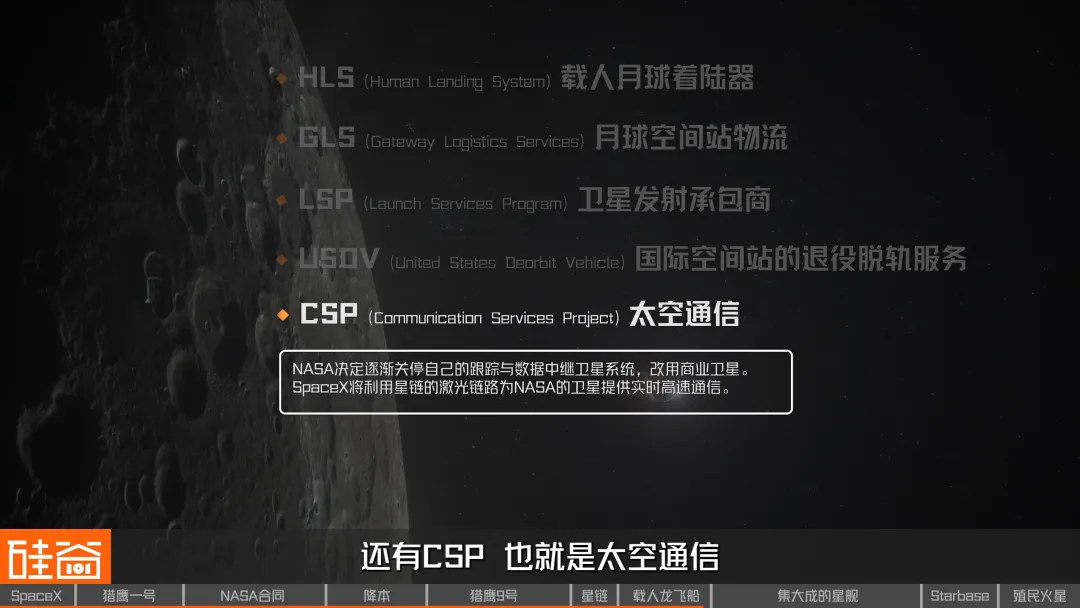
To date, SpaceX has penetrated nearly every major NASA program.
Starshield and Defense Contracts
A Critical Pillar of the Trillion-Dollar Valuation
Starting in 2024, SpaceX's financial briefings and analyst reports have shown defense revenue rising rapidly — both in absolute terms and as a share of total revenue. Based on estimates from research firms like Quilty Space and Payload, along with Wall Street Journal reporting, SpaceX's defense business has reached roughly $5 billion in annual revenue.
Some space industry observers have noted that in 2025, approximately 25% of SpaceX launches had no specified service area on the company website, with orbital altitudes kept classified. On SpaceX's website, there is a dedicated section introducing Starshield.
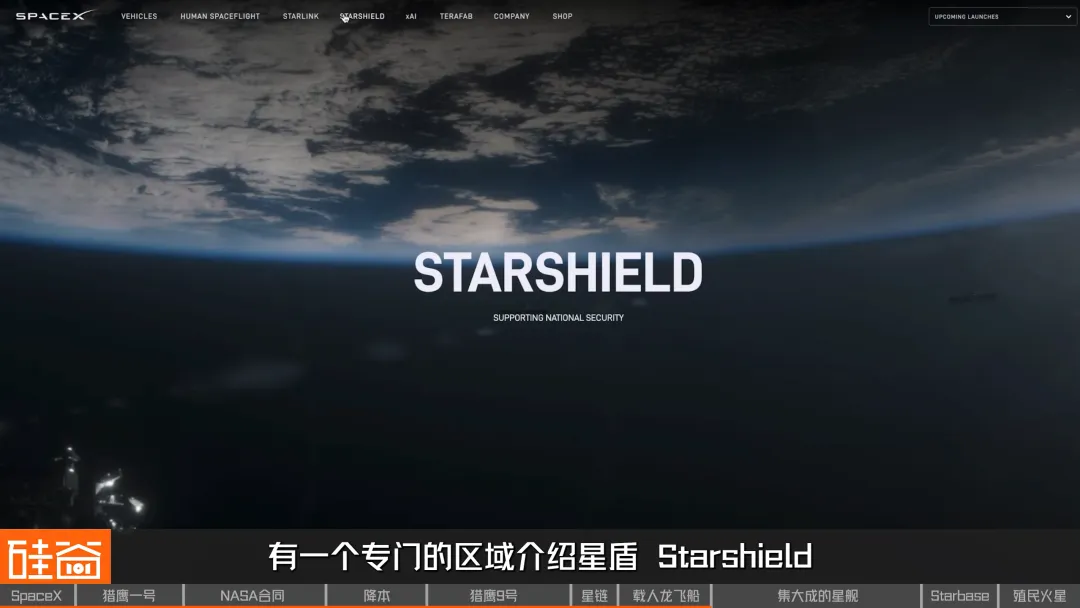
Starshield is not a specific satellite model but rather the umbrella term for SpaceX's government and defense business. The actual satellites in orbit fall into three main categories.
First, conventional military communications satellites. These are primarily modified Starlink V2 and V3 satellites, built on proven Starlink platforms and production lines, but upgraded with anti-jam antennas, military-grade encryption modules, and laser interlink interfaces.
Second, SpaceX provides only the satellite bus, while government or military customers select their own payloads. Think of it as "space Lego." SpaceX supplies a chassis with complete propulsion and navigation systems; clients then install whatever they need — high-resolution cameras, electronic surveillance equipment, or other mission-specific payloads.
Third, entirely new non-communications satellites developed in-house, such as the missile-tracking constellation already deployed at scale. These satellites are covered in various detectors and sensors, purpose-built for monitoring intercontinental ballistic missiles and hypersonic vehicles worldwide.
In just a few short years, SpaceX has become a core supplier to the U.S. military in space. According to American media disclosures, SpaceX is currently deploying hundreds of spy satellites with real-time imaging capabilities for the National Reconnaissance Office — an $1.8 billion contract.
SpaceX is also building a dedicated military communications network for the U.S. Space Force, consisting of 480 satellites. Just in late May, StarShield secured two new contracts totaling $6.45 billion. Both came from the U.S. Space Force — one for building a low-Earth-orbit communications network, the other for identifying and tracking ballistic missiles.
Unlike civilian business, government contracts are typically long-term, exclusive, and prepaid. With extensive customization requirements layered on top, their profit margins generally exceed those of civilian contracts. Consequently, the lucrative and steadily growing government and defense business not only underwrites Starship's hefty R&D costs but also constitutes a major component of SpaceX's trillion-dollar valuation.**
Starship: The Culmination
Solving Mars Logistics and Technical Innovation
Elon Musk once calculated that establishing a self-sustaining city on Mars would require at least one million tons of various materials in the early stages. This demanded a rocket with sufficient payload capacity and low enough cost — and thus Starship, the culmination of everything, was born.
By this point, SpaceX had grown into an industry giant, with high-margin businesses like Starlink and Starshield feeding resources back into the company. Unlike the Falcon 9 before it, Starship is a completely new rocket developed from scratch.
Lewis Hong:
Starship is a rocket without precedent. Nothing like it has ever existed in history. So much of the time, whether in construction or testing, we're doing something for the first time — no one else has done it either. We can use all kinds of simulations to make our best guesses, but we still encounter unexpected extreme cases.
Starship's importance to SpaceX can actually be explained with a simple first-principles analogy. If you need to move cargo today, using a Ferrari, a truck, or a train — the scale of what you can carry, the cost, and what you can actually do are completely different. Rocket Lab's vehicle is kind of like a Ferrari; Falcon 9 is more like a semi truck now. And in that analogy, Starship is basically a train to space.
More importantly, Starship is designed to be fully reusable — and not just reusable, but rapidly reusable. The emphasis is on rapid. That's the biggest difference between Starship and Falcon 9. From the very beginning of its design, it's a rapidly reusable, entirely new space platform. At the same time, its carrying capacity and volume represent an order-of-magnitude leap beyond Falcon 9 — maybe 10x, maybe 30x.
So Starship could open up many space possibilities that people previously thought impossible, in low Earth orbit and even farther out. What it's trying to do is build an entirely new ecosystem — one bigger than Earth, maybe even more important than Earth. It's about doing things in space that can't be done on Earth, but that Earth needs.
To support Starship launches, SpaceX developed the Starbase concept. Hundreds of engineers participate in design, testing, production, assembly, and launch here. All of this serves to advance the development and manufacturing of Starship — the largest rocket in human history.
Lewis Hong:
What we're looking at now is the core headquarters of Starbase — Starbase itself. These two large black buildings are what SpaceX internally calls the Megabays, the giant factories. The final assembly of large rockets happens inside these two black towers.
Behind them, in the blacked-out area we can't see right now, is a very large factory and engineering zone. The whole logic is: the rear area handles production, and all components get sent to these two Megabays for final assembly. Once assembly is complete, the rockets stand there just like the two we see on our left — these should be V2 versions. After that, the rockets are transported directly out of the Megabays and over to the launch pad on the right.
So this actually achieves production, assembly, and launch all at Starbase, all in the same location. You can think of it as SpaceX's next super-factory.
Now, let's break down Starship's main innovations in detail.
First, the engines. Starship completely abandoned the Merlin engines used on Falcon 9 and developed the Raptor engine from scratch. In multiple interviews, Musk has made clear that developing and mass-producing the Raptor engine has been one of the most difficult engineering challenges SpaceX has faced since its founding.** SpaceX President Gwynne Shotwell has also said that roughly half of Starship's development work has been concentrated on the Raptor rocket engine.**
What's special about the Raptor engine is its use of liquid oxygen-methane as propellant. Compared to the liquid oxygen-kerosene fuel used in the Merlin engines, methane offers several advantages:
First, there's no petroleum on Mars, but there is carbon dioxide and water ice. Through simple chemical reactions, methane can be produced on-site using local materials.
Second, kerosene produces large amounts of carbon deposits when burned at high temperatures, which easily clog the engine's narrow cooling channels. This is why each Falcon 9 requires more than ten days before it can launch again after recovery — the engines need complex cleaning. Methane burns much more cleanly, producing almost no carbon buildup, meaning Starship can be relaunched quickly after recovery. Musk's goal of "landing and taking off again within an hour" is only achievable with methane engines.
Third, liquid oxygen is cryogenic while kerosene is room temperature. This means the barrier between them must be made extremely thick to prevent the kerosene from freezing. But liquid methane's temperature is very close to that of liquid oxygen, eliminating the need for bulky insulation and reducing weight that can be traded for more payload.
Another innovation in the Raptor engine is its full-flow staged combustion cycle.
Simply put, it uses two preburners to separately drive the fuel pump and oxidizer pump, then routes all fuel and oxidizer into the main combustion chamber for complete combustion. This maximizes fuel efficiency and improves thrust-to-weight ratio and engine life, but the design complexity is extremely high, and the materials science demands are borderline insane. Musk has said that the Raptor engine's internal pressure and temperature approach the theoretical limits of physical materials.
Both methane as a fuel and the full-flow staged combustion engine architecture had been prototyped or demonstrated as experimental units before, but Raptor is the first to achieve mass production and actual flight on an orbital-class rocket.
What's even more impressive is the Raptor engine's iteration speed. From Raptor V1 to Raptor V3, the visible changes are dramatic. The V1 Raptor was wrapped in hundreds of tubes, sensors, and various wires, looking utterly chaotic. The V2 Raptor eliminated large numbers of redundant sensors and complex tubing through redesign. By the V3 Raptor, almost no plumbing is visible on the exterior — you might even wonder if it's actually an engine.
The numbers tell the story: Raptor engine weight dropped from 2 tons in V1 to 1.5 tons in V3, while thrust increased from 180 tons to 270 tons. It's fair to say that despite sharing the Raptor name, the V3 and V1 are completely different things. This entire process took just over two years.
Having covered the engines, let's turn to Starship's most visually distinctive feature: the stainless steel hull.
When Starship was first being designed, Elon Musk scrapped the original carbon fiber plan at the last minute and pivoted to stainless steel — a material that looked shockingly low-end to the aerospace establishment at the time. Using stainless steel for rocket bodies wasn't Musk's invention. Germany's V-2 rockets from World War II and the United States' first-generation Atlas launch vehicle both used stainless steel hulls.
As a structural material, stainless steel has several major advantages. First, it's cheap. Aerospace-grade carbon fiber is extraordinarily expensive; by comparison, stainless steel is practically free. Second, it's not finicky. A carbon fiber hull requires building the rocket in a cleanroom. Constructing a temperature- and humidity-controlled cleanroom big enough for a 100-meter rocket takes years and hundreds of millions of dollars. Erecting a giant tent takes weeks and costs next to nothing.
Another superpower of stainless steel: it fears neither heat nor cold. Carbon fiber softens and fails at around 200 degrees Celsius. That means a carbon fiber Starship would need extremely heavy, extremely high-maintenance heat tiles — adding back all the weight you saved and making rapid reuse that much harder. Stainless steel has a much higher melting point and retains structural strength at 800 degrees, which saves enormous weight on thermal protection.
Most metals turn glass-brittle at cryogenic temperatures, and Starship's propellants — liquid oxygen and liquid methane — are stored far below minus 150 degrees. But stainless steel actually gains strength in the cold: its yield strength and tensile strength improve by over 50%.
In July 2019, a comical-looking stainless steel "water tank," welded together in an open dirt field on the Texas coast, hopped 20 meters on a single Raptor engine. A month later, the same "tank" leaped to 150 meters, translated sideways in midair, and landed. This was Starhopper, the early test vehicle built primarily to validate the Raptor engine.
Lewis Hong:
This was significant — it was essentially Starship's first test version. For something as massive as Starship, this was the starting point. In 2019, we built this test rig together. It was basically a mini Starship-sized barrel with a thruster attached, testing the whole hop sequence. After that, in just five short years, Starship evolved all the way to what we see today — the reusable version.
Over the following two years, the Starship upper stage went through seven test flights, contributing more than its share of explosive spectacle to the world.
On the third test, it debuted the dramatic "belly-flop" and "landing flip" maneuvers for the first time, only to have its engines shut down before touchdown and disintegrate on impact. Tests four through six all ended in explosions.
It wasn't until the seventh test that a milestone was reached. The Starship upper stage flew to 10 kilometers altitude, then descended gracefully and landed smoothly. The landing algorithm was cracked.
Starting in 2023, the Starship first and second stages finally came together for integrated testing. This is when Starship truly broke into the mainstream consciousness.
In April 2023, the full-stack Starship launched for the first time. The thrust was so violent it shattered the launch pad; the vehicle self-destructed in flight. Musk was thrilled. "Not blowing up on the pad is a win," he said.
In March 2024, Starship reached suborbital space for the first time and attempted to open its payload bay.
Then came the epic imagery of October 2024. On Starship's fifth test flight, two "chopsticks" on the launch tower — Mechazilla — caught the returning first stage booster in midair. The world watched in awe. So this is how rocket recovery can be done.
Subsequent tests focused mainly on heat tile shedding and engine relight issues.
Then in May 2026, the all-new V3 Starship made its debut, equipped with the new Raptor 3 engines, a stretched body, nearly 9,000 tons of total thrust, and the ability to lift nearly 100 tons of payload in a single launch.
Lewis Hong: The very first generation of launch pad did get destroyed. This is a new design. On the first launch, nobody knew Starship had that much power, so it dug a crater in the ground and flung debris everywhere. But these are all newly designed now — that won't happen again.
Chen Qian: Falcon 9 can recover two boosters simultaneously. Could Starship ever achieve dual chopstick recovery?
Lewis Hong: Use your imagination. Eventually this whole row could be launch towers. You don't go to an airport and find only two gates. That's why there's so much space left here — because in the future there may be Tower Three, Tower Four, Tower Five.
Chen Qian: How many years do you think that will take?
Lewis Hong: At SpaceX speed, definitely within ten years. Within five years, I think SpaceX should already be pushing in that direction.
"Spaceport" Starbase
Integrated rocket manufacturing, testing, and launch
As Starbase has grown, SpaceX has rapidly transformed Boca Chica, Texas — the southernmost point in the continental United States, the closest location to the equator, separated from Mexico by a single bridge.
Previously, this was indigenous fishing and hunting territory. As recently as the 2010s, it was essentially a desolate strip with no post office, no mayor. The influx of engineers and their families brought by Starbase, plus tourists drawn by the spectacle, has livened up the town considerably in recent years.
Lewis Hong: Every SpaceX site has a "SpaceX bar" — it's a long-standing tradition. In the early days, every launch was a major event. Maybe one launch a year. When it succeeded, everyone was ecstatic, and we'd all go celebrate at Rock & Brews in El Segundo, Los Angeles. That gradually became the SpaceX tradition. Of course, as launch frequency increased and it became more routine, you can't celebrate every single time. But for major milestones — Starship's first flight, Starship's first recovery — SpaceX still gathers to celebrate. VPs, Gwynne [Shotwell, SpaceX President], Elon — everyone comes together. SpaceX works hard, and the celebration parties are equally serious.
Chen Qian:
Work hard, play hard.
Lewis Hong: Before SpaceX arrived, there wasn't much going on here. Since SpaceX came in, look around — sushi restaurants, ramen shops, even refined high-end French cuisine. Lots of new places have opened in just the past few years.
Chen Qian: But across the street it's still rundown old buildings — shoe repair, shoe stores, those are the old local businesses that were here before.
Lewis Hong: Because this was always just a regular border town. Lots of Mexicans work here.
Today, SpaceX has completely transformed what was once the Boca Chica beach area. Meanwhile, Starbase has secured "municipality" status, meaning SpaceX employees can directly participate in local governance — allowing the company to build the most efficient community environment around its rocket launch headquarters, making it easier to scale up its workforce and operations in the future.
What was once wilderness has now evolved into a "Space port" — a spaceport concept integrating rocket manufacturing, testing, and launch. Lewis says Starbase is just the beginning of the experiment; Elon Musk already plans to build such Space ports across the United States.
Lewis Hong: SpaceX manufactures here, launches here. And most importantly, this won't be the only spaceport. Elon also said on Twitter that SpaceX will build multiple spaceports. Right now SpaceX is already scouting Louisiana — planning to build a second spaceport right by the Gulf of Mexico. So while Starbase is expanding rapidly, SpaceX is already laying out its second spaceport.
Chen Qian: So Starbase is just an early sample, and then this can be replicated across many other states — each place would have its own launch port.
Lewis Hong: It's the Gigafactory concept, running through the SpaceX system all over again. Even though there's undevelopable marshland on both sides here, there's still enough space for SpaceX to fully expand the Starbase facility. If they're going to achieve Elon's goal of 1,000 launches per year, SpaceX genuinely needs this kind of scale — so everything you're seeing now might not even be one-tenth of the future size.
But as Starbase expands rapidly and Starship launch frequency increases, the launch site and surrounding local residents, regulators, and environmental concerns will clearly need to find a new balance.
Local residents told us that when rockets launch, they can feel the entire ground shaking, and the sound of rocket launches can be heard from thirty or forty kilometers away. For them, this is a bad thing. They believe that rockets exploding in the air can't be good for air quality.
Colonizing Mars
IPO Is Just the Beginning, and Going to Mars Isn't the End
From teetering on bankruptcy to becoming NASA's core supplier, from Starlink to Starship — every step SpaceX takes is preparation for colonizing Mars. Colonizing Mars carries Elon Musk's strong personal imprint, but it's already delivering real benefits to many people on Earth.
Starlink gave children in a remote village deep in the Amazon rainforest their first stable internet connection — the local village chief even started worrying about kids getting addicted to the web. Crew members on cargo ships crossing the oceans could video call their families and exchange well-wishes from the middle of the sea for the first time.
The dramatic drop in launch costs is making many things no longer science fiction. Varda Space has already manufactured crystals of Ritonavir — an HIV treatment drug — in space, and will produce other pharmaceuticals that can only be made in microgravity.
Xona Space is building a private GPS navigation system that's more precise and cheaper than the US government-operated GPS. Redwire has already manufactured dozens of meters of optical fiber in space — fiber made in zero gravity has virtually no impurities and near-zero signal loss.
Once Starship truly matures, many things that are completely unimaginable now will become reality. And Musk says going to Mars is just the first step. SpaceX's true vast frontier is helping humanity one day become a multiplanetary species and achieve interstellar travel. That day lies in a more distant future.
Chen Qian: Why does SpaceX want to go to Mars? Why "Gateway to Mars"?
Lewis Hong: Mars is the first stop, but SpaceX's mission has always been: Make life multiplanetary. So it's not a rocket company, not a tech company — its goal is to open up the universe for human exploration. Mars is the first stop, the moon is also the first stop, but the ultimate goal should be that the entire universe becomes open to human exploration.
Chen Qian: How long do you think before humans can set foot on Mars?
Lewis Hong: I used to think 15 years was a solid timeline. Based on SpaceX's latest progress adjustments, I'd conservatively estimate within 20 years. We're currently in both the Great Space Age and the Great AI Age — the intersection of these two is an incredibly exciting future.
Chen Qian: Looks like it's still within our lifetime.
Lewis Hong: Looking forward to our next podcast being recorded somewhere beyond Earth.
Chen Qian: Recording a podcast on Mars?
Lewis Hong: Mars might be a bit far, but recording an episode on a new low-Earth-orbit space station is very, very realistic.
Chen Qian: Okay, let's set a goal: one day, within our lifetime, we'll record a podcast episode in a low-Earth-orbit space station.
Lewis Hong: No, the next podcast episode should be recorded in low orbit, and the one after that on Mars.
Although we didn't get to witness a Starship launch this time, just being at Starbase in person made it feel completely worthwhile.
SpaceX's story is a good story — a story of making the impossible possible, unfolding the future right before our eyes. And the IPO milestone is just the beginning; "going to Mars" isn't its endpoint either.
【Video Platforms】
Domestic: Bilibili | Douyin | Xiaohongshu | Channels | Weibo Tencent | Xigua | Toutiao | 36Kr | Huxiu | TMTpost | Cyzone International: YouTube | X
Contact us: video@sv101.net
【Production Team】
Executive Producers | Jun Hong, Chen Qian Writer | Li Dihao Host/Interviewer | Chen Qian Editor | Juzi, Frentee Motion Graphics | Chuai, Jacob Operations | Wang Ziqin, 13, Sun Zeping Graphic Design | Shi Chen Editing Assistant | Wen Chunyun