The Globalization Path of Embodied Intelligence: A Deep Conversation on Value Creation, Innovation, and Organizational Capability

Hard-hitting, practical insights from the front lines of the industry
As AI technology evolves rapidly, embodied intelligence is quickly moving from the lab to industry. "Globalization" has become an unavoidable topic. Differences in technical approaches, application scenarios, and market demands across countries and regions mean that taking embodied intelligence overseas presents both opportunities and challenges.
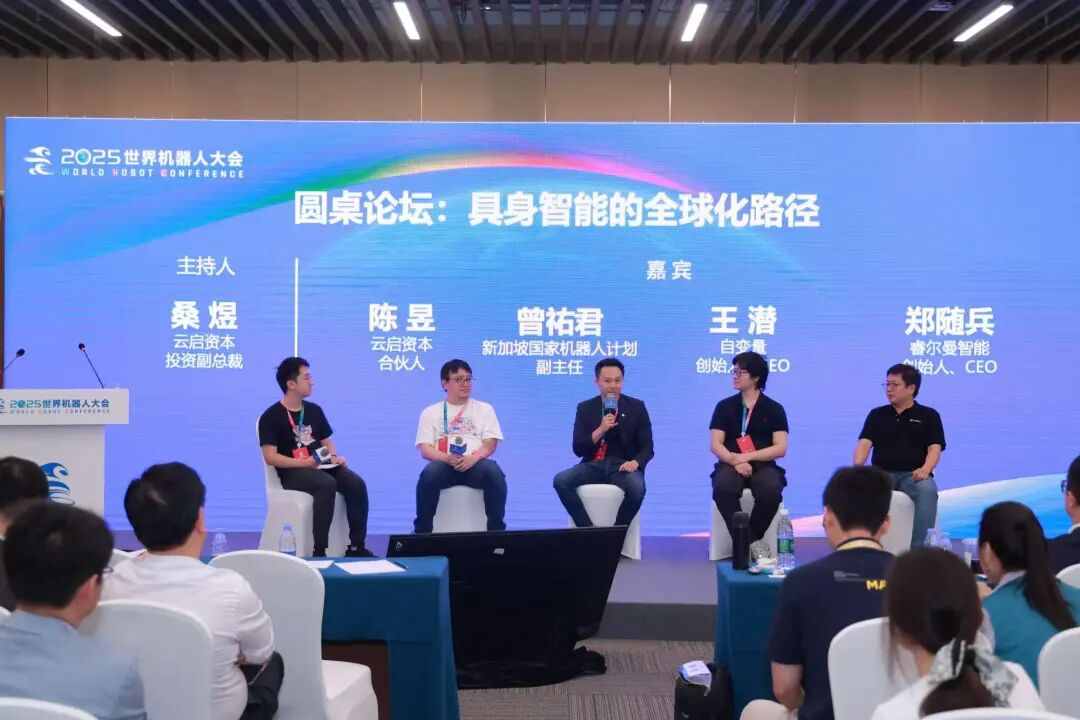
On August 9, at the WRC themed event "Embodied Intelligence: The Future Is Here — Venture Capital, Innovation, Creation" co-hosted by Yunqi Capital and the Unlimited Fund SEE Fund, we invited guests from investment, entrepreneurship, and international institutions to discuss "The Globalization Path of Embodied Intelligence." They shared genuine insights and practical experience on commercial deployment, technical adaptation, capital, and talent.
Below is the full transcript of the roundtable discussion.
Roundtable Guests
Chen Yu (Partner, Yunqi Capital)
Tsang Yu Chun (Deputy Director, Singapore National Robotics Programme)
Wang Qian (Founder and CEO, X-Variable Robotics)
Zheng Suibing (Founder and CEO, RealMan Intelligent)
Moderator
Sang Yu (Investment Vice President, Yunqi Capital)
The following content has been edited and organized.
Sang Yu:
I'm delighted to moderate today's roundtable on "The Globalization Path of Embodied Intelligence." Our guests include friends from investment, technology, and startups, as well as a delegation from Singapore. First, please introduce yourselves and share what concerns you most about the globalization of embodied intelligence.
Chen Yu:
Hello everyone, I'm Chen Yu from Yunqi Capital. Yunqi focuses on early-to-mid-stage technology investment, and embodied intelligence is a major priority for us. Since 2016, we've invested in robotics companies including Keenon, DeepRoute.ai, and Neolix, and in recent years we've supported embodied intelligence companies like X-Variable. We've always believed that China and the world face structural labor challenges. Robots can supplement the workforce, taking on dangerous, tedious, or repetitive work to make life better. That's the value of embodied intelligence.
Tsang Yu Chun:
I'm glad to be here in Beijing. The Singapore National Robotics Programme focuses on three areas: first, building research capabilities by investing in local universities and research institutes to advance robotics technology and talent; second, promoting industry and collaboration, such as through the RoboNexus project, which selects and supports Singapore's most promising companies; third, strengthening robotics applications by bringing together robot users, robotics companies, researchers, and relevant government agencies to jointly address economic, scientific, and other challenges. We also emphasize external exchange and promotion, and hope to have opportunities to invite everyone to Singapore for exchanges in the future.
Wang Qian:
Hello everyone, I'm Wang Qian from X-Variable Robotics. We have two layers of positioning: first, as a foundation model company for embodied intelligence; second, as a hardware-software integrated product company serving end customers.
We were the first company in China to propose and implement an end-to-end VLA embodied foundation model. We believe embodied foundation models are not an extension of language models, but rather original exploration independent of the digital world.
Currently, our model can already complete complex tasks such as pulling zippers, buttoning buttons, and industrial assembly, and we're seeing emergent signs of generalization. At this conference, we've also brought our latest self-developed robot body and dexterous hand.
From day one, X-Variable has positioned itself as a global company. We believe that in embodied intelligence, China and the US are starting from the same line, and we're working hard to catch up and strive for leadership.
Zheng Suibing:
Hello everyone, I'm Zheng Suibing from RealMan Intelligent. Since our founding in 2018, we've been committed to making robots truly accessible across all industries and into every household.
One of the biggest bottlenecks for robots entering daily life is whether they can actually "do work." Today, the vast majority of companies in this venue have developed or even customized products with different appearances based on RealMan's joint modules and robotic arms. What we do is build the foundation for the embodied intelligence industry. We hope to cooperate with companies like X-Variable in the future, combining the "brain" and the "body" to let robots truly enter people's lives.
Commercial Deployment and Overseas Applications
Sang Yu:
Today's topic is globalization. Technology going overseas cannot be separated from commercial deployment and adaptation. First, I'd like to ask Mr. Tsang to introduce what explorations Singapore has made in embodied intelligence applications.
Tsang Yu Chun:
From Singapore's perspective, embodied intelligence is developing very quickly and is quite competitive. In terms of hardware, there are multiple forms including wheeled, humanoid, bipedal, and quadrupedal; software and algorithm approaches are diverse; chip efficiency is improving; and data collection and usage are advancing rapidly. However, Singapore has limited resources and faces no small challenges. We must rely on partners to jointly create value. In terms of applications, we focus on manufacturing, logistics, aviation, maritime, and healthcare.
Singapore has a good business environment and research environment, and maintains good cooperative relationships with many countries and regions. We welcome more interested partners to come to Singapore.
Sang Yu:
I'd like to ask Mr. Wang — in terms of the underlying principles for scenario adaptation, how does the domestic approach differ?
Wang Qian:
Currently, neither models nor hardware are at a fully out-of-the-box usable state. As geographical distance increases, costs definitely increase. This gives us different choices compared to domestic operations. Domestically, we often do experimental work; overseas, we have to calculate ROI. I think this is both bad and good — in a sense, it makes us more careful in selecting actual application scenarios.
Actually, overseas customers are often clearer than domestic customers about one thing: mutual commitment. In the past, many industries were figured out in China before expanding overseas, but the globalization of embodied intelligence differs from this path. From day one, we positioned ourselves as a global company, and from day one we needed to expand overseas markets as much as possible within feasible management radius and cost tolerance.
Sang Yu:
The same question for Mr. Zheng — what are your principles for overseas deployment selection, and what opportunities do you see?
Zheng Suibing:
Whether domestic or overseas, the first priority must always be value. Any product must generate sufficient practical application value to truly be usable when it goes overseas.
Second, we've been going overseas for a long time. The biggest reason overseas customers choose to build on RealMan's hardware is reliability. The domestic market focuses more on who has new products and who's cheaper, but overseas is different. Customers who go out of their way to use your equipment don't put price first — the primary factor is reliability: whether this thing works well and doesn't have problems along the way. Overseas customers are less price-sensitive and value long-term stability more. We're the only joint module and robotic arm product supplier in the industry certified by the national testing center for 50,000 hours of failure-free operation, which is also key to our foothold in overseas markets.
Sang Yu:
Mr. Chen Yu, as an investor, what challenges and experiences have you seen when startups go overseas? What advice do you have for this wave of embodied intelligence technology going global?
Chen Yu:
Startups have limited resources and must focus. When evaluating which market to pursue, everyone must calculate ROI well, because this means investing significant human resources in both R&D and sales. And since everyone is making hardware products, there are also returns, maintenance, and logistics to handle.
After selecting a market, a very important thing is to localize the product well. Because many of us haven't lived overseas, we only discover after products arrive that they don't fit. For example: we once invested in a wall-painting robot company that worked very well domestically, but in Singapore they found the housing spaces were too small and the robot was too large to maneuver. Later they made a "slimmed-down version" specifically to adapt to the local market.
Similar problems are common when hardware goes overseas. The key is to discover them early and resolve them before large-scale distribution.
The Globalization Path for Technology and Brand
Sang Yu:
The globalization of embodied intelligence can be broken down into globalization of technology and supply chain. Next, I'd like to ask the entrepreneurs present about these topics.
Mr. Wang Qian, as everyone has seen, there is very frequent technological competition between China and the US in AI and embodied intelligence. Everyone is building their brand influence. We've already seen the "Six Little Dragons" in the large model era, and overseas giants building their brand influence through open source. The embodied intelligence field has also launched open source initiatives. As a domestic leader in embodied intelligence, how will X-Variable establish its advantages and voice in technology branding and globalization going forward?
Wang Qian:
We are indeed working on this. We used to think relatively conventional technology brand-building methods were sufficient, but later realized embodied intelligence is somewhat different — when you see a robot on site, you can immediately tell how the model is performing.
But after all, overseas markets and the global market have geographical barriers, so other methods are usually needed. For example, building academic influence by publishing papers to raise our profile globally.
You also mentioned open source. Unlike language models, embodied intelligence has a fairly obvious cross-embodiment generalization problem. In fact, to this day embodied models cannot be deployed and used immediately like language models — it's still relatively cutting-edge and early-stage. Open source is more advantageous from the perspective of building ecosystems and pure influence. It's unlikely to replicate the explosive impact of open source models like DeepSeek or others in the language model space. The influence of embodied models still needs to be evaluated comprehensively from multiple dimensions.
Sang Yu:
RealMan is committed to being the core of the underlying robot hardware. Today we find that hardware companies, in the current complex international environment, face more supply chain and compliance challenges. How are you laying this out? What supply chain challenges are you currently focused on solving?
Zheng Suibing:
RealMan's products follow two paths: a purely domestic route and a purely import route.
What I just mentioned about domestic and import refers to the chip level. Thanks to our production of 100,000 harmonic reducers and motors, core components are self-produced. Now part of our route is domestic — basically everyone domestically is using us — and we're building factories overseas to supply overseas markets through our own overseas brand.
As for the products themselves, we're pursuing both paths simultaneously, but still tend toward value. In both domestic and overseas markets, we used a straightforward approach — "ground promotion." For example, we'd set up a robotic arm on a table and demonstrate it directly, which pleasantly surprised many customers at home and abroad. Under these pleasant surprises, combined with the directions they were working in, they quickly started using it. We've gained some international influence in North America, the UK, Germany, Japan, and other places. What Mr. Wang just said about academics is a good direction. Additionally, when more users use products well and generate good value, that's also a natural transmission chain.
Sang Yu:
Next, I'd like to ask Mr. Chen Yu. Today, fundraising is also an important way for Chinese startups to obtain overseas resources and support. Could you give some advice on how Chinese startups should reach overseas investors and achieve breakthroughs in overseas financing?
Chen Yu:
China's financing ecosystem is now quite mature. There are usually two ways to reach overseas investors: first, through shareholder channels, where dollar fund LPs and sovereign funds refer overseas resources; second, through FA investment banks — the domestic FA ecosystem is very mature and can help companies connect with overseas investors.
But to secure overseas funding, several points need attention: the team must have an international perspective and understand overseas business practices; overseas capital often comes with附加条件, such as Middle Eastern capital requiring local factory construction, which also needs to be considered. In some cases, although there are such requirements, they can bring greater market resources to help companies going overseas better develop local overseas markets.
If a company wants to grow big and go global, I suggest engaging more with overseas capital during the growth stage.
Global Thinking in Organization and Talent
Sang Yu:
Globalization is still a "CEO project." I think from the top-level design perspective, the founder's role, mindset, and mindset are very important. Mr. Chen Yu, I'd like to ask you to give some advice to globalizing entrepreneurs. As a founder, what transformations should be made in organizational talent strategy and the founder's mindset?
Chen Yu:
I think for CEOs, it's still about sufficient delegation. We've seen many companies going overseas, from large ones like ByteDance to many small startups. When going overseas, they indeed found good local professional managers, but without sufficient delegation and good communication, strategic execution easily deviates. This is a relatively big problem we've seen.
Second, use local people. Especially in marketing and sales — in the US, as a local person it's easier to gain the trust of other companies; in Japan, which is a place that values business credibility highly, if you're not a local Japanese person, it's very difficult to even open a bank account. Even though I know everyone generally has language communication issues when using local people, use local people as much as possible when you can.
Sang Yu:
What experiences or lessons can RealMan share regarding the layout of overseas teams and organizational strategy?
Zheng Suibing:
I wouldn't say we have much experience to share — RealMan has indeed stumbled through pitfalls one by one. Opening a bank account in Japan without a localized company is quite difficult. In this process, early on we also relied on our own personnel to touch customers in various places. But you'll find that works okay at first to let people know you. But once you need a complete pre-sales, in-sales, and after-sales service system, it becomes very important. How to quickly build this system and achieve localization is the best path.
In this process, we hope to invite like-minded people. Our company talks about a sense of mission — those colleagues who are willing to make robots enter all industries and every household as a mission to change this era. If you're interested in this aspect, we welcome you to join RealMan. (For recruitment details, see: https://app.mokahr.com/social-recruitment/realman/149934#/)
Wang Qian:
If Mr. Zheng has stepped on many pitfalls, we're actually still stepping on them. If you have experience working both overseas and domestically, you're very welcome to join our company. Our mission is still to achieve general artificial intelligence and general robots, and to truly liberate human hands in a meaningful way.
We're also a relatively young company — only about a year and a half since founding. In this process, we still learn more from our predecessors and from our colleagues. We welcome everyone to join X-Variable. (Click here for X-Variable 2026 campus recruitment details)