The "Pick-and-Shovel" Play for Spatial Intelligence: Manycore Tech Opens Its Spatial Foundation Layer to All | Yunqi Capital

Being the "Pick-and-Shovel Play" for the Spatial Intelligence Era
In the post-foundation-model era, AI's technological frontier is shifting from content generation toward spatial and physical-world understanding.
Manycore Tech, an early Yunqi Capital portfolio company and one of the "Hangzhou Six Little Dragons," unveiled its latest answer at the 2025 Kujiale+ Conference held today (December 9). The company, which has deeply rooted itself in spatial technology, announced the full opening of its underlying spatial intelligence capabilities — launching the Aholo platform and releasing LuxReal, a 3D-native content production tool. This marks another leap in its evolution from 3D software provider to spatial intelligence infrastructure.
Meanwhile, Chen Yu, Partner at Yunqi Capital, also joined a roundtable discussion at the Kujiale+ Conference, sharing fresh observations on embodied intelligence technology and industry trends. Read on with this edition of Yunqi Partners.
The following content is partially adapted from Manycore Tech.
On December 9, at the 2025 Kujiale+ Conference, Manycore Tech announced it would systematically and continuously open its underlying spatial intelligence capabilities to accelerate technology deployment across industries.
Chen Hang, Co-founder and CEO of Manycore Tech, said: "As AI accelerates into the three-dimensional world, what the industry needs most are 'water sellers' for underlying technology. Manycore is committed to providing 'deployable' spatial intelligence — not just achieving visual realism, but outputting structured spatial data. And under real-world compute constraints, we combine generation, simulation, and other technologies to more efficiently bridge the physical and digital worlds."
Manycore Tech released a strategic overview mapping out the company's full layout. The company is currently upgrading from a 3D spatial software provider to a spatial intelligence infrastructure provider, expanding its mission from helping people realize their imagination in 3D space to helping intelligent agents such as embodied AI and AIGC become smarter.
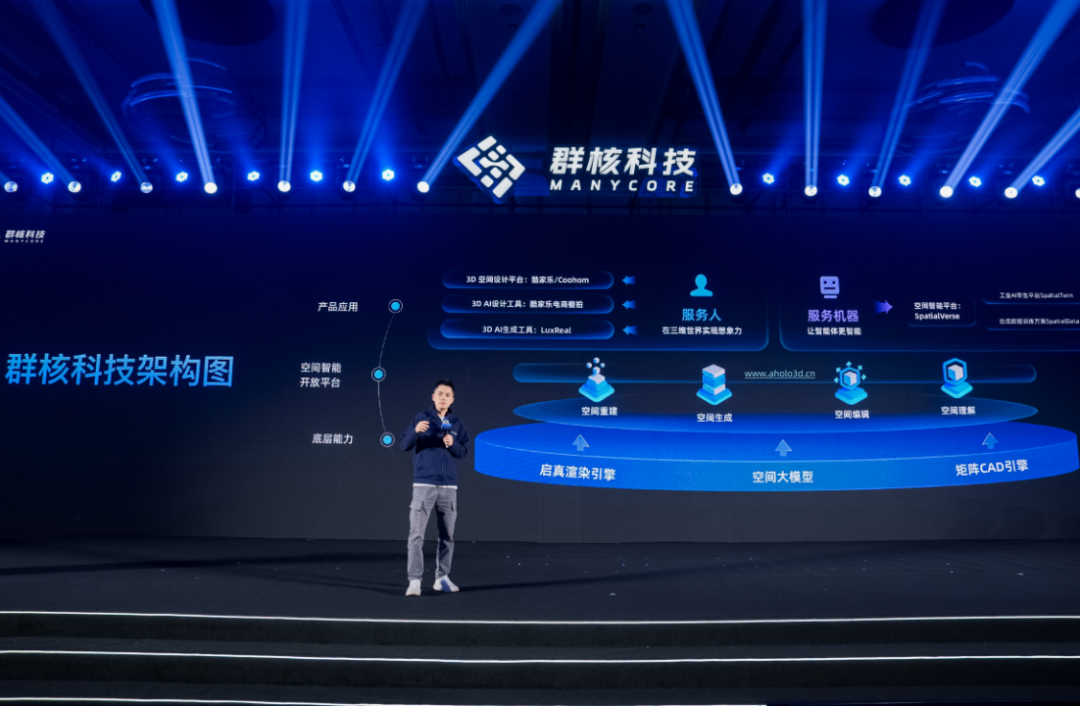
△ Manycore Tech CEO unveils the company's spatial intelligence panorama
Aholo Spatial Intelligence Open Platform Goes Live
Covering Four Core Spatial Capabilities
At the conference, Manycore Tech officially launched the Aholo Spatial Intelligence Open Platform. The platform integrates core capabilities accumulated over 14 years in spatial reconstruction, spatial generation, spatial editing, and spatial understanding, and will gradually open these as underlying models and tools to empower broader industry applications and innovation ecosystems.
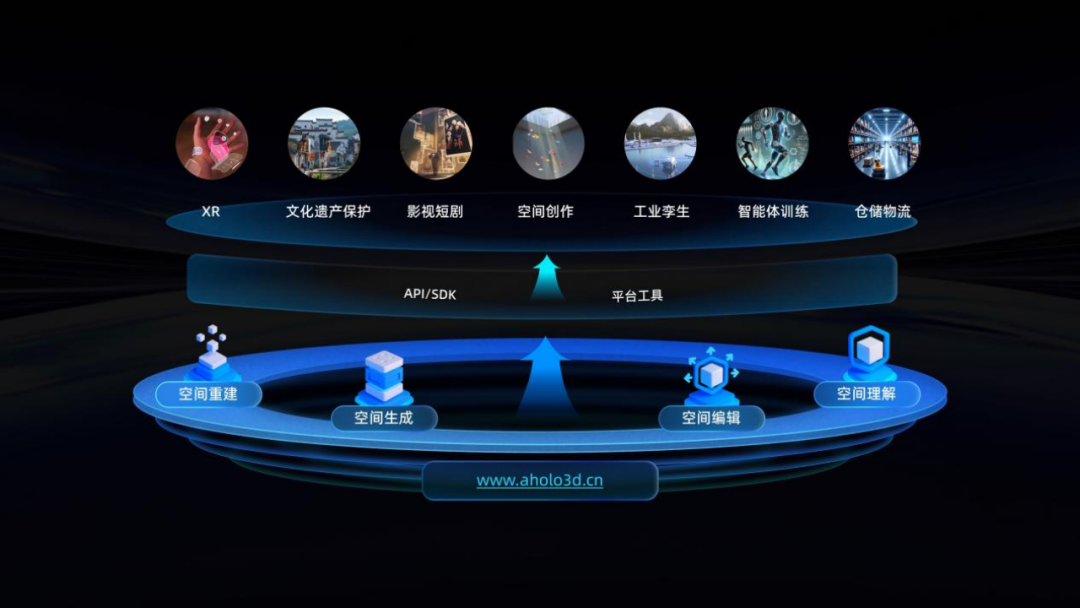
△ Panoramic view of Manycore Tech's Aholo Spatial Intelligence Open Platform
The Aholo platform has now entered closed beta. On the platform, developers and relevant enterprises can freely access these capabilities via API or SDK. Users can rapidly build high-fidelity holographic 3D spaces through multimodal inputs including images, videos, or panoramic photos.
Whether in 3D content creation fields such as spatial design, XR, film and short drama production, and cultural heritage preservation, or in scenarios with high demands for 3D structured data such as industrial digital twins and robot simulation training, Aholo is positioned to become the core foundation and engine driving spatial intelligence innovation, helping improve quality and efficiency.
At the event, Huace Film & TV, a leading domestic film and television enterprise, reached a strategic partnership with Manycore Tech to jointly advance cutting-edge applications and deep integration of spatial intelligence technology in film and television content creation and production. Huace Film & TV will leverage the Aholo open platform to conduct in-depth cooperation around virtual set generation, film scene reconstruction, and collaborative ecosystem building, enhancing production efficiency and artistic expression while driving the film and television industry's transformation toward intelligence and digitization.
Launch of 3D AI Content Creation Tool LuxReal
Enhancing "Spatial Consistency" in AI Video
Additionally, LuxReal, a 3D AI content creation tool incubated by Manycore Tech, made its official debut at the conference. The product was built by a young team of post-95s at Manycore over six months, representing an important internal exploration of AI-native products based on the company's spatial capabilities.

△ Interface of Manycore Tech's 3D AI content creation tool LuxReal
Built on Manycore's self-developed AI 3D generation model Lux3D as its foundation, the product integrates image and video generation models to construct the industry's first 3D Agent system. While ensuring spatiotemporal consistency, LuxReal can efficiently generate compliant, creative video content, achieving a high degree of unity between stability and flexibility in AI video creation. This will further meet the more demanding content creation needs of e-commerce practitioners, film and television directors, advertising directors, and product managers.
Existing AI video generation technologies often suffer from object position shifts, spatial logic confusion, and occlusion relationship errors during perspective switches in the creation process. The underlying reason is that most video generation models are trained on image or video data, lacking understanding and reasoning capabilities for 3D spatial structure and physical laws.
Long Tianze, AI Product Director at Manycore Tech, said: "Currently, AI video generation's entertainment value overall exceeds its practical value — it's in a 'lame' state where 'playable' outweighs 'usable.' LuxReal builds an integrated generation pipeline combining 3D rendering and video enhancement, enabling AI video to truly 'understand space,' thereby producing more stable and trustworthy content. This greatly enhances the deployability of AI-generated video in fields such as e-commerce, industrial design, and gaming."
LuxReal has opened global closed beta invitations and will officially launch closed beta in mid-to-late December.
Spatial Intelligence Applications Blooming Across Industries
On-site Partnerships Signed in Embodied Intelligence, XR, Entertainment, and More
Beyond years of accumulated spatial computing capabilities, Manycore Tech's other major advantage in spatial intelligence lies in massive amounts of interactive spatial data. This year, the company introduced 3D Gaussian technology into AI spatial training. Building on its existing dataset and leveraging 3D Gaussian reconstruction capabilities, it has fully embraced real-world data, significantly improving the realism and physical consistency of simulation environments and further narrowing the Sim2Real (simulation to reality) gap.
Leveraging this spatial data advantage, at the conference, Motphys, D-Robotics, and Manycore's spatial intelligence training platform SpatialVerse formally reached deep cooperation to jointly advance the innovative deployment of robot simulation training solutions. The three parties will integrate their respective strengths in embodied intelligence simulation training platforms, cloud computing power, and spatial training data to build an efficient, precise, and scalable robot simulation training system, tackling core challenges such as difficult scene generalization, low training efficiency, and large Sim2Real transfer gaps in robot simulation training.
XR platform PICO also reached an ecosystem partnership with Manycore Tech. Based on PICO's XR hardware system and Manycore Tech's platform's rich spatial dataset, the two will collaborate to build "the world's largest interactive XR asset library," providing a foundation for XR content production for global developers and enterprise users, and exploring an open and mutually beneficial "spatial intelligence + XR" innovation ecosystem.
It is reported that based on its spatial intelligence technology, Manycore Tech has continuously upgraded its product matrix over the past year, achieving deep AI integration. Kujiale launched an AI intelligent design platform, becoming an AI design agent for users' full workflows, capable of completing a whole-house spatial design proposal in just 5 minutes — a 100x efficiency improvement. The platform has already launched a globalized version to serve more overseas customers. SpatialVerse, which helps intelligent agents become smarter, has partnered with embodied intelligence companies including AgiBot, Galaxy Universal, Noematrix, Zhi Square, and Songying Technology. Meanwhile, SpatialVerse has expanded into industrial scenarios, launching the industrial AI twin platform SpatialTwin, exploring new models of human-machine collaboration in the embodied intelligence era.
Embodied Intelligence in 2025:
Technology Maturity Greatly Improved, Application Scenarios Showing Promise
In the conference roundtable discussion, Chen Yu, Partner at Yunqi Capital, joined enterprise representatives spanning the full stack of the spatial intelligence ecosystem to discuss the topic "How far are robots from 'going to work in factories'?" We excerpt some of the discussion to share with you.

Chen Yu, Partner at Yunqi Capital
Yunqi began paying attention to physical AI fields such as service robots and autonomous driving 10 years ago, because these domains can generate sustained value through standardized technologies or solutions.
The key turning point for the embodied intelligence industry in 2025 is that technology maturity has greatly improved, enabling robots to complete more complex long-horizon tasks. While there remains distance from actual scenario deployment, the dawn is visible.
Two categories of segmented embodied intelligence application scenarios are worth noting:
First, "remote work" data collection. Exploiting labor price differentials between regions, having low-cost-area workers remotely operate robots deployed in high-cost areas creates commercial value from labor arbitrage while simultaneously collecting real-world data.
Second, embodied intelligence deployment in logistics. The logistics industry has massive market scale, accounting for roughly 14% of China's GDP and around 10% in other developed countries. Meanwhile, logistics scenarios demand generalization capabilities from robots. Embodied intelligence can coordinate with autonomous logistics vehicles to improve logistics efficiency and reduce costs.