Ren Xinqi, Yue Dian Technology: The toB Agent Generating Over 100 Million RMB in Revenue Is Reshaping Human-Machine Collaboration | Yunqi Capital Doers

When Agents Actually Become Colleagues
In 2025, Agent is becoming one of the most closely watched product forms in the AI world. With the rise of projects like Manus, the imagination around general-purpose Agents has been widely ignited, earning them the expectation of becoming the "next-generation operating system."
But on the front lines of enterprise, Agent is already more than just imagination. It has begun to genuinely run inside processes, embed into systems, and replace human labor — becoming a new species that truly drives efficiency leaps. Yue Dian Technology, a Yunqi Capital angel-round project focused on enterprise-grade Agentic AI, is an innovative force forging and refining this "new species." It has already served multiple large enterprises and emerging consumer brands, generating hundreds of millions in revenue.
Recently, Ren Xinqi, founder and CEO of Yue Dian Technology, shared customer cases and implementation experience at an internal Yunqi session. From the perspective of moving from "tool upgrade" to "reconstructing human-machine collaboration," he offered frontline understanding and judgment on enterprise-grade Agents. This edition of "Yunqi Doers" brings you the highlights from that internal sharing.

*Edited from Ren Xinqi's sharing transcript
I. The Evolution of Agent: From Language Understanding to Autonomous Execution
Over the past six months, Agent technology has advanced by leaps and bounds, with several notable milestones:
- Anthropic proposes the Computer Use concept: Marking AI's shift from "understanding language" to "executing operations."
- OpenAI releases the Operator feature: Greatly enhancing AI's ability to simulate human system operations.
- MCP protocol enters universal adoption: Enabling models to directly invoke tools, significantly boosting execution capability.
- Domestic environment activation: DeepSeek ignites industry attention, projects like Manus accelerate Agent awareness, and major tech companies actively deploy solutions.
Behind these changes lies a redrawing of Agent capability boundaries, with the entire technology stack evolving toward "multimodal perception," "dynamic reasoning," and "system collaboration." Specifically, several important sub-directions stand out:
- Perception: Migrating from pure text to multimodal inputs including images and voice.
- Reasoning: Shifting from fixed workflows to context-driven dynamic decision-making.
- Execution: Moving from API calls to simulating human tool usage.
- Memory: Evolving from short-term memory to long-term, hierarchical knowledge systems.
- Collaboration: Transitioning from single Agents to multi-agent division of labor.
- Application: Evolving from tool replacement to organizational process reconstruction.
II. From Tool to "Colleague": Reconstructing Human-Machine Collaboration
In our view, the development trend of intelligent agents (Agents) is shifting from "replacing tools" to "replacing human involvement in system execution processes." Human work (primarily software-based work) can be divided into two categories:
One is standardized tasks — programmatic, highly deterministic. In the past two years, we've used workflow approaches to make execution more accurate, with the main pursuit being efficient operation.
The other is exploratory tasks — requiring human experience and intuition, with openness and creativity. These are things AI may not currently do so well.
Under the human-dominated operation model, what drives efficiency improvement and innovation acceleration? Three core elements:
- Knowhow/logical understanding: Grasping business context, process rules, and decision logic;
- System/environment connection: Operating multiple systems, scheduling task execution, and completing complex interactions;
- Data/knowledge invocation: Retrieving and integrating structured and unstructured data to build useful information and knowledge.
Previously, these three components relied on human operation to deliver corresponding services. Now, when we talk about using Agents to replace humans, the essence is that Agents must accomplish this too — corresponding to capability leaps for Agent systems at the perception, integration, and reasoning levels.
On top of this framework, some typical services have emerged: intelligent customer service, code generation, business analysis, production optimization, intelligence processing, and office automation. In these scenarios, "programmatic" work has already been done quite well, but "exploratory" work still has significant room for improvement. Intelligent customer service is a typical example: we can see that outbound call systems, which lean toward "programmatic" work, are relatively mature, while inbound call systems involving more "exploratory" work still fall short.
I'd like to expand on this point: the core of AI Agent is to bring a revolutionary breakthrough to human-machine interaction — whether in the future or already happening now. The breakthrough lies not in improving human-machine interaction, but in directly transforming the human-machine interaction model into a model-to-system interaction model, where the entire interaction process may not require human intervention at all. In other words, future machine-to-human interaction is not that important. I think this is a crucial insight for those of us building Agents, or traditional software and apps.
III. Business Selection Logic: Only Building Agents That "Do Human Work"
Our judgment of business scenarios references two core dimensions:
First, business knowledge complexity: This determines the demands on task comprehension and reasoning capability;
Second, process complexity: This determines whether tasks require cross-system collaboration and whether multiple steps need to be orchestrated.
Combining these two dimensions, we divide enterprise-grade intelligent agent deployment into four quadrants.
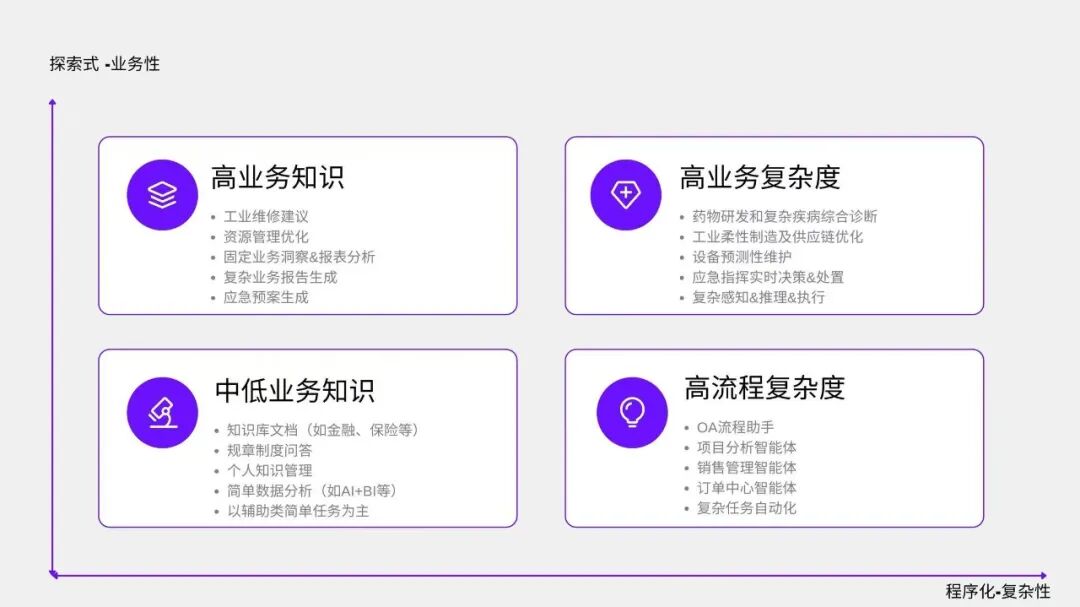
Since our founding in late 2023, we chose not to pursue the lower-left quadrant of "low knowledge + low process complexity." Simple knowledge base Q&A, policy inquiries, and AI+BI data analysis — while easy to deploy — are essentially "auxiliary tools" that can only serve as Copilots, not truly "replace humans."
We focus on the right-side quadrants — high knowledge + high process complexity. These tasks require not only strong knowledge understanding and reasoning capabilities from Agents, but also the ability to run through task chains, replacing human decision-making and execution in processes.
This is our understanding of the core value of "enterprise-grade Agent": not building a smarter assistant, but building an employee that can truly "get work done."
Going forward, we will continue extending in the "high business knowledge" quadrant, gradually coupling more complex tasks with higher expert knowledge barriers, making intelligent agents true "digital employees" for enterprises.
IV. Real Application Cases
Below are some interesting Agent application domains we've encountered.
Case 1: Manufacturing R&D — Intelligent Agent Assisting Full-Cycle Bearing Design
In serving a global large-scale bearing enterprise, our Agent system was deployed across the entire R&D process, from requirement extraction and modeling to design verification, achieving human replacement and process acceleration.
In this process, our Agent does not replace CAD or simulation software, but rather replaces the humans involved in operating these software workflows. This improves process clarity and reduces repetitive work, allowing designers to focus on truly creative work. Thus, in the entire R&D design process, designers remain at the core — responsible for creative thinking, evaluation, decision-making, and communication. The intelligent agent serves as an auxiliary tool, enhancing designer capabilities, improving efficiency and accuracy, and reducing repetitive workload.
In this project, we built four scenario-specific intelligent agents:
- Product Expert Knowledge Base Agent: Building a semantic retrieval system based on enterprise data, enabling non-specialists to quickly obtain accurate answers.
- Requirement Collection Agent: Integrating business, customer, and online feedback, using large models for preliminary judgment and structured processing to generate standardized R&D documents.
- Requirement Design Multi-Agent Collaboration: Decomposing tasks, extracting parameters, and adapting formats across multiple specialized Agents working in parallel.
- Design Decomposition Agent System: Multi-path concurrent computation of design tasks, effectively improving accuracy and generation efficiency.
Case 2: Industrial Operations — 600km Freight Railway Inspection Report Generation
Another client operates freight railway services. The railway spans approximately 600 kilometers, and track operation and maintenance is a crucial business segment. One core component is the preparation of "freight railway inspection reports." This workflow involves over 100 staff members across various subsidiary companies responsible for different sections, with long time consumption, inconsistent data entry standards, and numerous pain points including poor report timeliness and incomplete analysis metrics.
We subsequently built a "report generation chain" composed of four core intelligent agents: Format Standardization Agent, Metric Calculation Agent, Qualitative Analysis Agent, and Auto-Generation & Adjustment Agent.
After system deployment, efficiency gains were dramatic: human input reduced from 130 people to 10, report generation time shortened from 7 days to 20 minutes, with richer analysis dimensions and higher accuracy.
This system also demonstrates strong replicability. Horizontally, it can be centrally replicated and promoted across multiple similar subsidiaries of this company. Vertically, because inspection report output is the driving force and foundation of the entire business, it directly corresponds to core heavy-haul operations including track maintenance, rail replacement, and light screening by the locomotive branch; emergency repairs by the emergency response branch; and equipment analysis by the operations management branch.
Inspired by this intelligent agent system, the client enterprise is now reshaping its entire business ERP system, hoping to transform it from "human-driven" to "intelligent agent-driven." This represents a significant breakthrough for us in the industrial domain.
V. Where Is Our True Focus in Building Agents?
Many people ask us: what is Yue Dian's core logic in building Agents? Looking back at our practice over the past two years, the answer is clear: we have always focused on one thing — making Agents truly replace humans in "doing things," rather than just being chatty Copilots.
Early on, we mainly started from enterprise data systems, focusing first on the right-side pathway: abstracting enterprise resources (data, interfaces, callable tools) into operable components, combined with static industry knowledge and dynamic processing logic, to drive Agents in executing business processes. This was our main focus in 2023.
But entering 2024, we further discovered that high-frequency, repetitive business knowledge within enterprises — which is also heavily dependent on expert experience — could be completely "distilled" into generalized model capabilities. So we began building two key capabilities:
- One focused on knowledge distillation and training, specializing in industry know-how;
- One focused on reasoning logic distillation and training, abstracting transferable reasoning processes.
This forms the foundation of our current Knora Platform. From Knora, we've grown two layers of capabilities upward:
General Scenario Agents: Cross-industry general-purpose intelligent agents that can be quickly adapted to scenarios;
SLM Models: Small-parameter models for embedded or edge computing scenarios, such as military, aerospace, and industrial equipment.
We are not building a grand, all-encompassing framework platform, but rather breaking business processes into an arsenal. Behind every Agent is essentially a product of deep coupling between workflow and industry knowledge. We then integrate client domain knowledge according to their needs, ultimately delivering Agents that can truly "run" business operations.
In the implementation process, we have validated that scenarios with high process complexity + medium-to-high business knowledge density are mature and deliver high business value.
Examples include OA assistants, sales intelligent agents, and order center Agents — these agents can directly replace humans in "doing work," rather than merely "assisting thinking." In contrast, we actively abandon low-knowledge scenarios with small data value and fragmented processes, as they offer low cost-effectiveness and are not worth pursuing.
We have completed deep validation across multiple industries, particularly in industrial manufacturing and energy, building dozens of high-quality, stably executing Agents using structured, standardized engineering methods. We are now seeking more partners with business depth, hoping to replicate such capabilities across more industry scenarios.