From Bare-Bones Beginnings to Top of the Pack: 100,000 Robots and 15 Years of Bare-Knuckle Survival | Yunqi Capital Doers --- The title alone tells the story: "bare-bones" (毛坯房) and "bare-knuckle survival" (极限求生). These aren't buzzwords — they're the lived reality of a company that spent fifteen years clawing its way from nothing to industry leader. ## The 100,000-Robot Milestone In 2024, this robotics firm crossed a threshold few in China's hardware sector ever reach: deploying 100,000 units in the field. Not prototypes. Not showroom pieces. Production robots operating in factories, warehouses, and logistics hubs across the country. The number matters because hardware scales differently than software. Each unit demands supply chain discipline, manufacturing consistency, and after-service infrastructure. Ten thousand proves product-market fit. One hundred thousand proves operational mastery. ## The 15-Year Arc The company was founded in 2009 — ancient history by Chinese tech standards. That year, Alibaba's Taobao was still fighting eBay. WeChat didn't exist. The term "new energy vehicles" barely registered. The early years were spent in literal毛坯房: unfinished concrete spaces in industrial zones, the kind of startup offices where winter means seeing your breath and summer

Keenon's New Embodied Intelligence Opportunity
Three brushes with death. Three comebacks.
Over 15 years, Keenon Robotics, an early portfolio company of Yunqi Capital, has traversed the industry's "valley of death" — from bootstrapping in a bare-shell apartment to shipping more than 100,000 service robots. Today it commands 22.7% global market share, ranking No. 1 in commercial service robots.
Now, as the embodied intelligence wave surges, the company is using humanoid robots as its entry point to explore new commercialization paths, arriving at its next starting line.
As one of the earliest investors to back Keenon, Yunqi Capital has witnessed this resilient company's turbulent journey through cycles. Recently, China Entrepreneur magazine published an in-depth retrospective on Keenon. In this edition of "Yunqi Doers," we share their story — how a company that survived the limits of "extreme survival" rose to global No. 1, and how it's facing the future.
The following is reprinted from China Entrepreneur magazine.
Original title: Three Brushes with Death, Three Comebacks: A Robot Company's 15-Year "Extreme Survival"
Author: Kong Yuexin
Keenon Robotics CEO Li Tong's office looks nothing like what you'd expect from the robotics industry — neither smart nor flashy, but rather aggressively minimalist. The desk, chairs, and guest sofa are all IKEA-style; the side table is made of sheet metal. The employee workspace is similarly "construction-site minimal": gray tile floors, no partitions.
As a 15-year-old commercial robotics company, Keenon has ridden through multiple troughs and peaks in the industry. To date, it has sold over 100,000 commercial robots deployed across delivery, cleaning, and greeting scenarios. IDC data shows that in 2024, Keenon captured 22.7% of global shipments, placing it first in commercial service robots.
In 2025, with the explosion of DeepSeek and embodied intelligence, the robotics track has once again become capital's darling. Multiple robotics companies are preparing for IPO.
These days, Li Tong and his shareholders most frequently discuss the listing wave.
Pine VC was among Keenon's Series A investors. In the view of Wang Yang, Pine VC's managing partner, robotics companies today fall into three categories. The first: traditional industrial robot makers whose products directly compete with the "Big Four" (Switzerland's ABB, Japan's FANUC, Germany's KUKA, and Japan's YASKAWA) — these have long since listed on China's A-share market. The second: companies founded between 2010 and 2020 that combine AI algorithms with robotics, though not yet achieving general-purpose or embodied intelligence; they perform auxiliary human-efficiency work in specialized scenarios. The third: general-purpose embodied intelligence.
"Right now is precisely the window for the second type of robotics company to go public. If you miss this wave, competing for funding in the primary market against the third type becomes very difficult," Wang says. Keenon happens to be a company that has survived multiple cycles — both general-purpose and specialized, with embodied intelligence characteristics.
"We hope this [robotics boom] can last a bit longer, that the mood doesn't shift too fast," Li says. "Tech entrepreneurship, especially in robotics, requires massive technical iteration. In the past, R&D happened in universities, then companies commercialized; now companies are doing frontier research — people need more patience."
Keenon has joined this wave of technological renewal. In 2024, it launched its first dual-arm embodied service robot. In 2025, Keenon officially released two humanoid service robots: the wheeled XMAN-R1 and bipedal XMAN-F1.
Li believes that with continuous technological iteration, even if humanoid robot R&D leads to losses, this is the moment to invest. "I think a company needs sustained innovation. Staying unchanged for years means falling behind, so we will keep evolving."
"I Dug Myself a Massive Hole"
In 2010, Li Tong and three friends pooled 200,000 yuan, rented a two-bedroom Shanghai apartment, and founded Keenon Robotics. Strapped for cash, they worked for years in the completely unfinished space — doors not even installed — before moving to their current industrial park.
This year is widely regarded as the birth of mobile internet. Meituan (2010), Kuaishou (2011), DiDi (2012), and ByteDance (2012) were all founded in this period, as O2O, local lifestyle services, and app development exploded.
By contrast, robotics was the most unglamorous sector at the time — neither fashionable nor sexy, with barely any venture capital attention in China.
In its early days, the Keenon team groped for direction, trying educational robots, floor-cleaning robots, humanoid simulation robots, and more. Without funding, they took on projects to survive, "feeding ourselves while inching forward."
Li describes himself as "foolishly fearless." "I didn't think too much then. Only after jumping in did I realize I'd dug myself a massive hole — no early funding, and keeping a tech company alive on your own is brutally hard." With heavy investment and meager returns, his initial co-founders "couldn't sustain it," and the founding team nearly dissolved entirely.
But Li refused to quit. "I didn't have money to hire the best talent, so classmates were the easiest to 'recruit.'" His solution was to bring in fellow alumni. In those first years, Li and several classmates drew just a few thousand yuan monthly to get by.
After extensive experimentation, the Keenon team finally chose to commercialize in the service sector, with restaurants as their first landing scenario. In Li's view, a robot is fundamentally labor, and services — as a labor-intensive industry — will inevitably face labor shortages, giving service robots far more growth potential than other applications.
Yunqi Capital led Keenon's Series A round and was its earliest institutional investor. Yunqi Capital partner Chen Yu notes that around 2016, Dianping had 4 million restaurants listed, while China had roughly 400,000 hotels and about 10,000 major medical facilities (including tertiary hospitals). These were three entirely different orders of magnitude in addressable scenarios. Li had chosen the largest and most challenging market.
In 2013, Keenon launched its first-generation food delivery robot "Xiao Lang." Li still remembers: the moment "Xiao Lang" debuted, a restaurant owner showed up at the company entrance to "ambush" them.
"He was about to open for business but couldn't hire staff. When he heard about us, he came straight over, pulled out Alipay, and sent us money on the spot. The transfer limit was 5,000 yuan at the time, so he sent 5,000, 5,000, several times over, then immediately dragged the robot away to prep for opening." Li recalls — the incident even made the news.
This made the team realize: demand for service robots existed, and they could genuinely replace human labor.
But challenges dwarfed prospects. Compared to industrial environments, service settings are far more complex. Restaurants couldn't reconfigure themselves to accommodate robots like factories could. So robots entering these scenarios needed environmental perception, autonomous decision-making, and flexible, effective control — a technical direction Keenon continues optimizing to this day.
Keenon's in-office testing area fully replicates the complex restaurant environment, including slope navigation, 40-centimeter narrow passage traversal, and oil-stained floor traversal.
In 2015, Li's former manager at Microsoft invested 1 million yuan in a personal capacity.
Around this time, the third wave of AI development triggered by deep learning breakthroughs brought forth SenseTime, Megvii, and the other "AI Four Dragons," along with autonomous driving ventures. Robots with "AI attributes" entered venture capitalists' sights.
In mid-2016, Wang Yang's first meeting with Li took place at a Shanghai restaurant using Keenon robots. Most service robots at the time still relied on "tracks" or floor-laid QR codes for fixed-trajectory movement, but Keenon's robot was already navigating autonomously indoors. Intrigued, Wang traced the product back to Li's team.
That same Children's Day, Chen Yu was shopping at a Shanghai mall when he noticed children gathered around Keenon's guide robot "Peanut," interacting with it. After watching awhile, he found the robot's movement and engagement interesting. Finding Keenon's name on the back, he searched online for Li's contact and sent a text to arrange a meeting.
By late 2016, Keenon completed a tens-of-millions-yuan Series A round, its first institutional funding, with Yunqi Capital and Pine VC as investors.
Two More Crises and Comebacks
Post-Series A, Li's team rapidly concentrated resources on talent and product iteration.
But by 2018, when Li sought to raise another round, capital markets had shifted dramatically. AI faced a severe credibility crisis, and robotics was caught in the crossfire.
Keenon hit a funding wall. "Investors were judging tech innovation by the rhythm of mobile internet business model innovation. By 2018, they thought all AI people were frauds, none could deliver — the entire capital market stopped believing in tech entrepreneurs. We were discarded like worn-out shoes," Li says.
Chen Yu also acknowledges that the robotics market hadn't been well educated at the time.
A Keenon employee told China Entrepreneur: "In 2019, the company truly had no money left. Without another funding round, we'd have shut down." According to sources close to Keenon, in early 2019, existing shareholders made a new investment in the company. Li reflects that these shareholders "saved us."
Chen Yu notes their investment decision came in late 2018, based on two factors: First, Keenon had already spent over a year building mass production capabilities. Second, in October that year, Haidilao's Beijing smart restaurant launched, with follow-on orders for hundreds of Keenon robots — validating the company's ability to scale commercially.
"Before this, robot food delivery had low penetration in restaurants. The Haidilao project lifted the entire industry. Keenon seized this opportunity to become a paid supplier for Haidilao's smart restaurants. After Haidilao, more and more restaurants began accepting robot delivery," Wang assesses. Keenon was among the biggest beneficiaries.
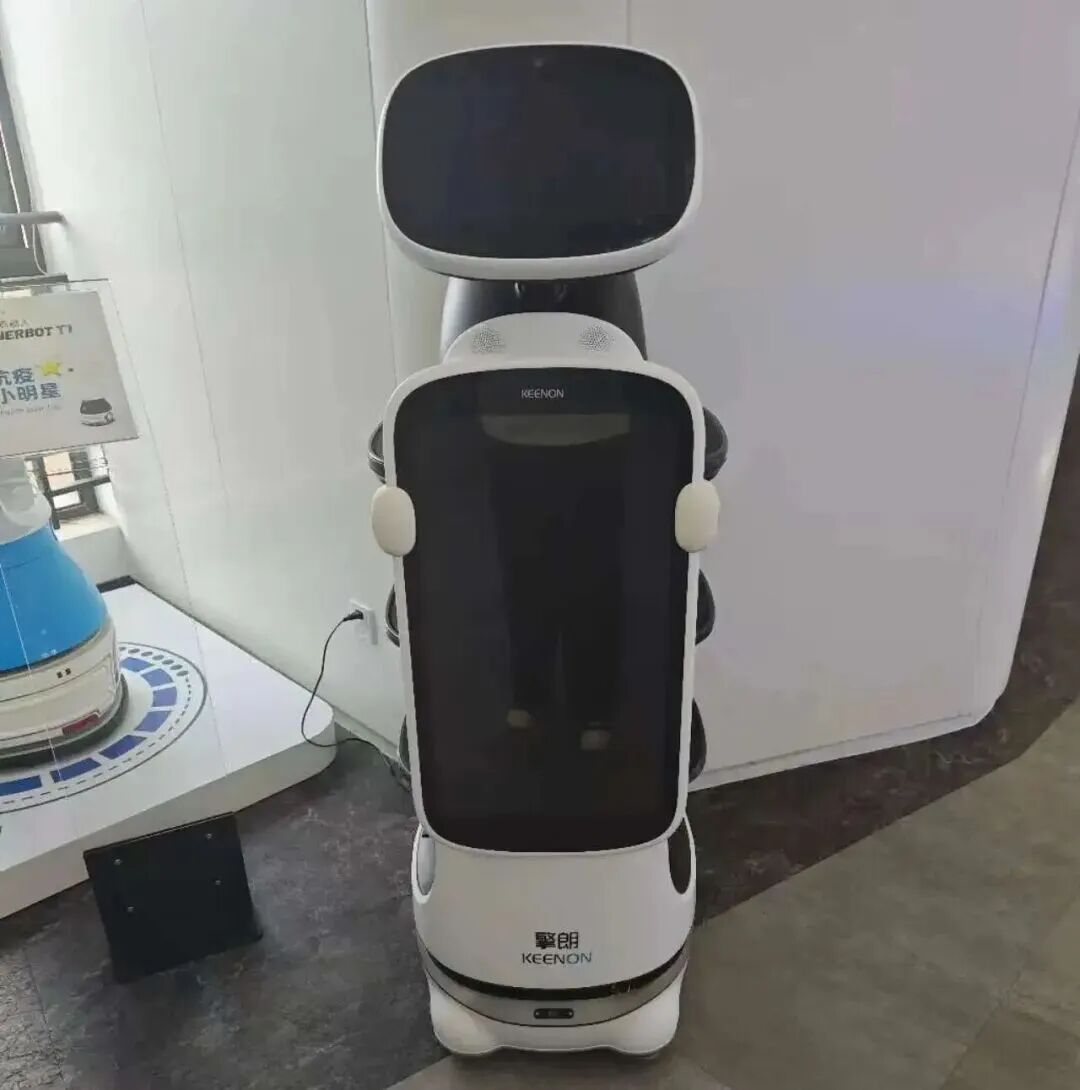
Image source: China Entrepreneur
In 2019, Keenon shipped over 1,000 robots; by year-end, it completed a 200-million-yuan Series B led by Source Code Capital.
From 2020, pandemic-driven contactless delivery became essential, commercial service robots found their market opening, and the sector became a new investment hotspot. Keenon, Pudu Technology, and Udi Technology all raised substantial funding. Keenon secured over 1.5 billion yuan from SoftBank Asia, SoftBank Vision, and others in 2020–2021.
The good times didn't last. In H2 2021, service robot market growth began slowing; by 2022, growth was notably weak. To compete for market share, the industry turned to promotional pricing, worsening conditions.
Earlier industry over-optimism meant many robot companies, Keenon included, had expanded headcount far faster than market growth, amplifying operational risk. Wang notes that while Keenon's situation wasn't as dire as in 2019, mishandling personnel adjustments could trigger serious organizational crisis. He believes Li's management at the time enabled a smooth transition.
SoftBank Asia VP Wang Yinzhen also endorsed Li's strategic choices — Keenon promptly reduced headcount while sharpening product focus.
"Team and financial complexity at scale far exceed expectations," Li says. "We now use lightweight management to ensure operational control." Current headcount stabilizes around 700.
The Required Course in Commercialization
After the 2022–2023 large model explosion, Keenon relaunched humanoid robot R&D. OpenAI's rapid GPT commercialization showed the team an opportunity. "We felt we could revisit what large models combined with robots might achieve," Li says. He believes the fundamental problem in humanoid robotics today is the inability to commercialize.
Thus, from day one of building humanoids, Li anchored on one thing: it must work, especially in service scenarios, solving real problems. Only then will customers pay. "We're not overly focused on how fast it runs or how high it jumps," Li emphasizes. "What matters is whether it's designed for work, and whether it does the work well."
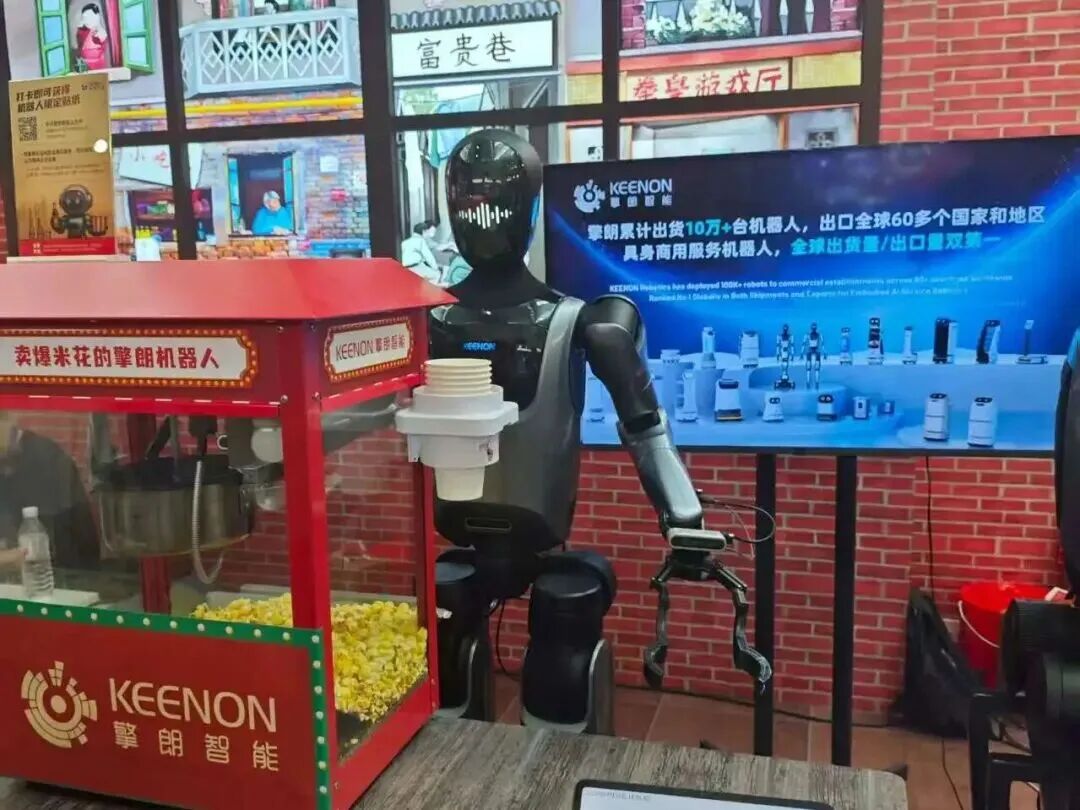
In March 2025, Keenon officially released its first humanoid embodied service robot XMAN-R1, using a wheeled design. In July, its bipedal service robot XMAN-F1 was officially unveiled at WAIC, serving as a waiter popping popcorn and making iced drinks. Li reveals that the company's humanoids are already in POC (proof of concept) at some customer sites, being adjusted per client needs.
"We're not a research institution. A company's essence is commercialization. If you pour massive money in without long-term industrial returns, that's unsustainable," Li says.
To accelerate commercialization, reducing production costs is a required course. Wang Yinzhen told China Entrepreneur that in 2020, SoftBank Asia's pre-investment research found Keenon's robot manufacturing costs were just 1/5 of Bear Robotics, a U.S. peer also backed by SoftBank — giving Keenon significant pricing advantage.
Lower prices improved market acceptance, helping Keenon establish leading position in food service robots. The company then pushed into additional service scenarios: entering hotel robots in 2021, medical robots in 2022, and cleaning robots in 2023.
Li emphasizes the company maintains a pace of entering one new vertical every 1–2 years. "Services is an extremely broad industry. Only by continuously entering new sectors can the business expand." Keenon's service map also covers leisure and entertainment, car 4S dealerships, and retail supermarkets.
While entering new segments, the Keenon team continuously optimized marketing strategy. In hotel robots, as a latecomer, Keenon sought differentiated catch-up approaches — not only offering hotels integrated scenario packages (combining delivery robots with cleaning robots, etc.) to boost per-customer revenue, but also providing smart vending cabinets whose revenue could cover single robot leasing costs, creating synergy between equipment sales and value-added services.
Separately, Keenon began exploring globalization in 2020.
But for a first-time overseas expansion, the team inevitably faced the "crossing the river by feeling the stones" phase all companies experience — building global sales and financial systems, product localization, and more. The domestic ethos of "extreme frugality" also carried overseas: one overseas national team worked from a garage for over half a year before moving into proper offices.
Given the complexity of robot operations and services, Li positioned Keenon as a R&D manufacturer rather than an operations service provider. Thus after setting globalization strategy, the company directly manages operations in China and select regions, while partnering with strategic collaborators for Europe, Americas, Japan, and Korea. Yunqi Capital, SoftBank, and other investors introduced numerous overseas strategic partners — for example, SoftBank Robotics Group and Hyundai handle operations and maintenance in Japan, Korea, and other markets.
Though already a sector leader in service robots, Keenon's challenges escalate with industry evolution.
Wang Yinzhen notes that humanoid robot R&D and commercialization exploration both require sustained heavy resource investment over considerable time. Going forward, can Keenon prove its value to shareholders, capital markets, and customers, building greater confidence?
Li says that in the coming year, Keenon will focus on commercializing new technologies, while hoping capital markets continue developing.